Adirondacks or Poconos?
Our verdict in twelve categories, each scored against the same fixed benchmark cities, and the climate month by month, so you can choose for your trip.
Choose Adirondacks for
- nature and the outdoors
- beaches
- culture and sights
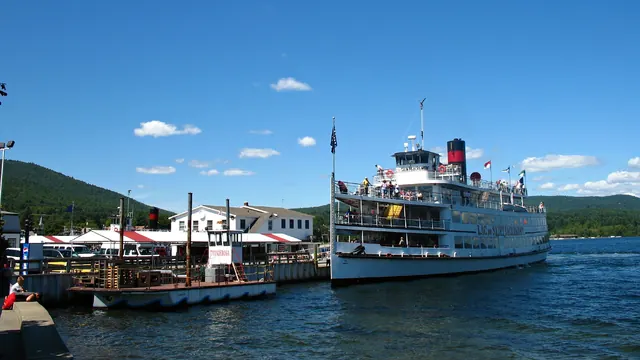
The Adirondacks suit travellers who want wilderness on a large scale: summit days in the High Peaks, canoe routes through the St Regis country with nights in lean-tos, and clear lakes such as Lake George and the Saranac chain to swim in. The colonial forts, Great Camps and Olympic venues at Lake Placid add more history than the Poconos can offer. The price is long drives on winding roads, a shorter warm season and resort-level rates in the main towns.
Choose Poconos for
- prices
- families
- shopping
Families with young children and couples after an easy weekend will usually do better in the Poconos. Everything sits within a short drive: indoor waterpark resorts that work in any weather, gentle ski hills, waterfalls with boardwalk trails and the outlet centre at Tannersville. Midweek cabins keep costs down. The landscape is gentler, a forested plateau rather than real mountains, but it asks much less effort of you.
Scoreboard
Twelve categories on one fixed scale from 0 to 100. The shaded stretch is the gap between the two.
Your match
Pick a travel style or drag the sliders, and both match scores follow your weighting.
Too close to call, 1 point apart
Wins on nature and the outdoors and beaches with your weighting.
Wins on prices and families with your weighting.
What matters to you?
Category by category
What the scores mean for a trip.
Beaches & swimming
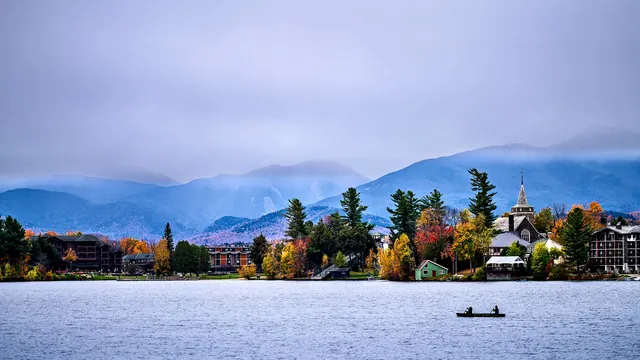
Both regions swim in lakes, but the Adirondacks have better ones. Lake George has sandy public beaches, clear water and islands you can reach by boat, and Mirror Lake, the Saranac chain and the Fulton Chain add town beaches and docks where a summer revolves around the water.
The Poconos' lake beaches are smaller and often grassy. They sit in state parks such as Promised Land and Hickory Run and on the coves of Lake Wallenpaupack, and they get crowded on summer weekends. Swimming there is something to add to a stay rather than a reason to come, though tubing down the Delaware River is a pleasure the Adirondacks do not offer in the same way.
Food & drink
Neither region is worth the trip for its food, and both serve hearty meals after a day outdoors. The Adirondacks lean towards maple-syrup pancakes in diners and steak and trout in log-built lodges, with Champlain Valley cider and cheese in autumn. The Poconos bring Pennsylvania Dutch baking such as shoofly pie, plus craft breweries and small wineries on the back roads, and the most interesting tables are in Jim Thorpe, Stroudsburg and Milford.
Culture & sights
The Adirondacks have more history to visit, though it is spread out. Fort Ticonderoga and Fort William Henry recall the colonial wars, the Adirondack Experience museum covers guides and boatbuilders, and Great Camps such as Sagamore show Gilded Age rustic style. Lake Placid keeps its Olympic arenas and ski jumps.
In the Poconos the heritage is coal and railways, and most of it is in Jim Thorpe, with the Asa Packer Mansion and the Old Jail Museum. Eckley Miners' Village and Grey Towers round out a few half-days, enough for a rainy afternoon but not a cultural trip.
Nightlife
Both regions go quiet early, and the evening is mainly a fire and an early night. What exists differs in kind. In the Adirondacks it is Lake George's summer strip of bars, waterfront decks and party boats with a young weekend crowd. In the Poconos it is the casino resort at Mount Pocono, with late gaming floors and lounges, plus après-ski bars on winter weekends.
Nature & outdoors
Here the Adirondacks are clearly ahead. They form a huge protected area with forty-six High Peaks, Mount Marcy rising to about 1,630m, and thousands of lakes where paddlers can travel for days between portages. Loons, moose, ice climbing and skiing at Whiteface add to it, though blackflies spoil late spring.
The Poconos are a forested plateau rather than mountains. The Delaware Water Gap, where the Appalachian Trail follows Kittatinny Ridge, waterfalls such as Bushkill and Dingmans, and rafting in the Lehigh Gorge make for fine days out. The ski slopes are short, and the whole landscape is gentler and more managed.
Day trips
The two are broadly level, but the outings go in different directions. From the Adirondacks you can drive to Saratoga Springs' Victorian streets and racecourse, take the ferry across Lake Champlain to Burlington, or make the long day to Montreal.
The Poconos look south and west, to Bethlehem's 1740s Moravian buildings beside the old steelworks and to Scranton's Steamtown railway museum. New York and Philadelphia are each about two hours away, though weekend traffic makes that a tiring day.
Good for families
The Poconos are the easier family base. The resorts around Mount Pocono and Tannersville are built around indoor waterparks, Camelback turns into an outdoor waterpark and alpine coaster in summer, and the gentle ski hills suit beginners. Because distances are short, the days stay relaxed.
The Adirondacks offer the classic lake summer of cabin, dock and canoe, along with the Wild Center's treetop walk, the theme park near Lake George and bobsled rides at Lake Placid. But the attractions are far apart, and the High Peaks trails are too steep for small legs.
Getting around
You need a car in both. The difference is distance. In the Adirondacks, winding two-lane roads make Lake George to Lake Placid well over an hour and a half, although a train runs along Lake Champlain. In the Poconos most drives take twenty minutes to an hour on the interstates, and coaches reach Stroudsburg from New York, but Friday and Sunday traffic can be heavy.
Shopping & style
The Poconos have more for shoppers, mainly because of the large premium outlet centre at Tannersville, which sells discounted brand-name clothing. Beyond it there are antiques and gift shops in Jim Thorpe and Milford.
In the Adirondacks shopping is mostly for keepsakes. The memorable buys are rustic twig furniture, pack baskets and balsam pillows from craft shops and summer fairs. Lake Placid adds outdoor-gear shops, and Lake George has a smaller outlet strip.
Affordability
The Poconos cost a little less, but the cost depends heavily on when you go. Summer, autumn-colour and ski-season weekends cost noticeably more than the same stay midweek. The waterpark resorts and lift tickets that families come for are charged at full American rates, so the savings come from timing and from cooking in a rental rather than from cheap attractions.
In the Adirondacks the peak seasons are dearer, and cabins have to be booked well ahead or the choice is gone. Restaurant meals plus tips add up across the long drives. Against that, the region's main draw costs almost nothing: High Peaks trails, canoe routes and state campgrounds on the lakes, so a camping or hiking trip can come out cheaper here than a resort weekend in the Poconos.
Live music & performing arts
The two are level, but the character differs. Adirondack performance is classical and limited to summer: chamber festivals in lakeside churches, a young singers' opera programme near Schroon Lake, and orchestral and ballet seasons at the Saratoga amphitheatre, an evening's drive from the southern lakes. The Poconos lean towards jazz at Delaware Water Gap, roots acts at the Mauch Chunk Opera House and summer-stock theatre.
Wellness & relaxation
Both are places to slow down rather than take the waters. In the Adirondacks rest comes from the setting: a porch over a still lake, a canoe at dawn, and Saranac Lake's long history as a mountain-air retreat. Spas are few, though Saratoga's mineral baths lie just to the south. The Poconos offer more spa treatment you can book, with couples' resorts that have in-room hot tubs and destination spa resorts around Lake Wallenpaupack.
When should you go?
Pick your month. The climate figures are measured averages, not a forecast.
Adirondacks in July
Poconos in July
Daytime high, °C
Rainfall in the month, mm
Where the figures come from
Adirondacks has no rain gauge within 25 km of the centre, so its rainfall comes from a gridded climate dataset read at the destination rather than from a gauge further away.
Poconos's temperatures are measured 40 km from the centre, at Wilkes-Barre/Scranton International.
Poconos's station stands 162 m above the place it is measured for, so that place is likely a little warmer than the figures say.
Poconos has no rain gauge within 25 km of the centre, so its rainfall comes from a gridded climate dataset read at the destination rather than from a gauge further away.
Temperature and rainfall are climate normals, averaged over the years shown. Adirondacks: 2006-2020 (rainfall 1991-2020) normals, Harrietstown (20.1 km from centre). Poconos: 1991-2020 (sunshine 1981-2010) normals, Wilkes-Barre/Scranton International (40 km from centre).
The Adirondacks have a short summer. Around the main lake resorts July reaches about 25°C, and the lakes are warm enough for a proper swim only in July and August. June is bracing and by mid-September most people only paddle. Summer is also the wettest time, up to 117mm in July, mostly as showers between drier spells. The leaves turn from late September, but October is cool and often wet. From December to February daytime highs stay below freezing, at around -3°C in midwinter. That suits skiing and ice climbing but makes anything else hard going, and March is barely above freezing.
The Poconos are a few degrees warmer all year. July highs are near 29°C, the lakes are swimmable from June to early September, and June and July get the most sunshine. Rain is spread fairly evenly through the year. The wettest spell is in September and October, which is also when the region's best autumn colour comes. Winter days stay just above freezing rather than well below it, so walks and village visits remain pleasant, and the ski slopes depend on snowmaking.
Which traveller are you?
On an outdoors trip, choose the Adirondacks. Forty-six High Peaks, rocky summits above the treeline, multi-day canoe routes and moose in the northern forests are on a far larger and wilder scale than the Poconos' waterfalls and Delaware Water Gap trails.
On a family trip with young children, the Poconos are the easier choice. Indoor waterpark resorts get you through rainy days, the ski hills have gentle learning areas, and attractions sit within short drives, whereas Adirondack days often mean long hours in the car.
On a trip on a tight budget, the Poconos stretch money further. Midweek cabins, older motels and shared rental houses are good value, while Lake Placid and the Lake George shore charge resort prices and cheaper stays mean heading to the remoter western lakes.
Before you go
| Measure | Adirondacks | Poconos |
|---|---|---|
| Currency | US Dollar (USD) | US Dollar (USD) |
| Sockets | AB120 V, 60 Hz | AB120 V, 60 Hz |
| Driving side | Right | Right |
| Time zone | UTC-5, UTC-4 in summer | UTC-5, UTC-4 in summer |
| Emergency number | 911 | 911 |
| Main airport | Albany International Airport (ALB)26 non-stop destinations | Lehigh Valley International Airport (ABE)14 non-stop destinations |
| Public holidays this year | 13 days | 12 days |
Where else could you go?
Every comparison below shares a destination with this one, so you can follow Adirondacks or Poconos somewhere new.
- Catskillsvs Poconos
- Catskillsvs Adirondacks
- Martha's Vineyardvs Poconos
- Cape Codvs Poconos
- Cape Codvs Adirondacks
- Nantucketvs Poconos