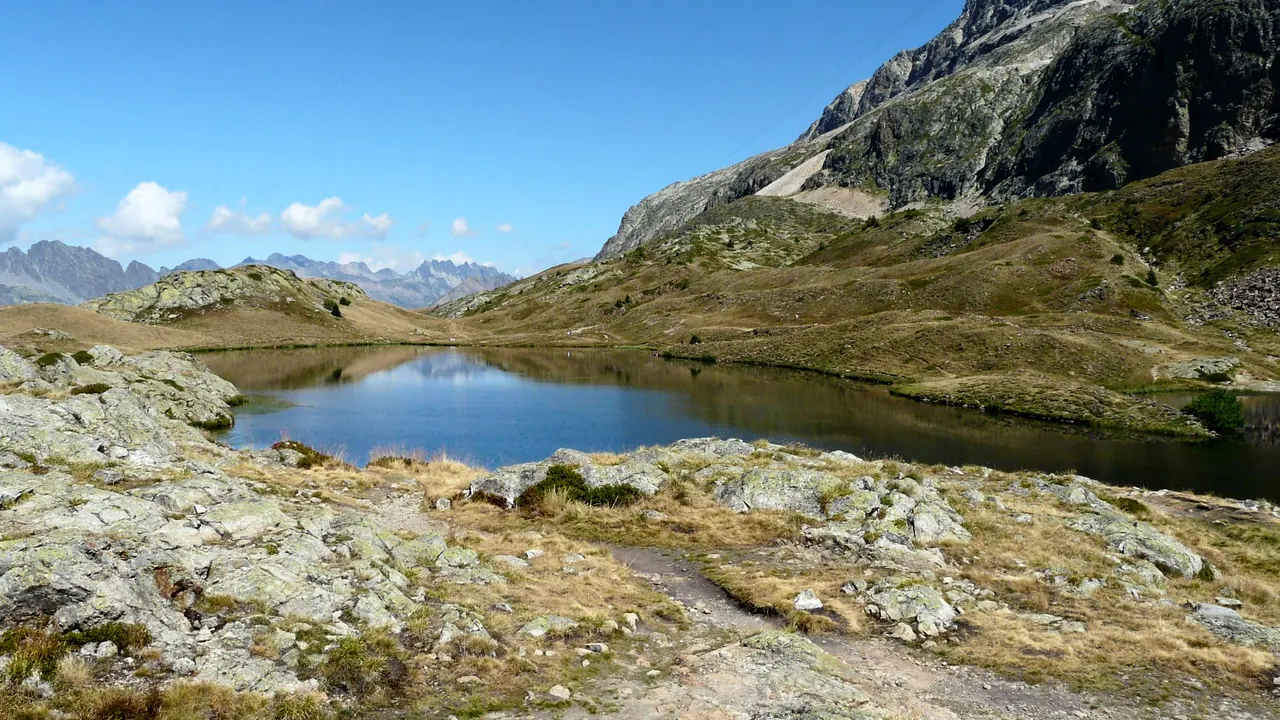
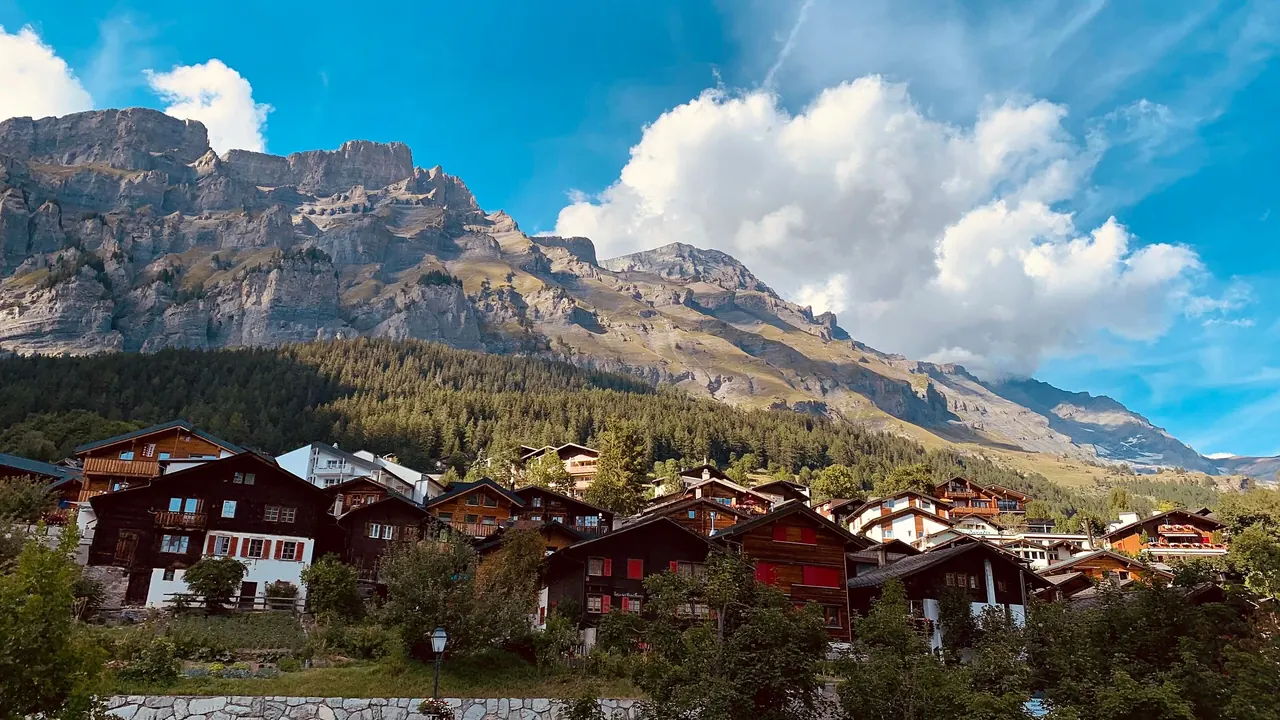
Photos: Alpe d'Huez by Beany, CC BY-SA 3.0, cropped; Leukerbad by LIUCemmi05, CC BY-SA 4.0, cropped.
Alpe d'Huez or Leukerbad?
Our verdict in twelve categories, each scored against the same fixed benchmark cities, and the climate month by month, so you can choose for your trip.
Choose Alpe d'Huez for
- nightlife
- prices
- families
Alpe d'Huez is the pick for an active week in the mountains. It has a huge linked ski area under the Pic Blanc, ski schools and gentle beginner slopes for children, and après-ski that carries on into the village pubs. In summer there are the famous hairpins and lift-served bike trails. It is not cheap, but it costs less than its Swiss rival, especially if you self-cater.
Choose Leukerbad for
- wellness
- day trips
- getting around
Travellers who want to slow down will be happier in Leukerbad. The hot springs beneath the village feed outdoor pools where you sit in warm water under snowy limestone cliffs, and the days pass between baths, treatments and short walks. The village is compact with little traffic, you can manage without a car, and the postbus down to the Valais rail line makes it the better base for outings to Sion or the wine villages. The trade-off is very quiet evenings and Swiss prices.
Scoreboard
Twelve categories on one fixed scale from 0 to 100. The shaded stretch is the gap between the two.
Your match
Pick a travel style or drag the sliders, and both match scores follow your weighting.
Too close to call, 2 points apart
Wins on nightlife and prices with your weighting.
Wins on wellness and day trips with your weighting.
What matters to you?
Category by category
What the scores mean for a trip.
Beaches & swimming
Neither is a swimming destination, so the difference is in what kind of water you get. At Alpe d'Huez the summer choice is a cold dip in the small lakes of the Lac Besson plateau or a session in the sports centre pool. Leukerbad's glacier-fed Daubensee is just as cold, but the village's thermal pools let you swim outdoors in warm water in any month, even with snow around you.
Food & drink
Both kitchens are built on melted cheese, but Alpe d'Huez has a little more range. Savoyard tartiflette and diots with polenta sit alongside pizzerias, brasseries and a few more ambitious French kitchens. On ski days, lunch on a sunny slope-side terrace is the highlight, though the choice gets repetitive over a week.
In Leukerbad you eat mostly in hotel dining rooms: raclette scraped at the table, dried meat and apricot desserts. Its real strength is the wine list, with Cornalin, Humagne Rouge and Petite Arvine from the vineyards around Salgesch just below the village.
Culture & sights
Neither is a place for sightseeing, and each fills an afternoon at most. Alpe d'Huez offers twentieth-century resort architecture, the tent-shaped Notre-Dame des Neiges and, in summer, the ruins of the medieval silver-mining village of Brandes. Leukerbad's interest is older and quieter: sun-blackened Valais houses and granaries in the old core, and a bathing history going back to Rome that you feel in the village rather than see in museums.
Nightlife
Alpe d'Huez wins easily here. In winter the evening starts at the bars by the lower runs as the lifts close, then moves to the village pubs, and a few late bars and small clubs keep going past midnight for a young British, Dutch and French crowd. It is a resort scene rather than a city one, and summer evenings are much calmer.
Leukerbad has a few après-ski bars and hotel lounges that fill for a while in the ski season, but no clubs. For much of the year, an evening there ends in a warm pool rather than a bar.
Nature & outdoors
Both are excellent mountain bases, with different strengths. Alpe d'Huez is about scale: a vast linked ski area rising to the Pic Blanc at 3,330m, the long Sarenne black run and unusually sunny south-facing slopes. In summer it has lift-served bike trails and the 21 hairpins up from Bourg d'Oisans, a climb road cyclists come specifically to ride.
Leukerbad is steeper and better suited to walkers and climbers. Limestone walls rise straight from the village, a cable car lifts you to the Gemmi Pass and the Daubensee, and long via ferratas climb the Daubenhorn. Its skiing is modest, so it is at its best in summer and autumn.
Day trips
Leukerbad has the wider choice, because its postbus connects with the Valais rail line at Leuk. Sion, with its two castle hills, is about an hour away and the Salgesch wine villages are closer still. Zermatt, Montreux with Chillon Castle and Bern are all possible on a long day.
From Alpe d'Huez, every outing begins with the winding road down the mountain. Grenoble, with its Bastille cable car and old town, is the main trip. You can stop at the Château de Vizille on the way down, or cross the Col du Lautaret to Briançon's Vauban upper town, but the options run out sooner.
Good for families
Alpe d'Huez is built around family ski weeks. It has ski schools, kids' clubs and wide beginner slopes close to the village, plus an ice rink, sledging and summer activity programmes. The steep, spread-out layout is hard work with a pushchair, though.
Leukerbad is smaller and easier to manage on foot, and the slides and children's area at the public thermal centre save a wet afternoon. Beyond that there is less to fill the days, and some of the more refined spas restrict young children.
Getting around
Leukerbad is simpler, both to reach and to get around. In the compact village, the baths, hotels and Gemmi cable car are a few minutes apart on foot, and a postbus reaches the railway at Leuk in about half an hour.
Alpe d'Huez has no railway, so you arrive by transfer from Grenoble or by driving up the hairpins, sometimes with chains. Once you are there, free shuttles and a small gondola link the quarters and many lodgings are ski-in, but walking between levels with ski gear is tiring.
Shopping & style
What you buy differs between the two. Alpe d'Huez is about kit, with rental shops, technical clothing from outdoor brands, a few boutiques and delicatessens selling Beaufort and charcuterie, and Grenoble is the place for a proper shopping day. Leukerbad has even less to browse, and the one thing worth bringing home is a bottle of Valais wine from the nearby vineyards, perhaps with some cheese and dried meat from the grocers.
Affordability
Both are expensive, but Alpe d'Huez is easier to manage. The lift pass, lessons and peak-week lodging add up quickly. Self-catering apartments and the quieter weeks bring the cost down, and there are more modest places to stay than in France's most exclusive resorts.
Leukerbad has Swiss prices on almost everything, from hotels and meals to bath entry and lift passes. A hotel package that includes the thermal pools is the usual way to soften the cost, but real bargains are rare.
Live music & performing arts
There is little live performance in either, so for anything serious you go down the valley. Alpe d'Huez has a slight edge, with organ concerts in Notre-Dame des Neiges and outdoor gigs in both seasons. Leukerbad's one distinctive event is a summer literature festival of readings. Beyond that it has occasional church concerts and après-ski bands, and Sion is the nearest real stage.
Wellness & relaxation
Bathing is Leukerbad's whole reason for being, and Alpe d'Huez has nothing like it. Springs rising at close to 51°C have been used since Roman times. Today they feed a large public thermal centre, a Roman-Irish bath circuit and many hotel pools, and the whole village keeps a spa pace.
At Alpe d'Huez, wellness means saunas, hot tubs and massages in hotels and residences to ease ski-tired legs, and early summer there is genuinely restful. For a real thermal spa, though, the nearest is Uriage-les-Bains, an hour's drive away.
When should you go?
Pick your month. The climate figures are measured averages, not a forecast.
Alpe d'Huez in July
Leukerbad in July
Daytime high, °C
Rainfall in the month, mm
Where the figures come from
Alpe d'Huez has no weather station within reach, so its figures come from a gridded climate model rather than a measured record, and read a broad area rather than one spot.
Leukerbad has no weather station within reach, so its figures come from a gridded climate model rather than a measured record, and read a broad area rather than one spot.
Temperature and rainfall are climate normals, averaged over the years shown. Alpe d'Huez: 2001-2020 normals, NASA POWER reanalysis grid, no weather station within 90 km. Leukerbad: 2001-2020 normals, NASA POWER reanalysis grid, no weather station within 90 km.
The two resorts sit at similar heights and their temperatures are almost the same through the year. From December to March the daytime high stays around or below freezing, down to -3°C in January. That is the ski season in both, and in Leukerbad it is also the best time for the outdoor thermal pools under snow. Summer highs reach about 18°C in July and August. That is cool, clear weather for hiking, cycling and walking around, though never warm enough for the beach, and nights at this altitude are cold.
Rain is where they differ. Alpe d'Huez stays fairly even, with about 60mm a month in high summer and its wettest months in May and November. Leukerbad gets far more rain from May to August, up to about 130mm a month, so its summer walking days are more often broken by showers. September and early October are drier there and often make the best months for the trails.
Which traveller are you?
For a relaxing and wellness trip, Leukerbad is the clear choice. Hot springs used since Roman times feed a large thermal centre and many hotel pools, and the village goes quiet after dinner. Alpe d'Huez has hotel saunas and hot tubs, but no bathing culture.
On a food and nightlife trip, Alpe d'Huez gives you more to do. Ski days end with après-ski bars by the lower runs, then village pubs and a few late bars, after long lunches on sunny slope-side terraces. Leukerbad mostly goes to bed after dinner.
On a family trip with children, Alpe d'Huez is better set up. It has kids' clubs, ski schools, wide beginner areas beside the village, an ice rink and sledging. Leukerbad's thermal pools with slides make good gentler days, but there is less to fill a week.
Before you go
| Measure | Alpe d'Huez | Leukerbad |
|---|---|---|
| Official language | French | French, German, Italian, Romansh |
| Currency | Euro (EUR) | Swiss Franc (CHF) |
| Sockets | CE230 V, 50 Hz | CJ230 V, 50 Hz |
| Driving side | Right | Right |
| Time zone | UTC+1, UTC+2 in summer | UTC+1, UTC+2 in summer |
| Emergency number | 112 | 112 |
| Elevation | 1,860 m | 1,402 m |
| Main airport | Grenoble Alpes Isère Airport (GNB)65 km from centre16 non-stop destinations | Geneva International Airport (GVA)118 km from centre150 non-stop destinations |
| Public holidays this year | 11 days | 9 days |
By the numbers
| Measure | Alpe d'Huez | Leukerbad |
|---|---|---|
| Population | - | 1,368 |
| People per km² | - | 20 |
| Museums within 10 km | 1 | 0 |
| UNESCO World Heritage sites within 50 km | 0 | 1 |
Where else could you go?
Every comparison below shares a destination with this one, so you can follow Alpe d'Huez or Leukerbad somewhere new.
- Les Deux Alpesvs Alpe d'Huez
- Crans-Montanavs Leukerbad
- Adelbodenvs Leukerbad
- Gstaadvs Leukerbad
- Mürrenvs Leukerbad
- Wengenvs Leukerbad