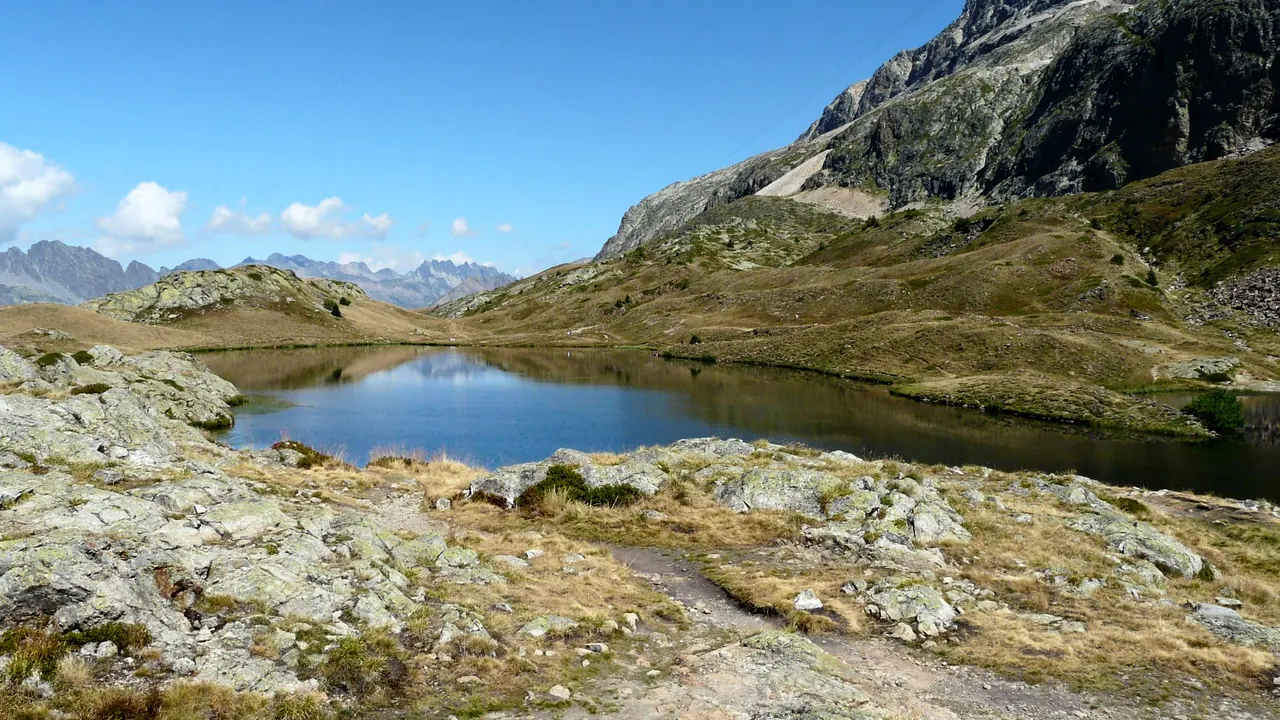
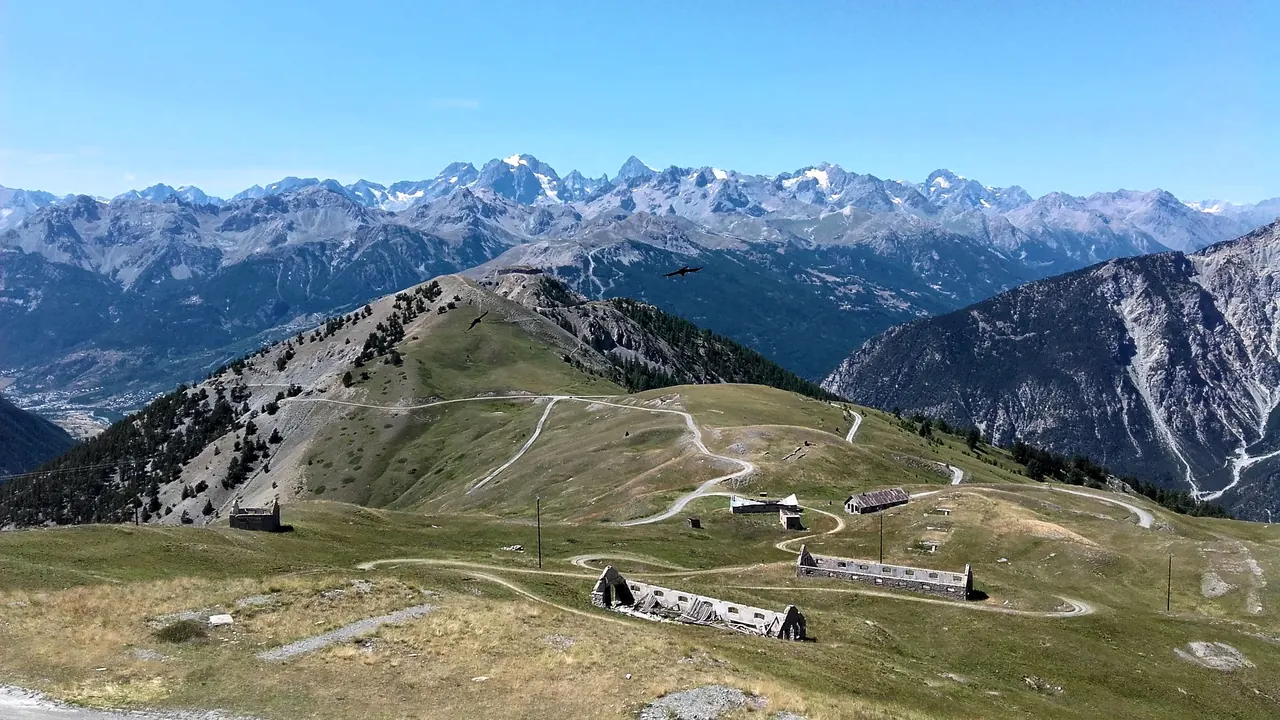
Photos: Alpe d'Huez by Beany, CC BY-SA 3.0, cropped; Montgenèvre by Jonathan Queutois, CC0.
Alpe d'Huez or Montgenèvre?
Our verdict in twelve categories, each scored against the same fixed benchmark cities, and the climate month by month, so you can choose for your trip.
Choose Alpe d'Huez for
- nightlife
- food and drink
- live music and the arts
Alpe d'Huez suits skiers and riders who want more going on after the lifts close. Its après-ski bars, village pubs and a few late clubs draw a young international crowd. The food runs a little wider, with some ambitious French kitchens alongside the fondue. In summer it has the 21 hairpins up from Bourg d'Oisans, the climb road cyclists come to ride. You pay for all of this, because a peak winter week here is expensive.
Choose Montgenèvre for
- day trips
- prices
- wellness
Montgenèvre is the better pick for families and groups who want a calmer, cheaper week and plan to leave the slopes now and then. The ski area runs across the border into Italy. Briançon's Vauban fortifications are just down the hill, and Turin is close enough for a day out. A proper spa in the village and hot springs down the valley help after a long day. Evenings are quiet and end early.
Scoreboard
Twelve categories on one fixed scale from 0 to 100. The shaded stretch is the gap between the two.
Your match
Pick a travel style or drag the sliders, and both match scores follow your weighting.
Too close to call, 1 point apart
Wins on nightlife and food and drink with your weighting.
Wins on day trips and prices with your weighting.
What matters to you?
Category by category
What the scores mean for a trip.
Beaches & swimming
Neither resort has a beach, and swimming in either means a cold alpine lake or an indoor pool. At Alpe d'Huez the options are the small lakes on the Lac Besson plateau, the slightly milder lakes down in the Romanche valley, or the sports centre pool.
Montgenèvre has heated leisure centre pools, plus one better option further away. Serre-Ponçon, more than an hour's drive south, has sandy shores and water warm enough for a proper summer swim.
Food & drink
Alpe d'Huez eats a little better. On top of the raclette and tartiflette it has a few more ambitious French kitchens, and lunch in the sun on the slope-side terraces is a real pleasure, though the choice still feels repetitive by the end of a week.
Montgenèvre's own restaurants are fewer and mostly built for quick, filling ski meals. What makes up for it is the border: Claviere, a few minutes away, has Italian bars, trattorias and proper espresso. For a serious dinner, people drive down to Briançon.
Culture & sights
Both are mountain resorts with very little to see, so neither is a place for sightseeing. Alpe d'Huez has a little more in the village: the tent-shaped Notre-Dame des Neiges, a small local museum and, in summer, the ruins of the medieval silver-mining village of Brandes. Montgenèvre has only its Napoleonic obelisk and an old parish church. Its advantage is that the fortified old town of Briançon is just down the road.
Nightlife
Alpe d'Huez has far more going on at night. Après-ski bars by the lower runs fill as the lifts close, the crowd then moves to the village pubs, and a few late bars and small clubs stay open past midnight. The crowd is mostly young British, Dutch and French skiers.
Montgenèvre has après-ski too, but the families and groups of friends who stay there turn in early. Only a few pubs and one small club keep going in peak weeks, and out of season the village is silent after dinner.
Nature & outdoors
Both villages sit at about 1,860m with superb mountains all around, so the difference lies in the kind of terrain. Alpe d'Huez rises higher: lifts reach the Pic Blanc at 3,330m, the Sarenne black run is one of the longest descents in the Alps, and the south-facing slopes get unusual amounts of sun.
Montgenèvre spreads sideways instead. It is the French end of the Milky Way ski area, which runs into Italy as far as Sestriere, and it adds cross-country tracks and ski touring. In summer the Clarée valley, the Queyras and rafting on the Durance give it a wider range of outdoor country.
Day trips
Montgenèvre has much the better choice of outings. Briançon's UNESCO-listed Vauban walls are just down the hill, and Mont-Dauphin and Embrun make a second day. Across the border are the Susa valley, the Sacra di San Michele, the Fenestrelle fortress and Turin itself. A car makes all of this easy.
From Alpe d'Huez, every outing starts with the long winding drive down. Grenoble, with its Bastille cable car and fine-arts museum, is the main trip, and the Château de Vizille is on the way. Briançon, which Montgenèvre has on its doorstep, is about an hour and a half away over the Col du Lautaret.
Good for families
Both resorts handle family ski weeks well, with sunny beginner areas, ski schools for young children and sledging. Alpe d'Huez has more off-snow extras, such as the ice rink, but it is steep and spread out, which is hard work with very young children and pushchairs.
Montgenèvre is small and sits right on the slopes, so daily logistics are simpler. Husky rides and a toddler lagoon in the leisure pool fill the gaps for children who are not skiing.
Getting around
Alpe d'Huez has no railway, and its quarters are strung up a steep slope at different heights. You arrive by coach or transfer from Grenoble, or by driving the hairpins. Once you are there, free shuttles and a small gondola link the levels, which matters because walking between them with ski gear is tiring. Many lodgings let you ski to and from the door, so a car can stay parked all week.
Montgenèvre is a compact village you can cross on foot, with stations on both sides of the border. Briançon in France is served by the night train from Paris, and Oulx in Italy is on the Turin line, with buses from both up to the pass. In winter the lifts carry you across the slopes into Italy. For the valleys and towns below, though, you will want a car with winter tyres or chains.
Shopping & style
Shopping is minimal in both, mostly ski hire, technical clothing and regional cheese and charcuterie. Alpe d'Huez adds a few boutiques, and Grenoble is the place for a real shopping trip. Montgenèvre has little more than a small supermarket, so people go down to Briançon's weekly market or cross into Italy for food.
Affordability
Montgenèvre is the cheaper resort. It is mid-priced by French standards and mostly made up of apartments and chalets where families can cook for themselves, and food and drink on the Italian side often cost less.
Alpe d'Huez is expensive in winter. The lift pass, lessons, peak-week lodging and slope-side lunches all add up, although self-catering helps. In both resorts, summer and the quieter ski weeks cost much less.
Live music & performing arts
Neither resort has a theatre or a concert hall, but Alpe d'Huez has something regular: organ concerts at Notre-Dame des Neiges in both seasons, along with occasional outdoor gigs. In Montgenèvre, live music means outdoor events and the odd band at après-ski. For a real programme, you would go to Grenoble from Alpe d'Huez or to Turin from Montgenèvre.
Wellness & relaxation
Montgenèvre is the better place to recover. Its balneo centre has warm indoor and outdoor pools, a sauna and a hammam, and the natural hot springs at Le Monêtier-les-Bains are about 40 minutes down the valley.
Alpe d'Huez relies on hotel and residence spas and the sports centre pool, and its nearest thermal spa, at Uriage, is about an hour away. Its quiet early summers, with empty terraces and open views, can still be very restful.
When should you go?
Pick your month. The climate figures are measured averages, not a forecast.
Alpe d'Huez in July
Montgenèvre in July
Daytime high, °C
Rainfall in the month, mm
Where the figures come from
Alpe d'Huez has no weather station within reach, so its figures come from a gridded climate model rather than a measured record, and read a broad area rather than one spot.
Montgenèvre has no weather station within reach, so its figures come from a gridded climate model rather than a measured record, and read a broad area rather than one spot.
Temperature and rainfall are climate normals, averaged over the years shown. Alpe d'Huez: 2001-2020 normals, NASA POWER reanalysis grid, no weather station within 90 km. Montgenèvre: 2001-2020 normals, NASA POWER reanalysis grid, no weather station within 90 km.
The two resorts share almost the same climate, so the choice is about the season more than the month. December to March are the snow months, with daytime highs below freezing in midwinter. April and early May are the slushy shoulder between ski season and summer. July and August are the hiking and biking months, with highs around 18°C at Alpe d'Huez and 19°C at Montgenèvre. That is fresh walking weather and never warm enough for a beach.
May and November are the wettest months in both places, at around 90mm, so they make a poor choice for either. The real difference comes in midwinter. Montgenèvre is noticeably drier then, with 45mm in January against 69mm at Alpe d'Huez, so clear days between snowfalls are a little more likely on the pass.
Which traveller are you?
For a food and nightlife trip, Alpe d'Huez is the clear pick. Après-ski spills from the lower runs into village pubs and late bars, and the restaurants go beyond cheese dishes. Montgenèvre's families are mostly in bed early for the first lift.
On a trip on a tight budget, Montgenèvre stretches the money further. It is a mid-priced resort with plenty of self-catering apartments and chalets, and cheaper food and drink just over the border in Italy. A peak week at Alpe d'Huez adds up fast.
For road cyclists, Alpe d'Huez is the reason to come. The 21 hairpins up from Bourg d'Oisans are one of the best-known climbs in the sport, and you can ride them from your door. Montgenèvre has good mountain biking but no climb with that reputation.
Before you go
| Measure | Alpe d'Huez | Montgenèvre |
|---|---|---|
| Official language | French | French |
| Currency | Euro (EUR) | Euro (EUR) |
| Sockets | CE230 V, 50 Hz | CE230 V, 50 Hz |
| Driving side | Right | Right |
| Time zone | UTC+1, UTC+2 in summer | UTC+1, UTC+2 in summer |
| Emergency number | 112 | 112 |
| Elevation | 1,860 m | 1,360 m |
| Main airport | Grenoble Alpes Isère Airport (GNB)65 km from centre16 non-stop destinations | Turin Airport (TRN)79 km from centre65 non-stop destinations |
| Public holidays this year | 11 days | 11 days |
By the numbers
| Measure | Alpe d'Huez | Montgenèvre |
|---|---|---|
| Population | - | 461 |
| People per km² | - | 11 |
| Museums within 10 km | 1 | 3 |
| UNESCO World Heritage sites within 50 km | 0 | 1 |
Where else could you go?
Every comparison below shares a destination with this one, so you can follow Alpe d'Huez or Montgenèvre somewhere new.
- Les Deux Alpesvs Alpe d'Huez
- Serre Chevaliervs Montgenèvre
- Val Cenisvs Montgenèvre
- Serre Chevaliervs Alpe d'Huez
- Val Thorensvs Montgenèvre
- Les Menuiresvs Alpe d'Huez