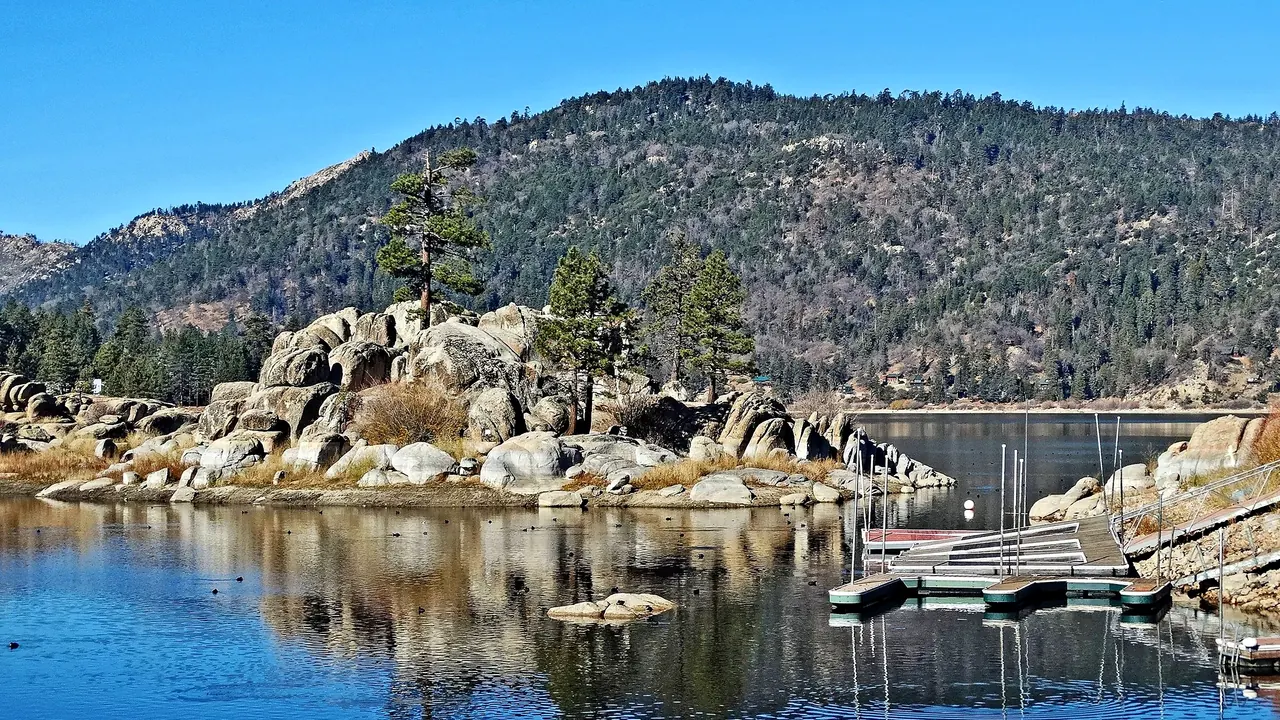
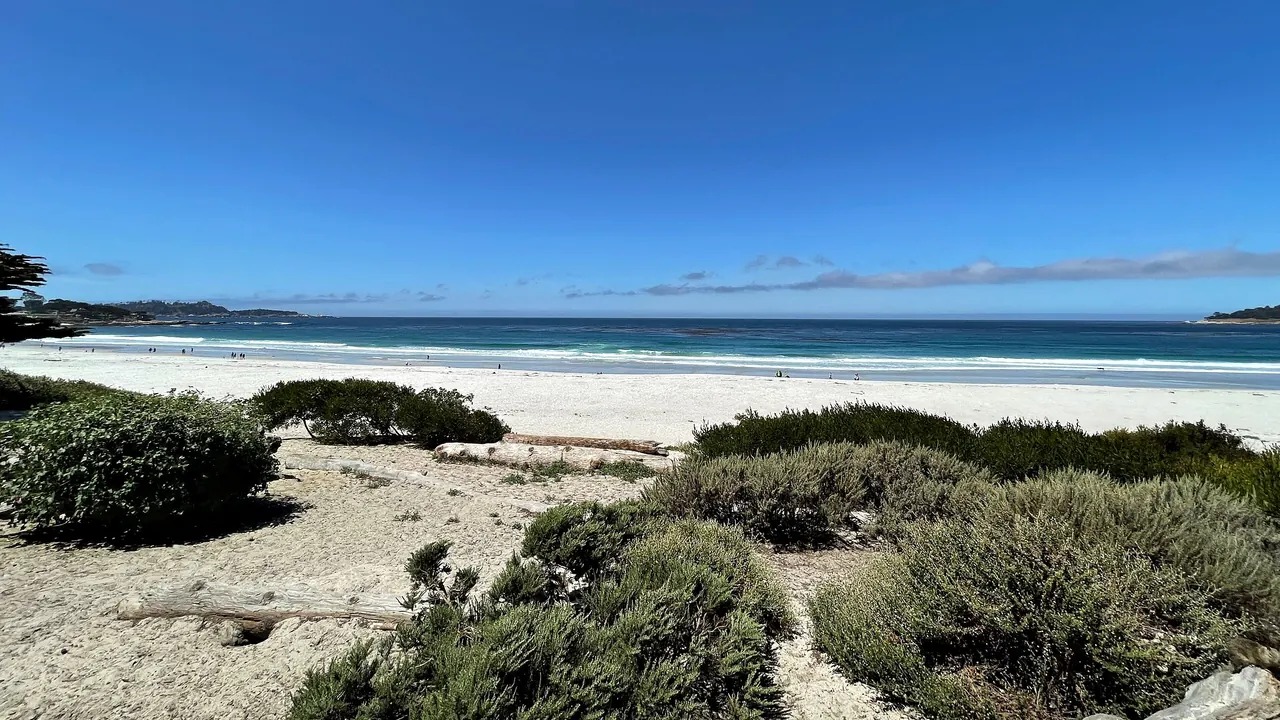
Photos: Big Bear Lake by inkknife_2000, CC BY-SA 2.0, cropped; Carmel-by-the-Sea by Gregory Ford Henderson, CC BY-SA 4.0, cropped.
Big Bear Lake or Carmel-by-the-Sea?
Our verdict in twelve categories, each scored against the same fixed benchmark cities, and the climate month by month, so you can choose for your trip.
Choose Big Bear Lake for
- prices
- families
- nightlife
Big Bear Lake is the choice for an active mountain vacation: skiing and sledding in winter, then mountain biking, hiking and paddling on the lake in summer. It suits families and groups who rent a cabin, cook for themselves and are happy with quiet evenings by the fire. Outside the busy winter weekends it also costs noticeably less than Carmel.
Choose Carmel-by-the-Sea for
- day trips
- shopping
- food and drink
Couples and slower travellers will get more from Carmel-by-the-Sea. The coast at Point Lobos and Big Sur is some of the finest walking country in California, and the village adds what Big Bear lacks: good restaurants, wine tasting, galleries, the old mission and summer music. It is expensive, but for a refined few days by the sea it gives you far more to do between walks.
Scoreboard
Twelve categories on one fixed scale from 0 to 100. The shaded stretch is the gap between the two.
Your match
Pick a travel style or drag the sliders, and both match scores follow your weighting.
Wins on prices and families with your weighting.
Wins on day trips and shopping with your weighting.
What matters to you?
Category by category
What the scores mean for a trip.
Beaches & swimming
Neither is a place to swim, but they fall short in different ways. Big Bear's lake reaches around 19°C in summer, and the supervised swim beach at Meadow Park makes a quick dip with children easy, though most of the shore is rocky.
Carmel has the better beach to look at and walk on: a long curve of white sand below Ocean Avenue, framed by cypress, with views across the bay. The Pacific there is much colder and the surf is rough, so the water belongs to wetsuit surfers while everyone else walks.
Food & drink
Carmel eats far better. Its small grid holds French and Italian dining rooms, candlelit bistros and tasting rooms pouring Pinot Noir from the Santa Lucia Highlands. Dungeness crab, sand dabs and Castroville artichokes give the cooking a sense of place, though it is pricey and narrow in range.
Big Bear serves the resort staples: hearty diner breakfasts, burgers, pizza, barbecue and a brewpub pint after the slopes. Many visitors cook in their cabins, and the restaurants are not a reason to come.
Culture & sights
Big Bear has little to show. A small museum tells the story of the 1860s gold rush in Holcomb Valley, and a dirt-road drive passes old mining remains and cabins. The Discovery Center explains the forest, and the Village is modern building in chalet style.
Carmel has far more to see, though it is still not a culture destination. The Carmel Mission, founded in 1771 and the resting place of Junípero Serra, is one of the finest in California's mission chain. Tor House, the granite tower Robinson Jeffers built by hand, and the storybook cottages and timber houses of the old artists' colony give the village real character for a morning or two.
Nightlife
Both towns go to bed early, and neither has clubs. What differs is the kind of evening. In ski season Big Bear has après-ski in its pubs, plus a brewpub or a sports bar. Carmel means a wine bar, a long dinner and a nightcap in a hotel lounge, with the streets quiet by ten. If you want something livelier, Carmel at least has Monterey's Alvarado Street close by.
Nature & outdoors
Both are superb bases for the outdoors, of very different kinds. Big Bear is mountain country: skiing and snowboarding in winter, then mountain-bike trails, the Pacific Crest Trail, short climbs to Castle Rock and Cougar Crest, and boating on the lake. Bald eagles winter there and the San Gorgonio Wilderness is close by.
Carmel has a slight edge for sheer scenery. Point Lobos, minutes away, has granite headlands, sea otters and passing grey whales, and Big Sur and its redwood canyons are within an hour. The bay adds kayaking and kelp-forest diving. This is a coast for walking and wildlife rather than snow sports.
Day trips
Carmel is far better placed. Monterey's Cannery Row and old adobes and Pacific Grove's Victorian streets are minutes away. The Carmel Valley wineries, Salinas with its Steinbeck centre, the mission at San Juan Bautista and the Santa Cruz boardwalk all make easy days out.
From Big Bear, every outing starts on slow mountain roads. Lake Arrowhead takes about an hour, and you can reach Oak Glen's orchards and the citrus-era streets of Riverside. Palm Springs and Los Angeles mean a long day, though, so most visitors stay on the mountain.
Good for families
Snow against sea otters is the real choice here, and Big Bear is the easier of the two with children. For lowland children the sledding hills, snow-play areas and beginner ski lessons are the main event, and the Alpine Zoo, home to rescued bears, bobcats and eagles, fills an hour or two in any season. Summer adds an alpine slide, mini-golf, go-karts and pedal boats on the lake, and a roomy cabin with a kitchen makes the stay simple.
Carmel's big family draw lies fifteen minutes away: the Monterey Bay Aquarium on Cannery Row, which can fill a whole day, plus the tide pools at Point Lobos and Pacific Grove. The village itself is made for adults, and the cold, rough water rules out paddling, so it suits school-age children who love wildlife better than it suits toddlers.
Getting around
In both towns you will need a car, for different reasons. At Big Bear the hard part is getting there: steep highways, snow chains in winter and slow traffic at weekends. Cabins are spread over hilly forest roads, though a bus and a seasonal trolley link the Village with the ski areas.
Carmel's village grid is easy to walk, if dark at night and steep down to the beach. Point Lobos, Big Sur and the aquarium all mean driving, and parking is tight in summer.
Shopping & style
Carmel is the better place to browse. The few blocks around Ocean Avenue and Dolores Street hold an unusual number of galleries, with cashmere, jewellery and homeware boutiques tucked into courtyards. It is polished and expensive, but small.
Big Bear's Village has gift shops, fudge, bear-themed souvenirs and outdoor outfitters. That is useful for hiring skis or a paddleboard, and for little else.
Affordability
Big Bear is the cheaper of the two, though neither is a bargain. A shared cabin midweek or in the shoulder seasons keeps costs reasonable if you do your own cooking. Winter weekends, lift tickets and equipment hire push them up.
Carmel is priced as a luxury destination all year, from its boutique inns to dinner and wine tasting. Its best things, the beach, the streets and the coastal walks, are free, and the usual way to save is to stay in Monterey or Seaside.
Live music & performing arts
Carmel has a real arts season. The Carmel Bach Festival has filled its summers with Baroque music since 1935, and the Sunset Center hosts touring performers. The open-air Forest Theater stages plays among the pines, and the Monterey Jazz Festival is close by each September.
Big Bear's stage amounts to a community arts centre, free concerts by the lake in summer and the Bavarian bands of its autumn Oktoberfest.
Wellness & relaxation
Carmel is the more restful choice. Misty mornings and still evenings set the pace, and the lodges of Pebble Beach and Carmel Valley have well-regarded spas for a proper day of treatments.
In Big Bear, relaxing is mostly done in private: a hot tub on the cabin deck, a wood stove and clear mountain air on quiet midweek days. Its few day spas are modest, and winter weekend crowds break the calm. Neither town has thermal springs.
When should you go?
Pick your month. The climate figures are measured averages, not a forecast.
Big Bear Lake in July
Carmel-by-the-Sea in July
Daytime high, °C
Rainfall in the month, mm
Where the figures come from
Big Bear Lake has no rain gauge within 25 km of the centre, so its rainfall comes from a gridded climate dataset read at the city rather than from a gauge further away.
Temperature and rainfall are climate normals, averaged over the years shown. Big Bear Lake: 2014-2025 (rainfall 1991-2020) normals, Big Bear City (5 km from centre). Carmel-by-the-Sea: 1991-2020 normals, Monterey / Pacific Grove Acres (8.7 km from centre).
Big Bear Lake has two clear seasons. From December to February daytime highs sit around 7°C, and the mountains get most of their rain and snow then, up to 135mm a month, which is what makes the skiing. Spring stays cool and damp into April. June to September is the outdoor season, dry and warm with highs up to 26°C in July, good for hiking, biking and a dip in the lake. October is crisp but still pleasant for walking.
Carmel-by-the-Sea barely changes through the year. Highs are mild every month and peak at 23°C, so the streets and coastal trails are comfortable in any season. Rain falls mostly from December to March. Summer is almost dry, though often grey with morning fog, and September and October are the warmest and clearest months. The sea never gets much above 15°C, so in any month this is a coast for walking, not swimming.
Which traveller are you?
On a trip on a tight budget, Big Bear Lake is the more realistic choice. A shared cabin with a kitchen keeps costs down midweek, and hiking, sledding and lake views cost little. Carmel's boutique inns and dinners are priced as luxury even out of season.
For a culture and arts trip, Carmel-by-the-Sea wins easily. The Carmel Mission, Tor House, the storybook cottages and the many galleries fill a morning or two, and summer adds the Bach Festival and the Forest Theater. Big Bear offers a small museum and little else.
For a ski trip, only one of these two will do. Big Bear Lake has two ski areas above the south shore with reliable snowmaking, plus sledding hills for children. Carmel stays mild all winter and offers passing grey whales instead of slopes.
Before you go
| Measure | Big Bear Lake | Carmel-by-the-Sea |
|---|---|---|
| Currency | US Dollar (USD) | US Dollar (USD) |
| Sockets | AB120 V, 60 Hz | AB120 V, 60 Hz |
| Driving side | Right | Right |
| Time zone | UTC-8, UTC-7 in summer | UTC-8, UTC-7 in summer |
| Emergency number | 911 | 911 |
| Elevation | 2,058 m | 68 m |
| Main airport | Ontario International Airport (ONT)67 km from centre28 non-stop destinations | Monterey Regional Airport (MRY)8 km from centre11 non-stop destinations |
| Public holidays this year | 13 days | 13 days |
By the numbers
| Measure | Big Bear Lake | Carmel-by-the-Sea |
|---|---|---|
| City population | 5,046 | 3,220 |
| People per km² | 299 | 1,150 |
| Museums within 10 km | 1 | 5 |
| UNESCO World Heritage sites within 50 km | 0 | 0 |
| Swim season, months above 21 °C | - | None |
Where else could you go?
Every comparison below shares a destination with this one, so you can follow Big Bear Lake or Carmel-by-the-Sea somewhere new.
- Montereyvs Carmel-by-the-Sea
- Palm Springsvs Big Bear Lake
- Palm Desertvs Big Bear Lake
- San Josevs Carmel-by-the-Sea
- Anaheimvs Big Bear Lake
- Laguna Beachvs Big Bear Lake