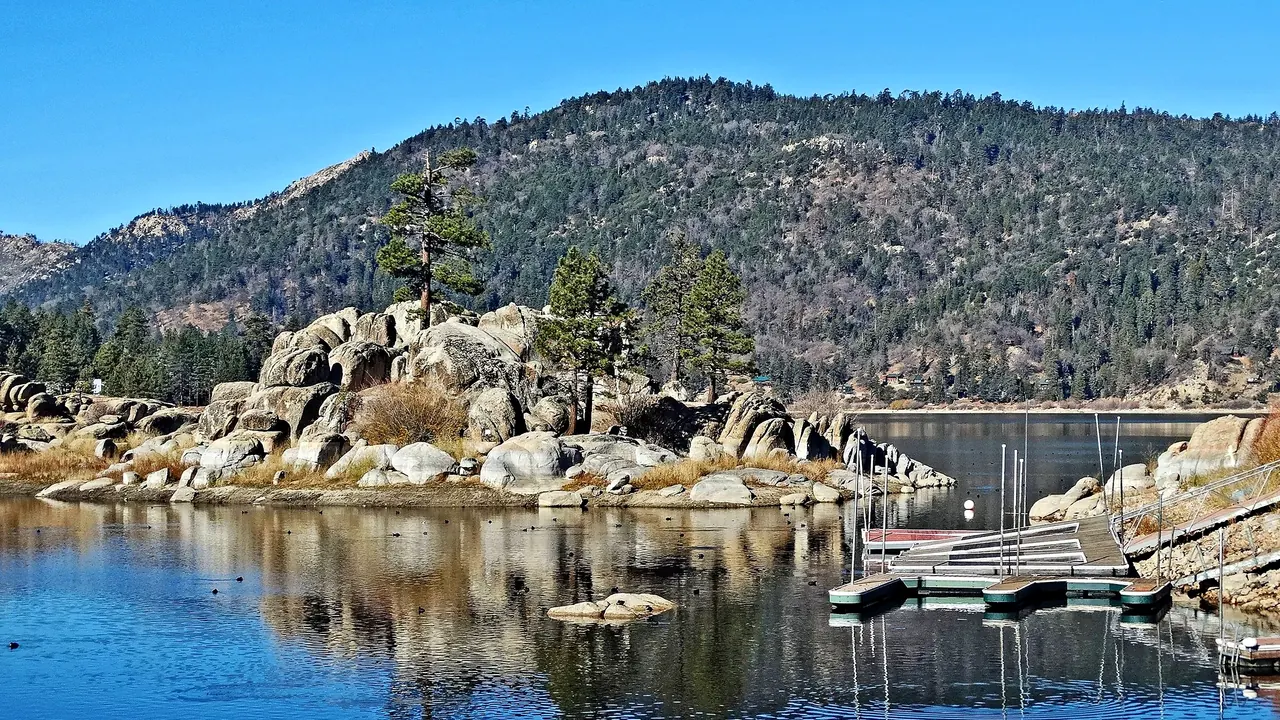
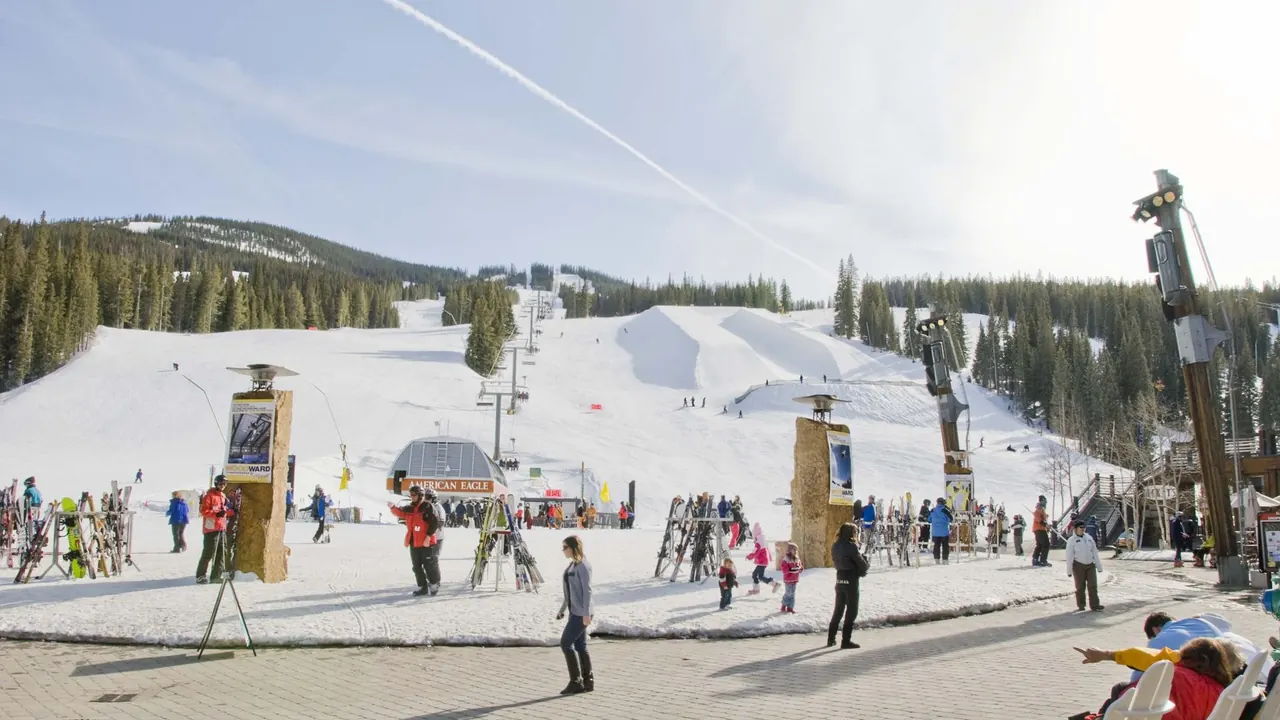
Photos: Big Bear Lake by inkknife_2000, CC BY-SA 2.0, cropped; Copper Mountain by SparkFunElectronics, CC BY 2.0, cropped.
Big Bear Lake or Copper Mountain?
Our verdict in twelve categories, each scored against the same fixed benchmark cities, and the climate month by month, so you can choose for your trip.
Choose Big Bear Lake for
- beaches
- prices
- wellness
Big Bear Lake suits Southern Californians and their visitors who want a mountain break that is gentle and easy to arrange: a cabin in the pines with a hot tub, a lake for paddling and fishing in summer, and snow for sledding and beginner skiing in winter. It costs less than a big Rockies resort, especially for groups who cook for themselves and come midweek. The altitude is also kinder.
Choose Copper Mountain for
- day trips
- getting around
- nature and the outdoors
Copper Mountain is the stronger choice when the mountains themselves are the point of the trip. The ski terrain is bigger and higher, several other major resorts are a short drive away, and summer brings serious trails and high peaks. The car-free village and the free buses make a stay simpler, and Breckenridge and Leadville are close for an afternoon off the slopes. Expect a bigger bill and a couple of days getting used to the thin air.
Scoreboard
Twelve categories on one fixed scale from 0 to 100. The shaded stretch is the gap between the two.
Your match
Pick a travel style or drag the sliders, and both match scores follow your weighting.
Too close to call, 1 point apart
Wins on beaches and prices with your weighting.
Wins on day trips and getting around with your weighting.
What matters to you?
Category by category
What the scores mean for a trip.
Beaches & swimming
Big Bear Lake at least gives you water to swim in. In midsummer the lake reaches about 19°C, and the supervised swim beach at Meadow Park is a sensible spot for children, although most of the shore is rock and granite with only a few sandy patches.
Copper Mountain has nothing comparable. Summit County's snowmelt reservoirs are too cold for bathing, so a swim means a heated lodge pool. Neither place is a beach destination, but at Big Bear a cool dip on a warm afternoon is a real option.
Food & drink
Both places serve the same hearty resort food: burgers, pizza, Mexican plates and a beer after a day outdoors, and many visitors cook in rented cabins or condos. Big Bear's Village offers a little more choice of its own, with a few lakeside tables. From Copper, the better evenings out are a short drive away in Frisco or Breckenridge.
Culture & sights
Neither is a place for sightseeing. Big Bear has a little more on its doorstep: the Discovery Center on the forest, a small history museum and a dirt-road drive past gold-rush relics in Holcomb Valley. Copper is purely a lift-base village, and its region's mining history lives in neighbouring towns.
Nightlife
Evenings are early in both. Copper's après-ski is a little more lively, with bars full of skiers in boots at the lift base and music on the plaza on busy weekends, and Breckenridge is close for a later night. Big Bear's version is more of a brewpub or sports bar in the Village, then back to the cabin fire.
Nature & outdoors
Both are proper mountain bases, but Copper Mountain is in a bigger league. Its slopes run up into treeless bowls above 3,600m, Vail and several Summit County resorts are within a short drive, and in summer the Colorado Trail and the Vail Pass path start right in the village.
Big Bear's skiing is more modest and depends on snowmaking. Its strength is the lake: fishing, kayaking and sailing, short hikes to Castle Rock and Cougar Crest, the Pacific Crest Trail and wintering bald eagles. Choose it for variety at an easier altitude, and Copper for the scale of the mountains.
Day trips
Copper Mountain makes a much better base for exploring. Breckenridge's Victorian main street and the silver-boom streets of Leadville are each about half an hour away, Vail is just over the pass, and Georgetown's narrow-gauge railway and Denver can be reached on the way to or from the airport.
From Big Bear, the winding descent slows every outing. Lake Arrowhead and the Oak Glen orchards make good half-days, and Riverside's Mission Inn is about an hour and a half away, but anything further means a long day on the road.
Good for families
Both work well for families, in different ways. Big Bear offers easy snow play for children who rarely see snow, an Alpine Zoo with rescued bears and bobcats, an alpine slide and pedal boats on the lake, and the lower altitude is easier on small children.
Copper is better organised for a ski week, with a car-free core, a strong children's ski school, tubing and an indoor trampoline centre. At nearly 3,000m, though, the altitude needs watching with young children.
Getting around
Once you arrive, Copper Mountain is the easier place to be without a car. Walkways, lifts and a free shuttle link the villages, and free county buses run on to Frisco, Breckenridge and Keystone, although getting there still means a two-hour drive or a shuttle from Denver.
At Big Bear the Village is walkable, and a bus and seasonal trolley serve the ski areas. Most cabins sit up hilly forest roads, however, so you end up driving to the shops and trailheads, and the mountain highways may require chains in winter.
Shopping & style
Neither is worth visiting for the shops. Big Bear's Village has a few blocks of fudge shops, bear souvenirs and the odd antique dealer to browse for an hour. Copper sells little beyond ski gear and resort-branded clothing, though the Silverthorne outlet mall and Breckenridge's galleries are close by.
Affordability
Big Bear Lake is the more affordable trip. A shared cabin with a kitchen, booked midweek or outside the peak season, keeps costs reasonable, and the hiking and sledding are cheap. Winter weekends do push prices up sharply.
Copper Mountain is expensive for most of the winter, with lift access, slope-side condos and equipment hire all costing a lot. Staying in Frisco or Silverthorne, or coming in summer, makes it noticeably cheaper.
Live music & performing arts
There is little on stage in either. Big Bear has a small community arts centre, free summer concerts by the lake and an autumn Oktoberfest with Bavarian bands. Copper has bands on the plaza on summer weekends, and Breckenridge's summer classical season is the closest real programme.
Wellness & relaxation
Big Bear Lake is the more restful choice. A cabin among the pines with a wood stove and a private hot tub, quiet midweek days and a few day spas in town make it easy to slow down, provided you avoid busy winter weekends.
At Copper, relaxing comes down to the condo hot tub and the athletic club's pools and massages. The hot springs are a long drive away, and the higher altitude often disturbs sleep for the first nights.
When should you go?
Pick your month. The climate figures are measured averages, not a forecast.
Big Bear Lake in July
Copper Mountain in July
Daytime high, °C
Rainfall in the month, mm
Where the figures come from
Big Bear Lake has no rain gauge within 25 km of the centre, so its rainfall comes from a gridded climate dataset read at the city rather than from a gauge further away.
Copper Mountain's temperatures are measured 35 km from the centre, at Leadville / Stringtown.
Copper Mountain has no rain gauge within 25 km of the centre, so its rainfall comes from a gridded climate dataset read at the city rather than from a gauge further away.
Temperature and rainfall are climate normals, averaged over the years shown. Big Bear Lake: 2014-2025 (rainfall 1991-2020) normals, Big Bear City (5 km from centre). Copper Mountain: 2006-2020 (rainfall 1991-2020) normals, Leadville / Stringtown (35.2 km from centre).
Big Bear Lake has two clear seasons. Winter is wet, with December to February bringing well over 100mm a month and daytime highs around 7°C. From May the town dries out almost completely, and June to August are warm and sunny, reaching about 26°C in July. That is the time for swimming and paddling on the lake, and early autumn stays pleasant for hiking.
Copper Mountain is colder all year. Winter highs stay below freezing, which suits skiing far better than walking around, and even July only reaches about 21°C. Precipitation is spread evenly across the months rather than piling up in winter, and summer afternoons often bring thunderstorms, so start hikes early. In summer Big Bear is the warmer and drier of the two. In deep winter Copper is the colder and more reliably wintry one.
Which traveller are you?
On an outdoors trip, Big Bear Lake has kayaking, sailing and fishing at an altitude that is easier on the lungs, but Copper Mountain is the better base. Its summer hikes climb above the treeline on the Colorado Trail, with Mount Elbert within an hour.
On a trip on a tight budget, Big Bear Lake is the realistic choice. A shared cabin with a kitchen keeps costs down, and days of lakeshore walks, forest trails and sledding cost little. At Copper, lift access and slope-side lodging add up every day.
For a relaxing and wellness trip, Big Bear Lake suits a quiet midweek stay in a forest cabin: mornings on the deck, an evening soak in the cabin's own hot tub, perhaps a massage in town. At Copper, the first nights at altitude rarely bring deep sleep.
Before you go
| Measure | Big Bear Lake | Copper Mountain |
|---|---|---|
| Currency | US Dollar (USD) | US Dollar (USD) |
| Sockets | AB120 V, 60 Hz | AB120 V, 60 Hz |
| Driving side | Right | Right |
| Time zone | UTC-8, UTC-7 in summer | UTC-7, UTC-6 in summer |
| Emergency number | 911 | 911 |
| Elevation | 2,058 m | 2,955 m |
| Main airport | Ontario International Airport (ONT)67 km from centre28 non-stop destinations | Denver International Airport (DEN)132 km from centre231 non-stop destinations |
| Public holidays this year | 13 days | 12 days |
By the numbers
| Measure | Big Bear Lake | Copper Mountain |
|---|---|---|
| City population | 5,046 | 650 |
| People per km² | 299 | 8 |
| Museums within 10 km | 1 | 0 |
| UNESCO World Heritage sites within 50 km | 0 | 0 |
Where else could you go?
Every comparison below shares a destination with this one, so you can follow Big Bear Lake or Copper Mountain somewhere new.
- Breckenridgevs Copper Mountain
- Keystonevs Copper Mountain
- Vailvs Copper Mountain
- Beaver Creekvs Copper Mountain
- Winter Park, Coloradovs Copper Mountain
- Palm Springsvs Big Bear Lake