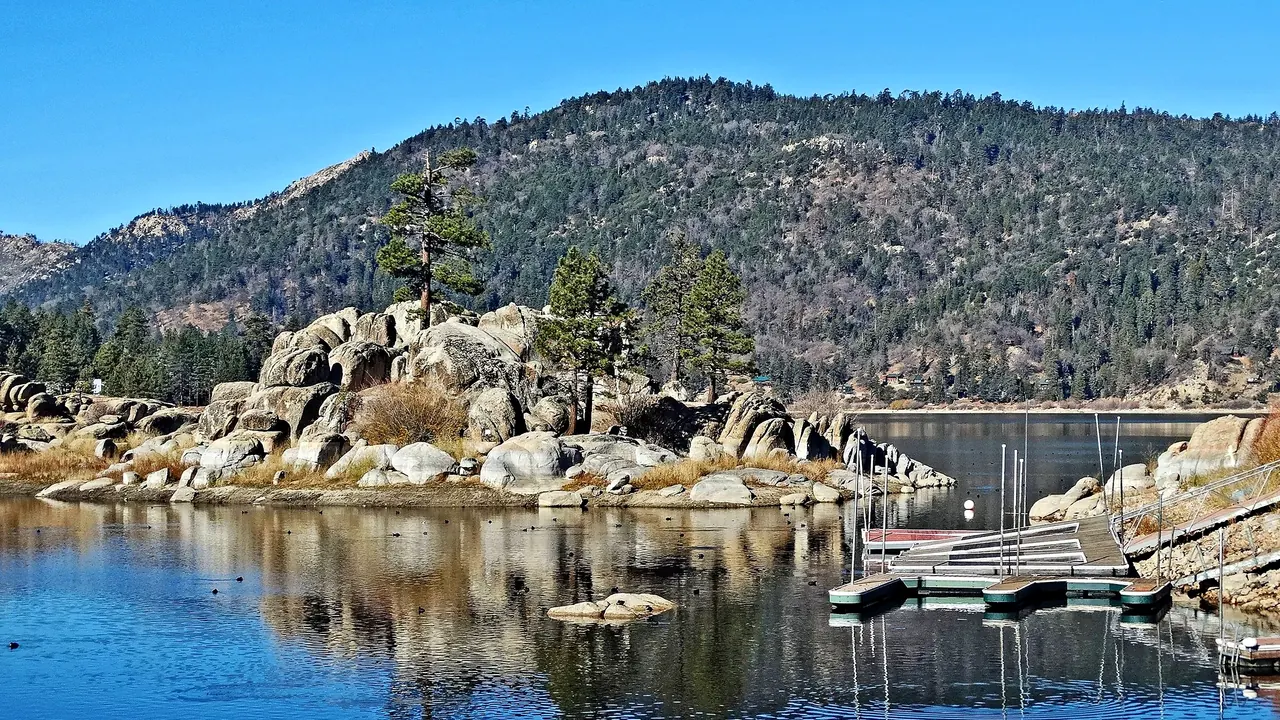
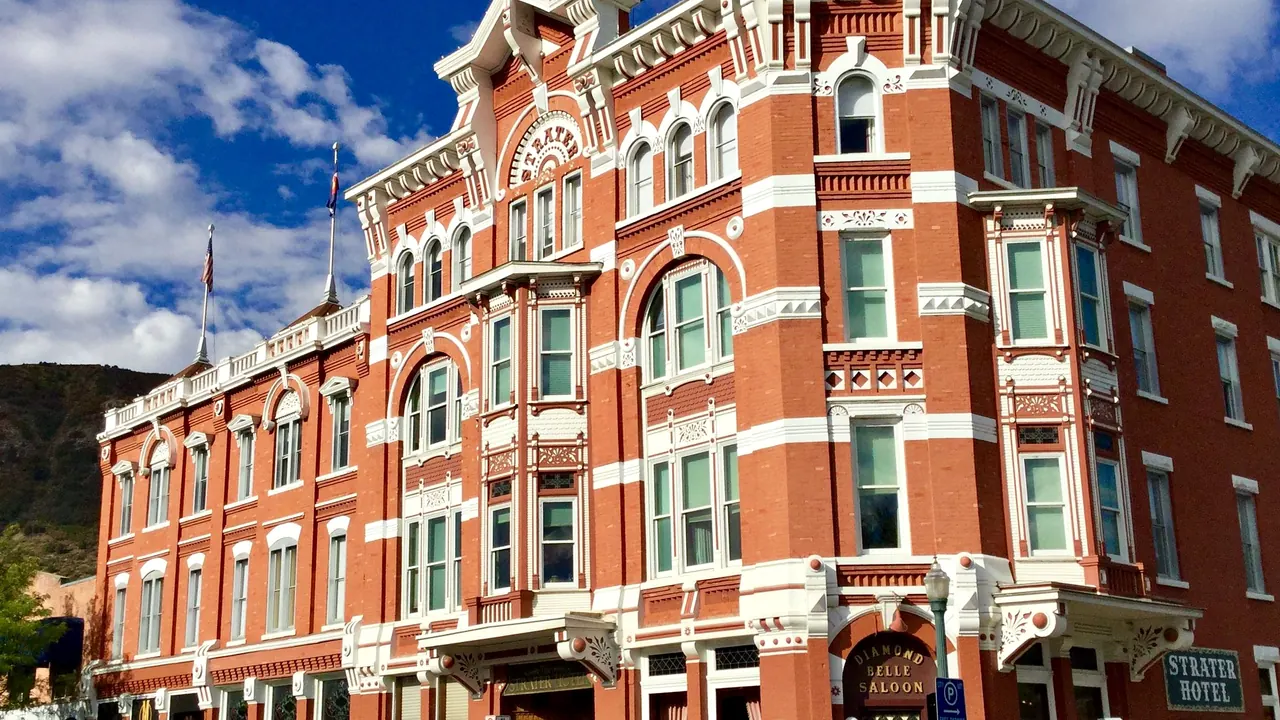
Photos: Big Bear Lake by inkknife_2000, CC BY-SA 2.0, cropped; Durango, Colorado by Adeledstarr, CC BY-SA 4.0, cropped.
Big Bear Lake or Durango, Colorado?
Our verdict in twelve categories, each scored against the same fixed benchmark cities, and the climate month by month, so you can choose for your trip.
Choose Big Bear Lake for
- beaches
- families
Big Bear Lake is the simpler, more domestic mountain trip. It suits families and groups who want a cabin with a hot tub among the pines, snow for children who rarely see it, and lazy summer days on the lake with pedal boats, kayaks and a supervised swim beach. Expect to stay up the mountain, cook for yourselves and make your own evenings. There are few sights, little to eat out for and not much worth driving to.
Choose Durango, Colorado for
- day trips
- culture and sights
- wellness
Durango gives a fuller trip on almost every count. The mountains are bigger and wilder, with famous mountain biking, rafting through town and deep winter snow. It also has a real town attached: a Victorian main street, a working steam railway, breweries and Southwestern cooking. Mesa Verde and Silverton are within a day out, and hot springs sit just up the valley, so it is the better pick for travellers who want history and things to do around the outdoors.
Scoreboard
Twelve categories on one fixed scale from 0 to 100. The shaded stretch is the gap between the two.
Your match
Pick a travel style or drag the sliders, and both match scores follow your weighting.
Wins on beaches and families with your weighting.
Wins on day trips and culture and sights with your weighting.
What matters to you?
Category by category
What the scores mean for a trip.
Beaches & swimming
Neither town is a beach destination, but Big Bear Lake makes swimming easier. Meadow Park has a small supervised swim beach, the lake reaches about 19°C at the height of summer, and the long dry season gives you more warm afternoons for a dip from the sandy patches between the rocks.
Durango's water is colder and the season shorter. There is a small swimming area at Lake Nighthorse and some sandy edges at Vallecito Lake, but locals are more likely to float the Animas River through town on inner tubes than to lie on a shore.
Food & drink
Big Bear Lake feeds skiers and hikers with diners, burgers, pizza and barbecue, and many visitors simply cook in their cabins. It is fuel rather than an attraction, and winter weekends bring queues.
Durango eats noticeably better. Main Avenue has green-chile Southwestern plates, steakhouses and a few careful kitchens cooking Colorado lamb, trout and local produce. Its craft breweries are unusually good for a town this size. The choice is still small, but there is a regional flavour that Big Bear lacks.
Culture & sights
Big Bear Lake has very little to see. There is the Discovery Center on the forest, a small history museum and a dirt-road drive past old mining remains from the 1860s gold rush in Holcomb Valley, and the chalet-style Village is mostly modern.
Durango has a real past you can walk through. The steam locomotives leave from the old depot and the roundhouse museum shows them up close. The downtown blocks of brick and sandstone Victorian hotels and saloons date from the mining boom, and the college on the mesa holds a respected Southwestern and Native American collection. It is still only a morning's worth, but it gives the town a character Big Bear does not have.
Nightlife
Both are early-to-bed mountain towns, but Durango has more going on after dark. Big Bear's evenings come down to some après-ski near the slopes, a brewpub or sports bar, and then the hot tub back at the cabin.
Durango has taproom patios along Main Avenue, old saloons with a piano player, and students from the college who keep a few bars busy at weekends. You will not find dancing or anything late in either town.
Nature & outdoors
Big Bear Lake is a lake ringed by pine and oak, with gentle mountains around it. You can sail, kayak and fish on the water, take short hikes to Castle Rock and Cougar Crest, walk a section of the Pacific Crest Trail and ski modestly on snowmaking at two areas above the south shore, with bald eagles around the lake in winter.
Durango sits under the San Juan Mountains, a far wilder range with peaks above 4,000m in the Weminuche Wilderness. It is one of the best-known mountain-biking centres in the country, the Colorado Trail starts just north of town and there is white water through the middle of town. The ski resort to the north has deep natural snow and nordic trails, so serious hikers, riders and paddlers will find more to do here.
Day trips
From Big Bear the roads are slow and the destinations modest. Lake Arrowhead is about an hour round the Rim of the World road, and Oak Glen's orchards and the Mission Inn in Riverside are further down the mountain. Los Angeles or Palm Springs means a long day.
Durango has some of the best day trips in the American West. There are the cliff dwellings of Mesa Verde and the steam train up the Animas canyon to the mining town of Silverton. The Aztec ruins, part of the Chaco UNESCO listing, are under an hour south, and Chimney Rock and Pagosa Springs lie to the east. A car is needed, but the trips are worth the miles.
Good for families
Both work well for families, in different ways. Big Bear is built around snow play for Southern California children: sledding hills, beginner ski lessons, then the alpine slide, go-karts, mini-golf and pedal boats in summer, plus the small Alpine Zoo with its rescued bears and bobcats. Roomy cabins with kitchens make it easy.
Durango suits slightly older, more active children. They can ride the steam train, raft and tube gently on the river, ride the alpine coaster and ziplines in summer and climb the ladders at Mesa Verde. It has no zoo and few rainy-day options, and the longer drives add up.
Getting around
You need a car in both. The difference is in the details. Big Bear's steep access highways can need snow chains in winter and crawl on busy weekends, and most cabins are scattered on hilly forest roads. Only the Village and its trolley link to the ski areas work without driving.
Durango's centre is small and flat. You can walk from the depot to the top of Main Avenue in a quarter of an hour, and a paved riverside trail is good for cycling. Its trailheads and day trips are spread along mountain highways, though, and many visitors rent a car at the regional airport.
Shopping & style
Big Bear's Village is fudge shops, bear-themed souvenirs, a few antique and decor stores and outfitters renting ski and lake gear, enough for an hour.
Durango's Main Avenue has more worth buying. There are Navajo and Pueblo silver and turquoise jewellery, rugs, art galleries, Western boots and serious bike, fishing and climbing shops. Neither has fashion or luxury, but Durango's turquoise and outdoor kit justify a proper browse.
Affordability
The two cost much the same, and in both the timing decides the bill. At Big Bear, a shared cabin midweek with your own cooking can be reasonable, while winter weekends and school vacations push rates and lift tickets up sharply.
Durango is cheaper than the famous Colorado ski towns, but rooms are scarce in summer and peak ski weeks. A hire car, the train and guided rafting add to the cost, and spring and late autumn are the thrifty seasons.
Live music & performing arts
There is little on stage in either town, but Durango has more. Big Bear has a community arts centre with local theatre, free summer concerts by the lake and Bavarian bands at its long-running Oktoberfest.
Durango has a summer festival of chamber and orchestral music and a college concert hall with touring musicians and dance. In summer there are two Western extras: a Victorian melodrama where you boo the villain, and cowboy music shows with a chuckwagon supper.
Wellness & relaxation
The difference comes down to hot water from the ground. Durango has mineral pools fed by a natural spring a few minutes north of town, with more spring-fed pools at Pagosa Springs and Ouray, ideal after a ride or a ski day. The town stays calm and unhurried.
At Big Bear, relaxing means the private hot tub and wood stove of a rented cabin. There are a few day spas but no springs, and the crowds on winter weekends spoil the quiet.
When should you go?
Pick your month. The climate figures are measured averages, not a forecast.
Big Bear Lake in July
Durango, Colorado in July
Daytime high, °C
Rainfall in the month, mm
Where the figures come from
Big Bear Lake has no rain gauge within 25 km of the centre, so its rainfall comes from a gridded climate dataset read at the city rather than from a gauge further away.
Durango, Colorado has no weather station within reach, so its figures come from a gridded climate model rather than a measured record, and read a broad area rather than the city itself.
Temperature and rainfall are climate normals, averaged over the years shown. Big Bear Lake: 2014-2025 (rainfall 1991-2020) normals, Big Bear City (5 km from centre). Durango, Colorado: 1991-2020 normals, TerraClimate 4 km grid at the town, no weather station within 90 km.
Both towns sit at about 2,000m, but their years run differently. Big Bear Lake has a wet winter and a very dry summer. December to February bring the heaviest falls, up to 135mm a month, much of it as snow, and that is the ski and sledding season. From June the weather turns dry and settled, and July and August reach about 26°C, the only weeks warm enough for a cool swim in the lake. September and October stay mild and dry, good months for hiking.
Durango has drier winters and warmer summers, with July highs near 30°C, hot enough to make the middle of the day on an exposed trail hard work. Its driest stretch is April to June, with only 12mm in June, so late spring is the easiest time for long days outside. Rain picks up from July, peaking at about 48mm in August and staying fairly high into autumn, though September is still warm and brings the golden aspens. Winter is cold enough for the ski resort to the north to run fully.
Which traveller are you?
For a beach and sun trip, Big Bear Lake is the better of two weak options. Its lake has a supervised swim beach at Meadow Park, sandy patches between the granite and a long dry summer. Durango's water is colder and its swimming season shorter.
On a culture and arts trip, Durango is the clear choice. It has a railway town from 1880 with a roundhouse museum, a Victorian historic district, the college's Native American collection, a summer music festival, and the cliff dwellings of Mesa Verde within reach.
For a relaxing and wellness trip, Durango has natural hot springs a few minutes north of town and more at Pagosa Springs and Ouray. Big Bear offers a private hot tub on a cabin deck and a few day spas, and its weekends get crowded.
Before you go
| Measure | Big Bear Lake | Durango, Colorado |
|---|---|---|
| Currency | US Dollar (USD) | US Dollar (USD) |
| Sockets | AB120 V, 60 Hz | AB120 V, 60 Hz |
| Driving side | Right | Right |
| Time zone | UTC-8, UTC-7 in summer | UTC-7, UTC-6 in summer |
| Emergency number | 911 | 911 |
| Elevation | 2,058 m | 1,988 m |
| Main airport | Ontario International Airport (ONT)67 km from centre28 non-stop destinations | Durango La Plata County Airport (DRO)18 km from centre4 non-stop destinations |
| Public holidays this year | 13 days | 12 days |
By the numbers
| Measure | Big Bear Lake | Durango, Colorado |
|---|---|---|
| City population | 5,046 | 19,071 |
| People per km² | 299 | 739 |
| Museums within 10 km | 1 | 2 |
| UNESCO World Heritage sites within 50 km | 0 | 1 |
Where else could you go?
Every comparison below shares a destination with this one, so you can follow Big Bear Lake or Durango, Colorado somewhere new.
- Palm Springsvs Big Bear Lake
- Telluridevs Durango, Colorado
- Palm Desertvs Big Bear Lake
- Anaheimvs Big Bear Lake
- Laguna Beachvs Big Bear Lake
- Newport Beachvs Big Bear Lake