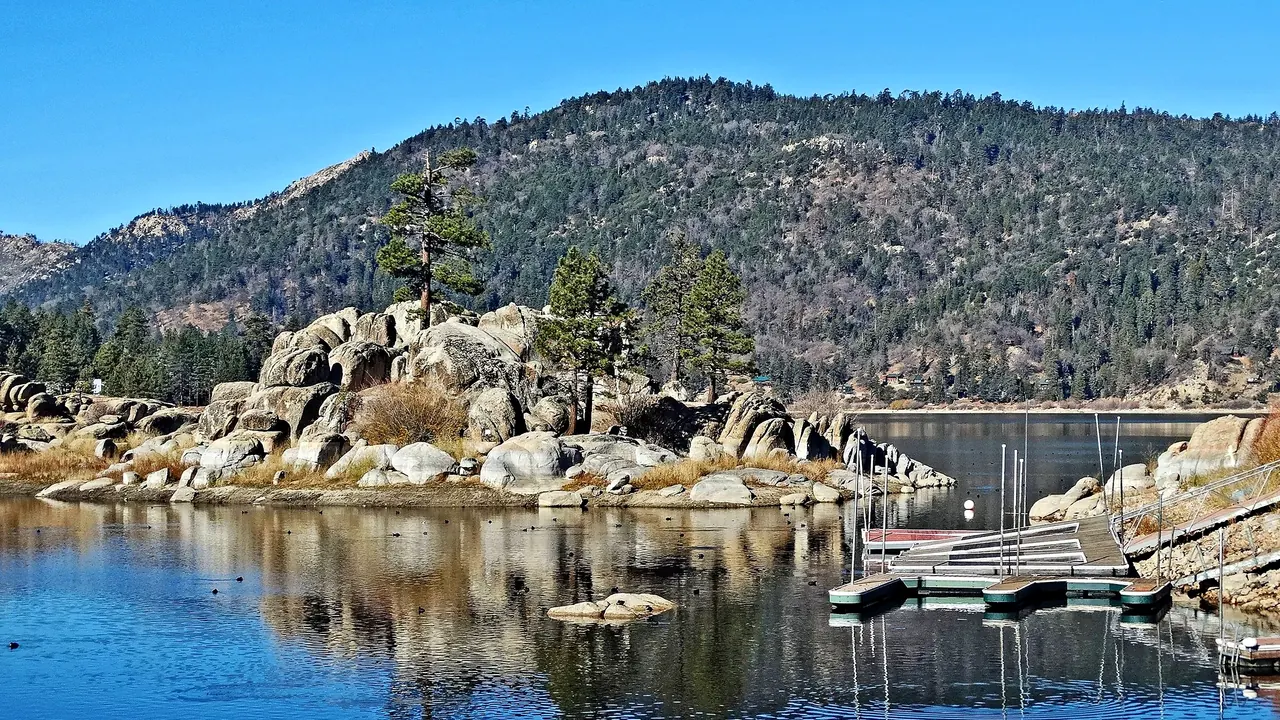
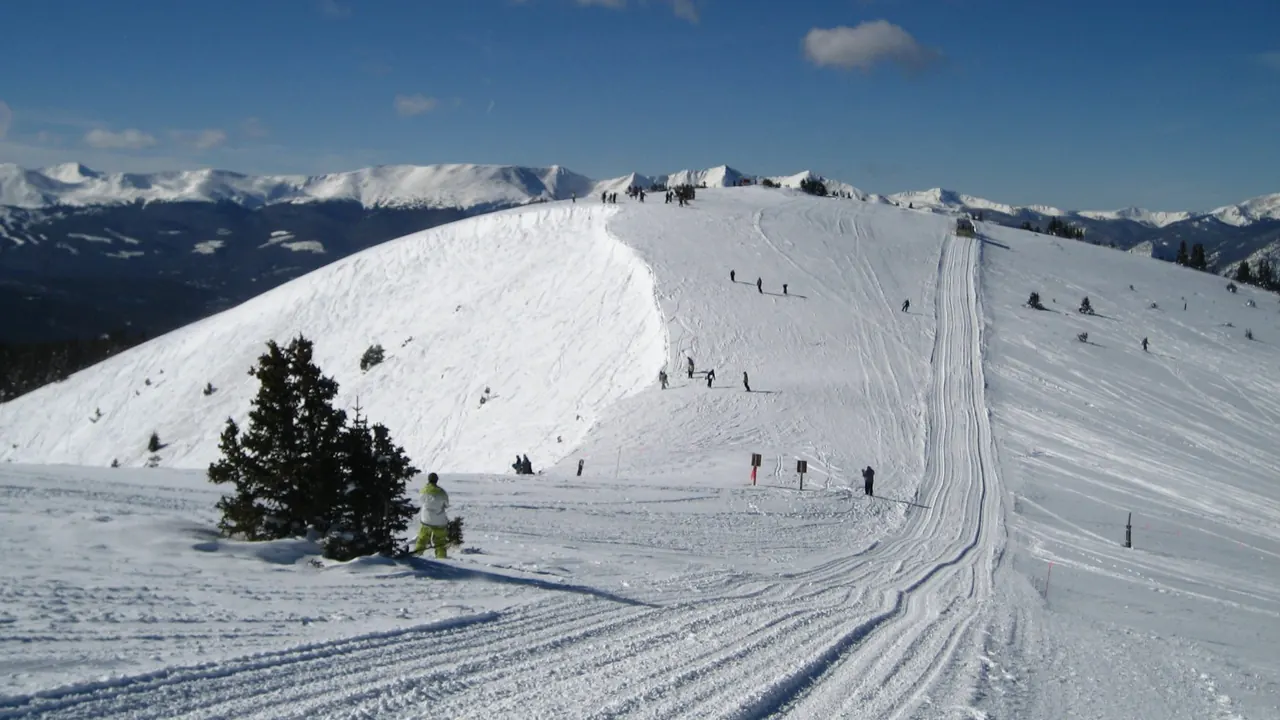
Photos: Big Bear Lake by inkknife_2000, CC BY-SA 2.0, cropped; Keystone by Rudi Riet, CC BY-SA 2.0, cropped.
Big Bear Lake or Keystone?
Our verdict in twelve categories, each scored against the same fixed benchmark cities, and the climate month by month, so you can choose for your trip.
Choose Big Bear Lake for
- prices
- beaches
- wellness
Big Bear Lake suits a relaxed, lower-cost mountain break, especially for Southern Californians who want snow, a lake and a cabin without flying anywhere. The skiing is modest, but summer adds a lake you can actually swim in, and a shared cabin with its own kitchen and hot tub keeps a group or family trip within reach. Pick it if what you're after is slow days among the pines rather than big terrain.
Choose Keystone for
- day trips
- getting around
- nature and the outdoors
Keystone is the stronger choice if the mountains are the main event. It has far bigger and higher skiing, with several other major resorts within an hour, better family ski facilities, and free buses that link a whole county of old mining towns. You pay heavily for all of it, but serious skiers, summer hikers and anyone who wants varied days out will get more from it.
Scoreboard
Twelve categories on one fixed scale from 0 to 100. The shaded stretch is the gap between the two.
Your match
Pick a travel style or drag the sliders, and both match scores follow your weighting.
Wins on prices and beaches with your weighting.
Wins on day trips and getting around with your weighting.
What matters to you?
Category by category
What the scores mean for a trip.
Beaches & swimming
Neither is a beach destination, but Big Bear Lake at least lets you swim. In midsummer the lake is cool rather than cold, and the supervised swim beach at Meadow Park gives children a safe place to splash between rocky stretches of shore.
At Keystone, Dillon Reservoir is cold snowmelt and mostly closed to swimmers. Getting in the water there means a hotel pool or a hot tub.
Food & drink
Eating out is much the same in both places: comfort food and a beer after the slopes, with many visitors cooking in their own cabin or condo. The difference is flavour. Big Bear Lake sticks to diner breakfasts, barbecue and Mexican plates in the Village. Keystone puts Colorado lamb, elk and trout on its menus, has a gondola-reached dining room at the summit, and lets you drive to Frisco or Breckenridge for more choice.
Culture & sights
Neither place has much in the way of sights, and both have modern resort villages. What history there is comes from mining in both cases. Big Bear has its gold-rush remains along a dirt-road drive through Holcomb Valley. Keystone has old cabins above Montezuma, and the Victorian streets of Breckenridge are near enough to fill the gap.
Nightlife
Both go quiet early. Keystone's après-ski is the livelier moment, with the decks at River Run full of skiers still in their boots, and Breckenridge's Main Street is a bus ride away if you want more. Big Bear's evenings are a brewpub or sports bar, then back to the cabin fire.
Nature & outdoors
Both are proper mountain bases, but Keystone works on a larger scale. It has three peaks of its own, bowls above 3,600m, Arapahoe Basin up the road and Vail within an hour, all on dry, reliable snow. Summer brings 14,000ft summits and alpine tundra over Loveland Pass.
Big Bear Lake's two ski areas are smaller and lean on snowmaking. Its strengths are the lake itself, the forest, the Pacific Crest Trail along the north shore and the bald eagles that winter around it.
Day trips
Keystone gives you far more to do on days off the mountain. Breckenridge is about half an hour away, and the silver towns of Georgetown and Silver Plume, with their loop railway, lie across the Divide. Leadville's mining-boom streets and Denver's museums are both within a manageable drive.
From Big Bear, the winding roads make most outings slow. Lake Arrowhead and the Oak Glen orchards are pleasant, but anything bigger means two hours or more each way.
Good for families
Big Bear Lake works best for families from the lowlands who want snow for a day or two and a cabin with room to spread out and a kitchen, at a lower cost. It also keeps children busier once the snow has gone, with an alpine slide, mini-golf, go-karts and fishing from the shore in summer.
Keystone is the more complete family resort for anyone whose trip is built around skiing, from first lessons to full days on the mountain. Off the snow there is less to offer: paddle boats, bike trails and easy hikes in summer, and little made for children beyond that. It also sits about 800m higher, so altitude and winter cold hit young children harder.
Getting around
At Keystone you can manage without a car once you arrive. Free shuttles link the resort's bases, and free county buses reach Frisco, Dillon and Breckenridge. The weak point is the I-70 drive up from Denver.
Big Bear needs a car almost the whole time. The Village is walkable and a trolley runs in season, but cabins are spread out on hilly forest roads, and the highways up the mountain can crawl on busy weekends.
Shopping & style
Keystone has the edge here because of the large outlet centre in Silverthorne, about ten minutes away, which is good for brand-name clothes and outdoor wear. Big Bear's Village offers fudge shops, bear-themed souvenirs and a few antique stores, which is fine for an hour but has no real clothing shopping.
Affordability
Big Bear Lake is the cheaper of the two by a clear margin. Midweek and shoulder-season cabins can be reasonable for a group, and the lake, trails and sledding cost little, although winter weekends push prices up.
Keystone is expensive throughout ski season, with lifts, slopeside lodging, ski school and resort meals all costing a lot. The free buses and self-catering condos help, and summer is easier on the wallet, but there is no budget version of a Keystone trip.
Live music & performing arts
Keystone, with its neighbours, offers noticeably more. In summer there are festival stages in the village, concerts at Dillon's lakeside amphitheatre and Breckenridge's classical music festival. Silverthorne also has a professional theatre company that plays all year round.
Big Bear has a small community arts centre, free summer concerts by the lake and the brass bands of its autumn Oktoberfest.
Wellness & relaxation
Relaxation looks much the same in both places: a private hot tub after a day outdoors, a few spas, and no real bathing tradition. Keystone's resort spas are geared to sore skiers, and the hot springs at Idaho Springs are over the pass. Big Bear's calm comes from the cabin itself, with a wood stove, a deck among the pines and quiet midweek days.
When should you go?
Pick your month. The climate figures are measured averages, not a forecast.
Big Bear Lake in July
Keystone in July
Daytime high, °C
Rainfall in the month, mm
Where the figures come from
Big Bear Lake has no rain gauge within 25 km of the centre, so its rainfall comes from a gridded climate dataset read at the city rather than from a gauge further away.
Keystone's temperatures are measured 51 km from the centre, at Leadville / Stringtown.
Keystone's station stands 232 m above the city centre, so the centre is likely a little warmer than the figures say.
Keystone has no rain gauge within 25 km of the centre, so its rainfall comes from a gridded climate dataset read at the city rather than from a gauge further away.
Temperature and rainfall are climate normals, averaged over the years shown. Big Bear Lake: 2014-2025 (rainfall 1991-2020) normals, Big Bear City (5 km from centre). Keystone: 2006-2020 (rainfall 1991-2020) normals, Leadville / Stringtown (50.8 km from centre).
Big Bear Lake has a clear wet season and a long dry one. From November to March storms bring heavy rain and snow, peaking at about 135mm in February, and daytime highs from December to February sit around 7°C. That is chilly but fine for a walk in a warm coat, with cold nights. From May to October it is almost dry, and July reaches about 26°C, warm enough for a lake swim, paddling and long hikes. Spring and autumn are cool, clear and good for walking.
Keystone is much colder all year. Daytime highs stay around -2°C from December to February and are barely above freezing in March and November, which keeps the snow in good condition through a long ski season. Rain and snow are spread fairly evenly over the year, with no real wet or dry season. Summer is short and mild, peaking at about 21°C in July, so the hiking and biking months run from late June to September. If you want summer warmth, Big Bear wins. If you want proper winter, it is Keystone.
Which traveller are you?
On a trip on a tight budget, Big Bear Lake is the more realistic choice. A shared cabin midweek or in the shoulder seasons, with your own cooking and free hikes and sledding, costs far less than Keystone, where lifts, lodging and resort meals are expensive all winter.
For an outdoors trip, Keystone is the better base. The skiing is higher and larger, Arapahoe Basin and Breckenridge are close by, and summer brings 14,000ft summits, alpine tundra and lift-served biking. That is a bigger range than Big Bear's forest trails and lake.
On a family trip with children, Keystone has the edge in winter. It offers a large ski school, gentle lower slopes, a snow fort, a huge skating rink and free shuttles. Big Bear answers with simpler snow play, an alpine zoo and summer pedal boats, at a lower cost.
Before you go
| Measure | Big Bear Lake | Keystone |
|---|---|---|
| Currency | US Dollar (USD) | US Dollar (USD) |
| Sockets | AB120 V, 60 Hz | AB120 V, 60 Hz |
| Driving side | Right | Right |
| Time zone | UTC-8, UTC-7 in summer | UTC-7, UTC-6 in summer |
| Emergency number | 911 | 911 |
| Elevation | 2,058 m | 2,796 m |
| Main airport | Ontario International Airport (ONT)67 km from centre28 non-stop destinations | Denver International Airport (DEN)116 km from centre231 non-stop destinations |
| Public holidays this year | 13 days | 12 days |
By the numbers
| Measure | Big Bear Lake | Keystone |
|---|---|---|
| City population | 5,046 | 1,369 |
| People per km² | 299 | 13 |
| Museums within 10 km | 1 | 0 |
| UNESCO World Heritage sites within 50 km | 0 | 0 |
Where else could you go?
Every comparison below shares a destination with this one, so you can follow Big Bear Lake or Keystone somewhere new.
- Breckenridgevs Keystone
- Copper Mountainvs Keystone
- Vailvs Keystone
- Winter Park, Coloradovs Keystone
- Beaver Creekvs Keystone
- Palm Springsvs Big Bear Lake