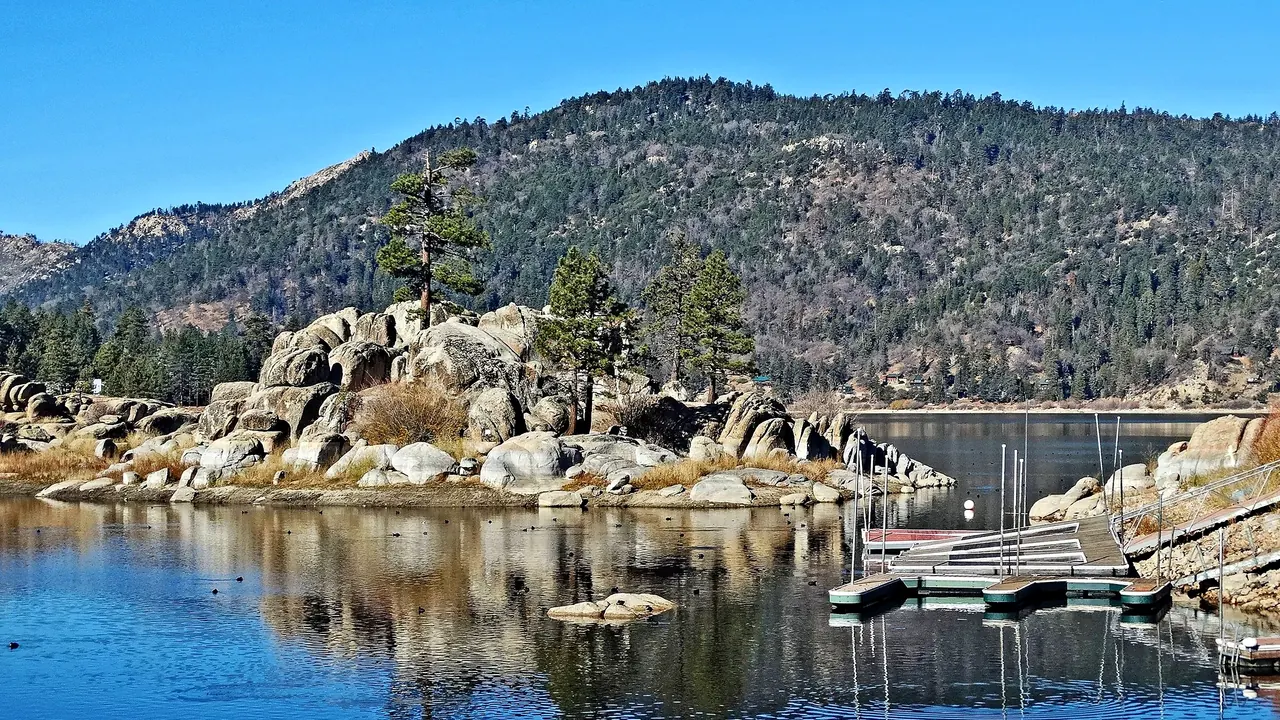
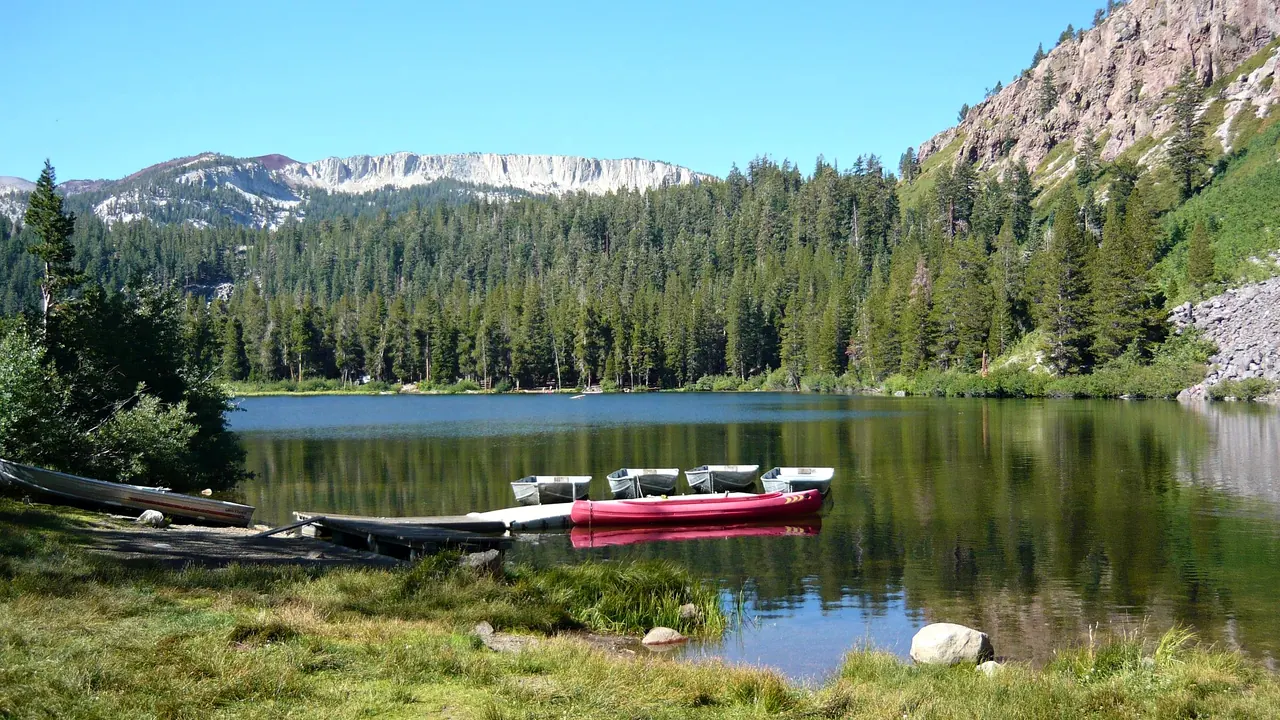
Photos: Big Bear Lake by inkknife_2000, CC BY-SA 2.0, cropped; Mammoth Lakes by Dr. Al. K. Lisch, CC BY-SA 3.0, cropped.
Big Bear Lake or Mammoth Lakes?
Our verdict in twelve categories, each scored against the same fixed benchmark cities, and the climate month by month, so you can choose for your trip.
Choose Big Bear Lake for
- prices
- beaches
Big Bear Lake suits a group or a family who want mountain air and snow without paying for a major ski resort. A shared cabin with a kitchen and a hot tub keeps costs down, especially midweek, and the lake is warmer for a summer swim and has a supervised beach. The town works best as a relaxed stay built around the cabin, with the lake, short hikes and sledding filling the days.
Choose Mammoth Lakes for
- wellness
- nature and the outdoors
- getting around
If the landscape is what you are going for, choose Mammoth Lakes. It has one of North America's largest ski areas, the Lakes Basin, Devils Postpile and the road over Tioga Pass to the Yosemite high country, so there is far more ground to cover. In the evenings there are volcanic hot springs and a slightly livelier après-ski scene. It costs more, so it is best for people who will use the mountains hard.
Scoreboard
Twelve categories on one fixed scale from 0 to 100. The shaded stretch is the gap between the two.
Your match
Pick a travel style or drag the sliders, and both match scores follow your weighting.
Wins on prices and beaches with your weighting.
Wins on wellness and nature and the outdoors with your weighting.
What matters to you?
Category by category
What the scores mean for a trip.
Beaches & swimming
Neither town is a beach destination, but Big Bear Lake is the better place for a swim. The lake warms to around 19°C in high summer, and the small beach at Meadow Park is the only supervised swimming spot in either town, which matters if you have children.
Mammoth Lakes offers only a cold dip at Horseshoe Lake, or in the slightly warmer Crowley Lake, during a short July and August window. Bathing in the steaming water of Hot Creek is banned. There, the lakes are for paddling and fishing far more than swimming.
Food & drink
Both towns eat like ski resorts, with big breakfasts, burgers, pizza and a pint of local beer, and neither has a cuisine of its own. Mammoth Lakes has the wider choice. Because it feeds a much larger winter crowd, it adds steakhouses and a few more ambitious dinner kitchens around its Village.
Big Bear Lake is plainer, with log-cabin diners, barbecue and Mexican plates. A table with a lake view is the main pleasure there, and many visitors simply stock the cabin kitchen.
Culture & sights
Culture is not a reason to visit either town, and each has little more than a small local history museum. Big Bear does have the forest displays of its Discovery Center and the 1860s gold-rush remains in Holcomb Valley, which you can follow on a dirt-road drive. Mammoth's real heritage sites are an hour or more away in the wider Eastern Sierra.
Nightlife
Mammoth Lakes has the livelier evenings, though only in the ski season. Then the Village and the bars by the lifts fill for après-ski, the brewery taprooms keep going, and long winter weekends can run late. Big Bear Lake's nights are quieter, with a few Village pubs and a brewpub or sports bar before most people go back to the hot tub and the fire, and neither town has clubs.
Nature & outdoors
Both are genuine mountain bases, but Mammoth Lakes works on a bigger scale. Its mountain is one of North America's largest ski areas, and its season can run into early summer. Beyond it lie the Ansel Adams and John Muir wildernesses, Devils Postpile, the tufa towers of Mono Lake and, once Tioga Pass opens, the Yosemite high country.
Big Bear Lake is smaller but easy to enjoy. It has modest, reliable skiing at two areas, a lake full of kayaks and sailing boats, short hikes to Castle Rock and Cougar Crest, the Pacific Crest Trail along the north side and bald eagles in winter. The big hike nearby is in the San Gorgonio Wilderness, which has Southern California's highest summit.
Day trips
Neither town makes a good base for excursions, and in both most outings head into the mountains rather than to other towns. Mammoth Lakes has the more memorable places to visit: the ghost town of Bodie and the Manzanar internment camp, each a little over an hour away along the highway below the Sierra.
From Big Bear the options are gentler: Lake Arrowhead along the Rim of the World road, the orchards of Oak Glen and the citrus-era streets of Riverside. The winding roads make every one of these trips slow.
Good for families
Families do equally well in either town, with ski schools, snow play and lakes for gentle summer days. The difference is what fills the gaps. Big Bear has the Alpine Zoo, an alpine slide, mini-golf and go-karts, which makes short attention spans easier to manage.
Mammoth relies on the outdoors, with a tubing hill, rowing boats in the Lakes Basin and the gondola to the summit, and it has little to offer on a day when you are stuck indoors. Its greater height can also make the first day or two harder on small children.
Getting around
Mammoth Lakes is easier to manage without a car, at least on a ski trip. Free winter shuttles link the lodgings with the lift bases, a gondola rises from the Village, and in summer a trolley and a shuttle reach the Lakes Basin and Reds Meadow. The wider Eastern Sierra still needs a car.
At Big Bear Lake, the Village is walkable and there is a local bus and a seasonal trolley. Most cabins, though, are scattered through the forest, so errands and trailheads mean driving. Its steep access highways may need snow chains and can crawl on busy weekends.
Shopping & style
Shopping is a minor pastime in both towns, and neither has fashion streets or markets. Big Bear's Village leans towards fudge, bear-themed souvenirs and antiques, which makes for a pleasant hour's browsing. Mammoth's shops are more practical, with serious ski, climbing and fly-fishing outfitters and a few galleries selling landscape photography.
Affordability
Big Bear Lake is the more affordable of the two, though neither is cheap. A cabin shared by a group midweek or in the shoulder seasons can be fairly economical there, and sledding and hiking cost little.
Mammoth Lakes is priced like a major ski resort. Its lift tickets are among the most expensive anywhere, and in winter lodging, equipment hire and even groceries carry resort prices. Summer and the spring and autumn shoulder months bring costs down, and a self-catering condominium helps.
Live music & performing arts
You would not plan a trip around performances in either town, but Mammoth Lakes has a little more on. A resident community theatre runs regular seasons, and summer brings jazz, chamber music and outdoor concerts with the mountains as a backdrop. Big Bear has a small community arts centre with local theatre and the occasional touring act, free concerts by the lake in summer, and Bavarian bands at its autumn Oktoberfest.
Wellness & relaxation
Big Bear Lake has no thermal springs, so a soak there means the private hot tub on your cabin deck among the pines, with a wood stove waiting indoors. A few day spas in town offer massage. The town is calmest midweek, because winter weekends bring crowds.
Mammoth Lakes is the better place to unwind. Its volcanic ground feeds natural pools in open country, with no facilities, just a dirt road in and a mountain view, so a soak there feels much wilder than any cabin tub. Back in town, the large lodges have spas and massage for legs tired from skiing or hiking.
When should you go?
Pick your month. The climate figures are measured averages, not a forecast.
Big Bear Lake in July
Mammoth Lakes in July
Daytime high, °C
Rainfall in the month, mm
Where the figures come from
Big Bear Lake has no rain gauge within 25 km of the centre, so its rainfall comes from a gridded climate dataset read at the city rather than from a gauge further away.
Mammoth Lakes's station stands 227 m below the city centre, so the centre is likely a little cooler than the figures say.
Mammoth Lakes has no rain gauge within 25 km of the centre, so its rainfall comes from a gridded climate dataset read at the city rather than from a gauge further away.
Temperature and rainfall are climate normals, averaged over the years shown. Big Bear Lake: 2014-2025 (rainfall 1991-2020) normals, Big Bear City (5 km from centre). Mammoth Lakes: 2008-2020 (rainfall 1991-2020) normals, Mammoth / Whitmore Hot Springs (12 km from centre).
Big Bear Lake has the wetter winter of the two. From December to February each month brings well over 100mm of rain and snow, and daytime highs sit around 7°C. That is weather for skiing and sledding, not for wandering the Village. The wet season eases in May, and June is almost completely dry. July and August reach about 26°C, the only weeks when the lake is pleasant for a swim. September and October stay mild and settled, which makes them good for hiking.
Mammoth Lakes is drier for most of the year, with much less rain and snow from autumn through to spring, although its May and June are slightly wetter than Big Bear's. Winters are just as cold, and high summer is a little warmer, near 28°C in July and August. Its ski season often runs into early summer, so Mammoth still has snow when Big Bear has already turned to hiking and boating. From late June to early October, the trails are at their best in either town.
Which traveller are you?
On a trip on a tight budget, Big Bear Lake makes your money go further. Its two small ski areas are a lighter expense than Mammoth's huge mountain, and much of a day there, by the lake or in the forest, needs no ticket at all.
For an outdoors trip, Mammoth Lakes is the stronger base. The ski mountain is far bigger and the season longer. In summer, granite lakes, two wilderness areas and the Yosemite high country are all within reach. Big Bear's trails and lake are pleasant but smaller.
On a relaxing and wellness trip, Mammoth Lakes gives you more ways to slow down. Its volcanic landscape adds natural soaking to the quiet of its off-season weeks, and the lodges can book a massage after a long day outdoors.
Before you go
| Measure | Big Bear Lake | Mammoth Lakes |
|---|---|---|
| Currency | US Dollar (USD) | US Dollar (USD) |
| Sockets | AB120 V, 60 Hz | AB120 V, 60 Hz |
| Driving side | Right | Right |
| Time zone | UTC-8, UTC-7 in summer | UTC-8, UTC-7 in summer |
| Emergency number | 911 | 911 |
| Elevation | 2,058 m | 2,402 m |
| Main airport | Ontario International Airport (ONT)67 km from centre28 non-stop destinations | Reno Tahoe International Airport (RNO)217 km from centre25 non-stop destinations |
| Public holidays this year | 13 days | 13 days |
By the numbers
| Measure | Big Bear Lake | Mammoth Lakes |
|---|---|---|
| City population | 5,046 | 7,191 |
| People per km² | 299 | 110 |
| Museums within 10 km | 1 | 0 |
| UNESCO World Heritage sites within 50 km | 0 | 0 |
Where else could you go?
Every comparison below shares a destination with this one, so you can follow Big Bear Lake or Mammoth Lakes somewhere new.
- Palm Springsvs Big Bear Lake
- Palm Desertvs Big Bear Lake
- Anaheimvs Big Bear Lake
- Laguna Beachvs Big Bear Lake
- Newport Beachvs Big Bear Lake
- Huntington Beachvs Big Bear Lake