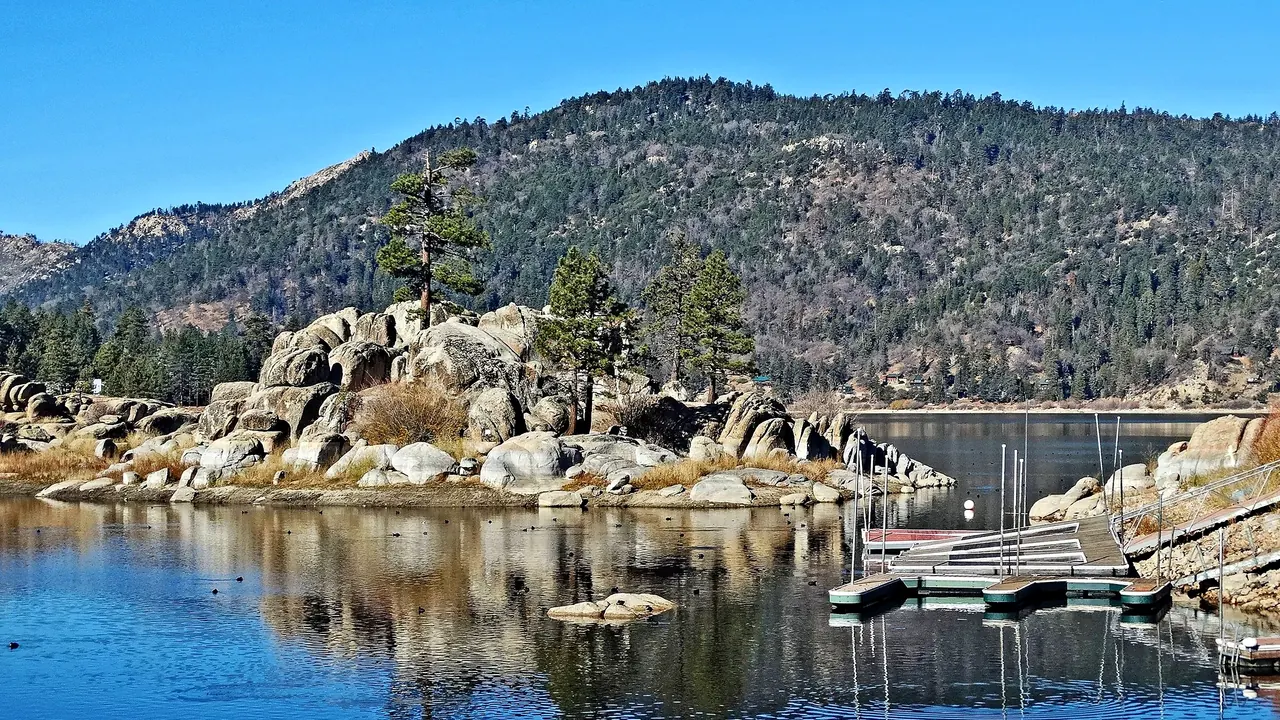
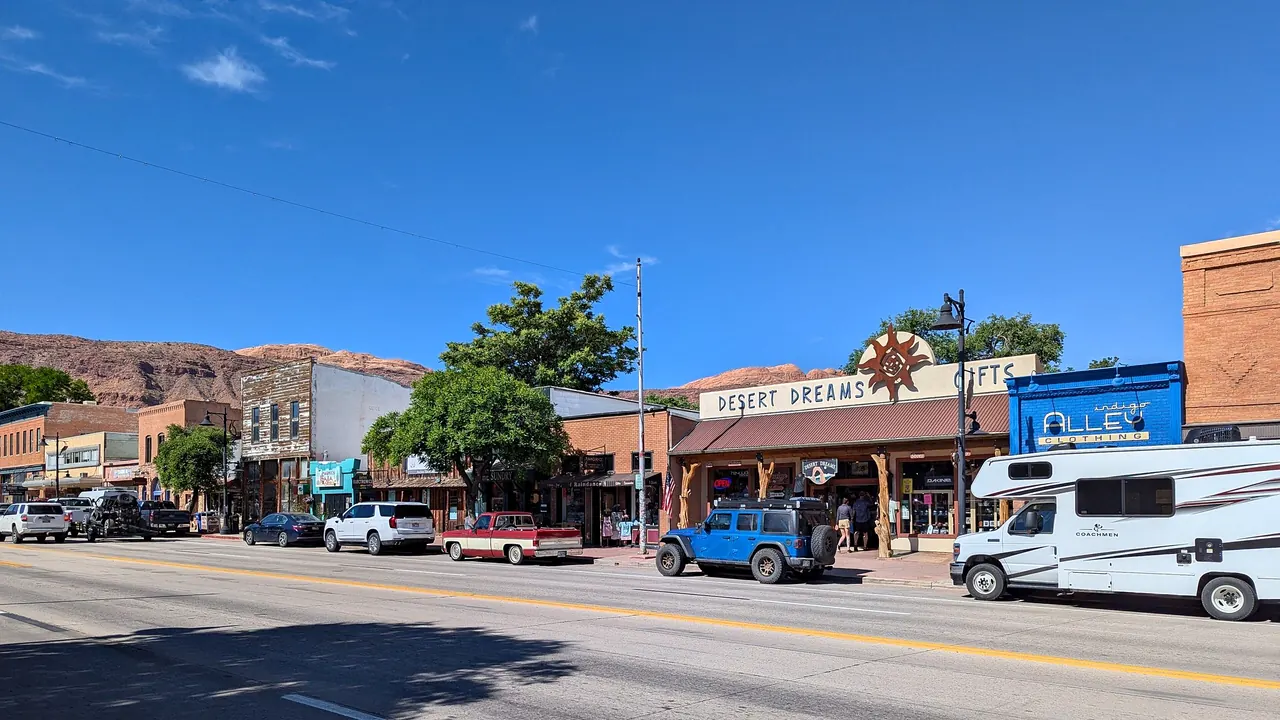
Photos: Big Bear Lake by inkknife_2000, CC BY-SA 2.0, cropped; Moab by G. Edward Johnson, CC BY 4.0, cropped.
Big Bear Lake or Moab?
Our verdict in twelve categories, each scored against the same fixed benchmark cities, and the climate month by month, so you can choose for your trip.
Choose Big Bear Lake for
- getting around
- beaches
- families
Big Bear Lake is the easier choice for families and for anyone who wants a mountain cabin more than a demanding itinerary. There is snow play and beginner skiing in winter, a supervised swim beach and pedal boats in summer, and a hot tub on the deck most evenings, so it's a place to settle into. Lake Arrowhead and the valley towns give you a little more to do on days off the trails.
Choose Moab for
- nature and the outdoors
- culture and sights
- live music and the arts
Travellers who judge a trip by what they see and do outdoors will find Moab the stronger pull. Arches and Canyonlands sit almost on its doorstep, its mountain biking draws riders from around the world, and rafting, canyoneering and petroglyph panels fill out the days. It asks more of you in return: a car for everything, early starts and serious heat in summer.
Scoreboard
Twelve categories on one fixed scale from 0 to 100. The shaded stretch is the gap between the two.
Your match
Pick a travel style or drag the sliders, and both match scores follow your weighting.
Wins on getting around and beaches with your weighting.
Wins on nature and the outdoors and culture and sights with your weighting.
What matters to you?
Category by category
What the scores mean for a trip.
Beaches & swimming
Neither place is a beach destination, but Big Bear Lake at least offers a proper swim in summer. The lake reaches around 19°C, and Meadow Park has the one supervised swim beach, which is the place to go with children. Most of the shore is rock and granite, and the water is busier with paddleboards than with swimmers.
Moab has nothing comparable. Mill Creek's shallow pools, Ken's Lake and the cold, silty Colorado offer a dip in the heat, but most visitors end up in the motel pool.
Food & drink
Both towns eat the same way: big portions, burgers, pizza and a brewpub after a day outside, and neither has a local cuisine worth travelling for. What differs is the setting. Big Bear leans on log-cabin breakfasts, a few lakeside tables and cabin kitchens stocked from the supermarket. Moab's Main Street adds early coffee for hikers and a handful of more ambitious Southwestern dinners, under Utah's stricter alcohol rules.
Culture & sights
Neither town is a place for museums, and the difference lies in the kind of history each offers. Big Bear's story is the 1860s gold rush in Holcomb Valley, with mining remains and old cabins along a dirt-road drive, plus a discovery centre about the forest.
Moab's history goes back much further. Ancestral Puebloan and Fremont petroglyphs line the cliffs along Potash Road and Kane Creek, and dinosaur trackways lie close to town. These give an outdoor trip a real sense of deep time, even though the town itself takes only a morning.
Nightlife
Nights are short in both places, with no clubs and little open late. Big Bear's evenings centre on après-ski in the Village pubs during ski season, then a hot tub back at the cabin. Moab's brewpubs fill with mountain bikers and rafters, and the main attraction after dark is the very dark, star-filled desert sky.
Nature & outdoors
Big Bear Lake is a genuine mountain base. It has an alpine lake in pine and oak forest, two ski areas, bike trails on the summer slopes, and the Pacific Crest Trail and San Gorgonio Wilderness close by. It suits varied, moderate days and has lift-served skiing, which Moab does not.
Moab is on another level. Arches begins minutes from town, Canyonlands and Dead Horse Point are under an hour away, and the Slickrock Trail, Colorado River rafting, canyoneering and climbing at Wall Street make it one of the world's great outdoor bases. The La Sal Mountains add high country above the red rock.
Day trips
Both towns sit at the end of long roads, but Big Bear has more within reach. Lake Arrowhead's lakeside village is about an hour away along the Rim of the World road. Oak Glen's orchards and Riverside's Mission Inn are not much further, and Los Angeles or Palm Springs make for a long day.
From Moab, nearly every outing is more landscape. The towns nearby are small. The best cultural day out, to Edge of the Cedars in Blanding or the stone towers of Hovenweep, takes up most of the day.
Good for families
Big Bear Lake is built around families. It offers snow play and beginner lessons for children who rarely see snow, and the Alpine Zoo's rescued bears and bobcats. In summer there are go-karts, mini-golf and pedal boats. The main drawbacks are the altitude and the traffic on winter weekends.
Moab works for school-age children who like scrambling over rock, with easy walks to arches, dinosaur tracks, gentle raft floats and Junior Ranger programmes. Summer heat, unfenced drops and hours in the car make it much harder with toddlers.
Getting around
You need a car in both places, but Big Bear offers more help once you arrive. The Village is walkable, and a local bus and a seasonal trolley reach the ski areas and parts of the lakeshore. Getting there means steep mountain highways that can slow to a crawl and may require snow chains.
Moab has a walkable Main Street and a paved bike path to the Arches entrance, and little beyond that. The parks and trailheads lie down long desert roads and dirt tracks, so visitors without a vehicle depend on outfitters' shuttles and tours.
Shopping & style
Fudge, candy stores and bear-themed gifts set the tone in Big Bear's Village, along with a few antique and home-decor shops and outfitters that rent ski and lake gear. You can browse there for a pleasant hour, but for anything bigger you have to drive down to the valley.
Moab's Main Street is better for a keepsake that comes from the place itself. Rock shops sell geodes, fossils and minerals, and galleries carry Southwestern art, Navajo jewellery and weavings. Its bike, climbing and camping shops are also well stocked if something breaks mid-trip, though neither town has any fashion or department-store shopping.
Affordability
Both cost more than their simple style suggests, and in both timing makes the difference. Big Bear is cheapest midweek for a group sharing a cabin and cooking for itself. Winter weekends, lift tickets and ski hire push costs up sharply.
In Moab the pressure comes in spring and autumn, when plain motels charge resort rates and guided trips add up. Campgrounds, free dispersed camping and a park pass that covers a week keep an outdoor trip affordable, and winter is far cheaper.
Live music & performing arts
Neither town has much regular live performance. Big Bear has a small community arts centre, free lakeside concerts in summer and an autumn Oktoberfest with Bavarian bands. Moab has one standout, its end-of-summer chamber music festival, with some concerts in canyon grottoes reached by boat, and it's worth timing a visit around if you like classical music.
Wellness & relaxation
Big Bear Lake is the more restful of the two, largely because of its cabins. You get a wood stove, a deck among the pines and often a private hot tub, and the days pass slowly midweek. Neither town has thermal springs or a spa tradition, and busy winter weekends break the calm.
Moab's days are built around early starts and heat, and its few massage studios mostly serve cyclists with sore legs. Rest there comes from quiet desert evenings and red cliffs at sunset, or from a ranch or cabin up in the La Sals.
When should you go?
Pick your month. The climate figures are measured averages, not a forecast.
Big Bear Lake in July
Moab in July
Daytime high, °C
Rainfall in the month, mm
Where the figures come from
Big Bear Lake has no rain gauge within 25 km of the centre, so its rainfall comes from a gridded climate dataset read at the city rather than from a gauge further away.
Moab's temperatures are measured 27 km from the centre, at Moab / Crescent Junction.
Moab's station stands 162 m above the city centre, so the centre is likely a little warmer than the figures say.
Moab has no rain gauge within 25 km of the centre, so its rainfall comes from a gridded climate dataset read at the city rather than from a gauge further away.
Temperature and rainfall are climate normals, averaged over the years shown. Big Bear Lake: 2014-2025 (rainfall 1991-2020) normals, Big Bear City (5 km from centre). Moab: 2006-2020 (rainfall 1991-2020) normals, Moab / Crescent Junction (27 km from centre).
Big Bear Lake has two clear seasons. From June to September the days are warm, peaking around 26°C in July, and almost dry, which is the time for the lake, hiking and biking. Winter is the wet half of the year, with up to 135mm a month from December to February and daytime highs in single figures. Come then to ski and sled rather than to linger outdoors.
Moab stays dry all year, so when to go depends on the heat. Summer highs reach 35°C, too hot for hiking in the middle of the day. April, May, September and October range from about 20°C to 29°C, which is ideal for trails and canyons, and December and January are cold by day. The two cities balance each other well: Big Bear is the cooler pick in high summer, and Moab the better one in spring and autumn.
Which traveller are you?
On a family trip with children, Big Bear Lake is the safer bet. Snow-play hills, ski lessons, the Alpine Zoo and a supervised swim beach are all close together, while Moab's heat, unfenced drops and long drives suit only older, active children.
For an outdoors trip, Moab is hard to beat. Two national parks lie within an hour, and the Slickrock Trail, river rafting and canyoneering fill a week of big days. Big Bear's lake, forest hikes and ski runs are gentler and on a smaller scale.
On a relaxing and wellness trip, Big Bear Lake wins on ease. A cabin with a wood stove and a private hot tub among the pines sets a slow pace, especially midweek. In Moab the days are early and energetic, and calm comes mainly at sunset.
Before you go
| Measure | Big Bear Lake | Moab |
|---|---|---|
| Currency | US Dollar (USD) | US Dollar (USD) |
| Sockets | AB120 V, 60 Hz | AB120 V, 60 Hz |
| Driving side | Right | Right |
| Time zone | UTC-8, UTC-7 in summer | UTC-7, UTC-6 in summer |
| Emergency number | 911 | 911 |
| Elevation | 2,058 m | 1,227 m |
| Main airport | Ontario International Airport (ONT)67 km from centre28 non-stop destinations | Canyonlands Regional Airport (CNY)27 km from centre2 non-stop destinations |
| Public holidays this year | 13 days | 12 days |
By the numbers
| Measure | Big Bear Lake | Moab |
|---|---|---|
| City population | 5,046 | 5,366 |
| People per km² | 299 | 501 |
| Museums within 10 km | 1 | 1 |
| UNESCO World Heritage sites within 50 km | 0 | 0 |
Where else could you go?
Every comparison below shares a destination with this one, so you can follow Big Bear Lake or Moab somewhere new.
- Palm Springsvs Big Bear Lake
- Palm Desertvs Big Bear Lake
- Anaheimvs Big Bear Lake
- Laguna Beachvs Big Bear Lake
- Newport Beachvs Big Bear Lake
- Huntington Beachvs Big Bear Lake