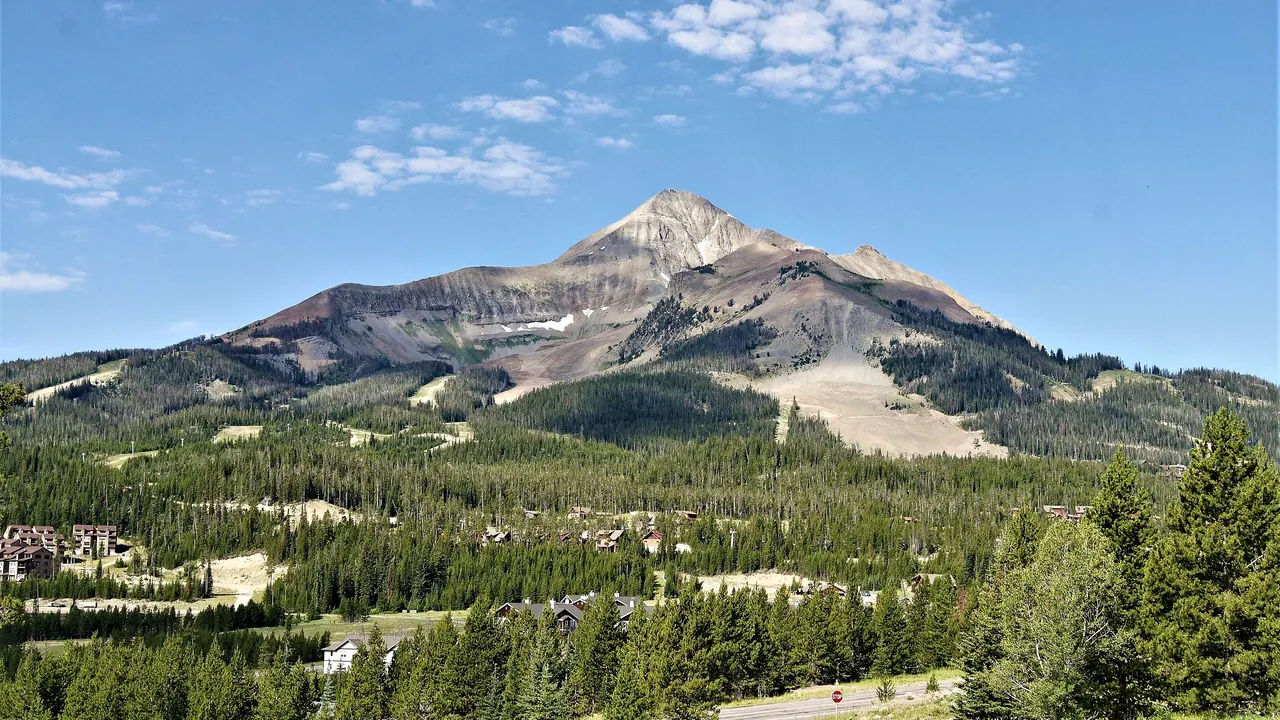
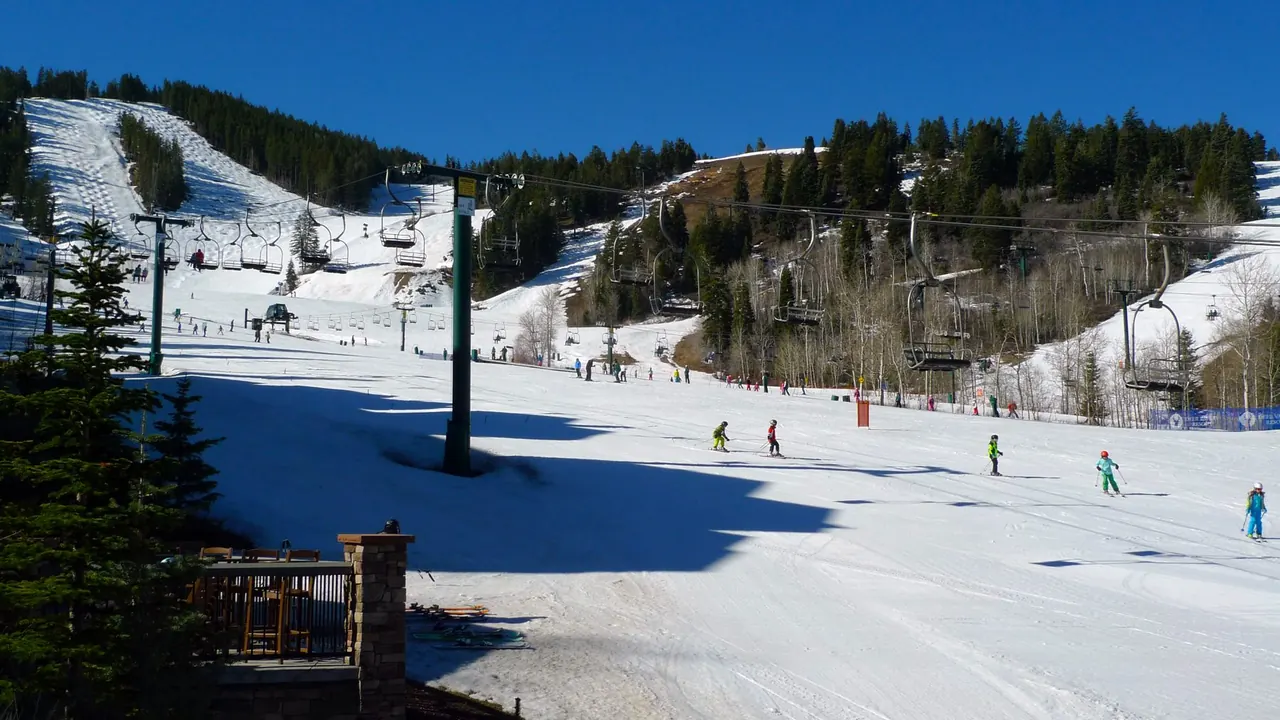
Photos: Big Sky by Greg Gjerdingen, CC BY 2.0, cropped; Deer Valley by Don Ramey Logan, CC BY 4.0, cropped.
Big Sky or Deer Valley?
Our verdict in twelve categories, each scored against the same fixed benchmark cities, and the climate month by month, so you can choose for your trip.
Choose Big Sky for
- nature and the outdoors
- prices
Big Sky suits travellers who want the mountains wild, empty and very big. Lone Peak's steep terrain, the Spanish Peaks and Lee Metcalf Wilderness on the doorstep and Yellowstone within a day out make it the stronger base for people who measure a trip in summits, rivers and wildlife. You trade away almost everything else, though: dining is narrow, evenings are quiet, and the resort is spread along a canyon road far from a major airport.
Choose Deer Valley for
- getting around
- food and drink
- shopping
Deer Valley is the easier and more rounded choice. It pairs polished, carefully groomed skiing with Park City's restored Main Street a few minutes away, so dinners, bars, galleries and a summer symphony season come with the stay. Free buses, a short run from Salt Lake City airport and better spas make it the better pick for a comfortable, well-organised ski week or for a group that does not all want to be on the mountain every hour.
Scoreboard
Twelve categories on one fixed scale from 0 to 100. The shaded stretch is the gap between the two.
Your match
Pick a travel style or drag the sliders, and both match scores follow your weighting.
Wins on nature and the outdoors and prices with your weighting.
Wins on getting around and food and drink with your weighting.
What matters to you?
Category by category
What the scores mean for a trip.
Beaches & swimming
You won't swim much in either place. In Big Sky the Gallatin River is too fast and cold even in midsummer, so a quick paddle in a pond or a picnic on the riverbank is about as far as it goes. Deer Valley is a little better placed: the state park at Jordanelle Reservoir has a sandy shore and water that is pleasant on hot July and August afternoons, and it makes a reasonable lake day out.
Food & drink
Deer Valley eats better, mainly because Park City is next door. Main Street and the old town streets have steakhouses, sushi, modern American bistros and après-ski grills, more than a town that size would normally support. Up on the mountain, the lodge food is polished and there is a long-standing turkey chili ritual. It is still upscale resort eating, with no markets or street food.
Big Sky's choice is narrower: bison, elk, trout, Montana beef and big breakfasts, served across three villages and the canyon roadhouses. Some kitchens cut their hours between seasons, and for real variety you have to drive an hour to Bozeman.
Culture & sights
Neither resort is a place for sightseeing, but Deer Valley has more to see nearby. Park City's restored silver-mining Main Street, with old mine headframes on the slopes and a museum in the old city hall, fills an afternoon, and the Utah Olympic Park adds a museum of Winter Games and skiing history. In Big Sky, the past comes down to the log cabins of the Crail Ranch homestead in Meadow Village. The rest is timber condos built since the 1970s.
Nightlife
Deer Valley's lodges go quiet after the lifts close, but Park City's Main Street is only a few minutes away. Its saloons, cocktail bars and après-ski spots fill up on ski-season weekends, though Utah's liquor rules and early closing keep it a small-town scene.
Big Sky's evenings centre on the decks at the foot of the lifts in Mountain Village, a few Town Center taverns and the old canyon saloons with pool tables and a ranch-country crowd. In spring and autumn it is almost silent after dark.
Nature & outdoors
Both are top-tier mountain bases, and the difference is in character. Big Sky feels bigger and rougher. Lone Peak rises to 3,403m above steep, high runs, summer trails lead into true wilderness, and the Gallatin offers rafting as well as fly fishing. On top of that, Yellowstone's wildlife is about an hour away.
Deer Valley is more about polish and choice. Its own runs are immaculately groomed, Park City Mountain is next door, and the deep powder of Alta and Snowbird is about an hour over the ridge. In summer the ski runs give way to a huge linked network of biking and hiking trails, with the Uinta lakes further out.
Day trips
From Big Sky, the best outing is Bozeman, an hour down the canyon, a college town with a Western main street and the dinosaur fossils of the Museum of the Rockies. Further afield, the 1860s gold-rush boardwalks of Virginia City and Nevada City and the old railway centre of Livingston make good days out, but they are all small places.
Deer Valley gives you more choice. Salt Lake City is about forty minutes away, with Temple Square, the State Capitol and proper museums. Closer in, the Heber Valley has Swiss-styled Midway, a historic steam railway and the arts village at Sundance, and Ogden's railway-era 25th Street is a little over an hour north.
Good for families
Both work well for active families, in slightly different ways. Deer Valley is the smoother ski week: well-run children's schools, wide groomed beginner runs and no snowboarders, plus tubing and an alpine coaster at the Olympic Park. Salt Lake City's zoo and children's museums are within reach on a bad-weather day.
Big Sky comes into its own in summer, with zip lines, a ropes course, horse riding and bison-spotting in Yellowstone. It has nothing indoors for rainy days, though, and its base sits higher, so small children may feel the altitude more.
Getting around
Deer Valley is clearly easier. Fare-free buses link its base areas with Main Street, Park City Mountain and Kimball Junction, the old town is compact enough to walk, and Salt Lake City airport is about forty minutes away.
Big Sky is strung out along about 15km of road from the canyon up to Mountain Village. A free bus connects the villages, but Bozeman airport is an hour's drive, and for Yellowstone you really need a car and some care on the winter canyon road.
Shopping & style
Deer Valley has more to browse, because Park City's Main Street has art galleries, western boots and hats and upmarket boutiques behind its mining-town façades. The outlet centre at Kimball Junction suits bargain hunters. Big Sky offers little beyond outdoor gear, a few Western-style boutiques and wildlife art galleries. It is fine for gloves or a fly rod, but for anything more you go to Bozeman.
Affordability
There is little to choose between them: both rank among the most expensive mountain stays in North America. At Deer Valley the luxury is the whole point, with high-end slopeside lodging and lift access among the dearest anywhere, although the free buses save on a car within town. Big Sky's costs are spread across lodging, lift passes, ski school and guided fishing. In both, summer is easier on the budget, and the usual way to save is to stay further out (the canyon or Bozeman for Big Sky, the Heber Valley or Salt Lake City for Deer Valley) and drive in.
Live music & performing arts
Deer Valley has the fuller programme. In summer, the Utah Symphony's long-running outdoor festival brings picnics on the grass at the Snow Park amphitheatre, and the restored 1920s Egyptian Theatre on Main Street stages plays and small concerts all year.
Big Sky does more than its size suggests: a small arts centre in Meadow Village hosts touring acts in winter, and there are free lawn concerts and a short classical festival in summer. Between those seasons there is very little on.
Wellness & relaxation
Deer Valley is the better place to unwind. It is built around comfort, with fireside lodges and some of the most polished hotel spas in the mountain West. It also has a genuine curiosity half an hour away: the warm spring pool inside the limestone dome of the Homestead Crater.
In Big Sky, relaxing means hot tubs on lodge decks, spa massages after a ski day and quiet, starry nights. The nearest natural hot springs are about an hour away towards Bozeman.
When should you go?
Pick your month. The climate figures are measured averages, not a forecast.
Big Sky in July
Deer Valley in July
Daytime high, °C
Rainfall in the month, mm
Where the figures come from
Big Sky has no weather station within reach, so its figures come from a gridded climate model rather than a measured record, and read a broad area rather than the city itself.
Deer Valley's temperatures are measured 82 km from the centre, at Evanston.
Deer Valley's station stands 297 m below the city centre, so the centre is likely a little cooler than the figures say.
Deer Valley has no rain gauge within 25 km of the centre, so its rainfall comes from a gridded climate dataset read at the city rather than from a gauge further away.
Temperature and rainfall are climate normals, averaged over the years shown. Big Sky: 2001-2020 normals, NASA POWER reanalysis grid, no weather station within 90 km. Deer Valley: 1999-2020 (rainfall 1991-2020) normals, Evanston (81.9 km from centre).
Big Sky is the colder of the two. Midwinter highs sit around -4°C, a few degrees below Deer Valley, and the snow lasts well into April. Its wettest spell comes in late spring and peaks in May at about 83mm, so spring is a poor time for the trails. Deer Valley is drier all year, and its early summer is the most reliable stretch for hiking and biking, with July the driest month at about 23mm.
July and August are the warm months in both places, reaching about 26°C in Big Sky and 28°C in Deer Valley. That is good weather for walking and hiking, never too hot, and it is the only time a lake or pool swim is tempting. September is still pleasant in both. After that Big Sky cools faster and is close to freezing by November, while Deer Valley's autumn lasts a few weeks longer.
Which traveller are you?
On an outdoors trip, both deliver, and the choice is one of style. Big Sky suits walkers heading for Beehive Basin and Ousel Falls, and rafters on the Gallatin. Deer Valley suits mountain bikers, with lift-served downhill runs and a web of linked summer trails.
For a relaxing and wellness trip, Big Sky offers quiet and open space, but spa comfort is a sideline to the mountain. Deer Valley takes more effort out of the stay, with rooms you can ski back to, a short airport transfer and easy, groomed runs.
For a short city break, neither is a city, but Big Sky loses too much of a long weekend to driving. From Deer Valley you can reach Park City's walkable old Main Street on the evening you land, for dinner and a play at the Egyptian Theatre.
Before you go
| Measure | Big Sky | Deer Valley |
|---|---|---|
| Currency | US Dollar (USD) | US Dollar (USD) |
| Sockets | AB120 V, 60 Hz | AB120 V, 60 Hz |
| Driving side | Right | Right |
| Time zone | UTC-7, UTC-6 in summer | UTC-7, UTC-6 in summer |
| Emergency number | 911 | 911 |
| Elevation | 2,200 m | 2,474 m |
| Main airport | Bozeman Yellowstone International Airport (BZN)59 km from centre27 non-stop destinations | Salt Lake City International Airport (SLC)45 km from centre108 non-stop destinations |
| Public holidays this year | 12 days | 12 days |
By the numbers
| Measure | Big Sky | Deer Valley |
|---|---|---|
| City population | 3,591 | - |
| People per km² | 12 | - |
| Museums within 10 km | 0 | 0 |
| UNESCO World Heritage sites within 50 km | 0 | 0 |
Where else could you go?
Every comparison below shares a destination with this one, so you can follow Big Sky or Deer Valley somewhere new.
- Park Cityvs Deer Valley
- Alta, Utahvs Deer Valley
- Snowbirdvs Deer Valley
- Salt Lake Cityvs Deer Valley
- Jackson Holevs Big Sky
- Moabvs Deer Valley