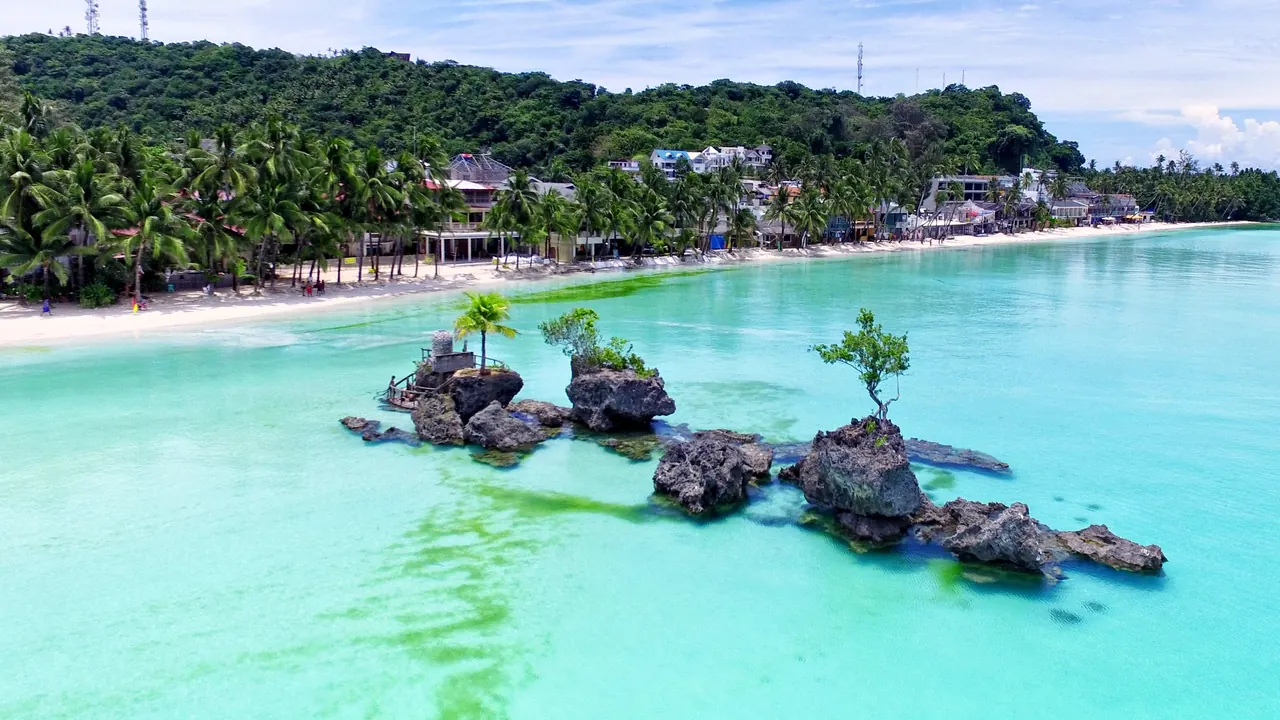
Photos: Boracay by Robert Anton Pimentel Aparente, CC BY-SA 4.0, cropped.
Boracay or Siargao?
Our verdict in twelve categories, each scored against the same fixed benchmark cities, and the climate month by month, so you can choose for your trip.
Choose Boracay for
- getting around
- nightlife
- families
Boracay is the easier choice for a classic beach vacation. Everything sits on one long strip of soft white sand, so your room, the water, the restaurants and the bars are all within a short walk, and the sea is calm and shallow through the dry months. It suits families with young children, couples who want massages and sunsets, and anyone who enjoys an evening out on the sand around Station 2.
Choose Siargao for
- nature and the outdoors
- day trips
- prices
Pick Siargao if you want to spend your days doing things in the water. The surf off General Luna, the Del Carmen mangroves, Sugba Lagoon and the boat trips out to the sandbars make for more active days. The trade-off is scooter rides on unlit roads and swims timed around the tide. It rewards surfers, teenagers and travellers who are happy on a looser, barefoot island.
Scoreboard
Twelve categories on one fixed scale from 0 to 100. The shaded stretch is the gap between the two.
Your match
Pick a travel style or drag the sliders, and both match scores follow your weighting.
Wins on getting around and nightlife with your weighting.
Wins on nature and the outdoors and day trips with your weighting.
What matters to you?
Category by category
What the scores mean for a trip.
Beaches & swimming
Both islands have white sand and warm, clear water, but on Boracay the best beach is the one you stay on. White Beach runs about 4km past the hotels and is softest at Station 1, and in the dry months you just walk into the sea. When the monsoon makes it rough, you swim from the sheltered beaches on the east side of the island instead.
Siargao's finest beaches need a boat. Naked Island, Daku and Guyam are lovely, but each visit is a day out. In front of General Luna the reef flat drains at low tide, so you plan swims around the water, although the Magpupungko rock pools make a good low-tide stop.
Food & drink
Neither island is a food destination, and the difference is one of style. Boracay's highlight is D'Talipapa, where you buy seafood at the market stalls and have it cooked in a small kitchen nearby. Its beachfront tables offer a wide but fairly similar international menu.
Siargao leans towards surfer cafés in General Luna, with smoothie bowls, good coffee and poke, alongside simple Filipino eateries. The dish to try there is kinilaw, raw fish cured in coconut vinegar.
Culture & sights
Neither island has museums or historic quarters, so a rainy day leaves little to do on either. What little there is differs a bit. Boracay has a couple of village chapels and an Ati community whose culture visitors barely see. Siargao has the Cloud 9 boardwalk and viewing tower, plain small-town churches and stilt-house fishing villages seen from a boat.
Nightlife
Boracay has the bigger night out. After sunset the bars in the busy middle of White Beach turn up the music, fire dancers perform on the sand and a few clubs stay open past midnight, especially in high season. Most of it is chart music on one stretch of beach, but there is plenty of it, and quieter lounges are a short walk away at either end.
Siargao's evenings are smaller and looser. Surfers and backpackers move between a few spots in General Luna, with a different party place each night: reggae, house and open-air dance floors under the palms. There are no proper clubs or cocktail bars, and getting home means a ride down dark roads.
Nature & outdoors
Siargao is the island for the outdoors. Surfing is the main draw, from the powerful reef break at Cloud 9 to beginner waves along the east coast. Beyond the surf there are the Del Carmen mangroves, the jade-green Sugba Lagoon, and the caves and jellyfish lakes of Sohoton Cove.
Boracay's nature is almost all on the water and on a smaller scale. There is kitesurfing on Bulabog's lagoon from about November to April, sunset sailing in a paraw, snorkelling, and dives on reefs close to shore. The view from Mount Luho is the only climb, and neither island has real hiking.
Day trips
Neither island is a base for exploring further afield, but Siargao has a little more to offer. A scooter loop through Pilar, Del Carmen and Burgos, plus boat trips to the outer islands, can fill a few days. From Boracay the choices are the fishing villages of Carabao Island, or Kalibo, a plain town about two hours away that is worth the trip mainly for its Ati-Atihan festival in January.
Good for families
Boracay is the easier island with small children. In the dry months White Beach slopes gently into shallow, warm water, many resorts have pools and family rooms, and the beach path keeps traffic away from the walk between hotel, food and sand. The main drawbacks are the long journey there and the noise around Station 2 at night.
Siargao suits older children better. Sandbar trips, rock pools and surf lessons are fun, but scooters on roads without pavements, swimming that depends on the tide and basic medical care make it harder going with toddlers.
Getting around
Reaching Boracay means a flight, a transfer and a boat, often most of a day, and Siargao needs a domestic flight or a ferry. The real difference comes once you arrive. On Boracay a sandy path along White Beach links most hotels, restaurants and bars on foot, and electric tricycles cover the longer trips to Puka or Bulabog.
On Siargao most people rent a scooter or hire a driver, because the places to see are spread out and the road to Cloud 9 is unlit and has no pavements. The lagoons and islands that matter most also need a boat.
Shopping & style
Shopping is an afterthought on both islands, and what differs is the kind of thing you can buy. Boracay has beachwear, shell jewellery and T-shirts along the path and in D'Mall behind Station 2, plus a few shops selling woven and pearl goods from elsewhere in the Philippines. General Luna's short strip on Siargao is better for surf gear, such as boards and rash guards, and has some linen and island-made jewellery.
Affordability
The two cost about the same. Both are pricier than most of the Philippines but still modest by Western standards. On Boracay the money goes on the beachfront hotels at the northern end, the Christmas to Easter peak and the transfers needed to reach the island, while guesthouses a few lanes back from the beach, market seafood and beach massages stay cheap.
On Siargao the international cafés and the boutique stays near Cloud 9 are the expensive part. Hostels, scooter hire and shared island-hopping tours keep a long surf stay affordable.
Live music & performing arts
Neither island has a theatre or concert hall, but Boracay does have an evening show. Acoustic and reggae cover bands play in the beach bars, and fire dancers perform on the sand around Station 2 after dark. On Siargao live music is occasional, perhaps an acoustic set or a DJ at a party, and there is nothing to plan an evening around.
Wellness & relaxation
Massage is cheap and easy to find on both islands, but Boracay has more polish. Therapists work along White Beach, and the larger resorts at the northern end and above Diniwid run full spas offering hilot, the traditional Filipino massage with warm oils and banana leaves. If you want quiet nights, stay away from Station 2.
On Siargao, rest comes from the slow pace rather than from the facilities. There are yoga shalas among the palms, small retreat stays and massage huts for after a day of surfing, but few spas beyond small resort treatment rooms. Neither island has hot springs.
When should you go?
Pick your month. The climate figures are measured averages, not a forecast.
Boracay in July
Siargao in July
Daytime high, °C
Rainfall in the month, mm
Where the figures come from
Boracay has no weather station within reach, so its figures come from a gridded climate model rather than a measured record, and read a broad area rather than one spot.
Siargao's temperatures are measured 72 km from the centre, at Surigao.
Siargao has no rain gauge within 25 km of the centre, so its rainfall comes from a gridded climate dataset read at the destination rather than from a gauge further away.
Temperature and rainfall are climate normals, averaged over the years shown. Boracay: 2001-2020 normals, NASA POWER reanalysis grid, no weather station within 90 km. Siargao: 1991-2020 normals, Surigao (71.9 km from centre).
The two islands have almost opposite wet seasons, so the calendar decides a lot. Boracay is at its best from January to April, when rain is light and White Beach is calm. From May the southwest monsoon brings heavy rain and waves to the main beach, with about 460mm in July, and it stays wet until late in the year. Siargao is the reverse. It is very wet from November to March, with close to 900mm in January, and settles from April to September, with August the driest month.
Heat does not separate them. Daytime highs stay between 27°C and 31°C all year on both, with Siargao a degree or two warmer, and the sea is warm enough for long swims in every month. For a trip between January and April choose Boracay. From June to September choose Siargao, which also gets the start of its big surf season in August.
Which traveller are you?
On a beach and sun trip, Boracay is the stronger pick. White Beach puts soft sand and calm, shallow water right outside the hotel through the dry season, while Siargao's finest sand lies on offshore sandbars that each take a boat trip to reach.
For an outdoors trip, Siargao wins clearly. There is surf for every level along the east coast, with Cloud 9 for experts, and you can paddle through the Del Carmen mangroves to Sugba Lagoon. Boracay offers mainly kitesurfing at Bulabog and snorkelling.
On a family trip with young children, choose Boracay and stay at one of the quieter ends of White Beach. Small children can paddle a few steps from the room all through the dry season. Keep Siargao for a later trip, when teenagers are ready to learn to surf.
Before you go
| Measure | Boracay | Siargao |
|---|---|---|
| Official language | English, Filipino, Taglish | English, Filipino, Taglish |
| Currency | Philippine Peso (PHP) | Philippine Peso (PHP) |
| Sockets | ABC220 V, 60 Hz | ABC220 V, 60 Hz |
| Driving side | Right | Right |
| Time zone | UTC+8 | UTC+8 |
| Emergency number | 911 | 911 |
| Main airport | Godofredo P. Ramos Airport (MPH)5 non-stop destinations | Siargao Airport (IAO)3 non-stop destinations |
| Public holidays this year | 18 days | 18 days |
By the numbers
| Measure | Boracay | Siargao |
|---|---|---|
| Population | 37,802 | 200,000 |
| People per km² | 3,670 | 481 |
| Swim season, months above 21 °C | 12 months | 12 months |
Where else could you go?
Every comparison below shares a destination with this one, so you can follow Boracay or Siargao somewhere new.
- Cebu Islandvs Siargao
- Boholvs Siargao
- El Nidovs Boracay
- Cebu Islandvs Boracay
- Boholvs Boracay
- Palawanvs Boracay