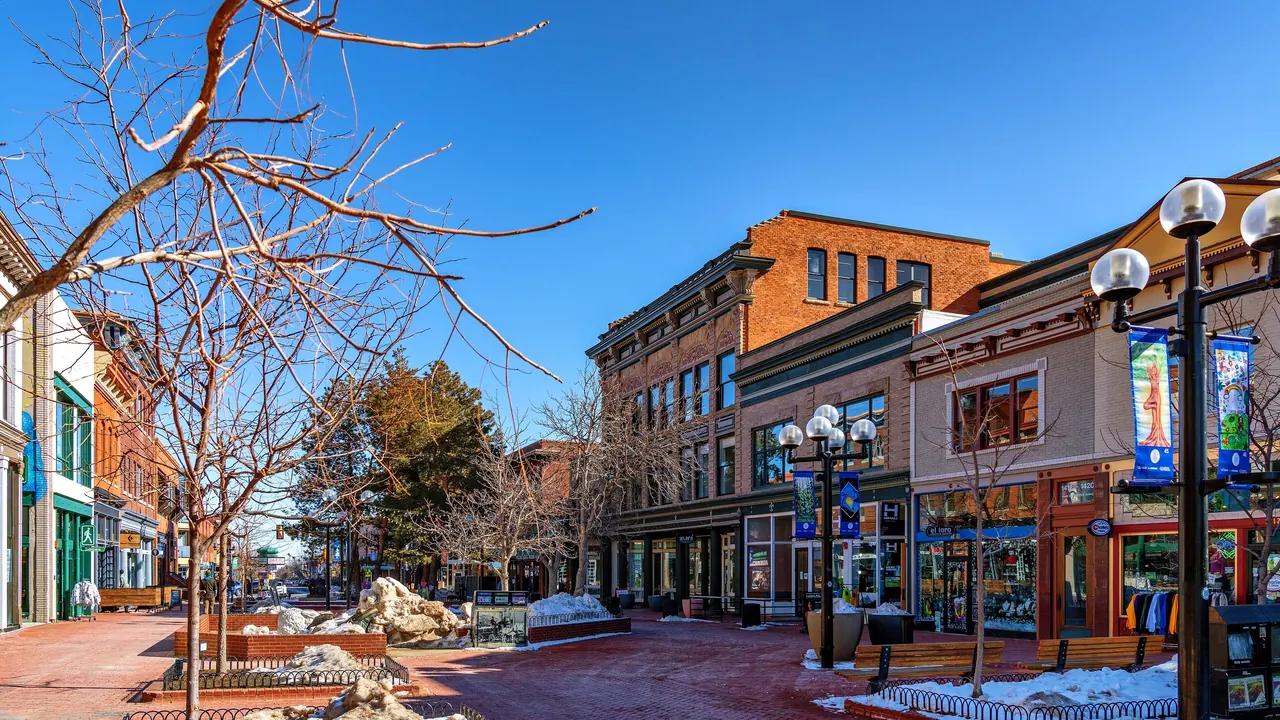
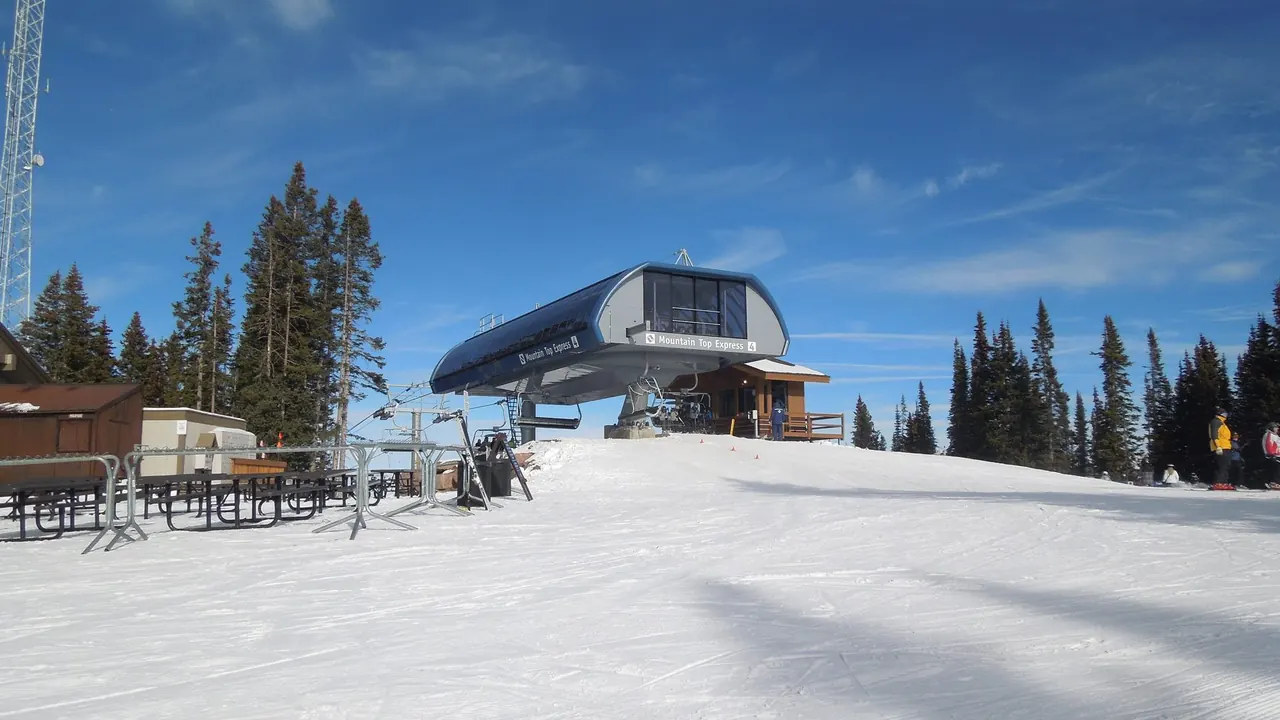
Photos: Boulder by Tony Webster, CC BY 2.0, cropped; Vail by DReifGalaxyM31, CC BY 3.0, cropped.
Boulder or Vail?
Our verdict in twelve categories, each scored against the same fixed benchmark cities, and the climate month by month, so you can choose for your trip.
Choose Boulder for
- prices
- culture and sights
- food and drink
Boulder suits travellers who want the mountains on the doorstep without giving up a real town. Trails start from Chautauqua, the Pearl Street Mall and the university give evenings and wet afternoons something to do, and Denver's museums and nightlife are a bus ride away. It is also the easier of the two on the wallet, and its winters are mild enough for walking around town.
Choose Vail for
- getting around
- nature and the outdoors
Vail is for a trip built around the mountain itself, above all a ski week. The lifts leave from the village, the Back Bowls and Blue Sky Basin give you a long winter of dry powder, and in summer the gondolas carry hikers and bikers to high trails while the music and dance festivals fill the amphitheatre. Expect to pay heavily for all this, and to find little to do away from the slopes.
Scoreboard
Twelve categories on one fixed scale from 0 to 100. The shaded stretch is the gap between the two.
Your match
Pick a travel style or drag the sliders, and both match scores follow your weighting.
Wins on prices and culture and sights with your weighting.
Wins on getting around and nature and the outdoors with your weighting.
What matters to you?
Category by category
What the scores mean for a trip.
Beaches & swimming
Neither town is anywhere near a beach, so this is not a reason to pick either. What differs is summer water. In Boulder you get the small sandy swim area at the reservoir and inner-tube floats down Boulder Creek, which make an easy afternoon. Vail's mountain lakes stay cold even in July, so swimming there mostly means a hotel pool.
Food & drink
Boulder eats better, and in a more relaxed way. Its strength is everyday food: farm-to-table menus, plenty of vegetarian cooking, good bakeries, the Saturday farmers' market by the creek, taprooms across the east side and lunch in the hand-carved Dushanbe Teahouse.
Vail's dining is polished resort fare, with steak, game, fondue and long hotel wine lists in Vail Village and Lionshead, plus mountain lodges for lunch. There is no cheap end, and many kitchens close in the quiet spring and autumn weeks. Food lovers in both towns go to Denver for real range.
Culture & sights
Neither is a sightseeing destination, but Boulder has at least a satisfying day. The Chautauqua cottages and auditorium below the Flatirons, the red-tiled university campus and Pei's atmospheric research laboratory on the mesa are all worth seeing, and there are a few small museums as well.
Vail was built in the 1960s, and its Tyrolean-style village is imitation rather than heritage. The Colorado Snowsports Museum, which tells the story of the Tenth Mountain Division, and the Betty Ford Alpine Gardens in summer fill an hour or two, and that is about all.
Nightlife
Boulder's evenings belong to taprooms and students, while Vail's belong to the end of the ski day. In Boulder that means brewery taprooms and cocktail bars around Pearl Street, loud bars on University Hill during term and an early finish. Denver is forty minutes away for anything bigger.
Vail comes alive as the lifts close, with crowded slopeside terraces in Vail Village and Lionshead and a few bars open past midnight on winter weekends. Summer nights are calm, and in the off-seasons the town is close to empty after dinner.
Nature & outdoors
Both are first-rate mountain bases, but for different things. Boulder's trails start at the edge of town among the Flatirons and the mesas, Eldorado Canyon is a famous climbing wall, cyclists train on the canyon roads, and Rocky Mountain National Park is about an hour away.
Vail sits higher, at about 2,500m, with a vast ski area, gondola-served summer trails, the Gore Range and Holy Cross wilderness areas, and fly fishing on Gore Creek. Choose Boulder for climbing, cycling and trail running, and Vail for skiing and high alpine hiking.
Day trips
The day trips from both are pleasant rather than remarkable, and both need a car for most of them. Boulder's advantage is Denver, reachable by express bus, along with Golden, Fort Collins and the old silver-mining towns of Georgetown and Idaho Springs.
From Vail, the outings are mostly other mountain towns: polished Beaver Creek, Breckenridge with its Victorian main street, the brick streets of Leadville, and Glenwood Springs down the canyon. Denver and Aspen are each about two hours' drive.
Good for families
Boulder is the summer family town and Vail the winter one, built around ski school. In Boulder, children have the creek path, the reservoir swim beach, tubing and the street performers on Pearl Street, plus a planetarium and natural history museum for indoor hours.
In Vail, the large ski schools, gentle children's terrain and car-free village make a ski week easy, and in summer the top of the gondola has ropes courses and a mountain coaster. The higher altitude and winter cold are harder on toddlers, and outside the mountain there is little made for children.
Getting around
Vail is the easier place to manage without a car once you are there. The village is pedestrian, the lifts start from town and a free bus runs the length of the valley, so a whole ski week can pass without driving. Getting there is the hard part: there is no passenger rail, and the pass can close in heavy snow.
Boulder is easy on foot and by bike within town, thanks to its off-street paths along the creek, bike share stations and an express bus to Denver. However, the trailheads outside town, Eldorado Canyon and the national park are hard to reach without hiring a car.
Shopping & style
Neither town is a shopping destination, and serious shoppers in both head to Denver. Boulder's Pearl Street Mall has independent bookshops, galleries and toy shops, and its climbing, running and cycling stores are unusually good. Vail's lanes are more upmarket, with ski clothing, fur and leather, jewellery, Western boots and mountain art, so they suit a luxury souvenir better than a casual browse.
Affordability
Neither is cheap, but Boulder is far easier on a budget. Rooms and meals cost a lot, but the trails are free, the buses are reasonably priced and staying in Denver is an easy way to save.
Vail is in another bracket entirely. Lift tickets, ski school, equipment hire and slopeside rooms all add up, and peak winter weeks push prices higher still. Summer and off-season rates and lodging further down the valley help only a little.
Live music & performing arts
The difference here is one of rhythm more than quality. In Boulder, downtown rooms book touring rock, bluegrass and roots acts most nights, the Colorado Music Festival fills the wooden Chautauqua Auditorium in summer and there is outdoor Shakespeare on campus. Red Rocks Amphitheatre is under an hour's drive.
Vail puts nearly everything into one grand summer. Orchestras take up residence for Bravo! Vail and leading dancers arrive for the Vail Dance Festival. Both festivals play the open-air Gerald R. Ford Amphitheater with the mountains behind the stage, and jazz follows in late summer. In winter the offer shrinks to après-ski bands.
Wellness & relaxation
Neither town has a bathing tradition, and anyone who wants a proper soak drives about an hour: from Boulder to the hot springs at Idaho Springs, or from Vail to the mineral pools and vapour caves of Glenwood Springs. The difference is in style. Boulder's wellness is yoga, meditation and a contemplative streak rooted in its Buddhist-inspired university, while Vail's is the resort spa, with massage after skiing and hot tubs beneath the peaks.
When should you go?
Pick your month. The climate figures are measured averages, not a forecast.
Boulder in July
Vail in July
Daytime high, °C
Rainfall in the month, mm
Where the figures come from
Boulder has no rain gauge within 25 km of the centre, so its rainfall comes from a gridded climate dataset read at the city rather than from a gauge further away.
Vail's temperatures are measured 47 km from the centre, at Kremmling.
Vail's station stands 186 m below the city centre, so the centre is likely a little cooler than the figures say.
Vail has no rain gauge within 25 km of the centre, so its rainfall comes from a gridded climate dataset read at the city rather than from a gauge further away.
Temperature and rainfall are climate normals, averaged over the years shown. Boulder: 2010-2025 (rainfall 1991-2020) normals, Boulder / Valmont (6.1 km from centre). Vail: 2006-2025 (rainfall 1991-2020) normals, Kremmling (46.5 km from centre).
Winter is where the two differ most. Boulder sits lower and stays fairly mild, with January highs of around 7°C and little rain, so the town and the lower trails are fine for walking. Vail's January hovers near -4°C, which is exactly what its skiing needs. Spring is Boulder's wettest season, peaking at 61mm in May. In Vail, rain and snow fall fairly evenly through the year, and April is still cool at the higher altitude.
Summer is warm in both. Boulder reaches about 31°C in July, hot enough that hikes are best started early, and Vail stays a few degrees cooler. Neither town has warm water for swimming. September is the best month in both places, with comfortable days and the aspens turning gold. By November, Vail is cold again while Boulder is still pleasant for a walk.
Which traveller are you?
On a culture and arts trip, Boulder is clearly the better base. The 1898 Chautauqua, the sandstone university campus and the I.M. Pei laboratory fill a day, Denver's art museum is a bus ride away, and summer adds music and outdoor Shakespeare.
On a trip on a tight budget, Boulder is easy to fill cheaply: tubing down the creek, the free weather exhibits at the atmospheric research centre, the Saturday market and the street performers on Pearl Street. In Vail, skiing is the main event and also the biggest expense.
For a ski trip, Vail is the clear choice. It has a vast ski area with groomed front-side runs for easier days, large ski schools for beginners and children, and a free valley bus to the slopes. From Boulder, the nearest skiing is Eldora, up the canyon, and the bigger resorts mean a long drive west.
Before you go
| Measure | Boulder | Vail |
|---|---|---|
| Currency | US Dollar (USD) | US Dollar (USD) |
| Sockets | AB120 V, 60 Hz | AB120 V, 60 Hz |
| Driving side | Right | Right |
| Time zone | UTC-7, UTC-6 in summer | UTC-7, UTC-6 in summer |
| Emergency number | 911 | 911 |
| Elevation | 1,655 m | 2,445 m |
| Main airport | Denver International Airport (DEN)56 km from centre231 non-stop destinations | Eagle County Regional Airport (EGE)48 km from centre16 non-stop destinations |
| Public holidays this year | 12 days | 12 days |
By the numbers
| Measure | Boulder | Vail |
|---|---|---|
| City population | 108,250 | 4,835 |
| People per km² | 1,628 | 400 |
| Museums within 10 km | 4 | 1 |
| UNESCO World Heritage sites within 50 km | 0 | 0 |
Where else could you go?
Every comparison below shares a destination with this one, so you can follow Boulder or Vail somewhere new.