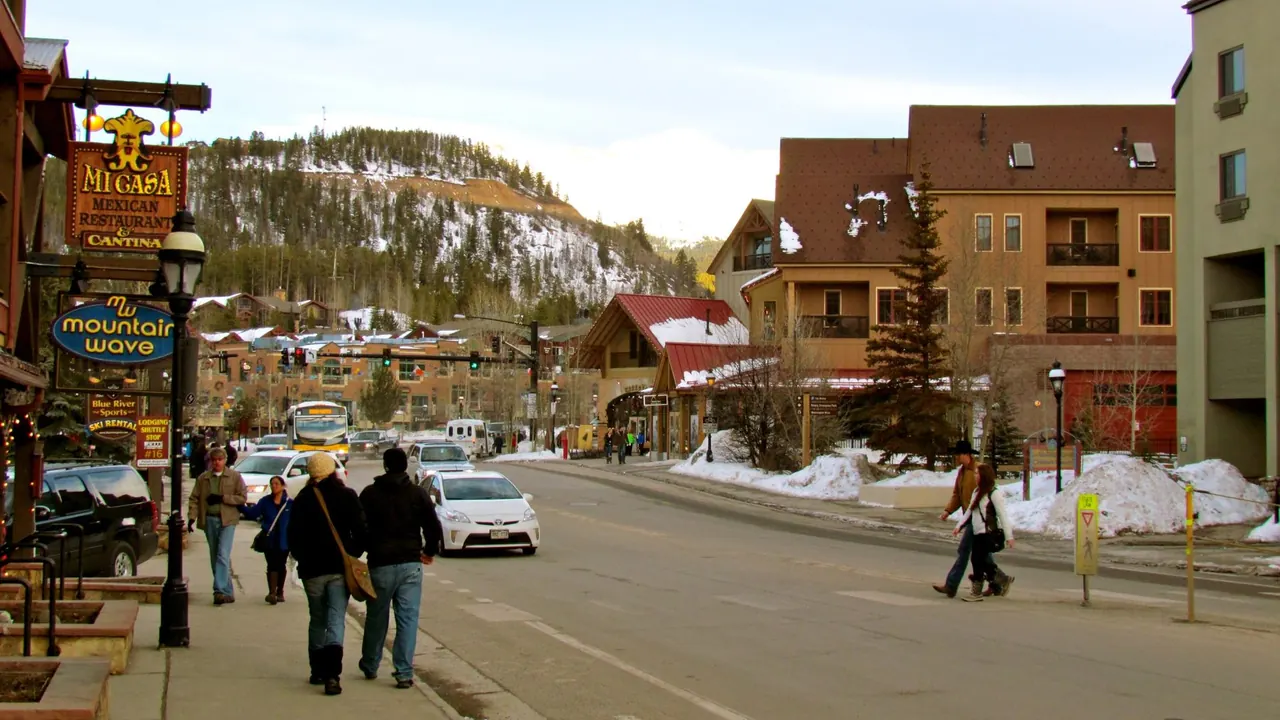
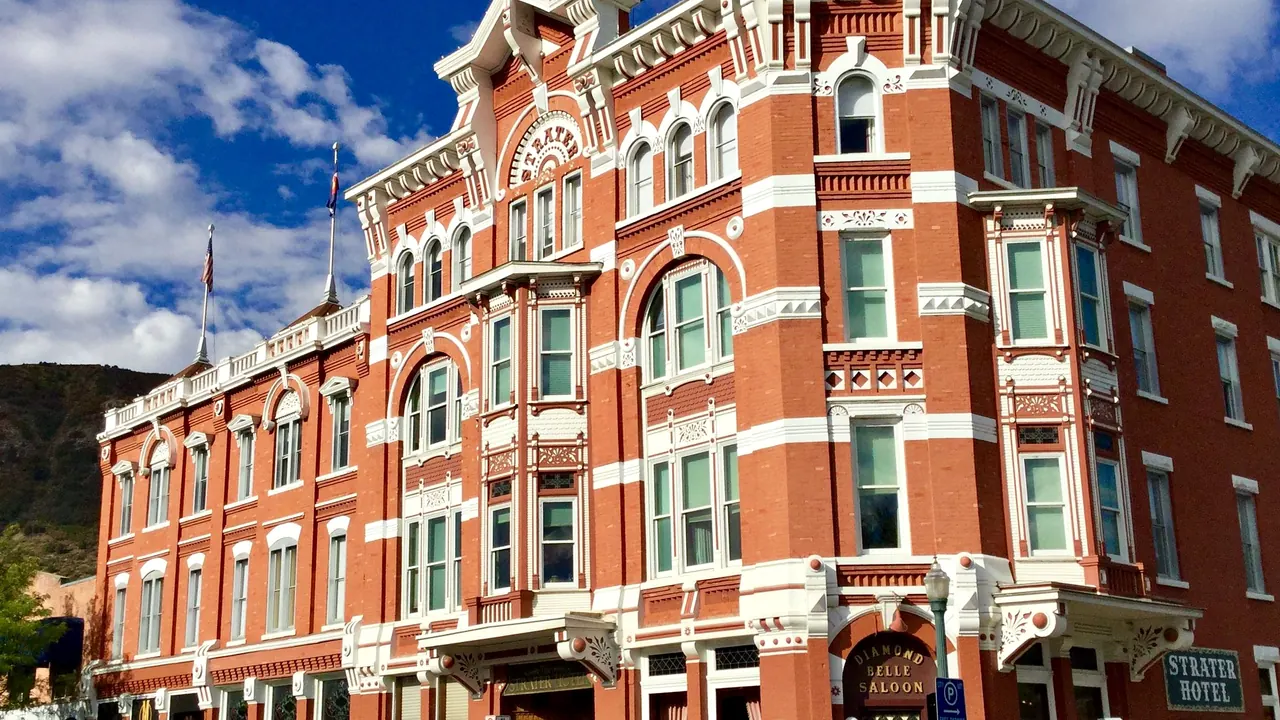
Photos: Breckenridge by Jeff Gunn, CC BY 2.0, cropped; Durango, Colorado by Adeledstarr, CC BY-SA 4.0, cropped.
Breckenridge or Durango, Colorado?
Our verdict in twelve categories, each scored against the same fixed benchmark cities, and the climate month by month, so you can choose for your trip.
Choose Breckenridge for
- getting around
- nightlife
- families
Breckenridge suits travellers who want the mountain on their doorstep and no need for a car. Skiers can ride the free gondola from Main Street to the lifts, the free buses reach the neighbouring resorts, and the après-ski evenings are livelier than anything Durango offers. In return you pay full ski-resort costs and sleep at almost 3,000m, which some visitors feel for the first day or two.
Choose Durango, Colorado for
- prices
- wellness
- day trips
Durango is the better base for a road trip that mixes the outdoors with history. Mountain biking and rafting start in town, Mesa Verde's cliff dwellings and the steam train to Silverton are within a day's reach, and there are natural hot springs to soak in afterwards. It costs noticeably less, sits lower and warmer, and is calmer in the evening. You will need a hire car to make the most of it.
Scoreboard
Twelve categories on one fixed scale from 0 to 100. The shaded stretch is the gap between the two.
Your match
Pick a travel style or drag the sliders, and both match scores follow your weighting.
Wins on getting around and nightlife with your weighting.
Wins on prices and wellness with your weighting.
What matters to you?
Category by category
What the scores mean for a trip.
Beaches & swimming
Neither town is anywhere near a coast, but Durango offers a little more for a summer swim. Lake Nighthorse has a proper swimming area, Vallecito Lake has a few sandy edges, and on hot afternoons people float the Animas through town on inner tubes. The warmer summers make all of this more inviting.
In Breckenridge, Lake Dillon is for sailing and paddling rather than swimming, and the snowmelt lakes are too cold for most people. A swim here usually means the recreation centre pool or a hotel hot tub.
Food & drink
Breckenridge has the wider spread on paper, with sushi, wood-fired pizza, Mexican kitchens and dishes of elk or bison, plus beer and whiskey made in town. But the cooking is built to feed hungry skiers, tables are hard to get in the peak vacation weeks, and some kitchens close between seasons.
Durango eats a little better and feels more rooted in its region. Green-chile Southwestern plates, kitchens using produce from local farms and an unusual number of breweries for a town its size give Main Avenue a character of its own, even if the range stays narrow.
Culture & sights
Breckenridge's appeal lies in its streets rather than its sights. The gold-rush district is among the largest in Colorado, with rows of painted Victorian shopfronts and false-fronted cabins, and a mine tour with gold panning adds an hour of hands-on history. A slow walk around it fills an afternoon, and there is no serious museum or gallery to move on to.
Durango gives a visitor interested in culture rather more. Its railway heritage is still in use, so rather than looking at relics you see steam engines up close in the yard and watch them pull out of town. The college above town adds real depth with its Native American and Southwestern holdings, which explain the Puebloan country around Durango in a way Breckenridge's mining story never needs to.
Nightlife
Breckenridge is where the evenings have some energy. Après-ski starts at the base of the lifts, Main Street's saloons and brewpubs fill up, and on a winter Saturday a couple of dance bars stay open past midnight. Off-season it goes quiet.
Durango keeps it low-key, with taproom patios, an old saloon with a piano player, and a few busy student bars at weekends. There is hardly any dancing, and most places close well before midnight.
Nature & outdoors
Both are excellent mountain bases, but the experience is different. Breckenridge is a skier's town first, with five peaks of lift-served terrain directly above the streets, several more resorts nearby, and Quandary Peak and wildflower trails for summer.
Durango is better for biking, paddling and backcountry. Singletrack leaves from town, rafters run the Animas through the centre, the Colorado Trail starts just north, and the Weminuche Wilderness rises behind. Its ski area is about half an hour away, and the town sits about 1,000m lower, which makes the first days easier.
Day trips
Durango is clearly better for day trips. Mesa Verde's cliff dwellings, the narrow-gauge steam train up the Animas canyon to Silverton, the pueblo ruins at Aztec and Chimney Rock, and Ouray under its cliffs make up a week of outings that you can't find anywhere else. Almost all of them need a car.
From Breckenridge, the best outings are Leadville's silver-boom streets and mining museum, and Georgetown's old railway. After that the choices are mostly other ski resorts or a long drive to Denver.
Good for families
Both work for active families, but in different ways. Breckenridge is the stronger ski-school vacation. Children can start young, the free gondola cuts out the drive to the slopes, and in summer the mountain becomes an activity park with an alpine coaster and climbing walls. The altitude is the main concern with small children.
Durango is better for a summer of mixed adventures, with the steam train, gentle tubing on the river and the ladders at Mesa Verde. The lower altitude is kinder to children, though rainy days have few backups and long drives are part of the deal.
Getting around
Breckenridge is much easier without a car. The compact centre is walkable, the free gondola and town buses cover lodging and trailheads, and free county buses reach Frisco, Keystone and Copper Mountain. The weak point is getting there, about two hours by road from Denver's airport.
Durango's centre is just as easy on foot, with a riverside trail and a trolley along the main road. Once you leave it, though, the trailheads, ski area and Mesa Verde are spread along highways that are poorly served by buses, so most visitors rent a car.
Shopping & style
Both offer an hour or two on one main street rather than real shopping, with outdoor gear, galleries and sweet shops in each. What differs is the specialities. Durango has Navajo and Pueblo silver, turquoise, rugs and Western boots. Breckenridge leans towards ski and technical clothing and Western landscape art, and the Silverthorne outlets are a short drive away if you want more.
Affordability
Durango is easier on the budget. Rooms and meals still cost what they do in a US mountain town, and you will probably need a hire car, but it costs far less than the big ski resorts, and spring and late autumn bring prices down further.
Breckenridge in ski season costs about as much as anywhere in the country, especially in the Christmas and spring-break weeks. Staying in Frisco or Silverthorne helps, and the free buses and gondola save on transport. Summer is the cheaper time to go.
Live music & performing arts
Both are small summer scenes, but in different styles. Breckenridge leans towards classical music, with a festival orchestra and a national academy of young professionals playing at the open-sided Riverwalk Center. A local theatre company stages plays for much of the year.
Durango's summer festival also brings chamber music, but its distinctive extras are lighter Western fare: a Victorian melodrama where the audience boos the villain, and cowboy music shows with a chuckwagon supper.
Wellness & relaxation
Durango is the more restful place. Spring-fed mineral pools sit a few minutes north of town, the terraced pools at Pagosa Springs and Ouray's hot springs are within reach, and the pace of the town is slow.
In Breckenridge, relaxing mostly means an outdoor hot tub in the snow or a resort spa massage. The nearest natural springs are an hour away, and full days at almost 3,000m often leave visitors tired rather than rested.
When should you go?
Pick your month. The climate figures are measured averages, not a forecast.
Breckenridge in July
Durango, Colorado in July
Daytime high, °C
Rainfall in the month, mm
Where the figures come from
Breckenridge's temperatures are measured 38 km from the centre, at Leadville / Stringtown.
Breckenridge has no rain gauge within 25 km of the centre, so its rainfall comes from a gridded climate dataset read at the city rather than from a gauge further away.
Durango, Colorado has no weather station within reach, so its figures come from a gridded climate model rather than a measured record, and read a broad area rather than the city itself.
Temperature and rainfall are climate normals, averaged over the years shown. Breckenridge: 2006-2020 (rainfall 1991-2020) normals, Leadville / Stringtown (37.7 km from centre). Durango, Colorado: 1991-2020 normals, TerraClimate 4 km grid at the town, no weather station within 90 km.
Breckenridge is a true high-mountain climate. From December to February daytime highs stay around -2°C, which is what keeps the snow dry and deep for skiing. Summer is short. July and August bring highs of about 21°C, ideal for hiking and biking, but late-summer afternoons are the wettest part of a year that is otherwise fairly even. Spring and October are cold and muddy, the quietest time to come.
Durango is warmer in every month. Winter afternoons in town sit a few degrees above freezing, while the ski area to the north holds the snow. Summer gets hot, with highs near 30°C in July, so midday is better spent on the river than on the pavement. June is the driest month at about 12mm, and rain builds in August to around 48mm, often as afternoon storms. May, September and early October are mild and comfortable for walking and riding, which makes the long shoulder seasons Durango's strongest time compared with Breckenridge.
Which traveller are you?
For a short city break, Breckenridge is the easier choice. You can arrive, park the car and stay on foot, by free gondola and by bus. Its brewpubs and après bars also give the evenings more life than Durango's.
For a culture and arts trip, choose Durango. It has a working steam railway and roundhouse museum, the college's Native American collection and the cliff dwellings of Mesa Verde within a day's drive. Breckenridge's pretty gold-rush streets cannot match that.
On a relaxing and wellness trip, Durango is calmer. Its mineral pools are simply good places for a long soak, and the town keeps an easy rhythm, with quiet riverside mornings, mild spring and autumn afternoons and evenings that end early.
Before you go
| Measure | Breckenridge | Durango, Colorado |
|---|---|---|
| Currency | US Dollar (USD) | US Dollar (USD) |
| Sockets | AB120 V, 60 Hz | AB120 V, 60 Hz |
| Driving side | Right | Right |
| Time zone | UTC-7, UTC-6 in summer | UTC-7, UTC-6 in summer |
| Emergency number | 911 | 911 |
| Elevation | 2,926 m | 1,988 m |
| Main airport | Denver International Airport (DEN)124 km from centre231 non-stop destinations | Durango La Plata County Airport (DRO)18 km from centre4 non-stop destinations |
| Public holidays this year | 12 days | 12 days |
By the numbers
| Measure | Breckenridge | Durango, Colorado |
|---|---|---|
| City population | 5,078 | 19,071 |
| People per km² | 332 | 739 |
| Museums within 10 km | 0 | 2 |
| UNESCO World Heritage sites within 50 km | 0 | 1 |
Where else could you go?
Every comparison below shares a destination with this one, so you can follow Breckenridge or Durango, Colorado somewhere new.
- Copper Mountainvs Breckenridge
- Keystonevs Breckenridge
- Vailvs Breckenridge
- Beaver Creekvs Breckenridge
- Winter Park, Coloradovs Breckenridge
- Telluridevs Durango, Colorado