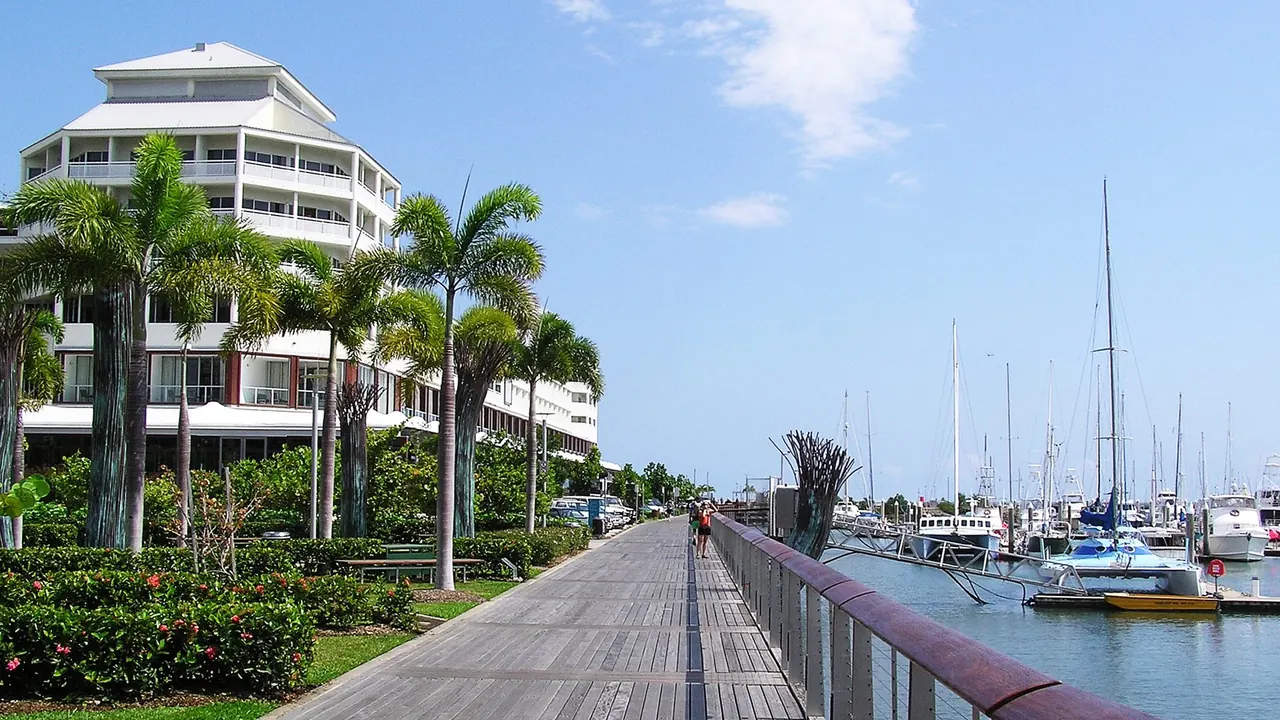
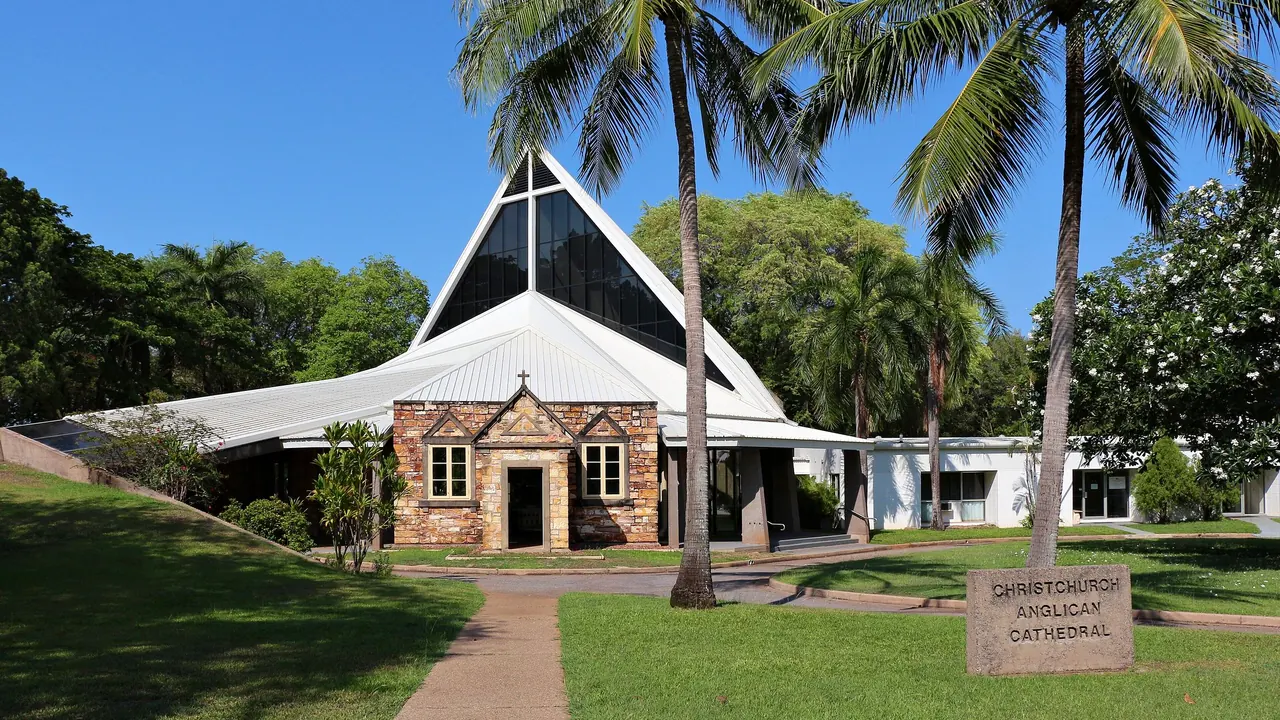
Photos: Cairns by Donaldytong, Public domain; Darwin by Bernard Gagnon, CC BY-SA 4.0, cropped.
Cairns or Darwin?
Our verdict in twelve categories, each scored against the same fixed benchmark cities, and the climate month by month, so you can choose for your trip.
Choose Cairns for
- beaches
- day trips
- nature and the outdoors
Choose Cairns if the trip is about the outdoors at its richest: the Great Barrier Reef by day boat and the Wet Tropics rainforest on the ranges behind town. It also has proper swimming beaches to the north, Kuranda and Port Douglas within easy reach, and a slower resort strip at Palm Cove. That makes it the easier choice for families, for swimmers and for anyone who wants to unwind.
Choose Darwin for
- culture and sights
- live music and the arts
- food and drink
Darwin suits a traveller drawn to frontier Australia rather than the reef. It offers crocodile country on the Adelaide and Mary rivers, the waterfalls of Litchfield, and a city whose story of the 1942 bombing and Cyclone Tracy is well told in its museum and wartime tunnels. Its Asian-flavoured markets are a real pleasure, but the sea is for looking at, and you will need a car or tours for almost everything.
Scoreboard
Twelve categories on one fixed scale from 0 to 100. The shaded stretch is the gap between the two.
Your match
Pick a travel style or drag the sliders, and both match scores follow your weighting.
Wins on beaches and day trips with your weighting.
Wins on culture and sights and live music and the arts with your weighting.
What matters to you?
Category by category
What the scores mean for a trip.
Beaches & swimming
Neither city has swimming straight off its town waterfront, but Cairns comes much closer to a beach vacation. Its northern beaches, from Trinity Beach to Palm Cove, are palm-backed sandy coves with patrolled stinger nets, and Green and Fitzroy islands have coral-sand swimming about an hour offshore.
Darwin's beaches at Mindil, Casuarina and East Point are lovely at sunset, but locals stay out of the sea all year because of crocodiles as well as jellyfish. Swimming there means the netted Waterfront lagoon and wave pool, or the waterholes of Litchfield.
Food & drink
Neither city is a place for serious eating, and they are about even, but the flavour differs. Cairns relies on what grows and is caught nearby: coral trout, mud crab, coffee and cheese from the Tablelands, and the tropical fruit piled up at Rusty's Markets.
Darwin's food looks north to Asia, and its best meals are eaten at the markets: laksa at Parap on a Saturday, or Indonesian and Sri Lankan dishes on the sand at Mindil in the dry season.
Culture & sights
Darwin has more to see, mainly because its history is so particular. The Museum and Art Gallery at Fannie Bay pairs strong Aboriginal art with the Cyclone Tracy gallery, and the wartime oil tunnels and the gun emplacements at East Point bring the 1942 bombing close.
Cairns has a regional art gallery with fine Torres Strait Island work, a small museum on its gold and sugar past and a few Queenslander houses. Most visitors see it all in a day.
Nightlife
Both towns go out in much the same way, around a backpacker strip of big pub-style bars, and there is little to choose between them. The blocks around Shields Street in Cairns draw dive crews and hostel crowds and have a couple of clubs open until the early hours, though many visitors go to bed early because the reef boats leave in the morning.
Darwin's Mitchell Street has a similar mood. It fills at weekends and in the dry season, and beyond it there is hardly any club scene. The quieter choice is a sunset drink at the sailing club or on the waterfront.
Nature & outdoors
Both cities are gateways to wild country, but Cairns has much more on offer. Two World Heritage areas meet there. Day boats reach the coral of Moore and Norman reefs, and on land Barron Gorge, the crater lakes of the Tablelands and the Daintree at Cape Tribulation are all within reach.
Darwin's outdoors is drier and more about watching wildlife: Litchfield's waterfalls and termite mounds, crocodile cruises on the Adelaide River and the birdlife of the wetlands. There is no reef to snorkel, and Kakadu needs an overnight trip.
Day trips
Cairns has the better range of outings, even if none of them is grand. Going up to Kuranda on the Scenic Railway and coming back by cableway makes a classic day, and Port Douglas, Paronella Park and the Tablelands villages add variety.
From Darwin, nearly every outing goes into a national park. The only towns within reach are Adelaide River, with its war cemetery, and Batchelor. The Tiwi Islands and their art centres are the one outing with a cultural focus.
Good for families
Cairns is the more rewarding place with children. The lifeguarded Esplanade Lagoon is right in town, and small children can see the reef from the glass-bottomed boats at Green Island and the underwater observatories on the outer pontoons.
Darwin has its own hits, especially seeing crocodiles up close, the jumping-crocodile cruises and the Waterfront wave pool. But the heat never lets up, the sea is off limits and most outings need a car.
Getting around
Both centres are compact, but Cairns is easier for a visitor overall. Its hotels, the Esplanade and the reef terminal are a short flat walk apart, and most reef and rainforest tours collect you from your accommodation, so you can manage without a car for much of a stay.
In Darwin, the midday heat makes even short walks heavy going. Buses to Mindil and East Point are infrequent and none go to the national parks, so a hire car or tours are close to essential.
Shopping & style
The Aboriginal art for sale in the two cities comes from different country. Cairns galleries sell paintings, prints and carvings from Cape York and the Torres Strait, and the craft markets at Kuranda and Port Douglas add handmade jewellery, wood and leather. Rusty's Markets is the place for local honey, coffee and fruit products to take home.
Darwin's galleries draw on Arnhem Land, the Tiwi Islands and the desert communities, with bark paintings and weavings among the work, and those linked to community art centres make sure the artists benefit. Beyond the art, the Mindil and Parap markets cover crafts and souvenirs, and the fashion offer is no better than in Cairns.
Affordability
Both are expensive, though Cairns is a little easier on the wallet because it has plenty of hostels and apartment hotels. In each city most of the money goes on getting out of town: reef boats, dives and the Kuranda train in Cairns, car hire and park tours in Darwin.
The ways to save differ. In Cairns the lagoon and the waterfront are free. In Darwin the main museum is free, the markets are a cheap way to eat well, and rooms cost noticeably less in the wet season.
Live music & performing arts
Cairns has a small programme spread across the year, while Darwin puts most of its energy into one event, the Darwin Festival each August. Cairns offers touring shows at its Performing Arts Centre, open-air evenings at Munro Martin Parklands in the dry season, gigs inside the old wartime fuel tanks of Tanks Arts Centre, and Indigenous dance at its cultural centres.
During the festival, Darwin has the stronger offer, with theatre, music, comedy and Aboriginal performance on outdoor stages across the city. The rest of the year it is no busier than Cairns, with touring acts at the Entertainment Centre and local theatre in the stone hall of Brown's Mart.
Wellness & relaxation
Cairns is the easier place to slow down, largely because of Palm Cove, where the resort day spas under the melaleuca trees use native botanicals. Port Douglas has more of the same, and a dusk walk along the Esplanade boardwalk helps too.
Darwin has a few hotel spas and the unhurried sunset gathering on the foreshore, and its best soak is the spring-fed pools at Berry Springs. For much of the year, though, its humidity is more tiring than restful.
When should you go?
Pick your month. The climate figures are measured averages, not a forecast.
Cairns in July
Darwin in July
Daytime high, °C
Rainfall in the month, mm
Where the figures come from
Cairns's temperatures are measured 27 km from the centre, at Green Island Aws.
Cairns has no rain gauge within 25 km of the centre, so its rainfall comes from a gridded climate dataset read at the city rather than from a gauge further away.
Temperature and rainfall are climate normals, averaged over the years shown. Cairns: 1993-2010 (rainfall 1991-2020) normals, Green Island Aws (27 km from centre). Darwin: 1991-2020 normals, Darwin Airport (7.7 km from centre).
Cairns is at its best from June to October. Rain is light then, and daytime highs drop to around 24°C in July, which is comfortable for walking while the sea stays warm enough to swim. The wet season from January to April is heavy, with close to 548mm falling in February, and from about November to May sea swimming is done inside stinger nets.
Darwin is hot all year. Highs rarely fall below 31°C and reach 34°C in October and November, so it is best to walk the streets in the morning or evening. Its seasons are more extreme than Cairns's. From May to September there is almost no rain and the days are long and sunny, while January brings about 470mm. For a milder, cooler trip, Cairns in winter is the better choice. Darwin's dry season is almost rainless, but it is never cool.
Which traveller are you?
On a beach and sun trip, Cairns is the clear choice. Its northern beaches have patrolled stinger nets and real sea swimming, and Green Island adds coral sand offshore. In Darwin people stay out of the sea all year, so swimming means a lagoon or pool.
For a culture and arts trip, Darwin has the edge, though neither city has a great deal. The Aboriginal art and Cyclone Tracy gallery at the Fannie Bay museum, the wartime tunnels and the August festival offer more than Cairns, where the sights take about a day.
On a relaxing and wellness trip, Cairns wins again. Palm Cove's resort spas and the quiet northern beaches make an easy base for doing very little. In Darwin, the heat and humidity of much of the year make rest harder work.
Before you go
| Measure | Cairns | Darwin |
|---|---|---|
| Official language | English | English |
| Currency | Australian Dollar (AUD) | Australian Dollar (AUD) |
| Sockets | I230 V, 50 Hz | I230 V, 50 Hz |
| Driving side | Left | Left |
| Time zone | UTC+10 | UTC+9:30 |
| Emergency number | 000 | 000 |
| Elevation | 7 m | 0 m |
| Main airport | Cairns International Airport (CNS)6 km from centre32 non-stop destinations | Darwin International Airport / RAAF Darwin (DRW)5 km from centre20 non-stop destinations |
| Public holidays this year | 11 days | 12 days |
By the numbers
| Measure | Cairns | Darwin |
|---|---|---|
| City population | 146,778 | 139,902 |
| People per km² | 301 | 3,446 |
| Museums within 10 km | 1 | 6 |
| UNESCO World Heritage sites within 50 km | 1 | 0 |
| Swim season, months above 21 °C | 12 months | 12 months |
Where else could you go?
Every comparison below shares a destination with this one, so you can follow Cairns or Darwin somewhere new.
- Port Douglasvs Cairns
- Noosavs Cairns
- Gold Coastvs Cairns
- Byron Bayvs Cairns
- Port Douglasvs Darwin
- Ubudvs Darwin