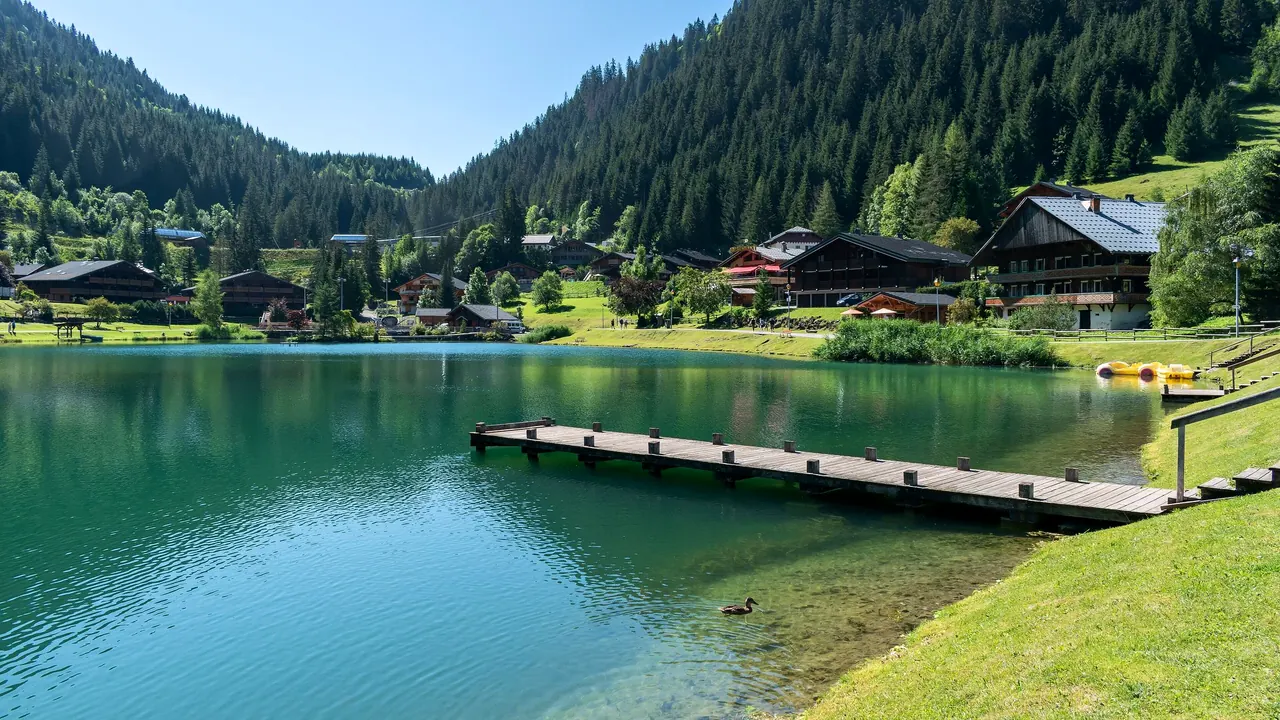
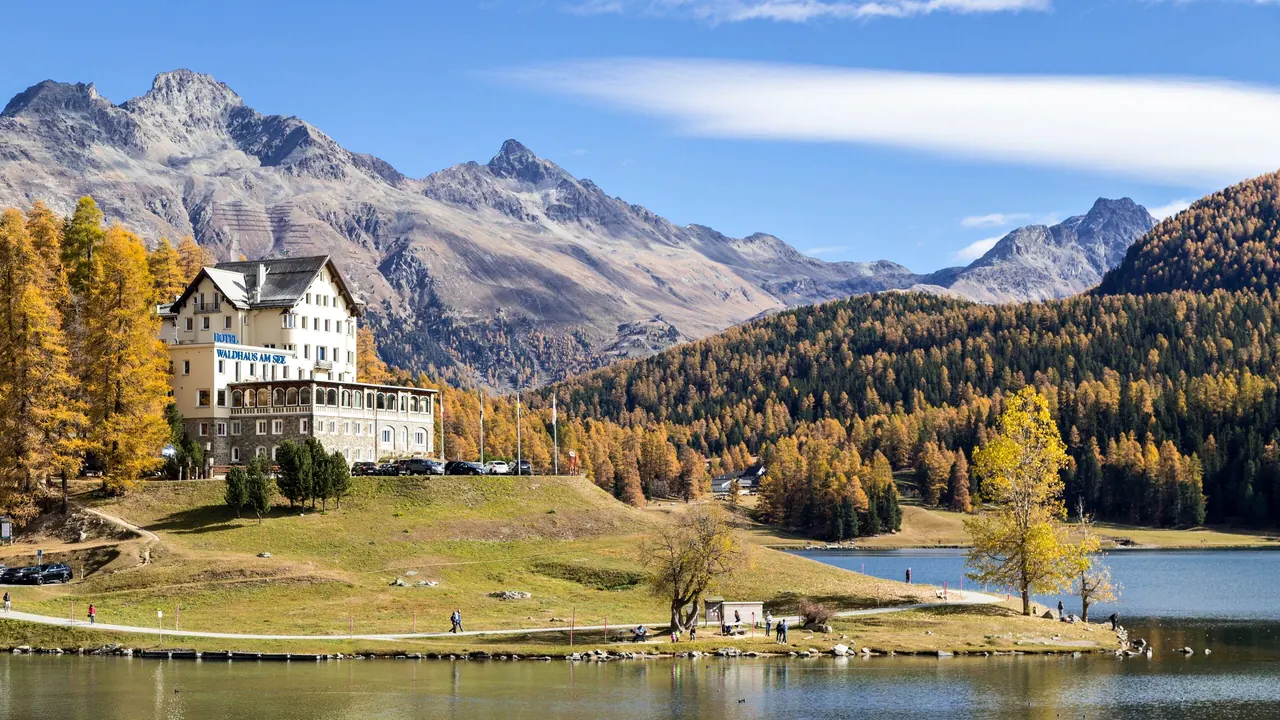
Photos: Châtel by Krzysztof Golik, CC BY-SA 4.0, cropped; St. Moritz by JoachimKohler-HB, CC BY-SA 4.0, cropped.
Châtel or St. Moritz?
Our verdict in twelve categories, each scored against the same fixed benchmark cities, and the climate month by month, so you can choose for your trip.
Choose Châtel for
- prices
- families
- day trips
Châtel is the better pick for families and for anyone watching what a mountain trip costs. It is a working village resort with ski schools, easy summer activities and self-catering chalets, and it opens straight onto the Portes du Soleil. With a car, Lake Geneva and its old towns are within an easy drive. It suits people who want long active days and simple evenings over fondue, without luxury pricing.
Choose St. Moritz for
- getting around
- shopping
- live music and the arts
St. Moritz is for travellers who want the grand Alpine resort and can pay for it. The Upper Engadine has the more striking high scenery, a railway and bus network that makes a car unnecessary, elaborate hotel spas, serious restaurants and a street of luxury boutiques. It is expensive and adult in feel, and it rewards couples and well-off skiers more than budget-minded families.
Scoreboard
Twelve categories on one fixed scale from 0 to 100. The shaded stretch is the gap between the two.
Your match
Pick a travel style or drag the sliders, and both match scores follow your weighting.
Wins on prices and families with your weighting.
Wins on getting around and shopping with your weighting.
What matters to you?
Category by category
What the scores mean for a trip.
Beaches & swimming
Neither is a swimming destination, but Châtel gives you the easier water. Its aquatic centre has outdoor pools, and the pebbly lidos and lawns of Évian and Thonon on Lake Geneva are under an hour's drive away.
St. Moritz is left with glacier-fed lakes. Lej da Staz is the only one warm enough for a brief swim in high summer, so most people use the indoor pool or a hotel pool.
Food & drink
St. Moritz eats better, mainly at the top end. Its grand hotels and mountain terraces at Corviglia and Muottas Muragl hold far more ambitious kitchens than a town this small would suggest. Local Engadine dishes such as capuns, pizzoccheri and nut tart from the old confectioners give it a distinct regional flavour too.
Châtel keeps to Savoyard comfort food: fondue, raclette and tartiflette in chalet restaurants. Its real treat is Abondance cheese, bought straight from the farms where it is made. In both places the choice thins and kitchens close out of season.
Culture & sights
St. Moritz has a little more to see. The Segantini Museum and its Alpine triptych are worth a real visit, the Engadin Museum shows painted farmhouse rooms, and the town's Olympic and Cresta Run history is part of the experience.
Châtel's sights come down to old wooden farmhouses, the parish church and the smuggling stories told at La Vieille Douane. That fills an hour. In both places, culture is a side trip rather than the reason to go.
Nightlife
Both places go to bed early, but St. Moritz has more going on in high winter. Its grand hotel bars, champagne on the terraces and a couple of exclusive late clubs make for a glamorous, expensive night out. Châtel's evenings are après-ski beers near the lifts and a few pubs, relaxed and family-friendly. Out of season, both are quiet after dinner.
Nature & outdoors
This is the strength of both, and St. Moritz is slightly ahead. The Upper Engadine is a wide, sunny, lake-strewn valley under peaks above 3,000m. It has skiing on Corviglia and Diavolezza, top-class cross-country trails, the hike to the Morteratsch glacier, kitesurfing on Lake Silvaplana and the Swiss National Park close by.
Châtel's advantage is the sheer size of the Portes du Soleil, where you can ski across into Switzerland. In summer its bike park and linked enduro trails rank among Europe's best for mountain biking, so riders may well prefer it.
Day trips
Châtel has the wider range of day trips, as long as you drive. Abondance Abbey is just down the valley, with Évian, Thonon and medieval Yvoire on Lake Geneva beyond it. A ferry crosses to Lausanne, and Montreux and Chillon are over the pass.
St. Moritz offers fewer outings, but you can reach them without a car. The Bernina line runs over the pass to Tirano in Italy, and Sils Maria, Soglio and the sgraffito villages of the Lower Engadine are easy to reach. These are small, pretty places rather than towns.
Good for families
Châtel's lift system lets a family of mixed abilities ski together, with beginners and stronger skiers sharing the same days out. The village is small and calm enough that older children can find their own way around. Its limits are real, though. Winter at this altitude is hard going for toddlers, there is no zoo, aquarium or big attraction for a wet afternoon, and between seasons the village goes very quiet.
St. Moritz is just as safe and clean, and its slopes and lift-served walks suit children well enough. Almost nothing else in town is designed with them in mind. Evenings centre on grand hotel dining and bars, every extra lift pass adds to an already steep bill, and the town sits higher and colder than Châtel. That is why many families stay in a quieter village further along the valley.
Getting around
St. Moritz is far easier without a car. The Rhaetian Railway arrives at the lakeside station, and regional trains and buses link the whole Upper Engadine with the lifts. The only effort is the climb from Bad up to Dorf, helped by escalators.
Châtel is strung out along its valley road, with no railway. Free shuttles cover the village and lifts in season, but for any outing beyond that you need a car, and in winter possibly snow chains.
Shopping & style
Châtel's main street is for kit rather than browsing: ski and bike hire, outdoor gear and a few boutiques in chalet style. What it offers that St. Moritz cannot is food bought where it is made. Abondance cheese comes straight from the farms and dairies of the valley, and that is the thing most visitors take home.
St. Moritz has far more shops to look round, though nearly all of them are priced for the wealthy winter crowd, with luxury labels, furriers and high-end ski wear around Via Serlas. Neither town has markets or independent design streets, and a few St. Moritz boutiques close outside the season. For something more modest, Engadine linen, woodwork or a nut tart fills the place that Châtel's cheese takes.
Affordability
Châtel costs far less. Even in winter, lift passes, ski school and hire add up, but its self-catering chalets and apartments keep a family week reasonable, and summer is much cheaper again.
St. Moritz is expensive at every level, from hotels and lift passes down to a coffee. Summer rooms that include local lifts and transport help a little, but budget travellers usually stay further down the valley.
Live music & performing arts
Neither place has a theatre, but St. Moritz has a few festivals worth timing a trip around. There is a summer jazz festival in small rooms, the Engadin Festival's chamber concerts in churches, and a winter classical series. Châtel's live music is après-ski bands and folk celebrations when the cows come down from the high pastures.
Wellness & relaxation
St. Moritz is the place to unwind. It started as a spa town, and the medical bath in Bad still uses its iron-rich spring water and peat. Its hotel spas, with indoor-outdoor pools facing the peaks, are among the most elaborate in the Alps.
In Châtel, relaxing means a chalet hotel sauna or the aquatic centre's wellness area after skiing, plus quiet pastures out of season. For a proper thermal spa you drive down to Évian or Thonon.
When should you go?
Pick your month. The climate figures are measured averages, not a forecast.
Châtel in July
St. Moritz in July
Daytime high, °C
Rainfall in the month, mm
Where the figures come from
Châtel's temperatures are measured 72 km from the centre, at Bourg-St-Maurice.
Châtel's station stands 188 m below the city centre, so the centre is likely a little cooler than the figures say.
Châtel has no rain gauge within 25 km of the centre, so its rainfall comes from a gridded climate dataset read at the destination rather than from a gauge further away.
St. Moritz has no rain gauge within 25 km of the centre, so its rainfall comes from a gridded climate dataset read at the destination rather than from a gauge further away.
Temperature and rainfall are climate normals, averaged over the years shown. Châtel: 1999-2020 (rainfall 1991-2020) normals, Bourg-St-Maurice (72.3 km from centre). St. Moritz: 2015-2025 (rainfall 1991-2020) normals, Samedan (5.5 km from centre).
Châtel is the warmer of the two through the year, climbing from about 5°C in January to 27°C in July. June to September is pleasant for hiking, biking and a drive down to swim in Lake Geneva. It is also wet in every month, and December is the wettest, which on these slopes falls largely as snow. Late spring and autumn are mild enough for walking but quiet, and many places close.
St. Moritz sits much higher and stays colder. Daytime highs are around 0°C from December to February, which keeps the snow reliable, and winter is also its driest season. Summer peaks at only about 20°C, comfortable for high trails but too cool for most people to swim, and June to August bring the most rain. For skiing, St. Moritz's crisp, drier winter has the edge. For a warm summer mountain trip, Châtel is the better choice.
Which traveller are you?
On a family trip with young children, Châtel is the clear choice. Beginner slopes, sledging, the valley zip line, pony rides, paddleboarding at Lac de Vonnes and the aquatic centre are all built for children, while St. Moritz is aimed mostly at adults.
For a trip on a tight budget, Châtel again. Self-catering chalets, farm shops and cheaper summer activity passes keep costs within reach. St. Moritz has no cheap way in, and budget visitors there end up sleeping elsewhere in the valley.
On a shopping trip, St. Moritz wins easily. Via Serlas and the streets around it are lined with fashion, watch and jewellery houses unusual for a town this size. Châtel offers ski hire, souvenirs and cheese from the farm, and little else.
Before you go
| Measure | Châtel | St. Moritz |
|---|---|---|
| Official language | French | French, German, Italian, Romansh |
| Currency | Euro (EUR) | Swiss Franc (CHF) |
| Sockets | CE230 V, 50 Hz | CJ230 V, 50 Hz |
| Driving side | Right | Right |
| Time zone | UTC+1, UTC+2 in summer | UTC+1, UTC+2 in summer |
| Emergency number | 112 | 112 |
| Elevation | 1,053 m | 1,822 m |
| Main airport | Geneva International Airport (GVA)56 km from centre150 non-stop destinations | Zürich Airport (ZRH)145 km from centre226 non-stop destinations |
| Public holidays this year | 11 days | 9 days |
By the numbers
| Measure | Châtel | St. Moritz |
|---|---|---|
| Population | 1,174 | 5,027 |
| People per km² | 36 | 175 |
| Museums within 10 km | 0 | 7 |
| UNESCO World Heritage sites within 50 km | 3 | 2 |
Where else could you go?
Every comparison below shares a destination with this one, so you can follow Châtel or St. Moritz somewhere new.
- Avoriazvs Châtel
- Morzinevs Châtel
- Les Getsvs Châtel
- Samoënsvs Châtel
- Flainevs Châtel
- Lenzerheidevs St. Moritz