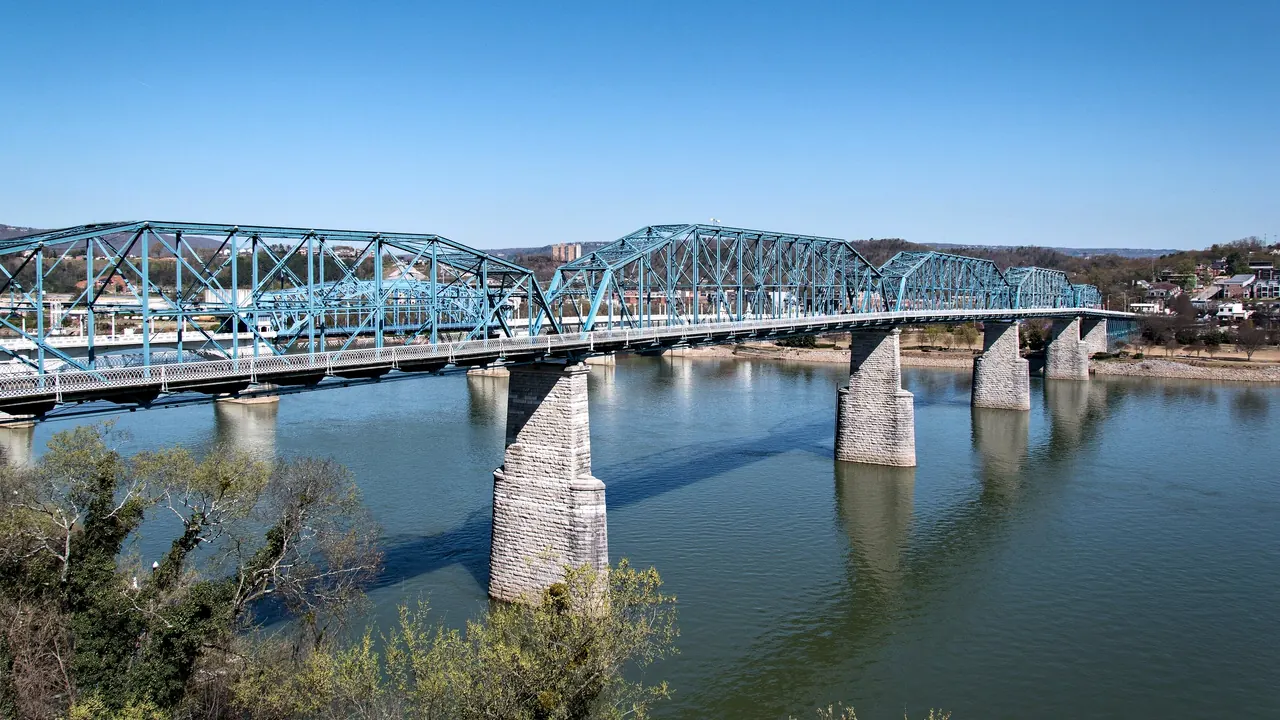
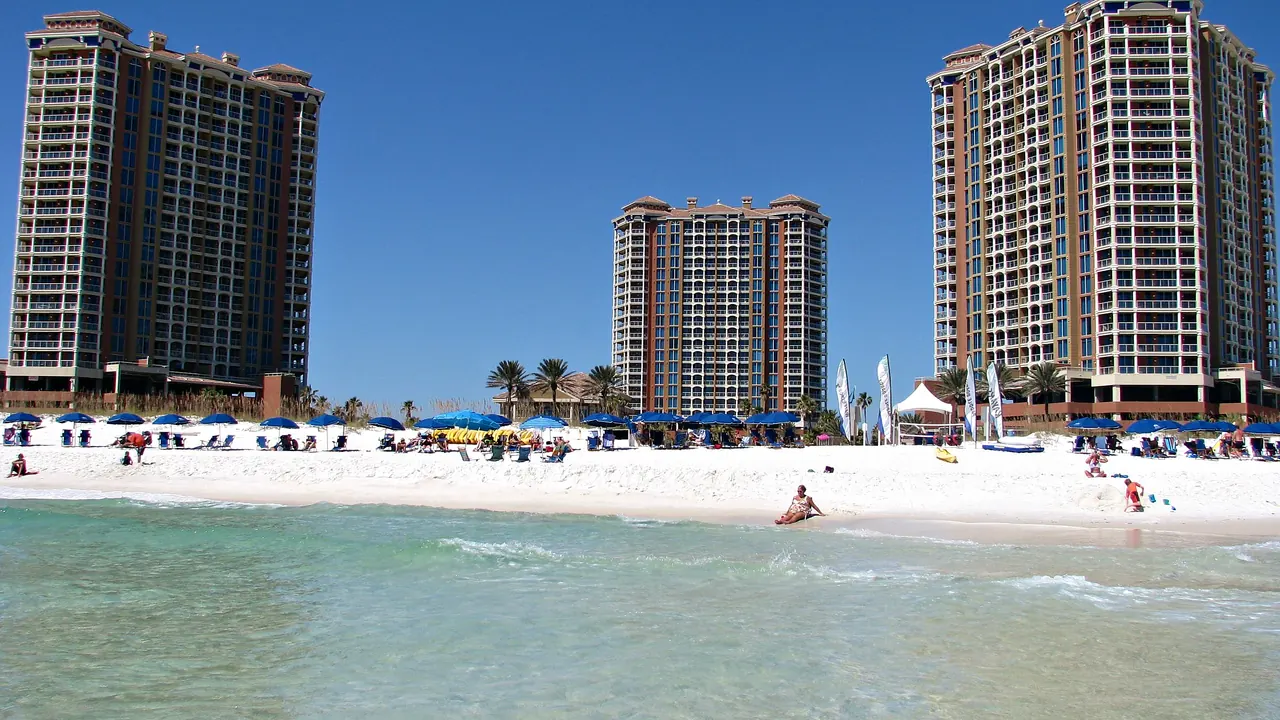
Photos: Chattanooga by Ɱ, CC BY-SA 4.0, cropped; Pensacola by Jason Meredith, CC BY 2.0, cropped.
Chattanooga or Pensacola?
Our verdict in twelve categories, each scored against the same fixed benchmark cities, and the climate month by month, so you can choose for your trip.
Choose Chattanooga for
- nature and the outdoors
- getting around
- day trips
Chattanooga is for travellers who want to be active. Lookout, Signal and Raccoon Mountains rise straight above town, the sandstone bluffs draw climbers, and the Tennessee River Gorge and the Ocoee give you trails and whitewater within an hour. It also makes the easier family city break, with the aquarium, Ruby Falls and the Incline Railway, and a centre you can walk end to end over the Walnut Street Bridge.
Choose Pensacola for
- beaches
- nightlife
- culture and sights
If the trip is built around the sea, pick Pensacola. White quartz sand and warm, gentle Gulf water on Santa Rosa Island are things an inland river city cannot offer, and evenings on Palafox Street or at the island's sand-floored bars are a little livelier. The price is a car for nearly every outing and a flat landscape that tells you to spend the middle of a summer day in the shade.
Scoreboard
Twelve categories on one fixed scale from 0 to 100. The shaded stretch is the gap between the two.
Your match
Pick a travel style or drag the sliders, and both match scores follow your weighting.
Wins on nature and the outdoors and getting around with your weighting.
Wins on beaches and nightlife with your weighting.
What matters to you?
Category by category
What the scores mean for a trip.
Beaches & swimming
This is where the two cities differ most. Chattanooga is a river city far inland, and its swimming is fresh water: a roped-off area at Chickamauga Lake or Harrison Bay, or a cold plateau creek on a hot afternoon. That is an hour's dip, not a beach vacation.
Pensacola's whole appeal starts here. Pensacola Beach and the Gulf Islands National Seashore run for miles along Santa Rosa Island, with white quartz sand and clear green water. The calm sound side suits toddlers, and quieter Perdido Key lies to the west. Mind the rip-current flags on rough days.
Food & drink
Both cities feed you well for a few days without giving you much range, and international cooking is thin in each. Chattanooga eats from the land: meat-and-three plates, smoked pork and brisket, fried chicken and biscuits. The chef-led kitchens and craft breweries are around the Southside and Main Street, and the North Shore is the place for a slow brunch.
Pensacola eats from the Gulf. Raw and chargrilled oysters, grouper sandwiches, royal red shrimp and gumbo with a Creole touch are at their best at the casual waterfront tables on the bay and the island. Be choosy out on the beach strip, though, where chains and tourist seafood houses take over. Downtown Palafox Street is the safer bet.
Culture & sights
Both have two or three days of sights, but the history is different. Chattanooga's is about the Civil War and the railways: the 1863 battlefields on Lookout Mountain and Missionary Ridge, the old Terminal Station, and the Hunter Museum's American art on its bluff above the river.
Pensacola's past is older and more mixed, with Spanish, French and British rule still visible in the colonial and Victorian houses around Plaza Ferdinand and the Seville district. Its two big draws are the brick Fort Pickens and the huge National Naval Aviation Museum, which sits on an active base and requires ID checks.
Nightlife
Pensacola gives you more of an evening out. Palafox Street and the Seville Quarter fill up at weekends with locals and young Navy personnel, and in summer the island adds beach bars with sand floors and a party mood.
Chattanooga is quieter: breweries, cocktail bars and patios on the Southside and Main Street, with Station Street as its one lively block. Most places wind down early, so it is better suited to a beer and a conversation than a long night.
Nature & outdoors
Chattanooga has the more dramatic landscape. The Tennessee River cuts through the Cumberland Plateau right at the edge of town, and the ridges bring climbing, hang gliding, mountain biking and gorge paddling. Cloudland Canyon and Fall Creek Falls are within easy reach for waterfalls.
Pensacola's nature is flat and watery: dunes, salt marsh, herons, ospreys and dolphins in the sound, best seen from a kayak or the seashore bike path. Divers have the sunken aircraft carrier offshore, and the clear Blackwater River is good for canoeing and tubing. There are no hills at all.
Day trips
Chattanooga has the wider choice of outings, because it sits where three states meet. Nashville and Atlanta are a long but possible day, Huntsville's rocket centre is about an hour and a half away, and Lynchburg's whiskey distillery and Sewanee make quieter drives.
From Pensacola the best outing is Mobile, about an hour west, with its antebellum streets and battleship museum, and Fairhope across the bay. Heading east along the coast, Destin and Seaside are mostly more beach towns. You need a car either way.
Good for families
Chattanooga has the edge for families because so much of it is built for children. The two-building Tennessee Aquarium and the Creative Discovery Museum are a few blocks apart. Lookout Mountain adds the steep Incline Railway, the underground waterfall at Ruby Falls and Rock City, and Coolidge Park has a carousel and splash fountains for a hot afternoon.
Pensacola works best when the sand is the main event, with shallow sound-side water for toddlers and condos with kitchens and pools. Away from the beach, the aviation museum, the lighthouse climb and the tunnels at Fort Pickens fill a few days, but there are no big attractions. Summer heat needs planning in both cities.
Getting around
Chattanooga is easier to manage without a car for the first few days. The riverfront, Bluff View, the Southside and the North Shore are all within walking distance, linked by the pedestrian bridge and a free electric shuttle. You will still need to drive for the mountains and trails.
In Pensacola only the Palafox and historic district is walkable. The beach, the naval air station and Perdido Key lie far apart along highways and bridges, so for most visitors the hire car is in use from the first day.
Shopping & style
Neither city is worth a shopping trip, and each gives you a short browse at most. In Chattanooga, Frazier Avenue on the North Shore has small boutiques, galleries and outdoor-gear shops, which are the city's one real specialty, while Warehouse Row downtown has a general mix of shops in old railway warehouses. In Pensacola, Palafox Street has antiques, gifts and Saturday market crafts, and the beach shops stick to swimwear and souvenirs.
Affordability
Costs are much the same: moderate by American standards, with car hire, sales tax and tipping on top. Chattanooga's bills grow at the aquarium and the Lookout Mountain attractions, while its trails and riverfront are free. Pensacola depends more on the season. Beachfront rooms are expensive in summer and much cheaper out of season, and the aviation museum costs nothing.
Live music & performing arts
A night at the theatre is much the same size in the two cities: regional in scale and good for an evening or two. Chattanooga's main stage is the gilded 1920s Tivoli, with the Walker Theatre in the Memorial Auditorium alongside it, for touring shows, comedy and the combined symphony and opera company. A community theatre on the North Shore puts on plays and musicals. The bands in the Southside and Main Street bars tend towards country, bluegrass and Americana, so the live music here has a clear regional sound.
Pensacola puts most of its programme under one roof, the restored 1925 Saenger downtown. There the symphony, the opera company and touring shows share the calendar with a ballet company, which makes Pensacola the better choice if you want to see dance. A long-running community theatre and a few bars with live bands make up the rest.
Wellness & relaxation
Neither has a spa or bathing culture beyond hotel and day spas, so the rest you get comes from the pace. In Chattanooga that means an unhurried afternoon on a porch in Bluff View or on the riverfront. Pensacola's version is an empty out-of-season beach on Santa Rosa Island or Perdido Key, which is the more restful of the two.
When should you go?
Pick your month. The climate figures are measured averages, not a forecast.
Chattanooga in July
Pensacola in July
Daytime high, °C
Rainfall in the month, mm
Temperature and rainfall are climate normals, averaged over the years shown. Chattanooga: 1991-2020 (sunshine 1981-2010) normals, Lovell Field (6.3 km from centre). Pensacola: 1991-2020 normals, Pensacola / Pleasant Grove (12.3 km from centre).
Chattanooga has four real seasons. Winter highs sit around 11°C, which is fine for museums but cold for an outdoor trip. July and August reach about 32°C with heavy humidity, too sticky for long hikes or climbing in the afternoon. April, May and October are the best months for the trails and bluffs, and May has the longest sunny days. Rain is spread fairly evenly through the year, so no month is reliably dry.
Pensacola is warmer all year, with winter days in the high teens that suit beach walks and sightseeing, though the water is too cool to swim. The Gulf is warm enough from late May to early October and reaches about 29°C in midsummer. June to September is also the wettest stretch, with close to 200mm in July, mostly as afternoon thunderstorms. Late May and October give you warm water without the worst of the heat and storms.
Which traveller are you?
For a beach and sun trip, Pensacola is the only real choice. Santa Rosa Island has miles of white sand and warm, calm Gulf water through the summer, while Chattanooga can only offer lake swimming areas and creek holes for an afternoon.
On an outdoors trip, Chattanooga comes out clearly ahead. It has climbing on sandstone bluffs, hang gliding from Lookout Mountain, trails in Prentice Cooper and whitewater on the Ocoee. Pensacola's outdoors is gentler and flatter: kayaking, birdwatching and cycling along the seashore.
For a short city break, Chattanooga works better. The aquarium, the Hunter Museum, Bluff View and the Southside are all within walking distance, linked by a free shuttle and the river bridge. In Pensacola the beach, the forts and the aviation museum are spread out across bridges and highways.
Before you go
| Measure | Chattanooga | Pensacola |
|---|---|---|
| Currency | US Dollar (USD) | US Dollar (USD) |
| Sockets | AB120 V, 60 Hz | AB120 V, 60 Hz |
| Driving side | Right | Right |
| Time zone | UTC-5, UTC-4 in summer | UTC-6, UTC-5 in summer |
| Emergency number | 911 | 911 |
| Elevation | 206 m | 31 m |
| Main airport | Chattanooga Metropolitan Airport (Lovell Field) (CHA)6 km from centre15 non-stop destinations | Pensacola International Airport (PNS)6 km from centre27 non-stop destinations |
| Public holidays this year | 13 days | 11 days |
By the numbers
| Measure | Chattanooga | Pensacola |
|---|---|---|
| City population | 181,099 | 54,312 |
| People per km² | 484 | 515 |
| Museums within 10 km | 7 | 5 |
| UNESCO World Heritage sites within 50 km | 0 | 0 |
| Swim season, months above 21 °C | - | 7 months |
Where else could you go?
Every comparison below shares a destination with this one, so you can follow Chattanooga or Pensacola somewhere new.
- Orange Beachvs Pensacola
- Gulf Shoresvs Pensacola
- Destinvs Pensacola
- Panama City Beachvs Pensacola
- Atlantavs Chattanooga
- Pigeon Forgevs Chattanooga