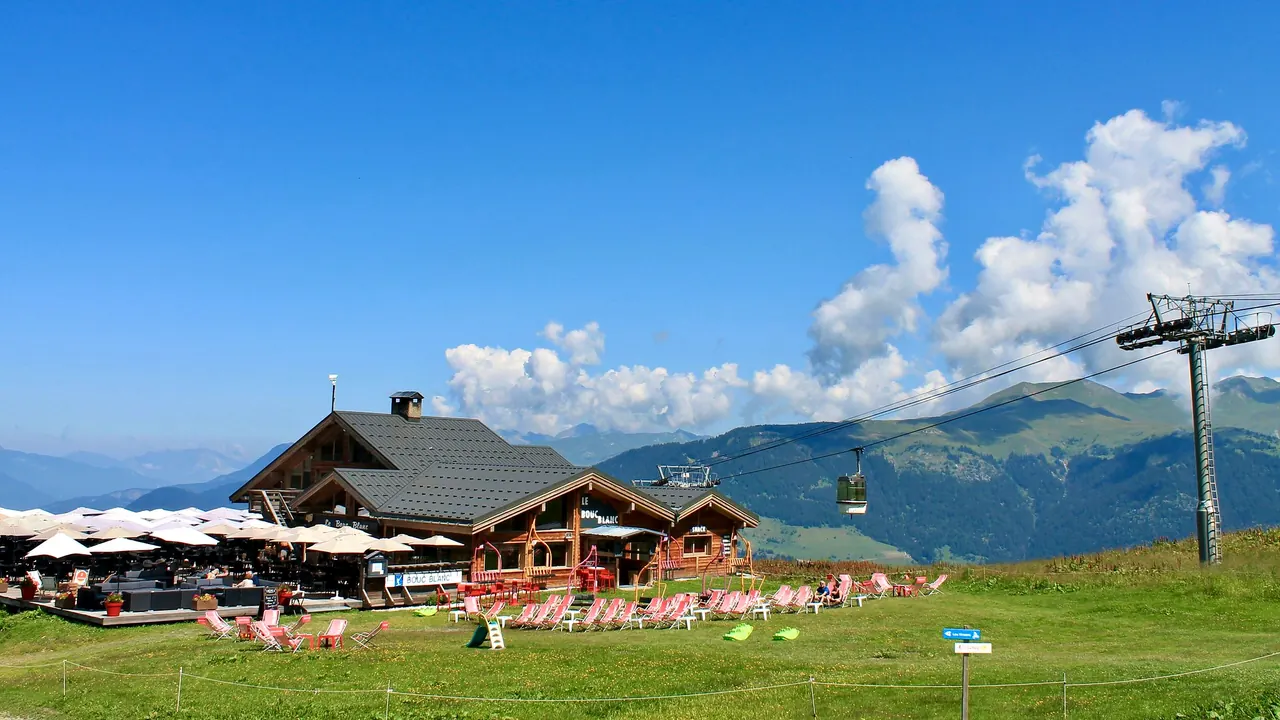
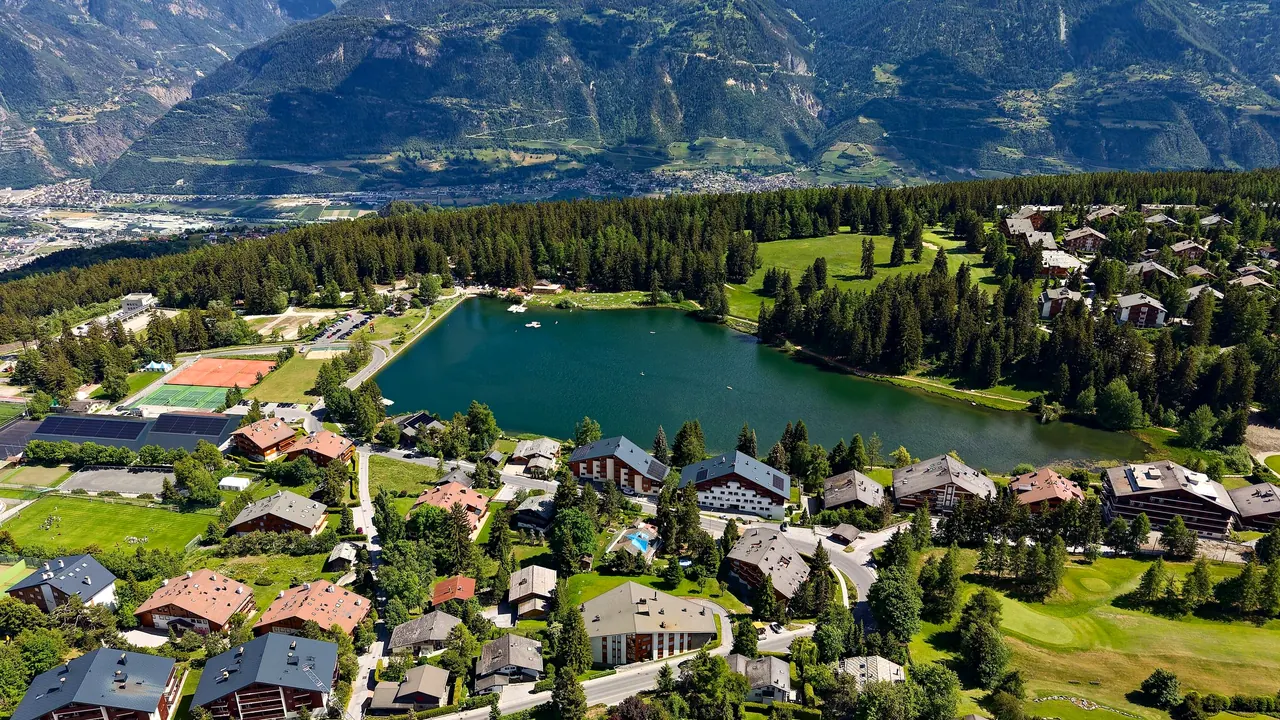
Photos: Courchevel by B. Brassoud, CC BY-SA 4.0, cropped; Crans-Montana by Daniel Reust, CC BY-SA 4.0, cropped.
Courchevel or Crans-Montana?
Our verdict in twelve categories, each scored against the same fixed benchmark cities, and the climate month by month, so you can choose for your trip.
Choose Courchevel for
- food and drink
- nightlife
- families
Courchevel is the choice for a winter trip built around skiing on a grand scale and eating very well. Les 3 Vallées puts an enormous linked ski area outside the door, the starred kitchens of 1850 and the long lunches on the slope-side terraces are part of the point, and the late clubs keep the evenings going. It also makes first ski days easy for children. In return you accept a long hairpin climb to get there and very little to do away from the snow.
Choose Crans-Montana for
- day trips
- live music and the arts
- getting around
Travellers who like sun, views and the option of leaving the mountain will get more from Crans-Montana. Its south-facing plateau looks across the Rhône valley to a long line of Valais peaks, and the funicular to Sierre links it to the Swiss railway, so Sion's castles, the wine villages and the hot pools at Leukerbad are all easy outings. In summer it has the bisse paths and alpine golf. The nights are quieter and the ski area is smaller, but for a mixed stay in summer or winter it is the easier place to be.
Scoreboard
Twelve categories on one fixed scale from 0 to 100. The shaded stretch is the gap between the two.
Your match
Pick a travel style or drag the sliders, and both match scores follow your weighting.
Too close to call, level with your weighting
Wins on food and drink and nightlife with your weighting.
Wins on day trips and live music and the arts with your weighting.
What matters to you?
Category by category
What the scores mean for a trip.
Beaches & swimming
Neither resort is anywhere for a beach trip, but Crans-Montana at least has somewhere to swim outdoors. In July and August, Lac Moubra and Lac Grenon warm to about 20°C on good days, with lawns, pontoons and families having picnics.
Courchevel's Lac de la Rosière above Moriond is better for a paddle and some time on the grass than for swimming, because the water stays mountain-cold. For a proper swim you go indoors to the aquatic centre in Courchevel Village.
Food & drink
Courchevel eats noticeably better. The palace hotels of 1850 have one of the densest clusters of Michelin-starred cooking in France, and lunch on the mountain can mean grilled meat, seafood and a serious wine list on a sunny terrace. Fondue, tartiflette and Beaufort cheese cover the everyday Savoyard side.
Crans-Montana offers Valais cooking instead: raclette scraped from the half-wheel, dried meat with rye bread, and wine from the terraced vineyards just below, where Petite Arvine and Cornalin are worth asking for. There are a few gastronomic tables for a special night, but nothing like as many. Both resorts have little cheap eating, and both close many kitchens out of season.
Culture & sights
Neither place is built for sightseeing. Courchevel's main landmarks are the 1992 Olympic ski jumps at Le Praz and the modernist chalets of 1850. Crans-Montana's past shows in its sanatorium-era grand hotels, but its real cultural asset is that the old towns and churches of the Rhône valley lie directly below.
Nightlife
Courchevel has the bigger and more famous night scene. After the slope-side après-ski, 1850's hotel bars and a few glamorous clubs keep going into the early hours, with big tables and champagne for guests who have money to spend.
Crans-Montana's evenings are more restrained: après-ski near the lifts, then piano lounges and hotel bars in Crans, with a couple of clubs open late at weekends. Outside winter, both resorts go quiet early.
Nature & outdoors
Both resorts are first-rate mountain country, but they offer different things. Courchevel is about scale. It links into some 600km of pistes across Les 3 Vallées, from wooded runs down to Le Praz to steep couloirs off the Saulire, and the glaciers and ibex of the Vanoise National Park lie just beyond.
Crans-Montana is about sun and views. Its ski area is a fraction of the size and mostly suits intermediates, but it climbs to the Plaine Morte glacier and looks out on a line of peaks from the Matterhorn to Mont Blanc. Summer here is more varied, with level walks along the old bisse channels, paragliding off the plateau and golf against an alpine backdrop.
Day trips
Crans-Montana makes leaving the resort far easier. The funicular down to Sierre meets the Rhône valley railway, which puts the castles of Valère and Tourbillon in Sion, the wine villages around Salgesch, Roman Martigny and the abbey at Saint-Maurice within easy reach. Lavaux and the Château de Chillon on Lake Geneva also make a full day out by train.
From Courchevel, every outing begins with the winding road down to Moûtiers. Medieval Conflans and the cheese town of Beaufort are about an hour away, and Chambéry and Annecy are further still. Most people on a ski week never go.
Good for families
Courchevel is the slightly better fit for young skiers. Moriond and Village have gentle, sunny nursery slopes, free beginner lifts and snow gardens for the youngest, and the aquatic centre's pools and slides fill a rest afternoon. The catch is that 1850 is geared to adults.
Crans-Montana suits families who like to be outdoors, with broad beginner slopes in winter and, in summer, pedalos, playgrounds and flat bisse paths that small legs can manage. Because the resort is spread out, though, families with toddlers need to choose where they stay carefully.
Getting around
Crans-Montana is easier to reach. A funicular climbs from Sierre's mainline station in about twelve minutes, so you can come without a car. Once you are there, though, Crans, Montana and the lift bases are strung out over several kilometres of hillside, so you need the free shuttle buses.
Courchevel is the reverse. It starts with about 25km of hairpin bends up from Moûtiers, which in winter means snow chains if you drive. Once you are up, it is compact, with plenty of ski-in, ski-out lodging, a gondola linking Le Praz and Village with 1850, and a free shuttle between the villages.
Shopping & style
The shopping is similar at both resorts: a short, very upmarket strip aimed at winter guests. Courchevel 1850 has fashion houses, jewellers and watchmakers alongside excellent ski shops, plus Savoyard cheese and carved wooden crafts. In Crans the pieces to take home are Swiss watches, cashmere and designer ski wear, and the delicatessens sell Valais wine and dried meats.
Affordability
Both are among the most expensive places in Europe to spend a vacation, and neither has a genuinely cheap option. In Courchevel, staying in Le Praz, Village or La Tania rather than 1850 takes some of the edge off. In Crans-Montana, visiting in late spring or early autumn and buying food in the valley helps a little. At both, self-catering is the main way to save, and the lift pass adds a lot to the cost.
Live music & performing arts
Crans-Montana has more going on, though in bursts. The Caprices festival brings electronic music to the slopes as the ski season ends, and a summer series of chamber and classical concerts fills churches and halls. Courchevel offers little beyond occasional concerts and bands playing at après-ski, and it has no theatre or concert hall.
Wellness & relaxation
The two are about level, but they offer different kinds of rest. Courchevel's palace spas are some of the most lavish in the Alps, with pools under timber roofs and hammams designed for legs tired after skiing, and the public aquatic centre has saunas and steam rooms that cost less to use.
Crans-Montana began as a place to recover, and the sun and clean air still make it suit a slow stay outside the peak weeks. Its hotel spas are good. The real extra is the alpine hot pools at Leukerbad, less than an hour away, which give it a thermal bathing option that Courchevel lacks.
When should you go?
Pick your month. The climate figures are measured averages, not a forecast.
Courchevel in July
Crans-Montana in July
Daytime high, °C
Rainfall in the month, mm
Where the figures come from
Courchevel has no weather station within reach, so its figures come from a gridded climate model rather than a measured record, and read a broad area rather than one spot.
Crans-Montana has no weather station within reach, so its figures come from a gridded climate model rather than a measured record, and read a broad area rather than one spot.
Temperature and rainfall are climate normals, averaged over the years shown. Courchevel: 2001-2020 normals, NASA POWER reanalysis grid, no weather station within 90 km. Crans-Montana: 2001-2020 normals, NASA POWER reanalysis grid, no weather station within 90 km.
Both resorts are at their best for skiing from December to March, when daytime highs stay around freezing or below. Courchevel is the colder of the two in deep winter, with January highs of about -4°C against -2°C at Crans-Montana, so a day on its slopes calls for serious layers. Neither is comfortable for walking until late spring. Both reach about 18°C in July and August, which is pleasant for hiking but only just warm enough for a dip in the small lakes.
The bigger difference is rain. Courchevel's wettest month is May, and after that its summer is fairly steady, with about 78mm in August. Crans-Montana stays wet right through the summer and is wettest in August, at about 130mm, so Courchevel is the safer choice for a summer hiking week. November is cold and damp at both, in the gap between autumn and the first reliable snow.
Which traveller are you?
On a food and nightlife trip, choose Courchevel. 1850 has a remarkable number of Michelin-starred kitchens for a village, long terrace lunches between runs and late clubs that run on champagne. Crans-Montana's hotel bars and piano lounges make for a gentler, shorter evening.
On a family trip with children, Courchevel has the edge. Moriond and Village have free beginner lifts, snow gardens and quiet pistes, and the aquatic centre with slides fills a day off. Crans-Montana's villages are spread over a hillside, so small children depend on the shuttle buses.
On a culture and arts trip, Crans-Montana is the better base, although neither resort has much in the way of sights itself. Trains reach Sion's castles, Martigny and Chillon easily, and the Caprices festival and summer chamber concerts add music that Courchevel rarely has.
Before you go
| Measure | Courchevel | Crans-Montana |
|---|---|---|
| Official language | French | French, German, Italian, Romansh |
| Currency | Euro (EUR) | Swiss Franc (CHF) |
| Sockets | CE230 V, 50 Hz | CJ230 V, 50 Hz |
| Driving side | Right | Right |
| Time zone | UTC+1, UTC+2 in summer | UTC+1, UTC+2 in summer |
| Emergency number | 112 | 112 |
| Elevation | 1,757 m | 1,495 m |
| Main airport | Geneva International Airport (GVA)100 km from centre150 non-stop destinations | Geneva International Airport (GVA)106 km from centre150 non-stop destinations |
| Public holidays this year | 11 days | 9 days |
By the numbers
| Measure | Courchevel | Crans-Montana |
|---|---|---|
| Population | - | 10,447 |
| People per km² | - | 175 |
| Museums within 10 km | 0 | 3 |
| UNESCO World Heritage sites within 50 km | 0 | 1 |
Where else could you go?
Every comparison below shares a destination with this one, so you can follow Courchevel or Crans-Montana somewhere new.
- Méribelvs Courchevel
- La Plagnevs Courchevel
- Les Menuiresvs Courchevel
- Leukerbadvs Crans-Montana
- Val Thorensvs Courchevel
- Adelbodenvs Crans-Montana