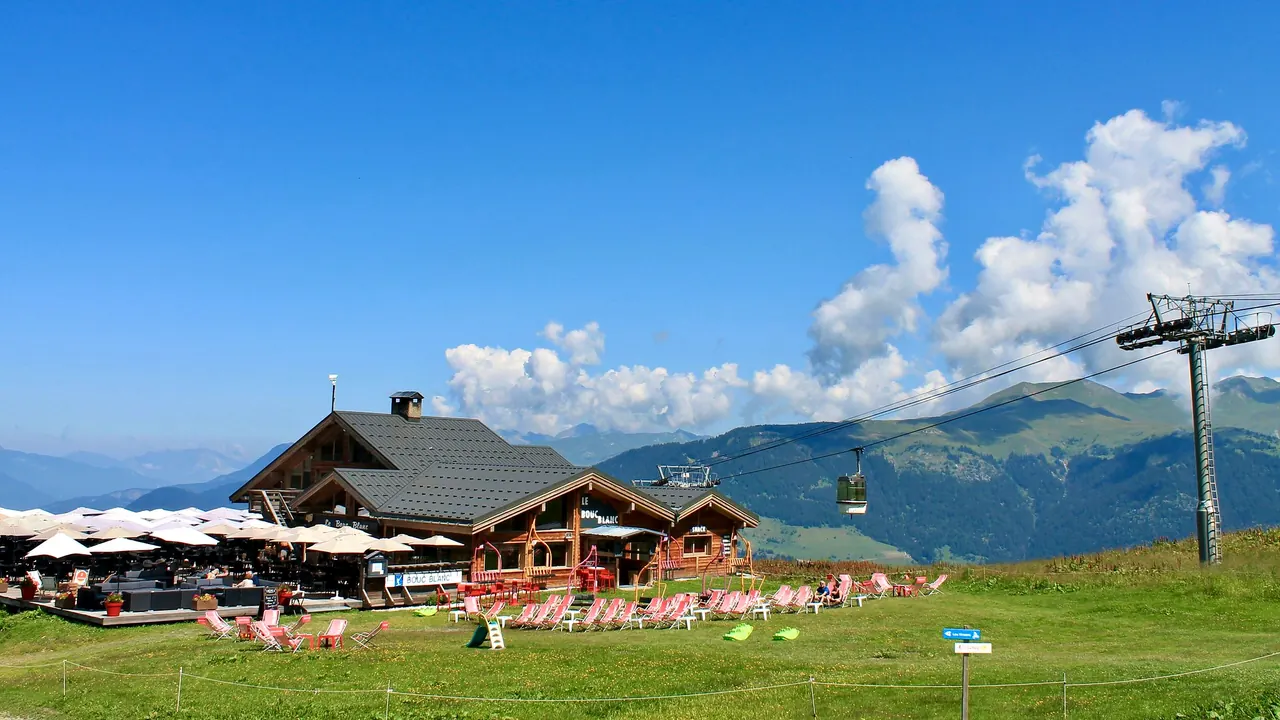
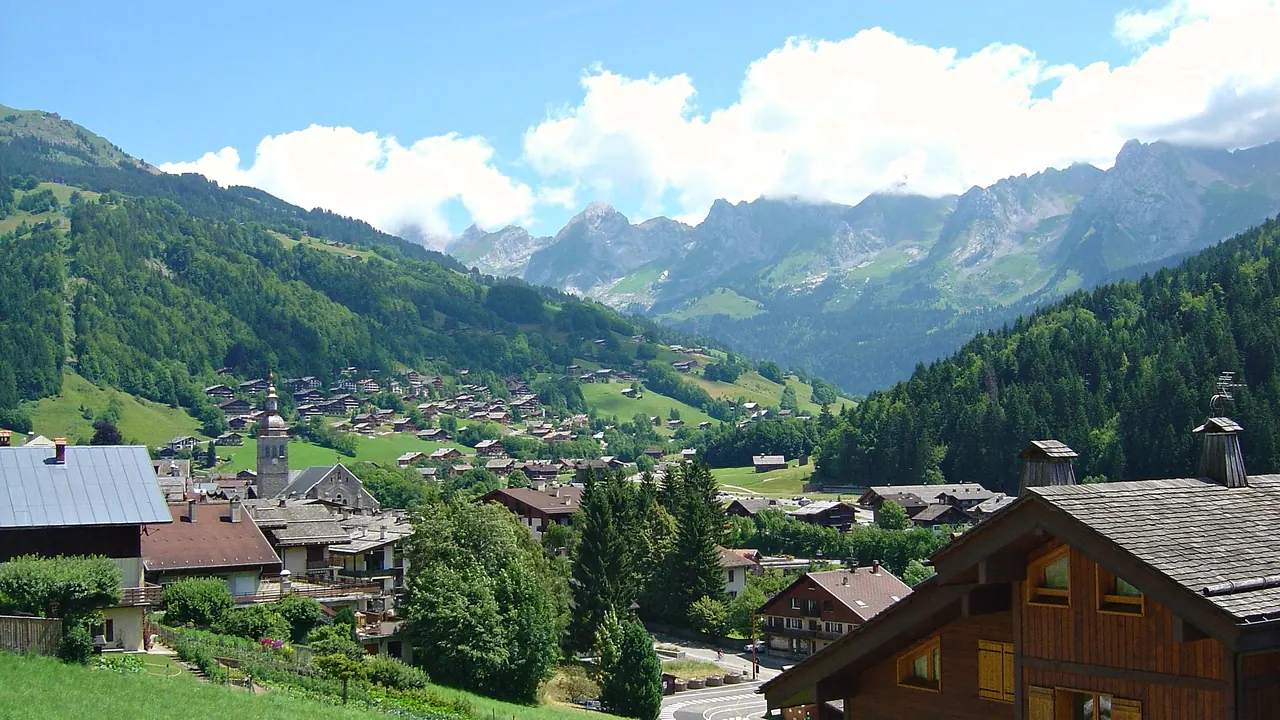
Photos: Courchevel by B. Brassoud, CC BY-SA 4.0, cropped; Le Grand-Bornand by Anthospace, CC BY-SA 3.0, cropped.
Courchevel or Le Grand-Bornand?
Our verdict in twelve categories, each scored against the same fixed benchmark cities, and the climate month by month, so you can choose for your trip.
Choose Courchevel for
- food and drink
- nightlife
- shopping
Courchevel is the choice for a ski week where nothing is held back. It sits in the largest linked ski area in the world, lunch on the slopes can be at a Michelin-starred table, the palace hotel spas are among the most lavish in the mountains, and 1850 keeps going late into the night. Lifts, shuttles and ski-in, ski-out chalets do most of the moving. The catch is cost, which is very high wherever you stay.
Choose Le Grand-Bornand for
- prices
- beaches
- day trips
Le Grand-Bornand suits families and anyone watching their spending who wants a real Alpine village rather than a showpiece. Ski schools and snow gardens sit near the village, Reblochon comes straight from the farms, and evenings are quiet. It works just as well in summer, with Annecy's old town and lake beaches close by, though you will want a car.
Scoreboard
Twelve categories on one fixed scale from 0 to 100. The shaded stretch is the gap between the two.
Your match
Pick a travel style or drag the sliders, and both match scores follow your weighting.
Too close to call, 1 point apart
Wins on food and drink and nightlife with your weighting.
Wins on prices and beaches with your weighting.
What matters to you?
Category by category
What the scores mean for a trip.
Beaches & swimming
Neither is a beach destination, but Le Grand-Bornand has proper swimming within reach. Lake Annecy is about 40 minutes down the valley, with lawns, pontoons and small beaches at Talloires, Sevrier and Menthon-Saint-Bernard. In July and August the clear water warms to the low twenties.
From Courchevel, the sea and the big lakes are a long drive away. A summer swim means a cold paddle in the little Lac de la Rosière above Moriond, or the indoor pools of the aquatic centre in Courchevel Village.
Food & drink
Both serve the Savoyard staples, fondue, raclette and tartiflette, but Courchevel goes much further. 1850 has a concentration of Michelin-starred kitchens in its palace hotels and chalets, and lunch on a sunny slope-side terrace, with seafood and a serious wine list, is part of the ski day. The drawbacks are price, little casual eating and many closures out of season.
Le Grand-Bornand's strength is the cheese itself. You can buy Reblochon from farms around the valley, and the weekly market is full of charcuterie and mountain produce. Restaurant menus tend to look alike, and for refined cooking people drive to Annecy.
Culture & sights
Both are thin on sights, and the difference is in age. Courchevel was built for skiing after the Second World War, so its points of interest are the Olympic ski jumps at Le Praz from 1992 and the modernist chalets of 1850.
Le Grand-Bornand is an older farming village, with a baroque church under an onion-domed bell tower, deep-roofed wooden farmhouses and a heritage house on how valley families made cheese. You can see either place in an afternoon.
Nightlife
Courchevel has a real night scene in winter, though a narrow one. In 1850, après-ski on the terraces leads on to hotel bars and a few glamorous clubs where big tables and champagne carry on into the early hours. It is made for big spenders, and it fades away in summer.
Le Grand-Bornand has a few après-ski bars in the village and at Chinaillon, and most guests go to bed early. For a proper night out you have to drive to Annecy.
Nature & outdoors
Both are outstanding mountain bases, but Courchevel has the bigger and higher terrain. It sits in the Trois Vallées, the largest linked ski area in the world, so you can ski across to Méribel and Val Thorens on some 600km of pistes, from the steep couloirs of the Saulire down to tree-lined runs. In summer, the glaciers, ibex and marmots of the Vanoise National Park are right next door.
Le Grand-Bornand is mid-mountain country under the limestone wall of the Aravis. Its peaks are lower, with no glaciers, and the skiing is on open pastures and wooded runs, with cross-country trails in the valley. Its summers have more variety: road cycling on Tour de France climbs such as the Col de la Colombière, and sailing or paddling on Lake Annecy.
Day trips
Le Grand-Bornand is much better placed for days out. Annecy, with its canals, old town and castle, is about 40 minutes away. Geneva is roughly an hour, and Yvoire and Chambéry each make a longer outing.
From Courchevel, every trip starts with the winding descent to Moûtiers. After that, Conflans and the cheese town of Beaufort take around an hour, and Annecy is nearly two hours away, so most skiers never leave. From either base, you will want a car.
Good for families
Both are good for a family ski week, and Le Grand-Bornand has a slight edge. It is a small, safe resort designed around children, with snow gardens, sledging, and summer visits to farms and mountain pastures.
Courchevel's ski schools run large children's programmes, and the gentle, free beginner lifts at Moriond and Courchevel Village make first days easy. The aquatic centre with its slides is useful for a day off the slopes. Away from skiing there is less for children, and 1850 is aimed at adult luxury.
Getting around
Courchevel is easier to manage without a car. A free shuttle links the villages, a gondola climbs from Le Praz to 1850, and many chalets are ski-in, ski-out. There is a railway station at Moûtiers about 25km below, but that is followed by a long climb up hairpin bends.
Le Grand-Bornand is easy to walk and has winter shuttles to Chinaillon and the lifts. Beyond that, though, there is no railway and few buses, so the lake, the trailheads and Annecy all mean driving.
Shopping & style
Courchevel 1850 has a short but grand shopping street. Luxury fashion houses, jewellers and watchmakers open for the winter, alongside excellent ski shops, though much of it closes out of season.
In Le Grand-Bornand the shopping is practical: gear hire, a few clothes shops and delis selling honey and sausages. The weekly market is its best shopping, and for anything more people go to Annecy.
Affordability
Le Grand-Bornand costs far less. It still charges Alpine resort prices in school vacation weeks, but self-catering is the norm, and the quieter January and March weeks and summer are easy on the budget.
Courchevel is among the most expensive destinations anywhere, from its 1850 chalets to the lift pass for the whole ski area. Staying at Le Praz, La Tania or Courchevel Village helps only a little.
Live music & performing arts
Le Grand-Bornand has one real event. Each August, the long-running children's festival Au Bonheur des Mômes fills the village with street theatre, circus, puppetry and music for a week. Otherwise there are occasional church concerts.
In Courchevel, live performance means a band playing during après-ski or the odd seasonal concert, and there is no hall. From either place, theatre and opera mean a trip down the mountain, and Annecy and Geneva are closer to Le Grand-Bornand.
Wellness & relaxation
Courchevel's palace hotels have some of the most lavish spas in the mountains, with timber-roofed pools, hammams and treatments, and non-residents can book many of them. The public aquatic centre adds saunas and steam rooms with outdoor views.
Le Grand-Bornand's hotel saunas and hot tubs are pleasant but modest. What it offers instead is calm: cow bells, wooden balconies and slow off-peak days, which Courchevel mostly finds only in summer.
When should you go?
Pick your month. The climate figures are measured averages, not a forecast.
Courchevel in July
Le Grand-Bornand in July
Daytime high, °C
Rainfall in the month, mm
Where the figures come from
Courchevel has no weather station within reach, so its figures come from a gridded climate model rather than a measured record, and read a broad area rather than one spot.
Le Grand-Bornand's temperatures are measured 45 km from the centre, at Bourg-St-Maurice.
Le Grand-Bornand has no rain gauge within 25 km of the centre, so its rainfall comes from a gridded climate dataset read at the destination rather than from a gauge further away.
Temperature and rainfall are climate normals, averaged over the years shown. Courchevel: 2001-2020 normals, NASA POWER reanalysis grid, no weather station within 90 km. Le Grand-Bornand: 1999-2020 (rainfall 1991-2020) normals, Bourg-St-Maurice (44.7 km from centre).
Courchevel is a winter place first and last. Highs stay below freezing from December to February, around -4°C in January, which keeps the snow reliable. Its summer is short and fresh, with July reaching only about 18°C. That is fine for hiking in the Vanoise but too cool for lazing by a lake. Rain is spread fairly evenly through the year, and May is the wettest month.
Le Grand-Bornand's figures are much milder all year. July and August reach about 27°C, warm enough for afternoons on the shores of Lake Annecy, and September, at about 22°C, is still pleasant for walking. It is also the wetter of the two, and the heaviest rain comes in early winter, peaking at 144mm in December. If you are going for summer, Le Grand-Bornand is the warmer bet. If you are going for deep winter, Courchevel is the colder and more dependable one.
Which traveller are you?
On a trip on a tight budget, Le Grand-Bornand is far easier to manage. Self-catering is the norm, the quieter weeks of January and March cost less, and summer is gentle on spending. Courchevel is among the costliest destinations anywhere, even in its lower villages.
For a food and nightlife trip, Courchevel wins clearly. 1850 has a cluster of Michelin-starred kitchens, long terrace lunches on the slopes and late clubs that run on champagne. Le Grand-Bornand offers excellent Reblochon, a handful of bars and early nights.
On a family trip with children, Le Grand-Bornand has the edge. The whole village is built around families, it is small and safe, children can visit farms to watch cheese being made, and August brings a children's festival. Courchevel's ski schools are excellent, but 1850 is aimed at adults.
Before you go
| Measure | Courchevel | Le Grand-Bornand |
|---|---|---|
| Official language | French | French |
| Currency | Euro (EUR) | Euro (EUR) |
| Sockets | CE230 V, 50 Hz | CE230 V, 50 Hz |
| Driving side | Right | Right |
| Time zone | UTC+1, UTC+2 in summer | UTC+1, UTC+2 in summer |
| Emergency number | 112 | 112 |
| Elevation | 1,757 m | 892 m |
| Main airport | Geneva International Airport (GVA)100 km from centre150 non-stop destinations | Geneva International Airport (GVA)41 km from centre150 non-stop destinations |
| Public holidays this year | 11 days | 11 days |
By the numbers
| Measure | Courchevel | Le Grand-Bornand |
|---|---|---|
| Population | - | 2,050 |
| People per km² | - | 33 |
| Museums within 10 km | 0 | 1 |
| UNESCO World Heritage sites within 50 km | 0 | 2 |
Where else could you go?
Every comparison below shares a destination with this one, so you can follow Courchevel or Le Grand-Bornand somewhere new.
- La Clusazvs Le Grand-Bornand
- Méribelvs Courchevel
- La Plagnevs Courchevel
- Les Menuiresvs Courchevel
- Val Thorensvs Courchevel
- Megèvevs Le Grand-Bornand