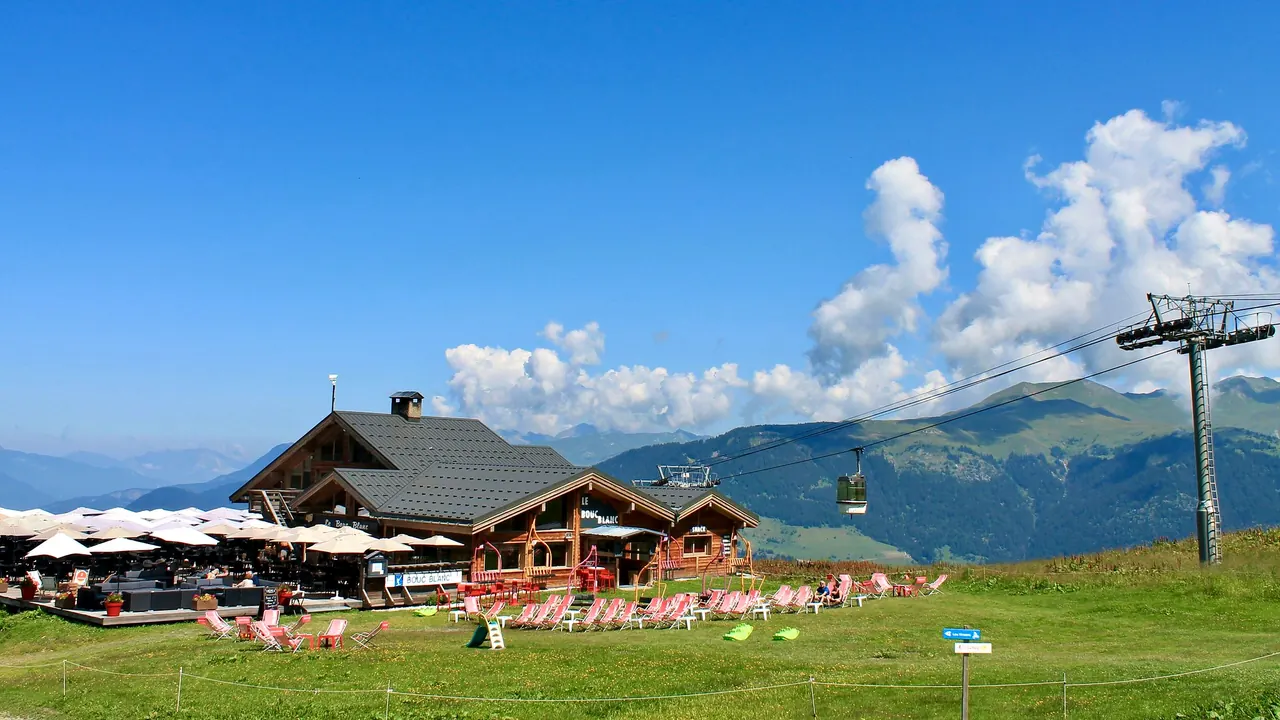
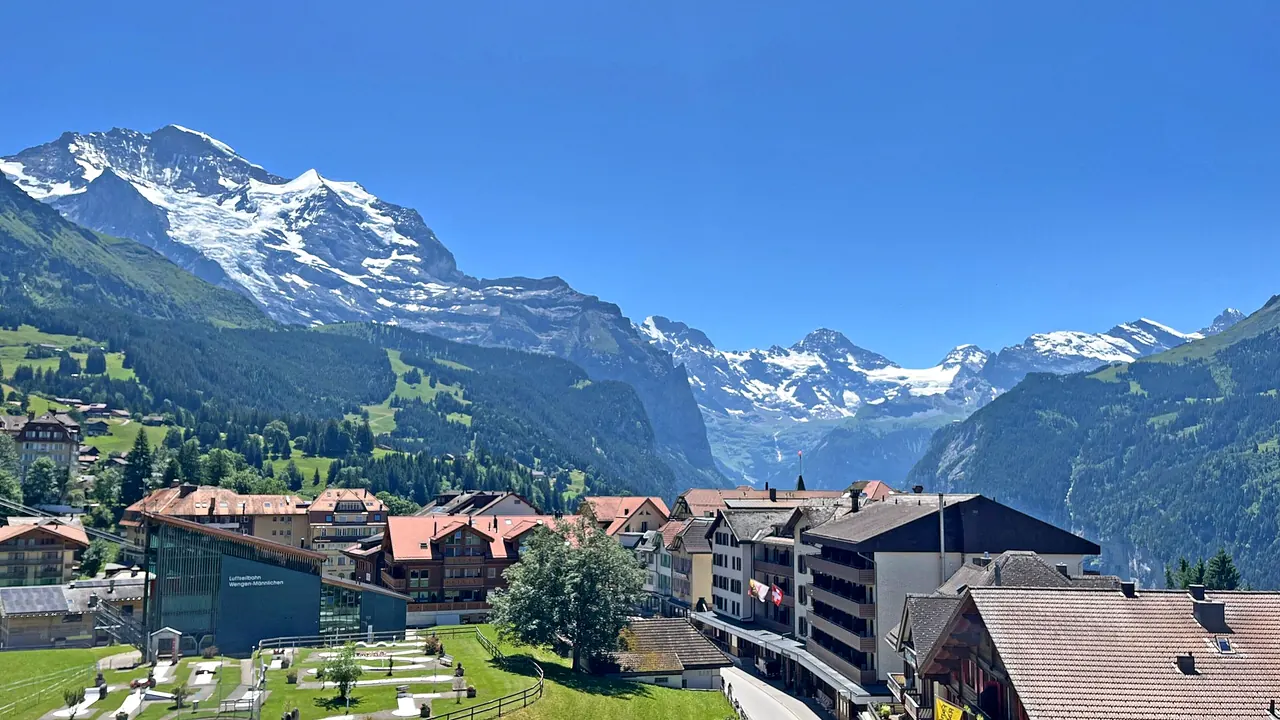
Photos: Courchevel by B. Brassoud, CC BY-SA 4.0, cropped; Wengen by Charles J. Sharp, CC BY-SA 4.0, cropped.
Courchevel or Wengen?
Our verdict in twelve categories, each scored against the same fixed benchmark cities, and the climate month by month, so you can choose for your trip.
Choose Courchevel for
- food and drink
- shopping
- nightlife
Courchevel is for a ski week where the meals and evenings matter as much as the pistes. Les 3 Vallées give almost endless runs, and the starred kitchens and long terrace lunches are rare anywhere in the Alps. In 1850 the lavish hotel spas, the glamorous late bars and the short street of luxury shops suit travellers who expect polish and can pay for it. Families teaching children to ski are well looked after too.
Choose Wengen for
- day trips
- getting around
- beaches
Wengen suits people who travel for the mountains themselves. Its car-free lanes, cowbells and the view of the Jungfrau, Eiger and Mönch make for a slower, quieter stay. Railways lead straight into the high country, and the lakes and castles around Interlaken make easy days out. Expect plain Swiss food and early nights, and go elsewhere if you want shopping or a late night out.
Scoreboard
Twelve categories on one fixed scale from 0 to 100. The shaded stretch is the gap between the two.
Your match
Pick a travel style or drag the sliders, and both match scores follow your weighting.
Wins on food and drink and shopping with your weighting.
Wins on day trips and getting around with your weighting.
What matters to you?
Category by category
What the scores mean for a trip.
Beaches & swimming
Neither is a place to swim, but Wengen is better placed for a hot summer afternoon. The lidos on Lake Thun near Interlaken are about an hour away by train and can reach around 20°C in July. Courchevel offers a cold paddle in the little Lac de la Rosière above Moriond, the indoor pools of the aquatic centre, and a sea several hours' drive away.
Food & drink
Courchevel is the clear choice if eating matters. The palace hotels and chalets of 1850 hold a cluster of Michelin-starred kitchens, and slope-side lunches of grilled meats, seafood and fine wine are an occasion in their own right. Fondue, tartiflette and Beaufort cheese fill out the everyday table.
Wengen eats simply: rösti, veal in cream sauce and fondue in hotel dining rooms and mountain huts, and many guests simply take half-board. Its memorable lunch is on a terrace facing the Jungfrau, and for any variety you go down to Interlaken.
Culture & sights
Neither resort is a sightseeing destination, and what little there is shows how each began. Courchevel was built for skiing after the Second World War, so its landmarks are the 1992 Olympic ski jumps at Le Praz and the modernist chalets of 1850. Wengen is older: a cluster of wooden chalets and Belle Époque hotels from its days as an English resort, with a long ski-racing history and a small church that make it the more pleasant to stroll.
Nightlife
After dark Courchevel 1850 has a real, if narrow, scene. Après-ski starts on the terraces as the lifts close, then moves to hotel bars and a few glamorous clubs running late on champagne, all aimed at big spenders. Wengen has a handful of après-ski bars and a hotel bar or two, and only the Lauberhorn race weekend in January becomes a proper party.
In summer both go quiet. Going out almost disappears in Courchevel, and in Wengen the evening ends after dinner.
Nature & outdoors
Both put you in superb mountain country, and the difference is in what you do there. Courchevel is above all a skier's resort, at the heart of Les 3 Vallées with some 600km of linked pistes reaching Méribel and Val Thorens. It also has steep couloirs off the Saulire, ski touring and paragliding, and the Vanoise National Park for a short summer of glaciers, ibex and marmots.
Wengen's strength is the scenery itself. The Jungfrau, Eiger and Mönch rise straight across the waterfall-lined Lauterbrunnen valley, walks lead to Kleine Scheidegg and beneath the Eiger north face, and the railway climbs to the Jungfraujoch. Its ski area shared with Grindelwald is large, but walkers gain most here, as long as the cloud that can hide everything for days stays away.
Day trips
Wengen is the better base for getting off the mountain. The rack railway to Lauterbrunnen and on to Interlaken brings Thun's old town, steamers to the castles at Oberhofen and Spiez, and the Ballenberg open-air museum within about an hour, while arcaded Bern makes a long but worthwhile day.
From Courchevel everything starts with the winding road down to Moûtiers. From there, medieval Conflans and the cheese town of Beaufort are about an hour away, Chambéry is further and Annecy close to two hours, so most ski-week visitors never go.
Good for families
For a first family ski week, Courchevel has the edge. Moriond and Courchevel Village have gentle, sunny nursery slopes, the ski schools run large children's programmes with snow gardens, the beginner lifts are free, and the aquatic centre has slides for an afternoon off the snow.
Wengen's best card is that it is car-free, so children can wander the village safely, with sledging runs and nursery slopes close to the hotels. It struggles on rainy days, though, and its steep paths defeat buggies. In Courchevel, the part to avoid with children is adult-focused 1850.
Getting around
Wengen is easier to manage without a car, and you cannot bring one anyway. The rack railway from Lauterbrunnen carries you up, electric carts collect the luggage, and the same line and the Männlichen cable car take you straight into the high mountains.
Courchevel works smoothly once you are there, with a free shuttle between villages, a gondola from Le Praz to 1850 and plenty of ski-in, ski-out lodging. Arriving is the hard part: about 25km of hairpin bends up from the station at Moûtiers, with snow chains needed in winter.
Shopping & style
Courchevel 1850 is the only one of the two where shopping is a pastime. In winter it has a short stretch of luxury fashion houses, jewellers and watchmakers beside excellent ski shops and Savoyard cheese counters. Wengen's main street covers ski hire, outdoor gear, chocolate and groceries, and anything more means going down to Interlaken or Bern.
Affordability
The money goes on different things in these two resorts. In Courchevel the largest bills are a room or chalet in 1850, priced for the very wealthy, and a lift pass covering the whole of Les 3 Vallées. Staying lower down in Le Praz, Courchevel Village or La Tania, or taking a self-catering apartment, saves a little, though even these are high by any standard.
Wengen's costs are spread more evenly. Rooms, meals and drinks all carry Swiss resort prices, and the mountain railways charge for every outing, with the Jungfraujoch train the most expensive of all. Walking the trails costs nothing and regional rail passes bring the fares down, but neither resort makes a cheap stay.
Live music & performing arts
Live performance hardly exists in either resort. Courchevel has the occasional concert or seasonal event and live bands at après-ski. Wengen has more folk colour than programme: yodelling or alphorn evenings in a hotel and a brass band at village celebrations, with theatre and concerts a trip down to Interlaken or Bern.
Wellness & relaxation
For a proper spa, Courchevel is the better choice. Its palace hotel spas, with timber-roofed pools, hammams and treatments for tired ski legs, are among the most lavish in the mountains and many take outside guests, while the aquatic centre adds a more accessible spa with views.
Wengen offers a different kind of rest: the quiet of a car-free village where cowbells and waterfalls are the loudest sounds. Its hotel spas are more modest, so it suits people who recharge on a balcony facing the Jungfrau.
When should you go?
Pick your month. The climate figures are measured averages, not a forecast.
Courchevel in July
Wengen in July
Daytime high, °C
Rainfall in the month, mm
Where the figures come from
Courchevel has no weather station within reach, so its figures come from a gridded climate model rather than a measured record, and read a broad area rather than one spot.
Wengen has no weather station within reach, so its figures come from a gridded climate model rather than a measured record, and read a broad area rather than one spot.
Temperature and rainfall are climate normals, averaged over the years shown. Courchevel: 2001-2020 normals, NASA POWER reanalysis grid, no weather station within 90 km. Wengen: 1991-2020 normals, TerraClimate 4 km grid at the town, no weather station within 90 km.
Both are snow resorts first. Courchevel is the colder of the two in deep winter, staying below freezing from December to February with highs around -4°C in January, while Wengen hovers around 0°C. Spring comes slowly to both, and May is wet in each.
For walking, June to September is the window in both, and neither ever gets warm enough for a beach. Courchevel is a little warmer and noticeably drier in summer, reaching 18°C in July. Wengen peaks at about 16°C and gets over 110mm of rain a month in early summer, so pack for wet days. Early autumn stays mild and fairly dry in Courchevel, while Wengen's rain carries on through October and November.
Which traveller are you?
For a food and nightlife trip, Courchevel wins easily. There are Michelin-starred dining rooms in 1850, long slope-side lunches with serious wine, then hotel bars and late clubs. Wengen offers hearty Swiss suppers and a few après-ski bars that empty early.
On an outdoors trip built around walking and views, Wengen is the pick. Trails to Männlichen and Kleine Scheidegg leave from the village, the Jungfrau fills the skyline and railways climb to the glacier, though skiers chasing mileage may prefer Les 3 Vallées.
On a family trip with children learning to ski, Courchevel makes the first days easier. It has sunny beginner slopes, snow gardens, free beginner lifts and an aquatic centre with slides. Wengen's car-free lanes are safe, but rainy days there are hard to fill.
Before you go
| Measure | Courchevel | Wengen |
|---|---|---|
| Official language | French | French, German, Italian, Romansh |
| Currency | Euro (EUR) | Swiss Franc (CHF) |
| Sockets | CE230 V, 50 Hz | CJ230 V, 50 Hz |
| Driving side | Right | Right |
| Time zone | UTC+1, UTC+2 in summer | UTC+1, UTC+2 in summer |
| Emergency number | 112 | 112 |
| Elevation | 1,757 m | 1,274 m |
| Main airport | Geneva International Airport (GVA)100 km from centre150 non-stop destinations | Zürich Airport (ZRH)106 km from centre226 non-stop destinations |
| Public holidays this year | 11 days | 10 days |
By the numbers
| Measure | Courchevel | Wengen |
|---|---|---|
| Population | - | 1,116 |
| People per km² | - | 31 |
| Museums within 10 km | 0 | 2 |
| UNESCO World Heritage sites within 50 km | 0 | 1 |
Where else could you go?
Every comparison below shares a destination with this one, so you can follow Courchevel or Wengen somewhere new.
- Méribelvs Courchevel
- Mürrenvs Wengen
- Grindelwaldvs Wengen
- La Plagnevs Courchevel
- Les Menuiresvs Courchevel
- Val Thorensvs Courchevel