
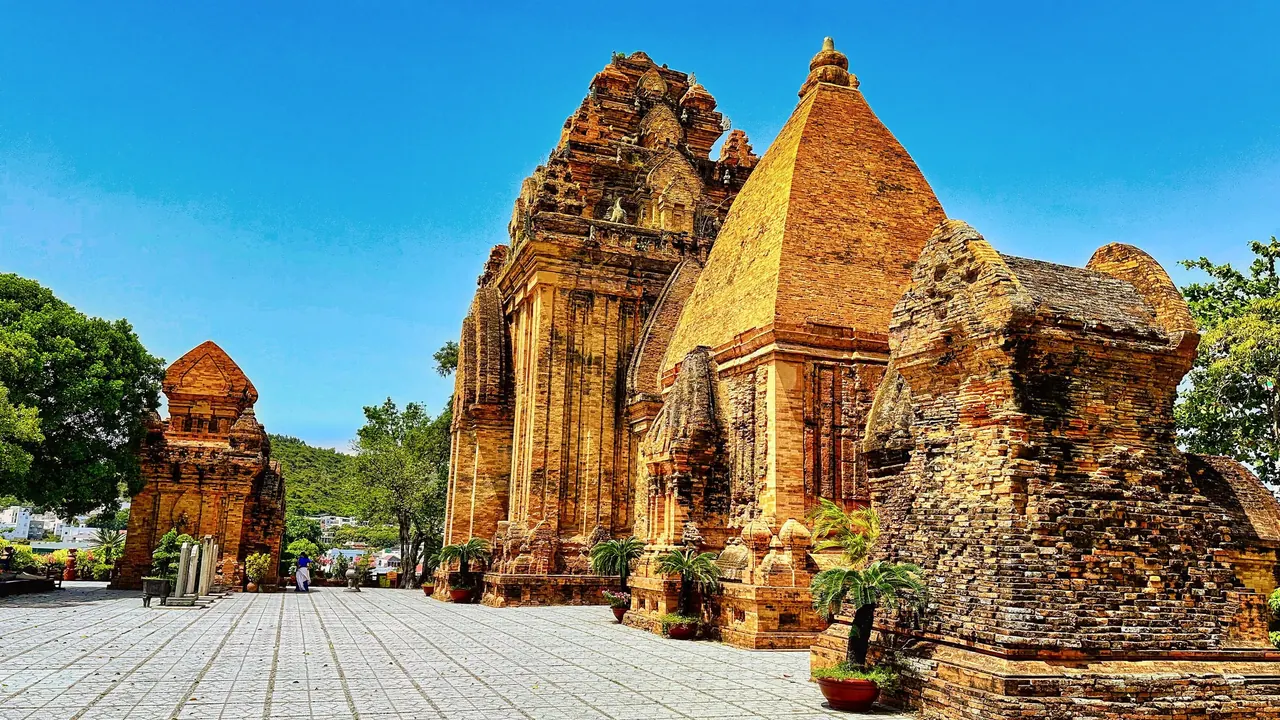
Photos: Da Nang by Nghia Tran, Pexels License; Nha Trang by Ms Sarah Welch, CC0.
Da Nang or Nha Trang?
Our verdict in twelve categories, each scored against the same fixed benchmark cities, and the climate month by month, so you can choose for your trip.
Choose Da Nang for
- day trips
- shopping
- nature and the outdoors
Da Nang is the better base for a trip that mixes the beach with sightseeing. Hoi An's lantern-lit old town is less than an hour away, Hue and the My Son ruins make full days out, and the Hai Van Pass, the Son Tra peninsula and the Ba Na Hills give you more to do on land. Choose it if a week on the sand alone would leave you restless.
Choose Nha Trang for
- getting around
- wellness
Travellers who want the sea to be the whole trip will be happier in Nha Trang. The beach runs right in front of the hotels, boat trips across the bay to the islands and the reef at Hon Mun fill the days, and the mud baths near the Thap Ba springs make an easy lazy afternoon. Its winter and spring are also sunnier and its summers gentler, though there is little beyond the bay worth a day out.
Scoreboard
Twelve categories on one fixed scale from 0 to 100. The shaded stretch is the gap between the two.
Your match
Pick a travel style or drag the sliders, and both match scores follow your weighting.
Wins on day trips and shopping with your weighting.
Wins on getting around and wellness with your weighting.
What matters to you?
Category by category
What the scores mean for a trip.
Beaches & swimming
Both give you a long, wide sandy beach with the same rhythm through the year: a warm, calm sea from spring and rough surf with red flags during the autumn monsoon. Where they differ is in how the beach sits in the town.
Da Nang's My Khe and Non Nuoc form a broad, open strip running south from the Son Tra peninsula, with lots of room, and quieter An Bang near Hoi An if you want a change. The centre lies back across the river. Nha Trang's 6km crescent runs right along the town centre behind a palm-shaded promenade, and its clearest water is out at the island bays, reached by boat.
Food & drink
Both are cheap, seafood-led places to eat, where you choose crab and clams from tanks and have them grilled to order, and where iced coffee with condensed milk is a daily habit. Da Nang has the stronger regional identity. Its central Vietnamese cooking is spicier and bolder, with mi quang turmeric noodles, banh xeo and pork rolled at the table, and Han and Con markets are good places to graze.
Nha Trang's own dishes are lighter and more local: banh can cooked in clay moulds, nem nuong pork rolls from Ninh Hoa, and fish-cake noodle soup with jellyfish. Around the tourist streets, though, many menus give way to pizza and Russian food, so you have to head into the residential streets to eat well.
Culture & sights
Neither is a sightseeing city, and a day or two covers each. What you see differs. Da Nang's highlights are a world-class collection of Cham sandstone carving in its museum and the cave shrines of the Marble Mountains, climbed by stone stairways.
Nha Trang's Cham heritage is a living one: the brick towers of Po Nagar above the river mouth are still used for worship. Add the hilltop Buddha at Long Son Pagoda and the small museum to Alexandre Yersin, and that is the town's list.
Nightlife
Evenings are equally modest in both places, but they feel different. Da Nang's are slower and more scenic: walks along the Han River while the bridges light up, rooftop bars, craft beer in the An Thuong blocks behind the beach, and most of the city quiet by midnight.
Nha Trang is louder and runs later, with backpacker bar crawls, fire shows and DJ nights on the sand, and a few clubs that keep going into the early hours. In both, the most local night out is beer and grilled seafood at long outdoor tables.
Nature & outdoors
Da Nang has more varied landscape within reach. The forested Son Tra headland with its rare douc langurs is on the city's edge, the Hai Van Pass is one of Vietnam's great coastal rides, and the Ba Na Hills and the rainforest trails of Bach Ma National Park take you up into the mountains.
Nha Trang's outdoors is mostly the bay. Its strength is underwater, with the protected coral around Hon Mun among the country's best-known diving and snorkelling grounds. On land there is only the scramble up to the Ba Ho waterfalls and half-days in the Hon Ba hills.
Day trips
This is where the two differ most. From Da Nang, the old trading port of Hoi An is about 45 minutes away and worth more than one evening visit. The jungle temples of My Son and the citadel and royal tombs of Hue each make a rewarding full day, the latter by way of the Hai Van Pass.
Nha Trang has little within an easy day. The best outing is two hours south to the Cham towers of Po Klong Garai near Phan Rang, plus boat trips to fishing islands such as Binh Ba. Dalat needs an overnight stay, so most visitors simply stay by the bay.
Good for families
Both are equally good for families and share the same drawbacks: scooter traffic, broken pavements for pushchairs, midday heat and an autumn sea that is often off limits. The big days out differ. Da Nang's is the Ba Na Hills, with its long cable car, mock French village and the Golden Bridge held up by stone hands, plus a riverside Ferris wheel and water parks in town.
Nha Trang's is a boat ride across the bay to the Hon Tre island amusement park, which combines rides, a water park and an aquarium. The turtles at the Oceanographic Institute and a messy afternoon in the mud baths go down well with children too.
Getting around
Neither has a metro or useful buses, and in both you rely on cheap app-booked cars and motorbike taxis or a hired scooter. Nha Trang's hotels, restaurants and beach sit in one strip you can mostly walk, but its airport at Cam Ranh is about 35km away.
Da Nang is more spread out, with the river centre and the beach a short ride apart, but its airport is inside the city, and the flat, straight coastal road makes reaching Hoi An and the Marble Mountains simple.
Shopping & style
Neither is a place for fashion, but Da Nang offers more to browse. Han and Con markets sell coffee, dried seafood and fabrics, there are modern malls, and the stone-carving workshops of Non Nuoc village near the Marble Mountains make an interesting stop. Above all, Hoi An's tailors, lanterns and leather goods are close by.
In Nha Trang, shopping means the round Cho Dam market hall and the night market by the beach, where haggling is expected. The regional specialities to look for are pearls, agarwood and bird's nest products.
Affordability
Noodles, coffee and app rides cost little in either city, so the real difference is where the bill climbs. In Da Nang the good-value mid-range hotels sit a block or two back from the beach. The extra spending comes at the big Son Tra resorts, a day at the Ba Na Hills and the western-style bars near the sand.
Nha Trang's mid-range rooms often come with a sea view or a pool, and Po Nagar and the pagodas cost little or nothing to visit. The extras are the island amusement park, dive and boat trips, imported drinks and tourist-street seafood priced by weight, so check before you order.
Live music & performing arts
Da Nang has a little more on stage, though in either city a performance is a bonus rather than a reason to book. Tuong, central Vietnam's painted-face classical theatre, has its own theatre here, though shows are irregular. An international fireworks festival lights up the Han River over several summer weekends, and Hoi An adds river shows and bai choi singing games in the evenings.
In Nha Trang, live entertainment comes down to cover bands in beach bars and hotel lounges and the odd folk dance or Cham music show at the temple sites. There are also outdoor performances when the sea festival is held.
Wellness & relaxation
For rest and pampering the two are evenly matched, with massage shops on almost every street in both. Da Nang has the easier pace overall, with dawn swims, long coffees, quiet riverside evenings and spa villas over the sea on Son Tra. Its hot springs park is about 30km out.
Nha Trang's mud baths near the Thap Ba springs are its signature, a half day of warm mineral mud and hot pools. The high-rise centre is noisy into the evening, though, so the most restful stays are in the bays outside town.
When should you go?
Pick your month. The climate figures are measured averages, not a forecast.
Da Nang in July
Nha Trang in July
Daytime high, °C
Rainfall in the month, mm
Temperature and rainfall are climate normals, averaged over the years shown. Da Nang: 1991-2020 normals, Da Nang (4.9 km from centre). Nha Trang: 1991-2020 normals, Nha Trang (1.1 km from centre).
Da Nang's year splits sharply in two. February to July are the dry months, and the sea is at its best from May, when it reaches about 28°C. February to April suit walking the streets, before highs of 35°C in June and July make midday sightseeing hard work. August turns wetter, and from September the monsoon arrives in force, with around 726mm of rain in October. December is grey and dull, so autumn and early winter are poor for the beach.
Nha Trang follows the same pattern more gently. Its summer peaks a couple of degrees cooler and the sea is already warm by April. From February to April it gets clearly more sunshine than Da Nang, which makes it the better choice early in the year. Its rains come later and lighter, peaking in November at around 390mm, and even January stays warm and dry enough for a beach day.
Which traveller are you?
On a culture and arts trip, Da Nang is the clear choice. The Cham sculpture museum and the Marble Mountains are a start, but the real draw is what you can reach: Hoi An, the My Son temples and imperial Hue all work as day trips.
For an outdoors trip, Da Nang has more range on land: langurs on the Son Tra peninsula, the Hai Van Pass by motorbike or bicycle, the Ba Na Hills and rainforest trails in Bach Ma. Nha Trang wins only if you spend your days underwater at Hon Mun.
On a beach and sun trip, especially between January and May, Nha Trang edges ahead. Both beaches are excellent, but Nha Trang's winter and spring are warmer and noticeably sunnier, its summer heat is milder, and the sand starts at the hotel door.
Before you go
| Measure | Da Nang | Nha Trang |
|---|---|---|
| Official language | Vietnamese | Vietnamese |
| Currency | Dong (VND) | Dong (VND) |
| Sockets | ACFG220 V, 50 Hz | ACFG220 V, 50 Hz |
| Driving side | Right | Right |
| Time zone | UTC+7 | UTC+7 |
| Emergency number | Police 113, ambulance 115, fire 114 | Police 113, ambulance 115, fire 114 |
| Elevation | 19 m | 13 m |
| Main airport | Da Nang International Airport (DAD)3 km from centre47 non-stop destinations | Cam Ranh International Airport / Cam Ranh Air Base (CXR)28 km from centre53 non-stop destinations |
By the numbers
| Measure | Da Nang | Nha Trang |
|---|---|---|
| City population | 2,819,900 | 392,279 |
| People per km² | 238 | 1,563 |
| Museums within 10 km | 2 | 1 |
| UNESCO World Heritage sites within 50 km | 2 | 0 |
| Swim season, months above 21 °C | 12 months | 12 months |
Where else could you go?
Every comparison below shares a destination with this one, so you can follow Da Nang or Nha Trang somewhere new.
- Hoi Anvs Da Nang
- Huevs Da Nang
- Ho Chi Minh Cityvs Nha Trang
- Hoi Anvs Nha Trang
- Phnom Penhvs Nha Trang
- Huevs Nha Trang