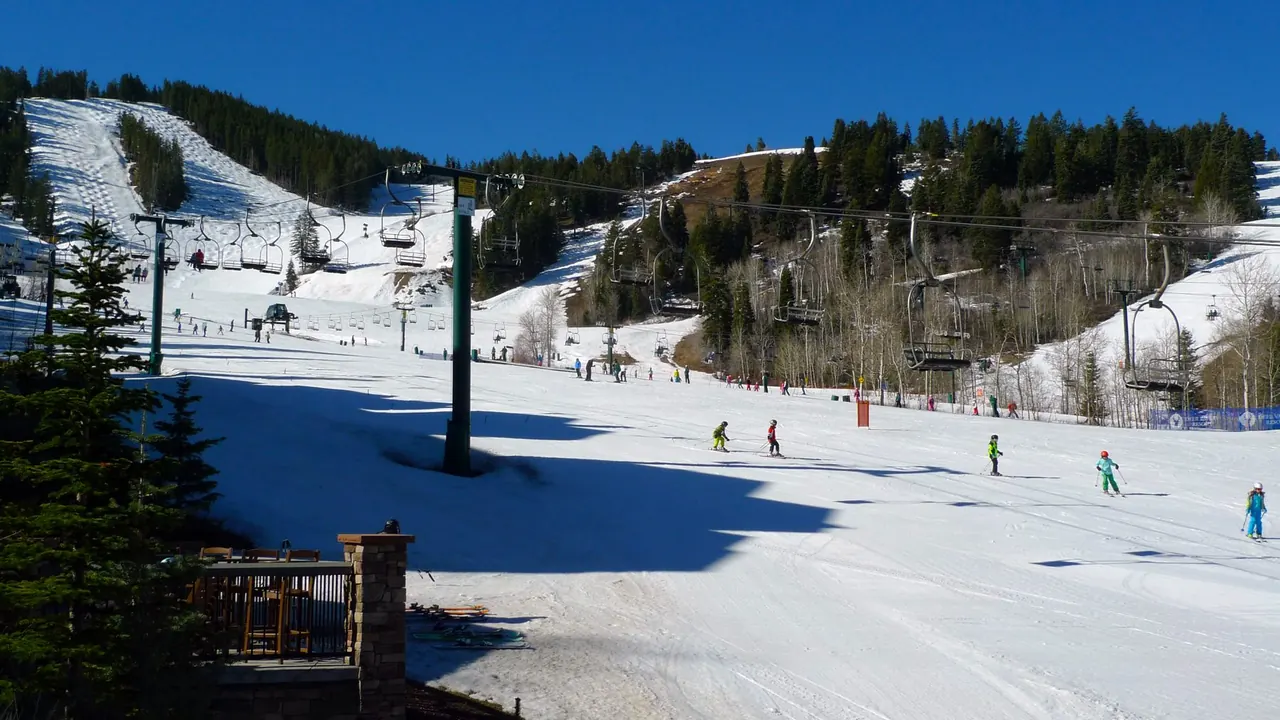
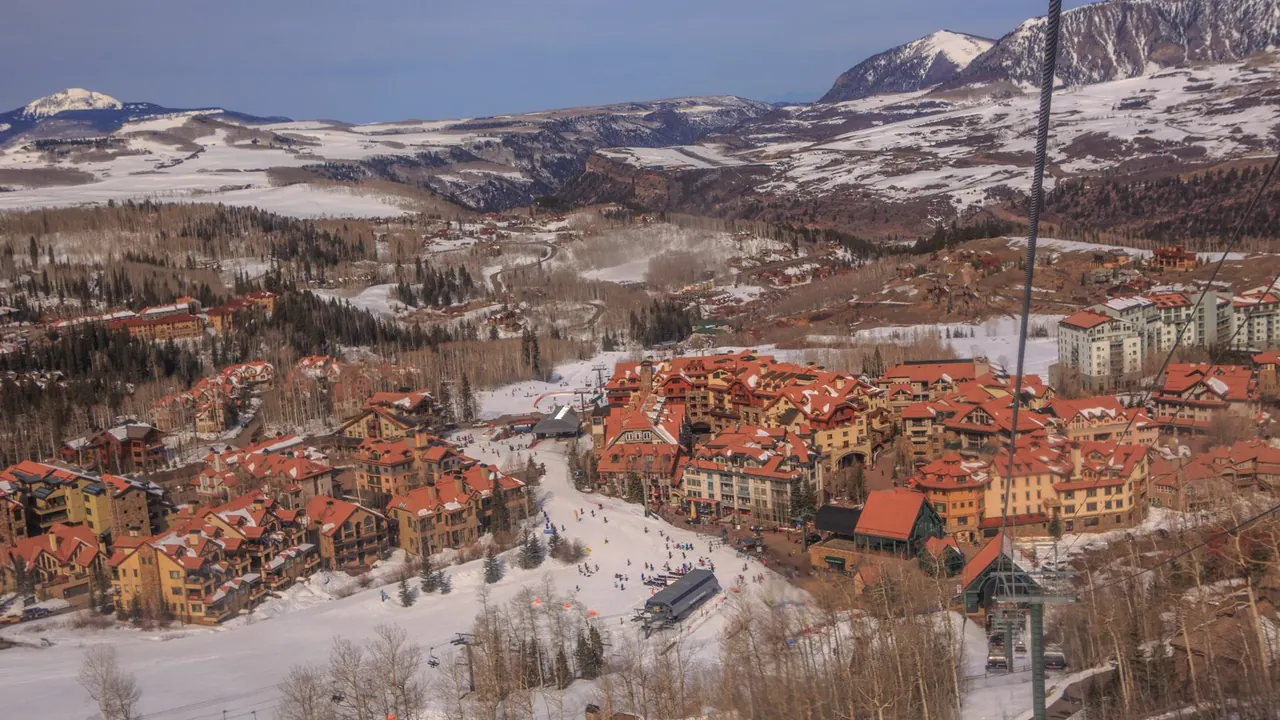
Photos: Deer Valley by Don Ramey Logan, CC BY 4.0, cropped; Telluride by Murray Foubister, CC BY-SA 2.0, cropped.
Deer Valley or Telluride?
Our verdict in twelve categories, each scored against the same fixed benchmark cities, and the climate month by month, so you can choose for your trip.
Choose Deer Valley for
- families
- day trips
- wellness
Deer Valley suits families who ski and travellers who want an easy, polished mountain stay. Children's ski schools, wide groomed runs and attractions such as the Olympic park make the days run smoothly. The lodges and hotel spas put comfort first, and Salt Lake City, with its airport and museums, is close enough for a wet afternoon or a convenient flight home.
Choose Telluride for
- getting around
- culture and sights
- live music and the arts
Telluride rewards those who don't mind a longer journey. Once you arrive, you can leave the car parked: the historic mining town is a walkable grid, a free gondola carries you to the ski area, and cliffs, waterfalls and trailheads begin at the end of the main street. Choose it for summer festivals in a dramatic canyon, or for a car-free week in a town that has kept its nineteenth-century streets.
Scoreboard
Twelve categories on one fixed scale from 0 to 100. The shaded stretch is the gap between the two.
Your match
Pick a travel style or drag the sliders, and both match scores follow your weighting.
Too close to call, level with your weighting
Wins on families and day trips with your weighting.
Wins on getting around and culture and sights with your weighting.
What matters to you?
Category by category
What the scores mean for a trip.
Beaches & swimming
Neither place is for swimmers, and the difference is only in how far you go to find water. From Deer Valley, the sandy state-park shore at Jordanelle Reservoir is a short drive downhill and is pleasant on hot midsummer afternoons. From Telluride, the nearest proper swimming spot is a reservoir near Ridgway, about an hour away, where the water stays cool even in July, so most visitors raft or paddle instead.
Food & drink
The two eat at much the same level and fill the same niche: upscale resort dining with no local cuisine or market culture behind it. Deer Valley borrows Park City's surprisingly wide spread of steakhouses, sushi and bistros, and adds its own famous base-area turkey chili. Drinking there revolves around restaurants, local distilleries and breweries.
Telluride's kitchens lean more on the region, with Colorado lamb, elk, trout and Western Slope produce, and its wine lists are deeper than the town's size would suggest. Its circle of restaurants is smaller, though, and on festival weekends tables are hard to come by.
Culture & sights
Each offers an hour or two of mining history rather than a reason to visit. Telluride's version is more complete: the whole town is a protected landmark district of clapboard houses and false-fronted blocks, with ruined mills on the canyon walls above. Deer Valley relies on neighbouring Park City's restored Main Street and its museum in the old city hall. What it adds is the Olympic Park, where you can see the ski-jump towers from the 2002 Games.
Nightlife
Both are early-to-bed resorts where the evening means après-ski and a drink, not clubs. Deer Valley's own lodges go quiet, and the action moves a few minutes down to Park City's Main Street, which has a wider choice of cocktail bars and saloons, though Utah's liquor rules shape the night. In Telluride the scene is a handful of Victorian saloons on Colorado Avenue. They can stay lively late in peak ski weeks and on festival weekends, but the town falls very quiet in the shoulder seasons.
Nature & outdoors
Both are top-tier mountain bases, but the setting is different. Deer Valley's strength is reach. Its immaculately groomed slopes sit next to Park City Mountain, and the powder of Alta, Snowbird, Brighton and Solitude is about an hour away. In summer the lift-served bike trails run through aspen and fir.
Telluride is the more dramatic place to stand in. Peaks above 4,000m, Bridal Veil Falls and trails to Blue Lake rise straight from the town, and the ski area adds steep hike-to terrain with some of the best views in American skiing. It is also higher, at about 2,670m, so allow a little longer to adjust.
Day trips
Deer Valley has more within reach. Salt Lake City's Temple Square, capitol and museums are about forty minutes away. Nearer still are the Heber Valley's steam railway and Swiss-styled Midway, and the arts village at Sundance.
Telluride's outings mean long mountain drives to small places: Ouray's canyon setting, Silverton at the end of the narrow-gauge line, and Mesa Verde's cliff dwellings, about two and a half hours each way. Winter passes can slow or close all of these routes.
Good for families
Deer Valley is the better fit for children. Its ski schools are well run and its beginner runs are wide and free of snowboarders, and the Olympic park's coaster, ziplines and tubing fill the days off the slopes. Salt Lake City's zoo, planetarium and children's museum are close enough for a rainy day.
Telluride suits active families who are happy with gondola rides, easy waterfall walks and fishing. With no museums or attractions for children and little to do indoors, a wet day is hard to fill, and its greater altitude can trouble young sleepers.
Getting around
Once you have arrived, Telluride is the easier place to get around. The historic grid takes a quarter of an hour to cross on foot, and the free gondola to Mountain Village means many visitors never drive. Getting there is harder, though, because the local airport is prone to weather delays.
Deer Valley is the opposite case. Salt Lake City airport is only about forty minutes away, and fare-free buses link the bases with Main Street. But the resort is spread over steep hillsides, so walking between lodges is impractical, and most outings mean driving.
Shopping & style
Neither is a shopping destination, and both offer galleries, Western wear and outdoor gear behind old mining-town façades. Deer Valley has the outlet centre at Kimball Junction for bargains, and Salt Lake City is close for anything else. Telluride's few blocks of Colorado Avenue offer jewellery boutiques and a couple of good bookshops, but there is nothing larger within easy reach.
Affordability
Both are among the priciest mountain resorts in North America, and neither makes a sensible budget choice. What differs is how you cut costs.
At Deer Valley, summer is noticeably cheaper, and staying in the Heber Valley or Salt Lake City puts only a short drive between you and the slopes. In Telluride, the scarce rooms climb even higher over Christmas, New Year and the summer festival weekends, and the cheaper beds in Ridgway mean a longer daily commute.
Live music & performing arts
Summer is the season in both, but the music differs. At Deer Valley, the Utah Symphony's outdoor festival brings picnics on the grass at Snow Park for classical and pops concerts, and the 1920s Egyptian Theatre stages plays and comedy all year.
Telluride's summer calendar is more of a draw in itself. It includes the long-running bluegrass festival in Town Park, jazz and chamber music, and the film festival over Labor Day weekend, with the Sheridan Opera House hosting smaller shows in between.
Wellness & relaxation
Deer Valley is a little more geared to unwinding. Its quiet slopeside lodges have fireplaces, hot tubs on snowy terraces and some of the most polished spas in the mountain West. The warm spring inside the Homestead Crater is half an hour away.
Telluride has good hotel spas in Mountain Village and calm shoulder seasons. Its best soaks are the hot springs at Ouray and near Ridgway, about an hour's drive, and its higher altitude leaves some guests sleeping poorly at first.
When should you go?
Pick your month. The climate figures are measured averages, not a forecast.
Deer Valley in July
Telluride in July
Daytime high, °C
Rainfall in the month, mm
Where the figures come from
Deer Valley's temperatures are measured 82 km from the centre, at Evanston.
Deer Valley's station stands 297 m below the city centre, so the centre is likely a little cooler than the figures say.
Deer Valley has no rain gauge within 25 km of the centre, so its rainfall comes from a gridded climate dataset read at the city rather than from a gauge further away.
Telluride has no rain gauge within 25 km of the centre, so its rainfall comes from a gridded climate dataset read at the city rather than from a gauge further away.
Temperature and rainfall are climate normals, averaged over the years shown. Deer Valley: 1999-2020 (rainfall 1991-2020) normals, Evanston (81.9 km from centre). Telluride: 2006-2020 (rainfall 1991-2020) normals, Telluride / Lime (8.2 km from centre).
Both resorts are deep in winter from December to February. Deer Valley is the colder of the two, with daytime highs around -2°C, while Telluride's highs stay just above freezing. Spring warms slowly at the same pace in both. In summer they part ways. Deer Valley climbs to about 28°C in July, warm enough for the reservoir beach on a hot afternoon, and June and July are its driest months at around 23mm.
Telluride's summer is cooler, peaking around 23°C, which is better weather for hiking at altitude. July and August are its wettest months, though, reaching 67mm in August, so plan high walks for the morning. September is pleasant in both, and in Telluride it brings the aspens turning gold. By November both are heading back to snow.
Which traveller are you?
On a family trip with children, Deer Valley is the safer bet. The resort is organised so that ski days run without friction, the airport transfer is short for tired children, and a full-size city is within the hour for days off the snow.
For a relaxing and wellness trip, Deer Valley edges ahead because comfort is the whole point of the resort, so unwinding takes no planning or driving. Its lower base also means easier sleep in the first nights than Telluride's thinner air.
On an outdoors trip, especially a summer one, Telluride offers the more dramatic setting. Trails to waterfalls and high basins start within minutes of town, and there is a via ferrata on the canyon wall, along with jeep roads over old mining passes.
Before you go
| Measure | Deer Valley | Telluride |
|---|---|---|
| Currency | US Dollar (USD) | US Dollar (USD) |
| Sockets | AB120 V, 60 Hz | AB120 V, 60 Hz |
| Driving side | Right | Right |
| Time zone | UTC-7, UTC-6 in summer | UTC-7, UTC-6 in summer |
| Emergency number | 911 | 911 |
| Elevation | 2,474 m | 2,667 m |
| Main airport | Salt Lake City International Airport (SLC)45 km from centre108 non-stop destinations | Montrose Regional Airport (MTJ)64 km from centre11 non-stop destinations |
| Public holidays this year | 12 days | 12 days |
By the numbers
| Measure | Deer Valley | Telluride |
|---|---|---|
| City population | - | 2,607 |
| People per km² | - | 1,372 |
| Museums within 10 km | 0 | 0 |
| UNESCO World Heritage sites within 50 km | 0 | 0 |
Where else could you go?
Every comparison below shares a destination with this one, so you can follow Deer Valley or Telluride somewhere new.