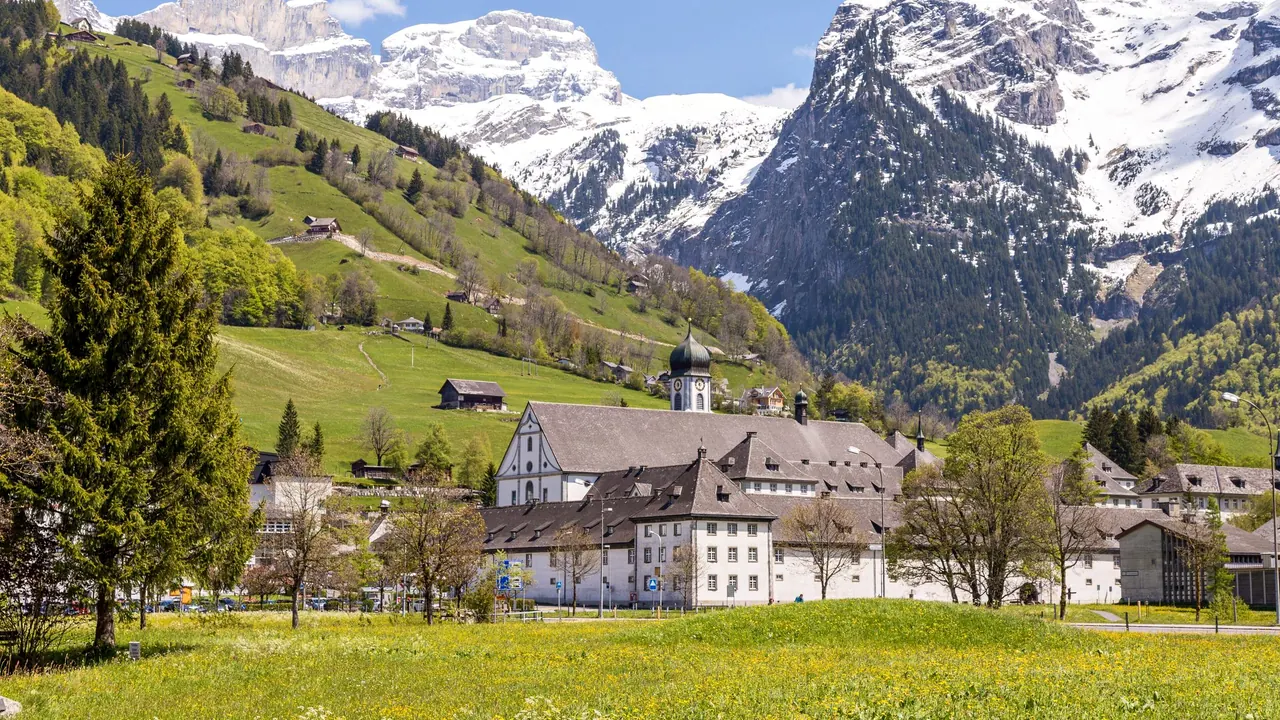
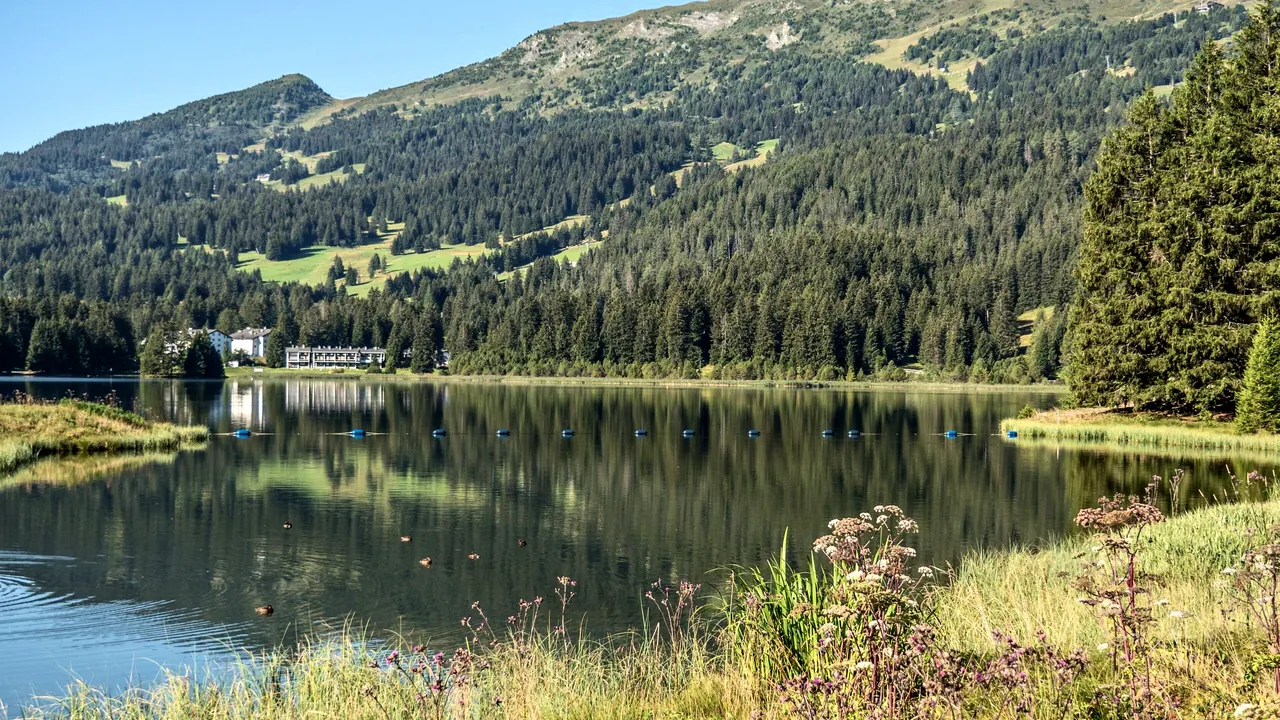
Photos: Engelberg by JoachimKohler-HB, CC BY-SA 4.0, cropped; Lenzerheide by Jag9889, CC BY-SA 4.0, cropped.
Engelberg or Lenzerheide?
Our verdict in twelve categories, each scored against the same fixed benchmark cities, and the climate month by month, so you can choose for your trip.
Choose Engelberg for
- getting around
- culture and sights
- day trips
Engelberg suits travellers who want the high mountains without a car. The train from Lucerne pulls in at the edge of the village, everything is a short walk, and the Titlis glacier puts permanent snow, an ice cave and serious freeride slopes within a cable-car ride. It also has the stronger extras: a Benedictine abbey at its heart and Lucerne's old town and lake steamers less than an hour away.
Choose Lenzerheide for
- food and drink
- wellness
- nature and the outdoors
Lenzerheide is the better pick for active people who want a wide, open mountain bowl, especially in summer. Its bike park and singletrack make it one of the great cycling bases in the Alps, the ski area links over to Arosa, and the Heidsee gives the village its own lake shore. The Graubünden cooking and local wines give meals a little more character, and the Albula railway and Chur are within easy reach.
Scoreboard
Twelve categories on one fixed scale from 0 to 100. The shaded stretch is the gap between the two.
Your match
Pick a travel style or drag the sliders, and both match scores follow your weighting.
Too close to call, 2 points apart
Wins on getting around and culture and sights with your weighting.
Wins on food and drink and wellness with your weighting.
What matters to you?
Category by category
What the scores mean for a trip.
Beaches & swimming
Neither village is for swimmers, but they handle a hot day differently. In Engelberg the Trübsee and the other mountain lakes are for looking at, so a proper swim means taking the train down to Lake Lucerne, about an hour away, where the lidos and lakeside meadows have clear water that reaches about 22°C in midsummer.
Lenzerheide has its swim on the doorstep. The Heidsee lido sits at the foot of the village with a grassy shore, but at this altitude the water stays noticeably colder, rarely much above 18°C. Expect a brisk dip in July or August rather than a long, lazy afternoon in the water.
Food & drink
Both villages are about hearty mountain meals rather than a food scene, but Lenzerheide's table has a bit more regional character. Graubünden dishes such as capuns in chard and pizokel dumplings, air-dried beef and Engadine nut tart sit alongside wines from the Bündner Herrschaft, and a couple of hotel kitchens aim higher.
Engelberg's menus come back to the same fondue, rösti and Älplermagronen, and there is little else. Its one real food stop is the show dairy inside the monastery, where you can watch cheese being made, and a terrace lunch facing the glacier.
Culture & sights
Engelberg has a real centre. The white monastery buildings fill the valley floor, the bright late-baroque abbey church is worth an unhurried visit, and a small valley museum and the old Belle Époque hotels tell the story of early Alpine tourism. It fills a morning rather than a week, but it is there.
Lenzerheide is a resort strip of chalets and hotels with almost no historic fabric. Small village churches and Romansh place names hint at older Graubünden, but for a cathedral or a museum you go down to Chur.
Nightlife
Going out is a winter-only affair in both places and much the same size: après-ski bars that fill at the bottom of the lifts, then a couple of late bars and a small club on peak weekends. Engelberg's crowd has a particular flavour, young freeriders and seasonal workers, many of them Scandinavian. Lenzerheide's is the louder slope-side, ski-boot kind. Summer evenings in either end with a drink on a terrace.
Nature & outdoors
Both are first-rate mountain bases with different strengths. Engelberg is about drama and height: a deep valley under the glaciated Titlis, with an ice cave, a suspension bridge and a rotating gondola that bring permanent snow within anyone's reach. Its steep north faces draw freeriders, and the Four Lakes route over the Jochpass is the classic summer walk.
Lenzerheide is broader and gentler, a wide bowl of larch forest and meadow between the Rothorn and the Stätzerhorn. Its ski area links to Arosa for long, varied pistes, and in summer its bike park and singletrack lead the way, with easy lake loops for walkers.
Day trips
Engelberg has the stronger day out and the simpler one to reach. Lucerne is under an hour down the valley by train, and its covered wooden bridges, old town lanes and paddle steamers across the lake make a fuller day than Chur, Lenzerheide's nearest town. For a second outing, Einsiedeln's great baroque abbey or Zurich are both within a couple of hours, although every trip starts with the same train back down the valley.
From Lenzerheide, the best day is the train ride itself. The UNESCO-listed Albula line climbs over spirals and viaducts towards St Moritz, which is a memorable day but a longer one, starting with the PostBus down to Chur, where the cathedral and painted lanes are worth a stop. The Heidi country around Maienfeld and its wine villages makes a gentler day, and Vaduz in Liechtenstein is easiest by car.
Good for families
Both are safe, easy villages for children. In Engelberg the highlights are the stepping stones and rafts on the Härzlisee and summer snow on Titlis, and Lucerne's large transport museum saves a rainy day. Take care with very small children at the glacier station, which is high and cold.
Lenzerheide's broad, sunny slopes suit families with mixed skiing abilities, and summer brings pedalos on the Heidsee, toboggan runs and easy bike trails for young riders. When it rains, though, the nearest real attraction is down in Chur.
Getting around
Engelberg is the easier place to be without a car. The cog railway from Lucerne arrives in the village itself, the centre is small and flat enough to walk, and the cable cars leave from its edge.
Lenzerheide has no railway, so arriving means a PostBus up from Chur. The resort stretches for several kilometres along the valley road through Valbella and Parpan, so local buses do more of the work, and a car helps for reaching the wine villages and other valleys.
Shopping & style
Neither is a shopping destination, and in both the shops are mostly ski, bike and outdoor gear. What you take home differs. In Engelberg it is cheese from the monastery dairy, with a few watch and jewellery shops aimed at tour groups. In Lenzerheide the village delis sell Graubünden sausage and nut tart, and for anything more you go to Chur.
Affordability
Both are among the most expensive kinds of places to stay in Europe, and budgets suffer in either. The particular costs differ. In Engelberg the Titlis cable car is a big expense on its own, though a Swiss travel pass softens train fares and some lift prices. In Lenzerheide the guest card covers local buses and summer is a little gentler, but in both places self-catering is the usual way to save.
Live music & performing arts
Live performance is thin in both. Engelberg has the edge in setting, with organ recitals and a small summer classical festival in the baroque abbey church, and Lucerne's concert halls less than an hour away. Lenzerheide offers only occasional open-air concerts around its big sporting events, so a proper evening of music means a trip to Chur.
Wellness & relaxation
In both villages, relaxing means a hotel spa followed by quiet mountain evenings, and neither has a public bathing tradition. Engelberg began as a health resort and still offers clean valley air, though the Titlis crowds make it feel busy at peak times. From Lenzerheide, real thermal water is within reach, at Bad Ragaz about an hour away, or at the stone baths in Vals for those willing to drive further.
When should you go?
Pick your month. The climate figures are measured averages, not a forecast.
Engelberg in July
Lenzerheide in July
Daytime high, °C
Rainfall in the month, mm
Where the figures come from
Engelberg has no weather station within reach, so its figures come from a gridded climate model rather than a measured record, and read a broad area rather than one spot.
Lenzerheide's temperatures are measured 33 km from the centre, at Samedan.
Lenzerheide's station stands 234 m above the city centre, so the centre is likely a little warmer than the figures say.
Lenzerheide has no rain gauge within 25 km of the centre, so its rainfall comes from a gridded climate dataset read at the destination rather than from a gauge further away.
Temperature and rainfall are climate normals, averaged over the years shown. Engelberg: 2001-2020 normals, NASA POWER reanalysis grid, no weather station within 90 km. Lenzerheide: 2015-2025 (rainfall 1991-2020) normals, Samedan (32.9 km from centre).
Neither village is ever warm enough for a beach vacation. Both are at their best for walking and biking from June to September, and both are wettest then, with heavy summer rain from May to August. Engelberg is slightly warmer in high summer, reaching about 21°C in July and August, and its spring arrives sooner, so April and May walks in the valley are milder than up on Lenzerheide's high pass.
The two part ways in autumn. Engelberg turns drier from September, with around 101mm a month, while Lenzerheide stays wet well into November, with about 143mm in September. In winter Lenzerheide is the colder of the two, with January highs near -1°C, which keeps its snow reliable. In Engelberg, Titlis keeps glacier snow all year above the green valley.
Which traveller are you?
On a culture and arts trip, Engelberg is the clear choice. Its abbey, founded in 1120, has a baroque church with one of Switzerland's largest organs and holds recitals, and Lucerne's museums and concert halls are an easy train ride away.
For a short city break with a mountain day attached, Engelberg is much simpler. The train runs straight from Lucerne to the village, everything is within walking distance, and the glacier fits into a single day. Lenzerheide means a PostBus connection and a village spread along the road.
For mountain bikers, Lenzerheide is the place. Its bike park hosts international races, and there is flowing singletrack and long tours across a wide bowl of forest and meadow. Engelberg has trails, but its steep valley is better known for freeriding and glacier walks.
Before you go
| Measure | Engelberg | Lenzerheide |
|---|---|---|
| Official language | French, German, Italian, Romansh | French, German, Italian, Romansh |
| Currency | Swiss Franc (CHF) | Swiss Franc (CHF) |
| Sockets | CJ230 V, 50 Hz | CJ230 V, 50 Hz |
| Driving side | Right | Right |
| Time zone | UTC+1, UTC+2 in summer | UTC+1, UTC+2 in summer |
| Emergency number | 112 | 112 |
| Elevation | 1,015 m | 1,473 m |
| Main airport | Zürich Airport (ZRH)72 km from centre226 non-stop destinations | Zürich Airport (ZRH)112 km from centre226 non-stop destinations |
| Public holidays this year | 13 days | 9 days |
By the numbers
| Measure | Engelberg | Lenzerheide |
|---|---|---|
| Population | 4,181 | 2,641 |
| People per km² | 56 | - |
| Museums within 10 km | 0 | 1 |
| UNESCO World Heritage sites within 50 km | 2 | 1 |
Where else could you go?
Every comparison below shares a destination with this one, so you can follow Engelberg or Lenzerheide somewhere new.
- Arosavs Lenzerheide
- Davosvs Lenzerheide
- Laaxvs Lenzerheide
- Andermattvs Engelberg
- Klostersvs Lenzerheide
- St. Moritzvs Lenzerheide