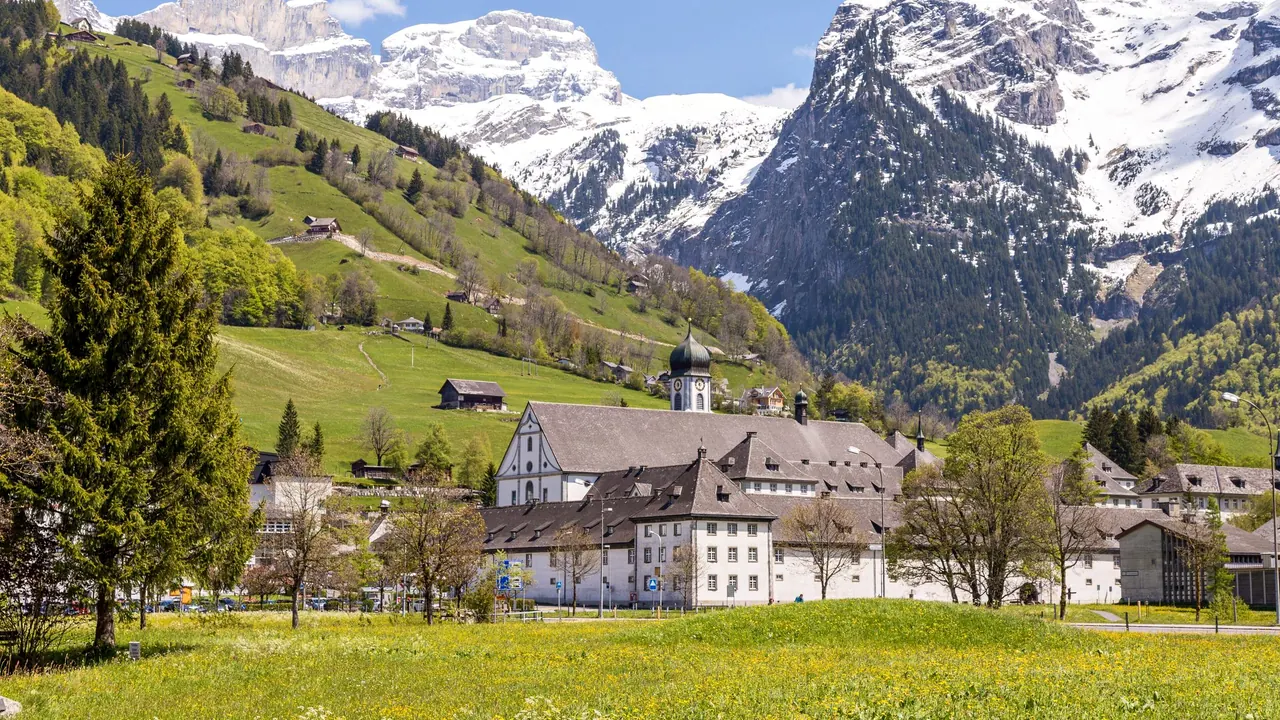
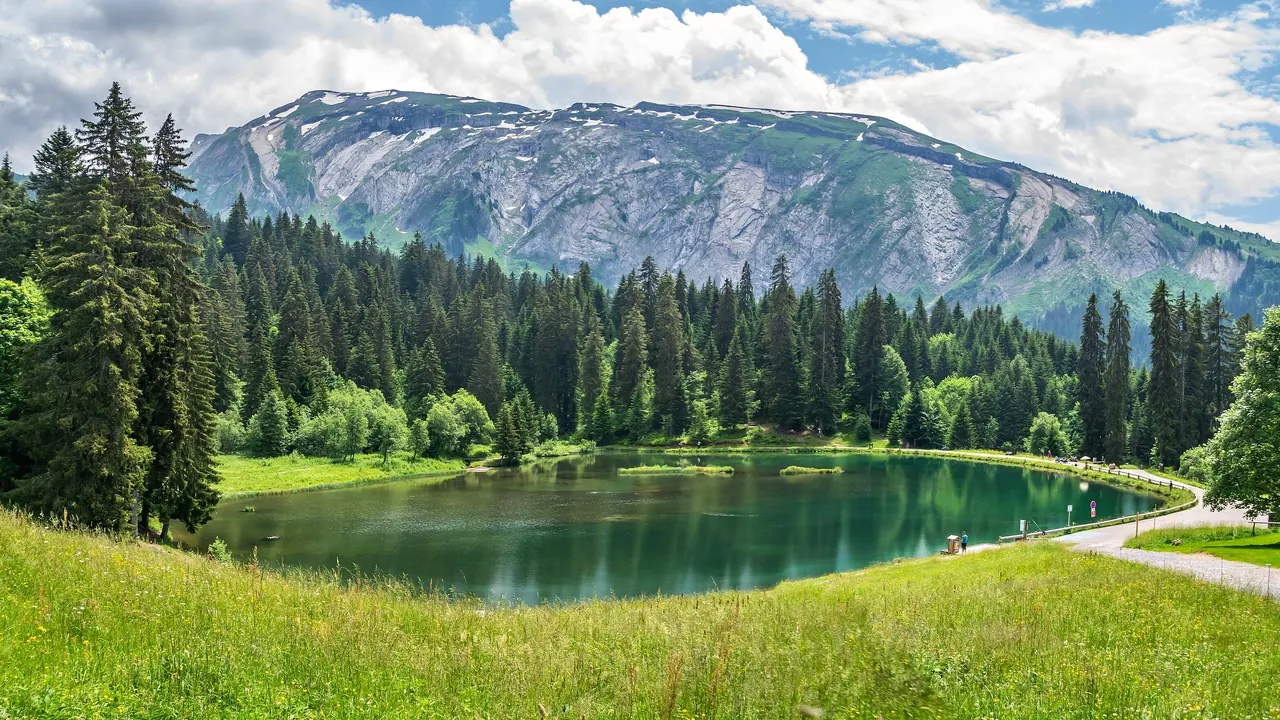
Photos: Engelberg by JoachimKohler-HB, CC BY-SA 4.0, cropped; Morzine by Krzysztof Golik, CC BY-SA 4.0, cropped.
Engelberg or Morzine?
Our verdict in twelve categories, each scored against the same fixed benchmark cities, and the climate month by month, so you can choose for your trip.
Choose Engelberg for
- getting around
- culture and sights
- day trips
Engelberg suits travellers who want a single great mountain and no car. The train climbs from Lucerne to the village, cable cars leave from its edge, and the Titlis glacier puts permanent snow and an ice cave within reach of anyone, while its steep north faces draw serious freeriders. Evenings are quiet, the abbey gives the valley a centre, and Lucerne's lakes and old town are an easy outing. Swiss prices come with it.
Choose Morzine for
- prices
- nightlife
- beaches
Morzine is the better pick for skiers who want huge linked terrain and for summer mountain bikers. The Portes du Soleil spreads across the French-Swiss border, and its lifts carry bikes all summer. The après-ski is louder, the Savoyard cooking is richer and summers are warmer, with Lake Geneva close enough to swim in. It costs less than Engelberg, though it is far from cheap, and a car makes the most of it.
Scoreboard
Twelve categories on one fixed scale from 0 to 100. The shaded stretch is the gap between the two.
Your match
Pick a travel style or drag the sliders, and both match scores follow your weighting.
Too close to call, 2 points apart
Wins on getting around and culture and sights with your weighting.
Wins on prices and nightlife with your weighting.
What matters to you?
Category by category
What the scores mean for a trip.
Beaches & swimming
Neither village has a beach, but Morzine gets you into the water more easily. Lac de Montriond is a few minutes up the valley for a cool dip on hot afternoons. The grassy and pebble bathing spots of Thonon and Evian on Lake Geneva are under an hour's drive, and they warm up properly in July and August.
In Engelberg the Trübsee is for looking at, not swimming. A real swim means the train down to the Lake Lucerne lidos, about an hour away, or else the indoor pool at the sports centre.
Food & drink
Both kitchens are built on cheese and mountain appetites, but Morzine's Savoyard table has a little more range. As well as tartiflette, croziflette, reblochon and Abondance, it has a weekly market, good cheese shops and a few more ambitious village restaurants.
Engelberg's menus repeat rösti, fondue and Älplermagronen from one panelled dining room to the next, at higher prices. Its one real draw is the show dairy inside the monastery, where you can watch the cheese being made and then buy it.
Culture & sights
Neither is a sightseeing destination, but Engelberg has the one sight worth planning around. Its Benedictine abbey, founded in 1120, has a bright late-baroque church with one of Switzerland's largest organs, and a small valley museum and a few Belle Époque hotels add a little more.
Morzine offers a baroque church, some old farm chalets with wooden balconies and a short heritage walk about its slate-quarrying past. That takes an hour at most.
Nightlife
Both places come alive only in winter, but Morzine's après-ski is the bigger and louder of the two. Bars in the village centre fill as the lifts close, several keep DJs and bands going late, and in summer the mountain-bike crowd keeps a few places busy.
Engelberg's scene centres on young Scandinavian freeriders and seasonal workers, with a couple of late bars and a small club at high-season weekends. In summer the evening usually ends with a drink on a hotel terrace.
Nature & outdoors
Both are first-class mountain bases, and the difference is in kind. Engelberg is about one dramatic peak. Titlis takes you to a glacier with an ice cave and a suspension bridge, its north faces are famous freeride terrain, and the Four Lakes walk over the Jochpass is a classic summer hike.
Morzine is about scale. The Portes du Soleil links resorts across the French-Swiss border into a vast ski area, and in summer the same lifts serve hundreds of kilometres of downhill and enduro trails, with canyoning and rafting nearby and Chamonix within reach.
Day trips
Engelberg has the slight edge because its outings run by train. Lucerne is under an hour down the valley, with covered bridges and paddle steamers to Weggis and Vitznau. Stans, Schwyz with its federal charters and the great abbey at Einsiedeln are all close, and Zurich is under two hours away.
Morzine's list is just as varied: the painted cloister at Abondance, walled Yvoire, ferries from Evian to Lausanne, Annecy's canals and Chamonix. Most of these need a car, though, and winter roads can make the journeys longer.
Good for families
Both are safe, manageable villages with good ski schools. Morzine has slightly more to fill the days: car-free Avoriaz above it has a children's ski village and a tropical indoor water park, and in summer there are the roaming goats of Les Lindarets and pedal boats on Lac de Montriond. Its steep streets are hard going with a pushchair.
Engelberg is flatter and more compact. Children can play on the stepping stones and rafts on the Härzlisee and take boats out on the Trübsee, and Lucerne's transport museum is there for a wet day. The 3,000m glacier station can be tough on very young children.
Getting around
Engelberg is far easier without a car. The railway runs from Lucerne straight into the flat, walkable village, and the cable cars to both mountain areas start from its edge. The only drawback is that every outing begins with the same train back down the valley.
Morzine has no railway, so most people arrive by transfer from Geneva airport or drive in. The centre is spread along a hillside, the shuttle buses largely stop between seasons, and day trips really need a car, with snow chains in winter.
Shopping & style
Neither is somewhere to shop, and in both the main street is mostly gear hire and outdoor clothing. Engelberg adds watch and jewellery shops aimed at tour groups, and its best souvenirs are monastery cheese and Swiss chocolate. Morzine's weekly market and delicatessens sell Savoyard cheese, charcuterie and wine, and for anything more you would go to Geneva or Annecy.
Affordability
The money goes in different places. In Engelberg it is the everyday things that cost the most: a hotel night, dinner in a village restaurant and a round of drinks are all priced well above European norms, in summer as much as in winter, and ski passes and hire come on top. A Swiss travel pass cuts the train fares and takes something off some lifts, but the basics stay expensive.
Morzine is the cheaper of the two, and most of its costs come from the ski week itself: lift passes, equipment hire, ski school and lunches on the slopes at mountain prices. Off the mountain, a meal or a drink in the village costs noticeably less than in Engelberg, though a week here is still far from cheap.
Live music & performing arts
There is little to see in either, but what there is differs. Engelberg has organ recitals and concerts in the baroque abbey church, plus a small classical festival in summer, and Lucerne's concert halls are under an hour away by train. Morzine's live music is mostly cover bands and acoustic sets in après-ski bars, plus the odd village festival, and the nearest concert hall is in Geneva.
Wellness & relaxation
The two are much alike: hotel saunas and steam rooms, and no bathing tradition of their own. Engelberg began as a health resort, and its valley still feels restful midweek or in early summer. Morzine is more about hot tubs for tired legs after skiing, with massage in the village and the thermal baths of Evian within an hour's drive.
When should you go?
Pick your month. The climate figures are measured averages, not a forecast.
Engelberg in July
Morzine in July
Daytime high, °C
Rainfall in the month, mm
Where the figures come from
Engelberg has no weather station within reach, so its figures come from a gridded climate model rather than a measured record, and read a broad area rather than one spot.
Morzine's temperatures are measured 63 km from the centre, at Bourg-St-Maurice.
Morzine has no rain gauge within 25 km of the centre, so its rainfall comes from a gridded climate dataset read at the destination rather than from a gauge further away.
Temperature and rainfall are climate normals, averaged over the years shown. Engelberg: 2001-2020 normals, NASA POWER reanalysis grid, no weather station within 90 km. Morzine: 1999-2020 (rainfall 1991-2020) normals, Bourg-St-Maurice (62.7 km from centre).
Engelberg is the colder of the two in every month. From December to February the valley barely gets above freezing by day, which suits skiing and little else. Summer tops out at about 21°C, good walking weather but too cool for an outdoor swim. May to August is also the wet season, at around 150mm a month, so expect showers on the high trails. September is clearly drier and still mild, which makes it the best month for long hikes. October and November turn cool and grey.
Morzine runs several degrees warmer all year and reaches about 27°C in July, warm enough for an afternoon swim at Lac de Montriond or on Lake Geneva. Its rain is spread more evenly through the year and is heaviest in winter, at about 160mm in December. June and September are warm without being hot, and they are the most comfortable months for walking and riding.
Which traveller are you?
For a food and nightlife trip, Morzine is the clear choice. Tartiflette, reblochon and Savoie whites give its tables more character, and a large British and seasonal crowd keeps village bars loud until late, with summer bikers filling some of them too.
For a short city break, Engelberg works far better. The train arrives straight from Lucerne, the flat village needs no car, and the glacier cable car starts at its edge. Morzine has no railway and usually means a transfer from Geneva.
On a trip on a tight budget, Morzine is the less painful option. Engelberg charges full Swiss prices, and the Titlis cable car alone is a large expense. Morzine's catered chalets, self-catering and cheaper quiet weeks in January, March and summer stretch money further.
Before you go
| Measure | Engelberg | Morzine |
|---|---|---|
| Official language | French, German, Italian, Romansh | French |
| Currency | Swiss Franc (CHF) | Euro (EUR) |
| Sockets | CJ230 V, 50 Hz | CE230 V, 50 Hz |
| Driving side | Right | Right |
| Time zone | UTC+1, UTC+2 in summer | UTC+1, UTC+2 in summer |
| Emergency number | 112 | 112 |
| Elevation | 1,015 m | 890 m |
| Main airport | Zürich Airport (ZRH)72 km from centre226 non-stop destinations | Geneva International Airport (GVA)47 km from centre150 non-stop destinations |
| Public holidays this year | 13 days | 11 days |
By the numbers
| Measure | Engelberg | Morzine |
|---|---|---|
| Population | 4,181 | 2,658 |
| People per km² | 56 | 60 |
| Museums within 10 km | 0 | 1 |
| UNESCO World Heritage sites within 50 km | 2 | 3 |
Where else could you go?
Every comparison below shares a destination with this one, so you can follow Engelberg or Morzine somewhere new.
- Les Getsvs Morzine
- Avoriazvs Morzine
- Samoënsvs Morzine
- Châtelvs Morzine
- Flainevs Morzine
- Andermattvs Engelberg