Photos: Engelberg by JoachimKohler-HB, CC BY-SA 4.0, cropped; Wengen by Charles J. Sharp, CC BY-SA 4.0, cropped.
Engelberg or Wengen?
Our verdict in twelve categories, each scored against the same fixed benchmark cities, and the climate month by month, so you can choose for your trip.
Choose Engelberg for
- culture and sights
- day trips
- families
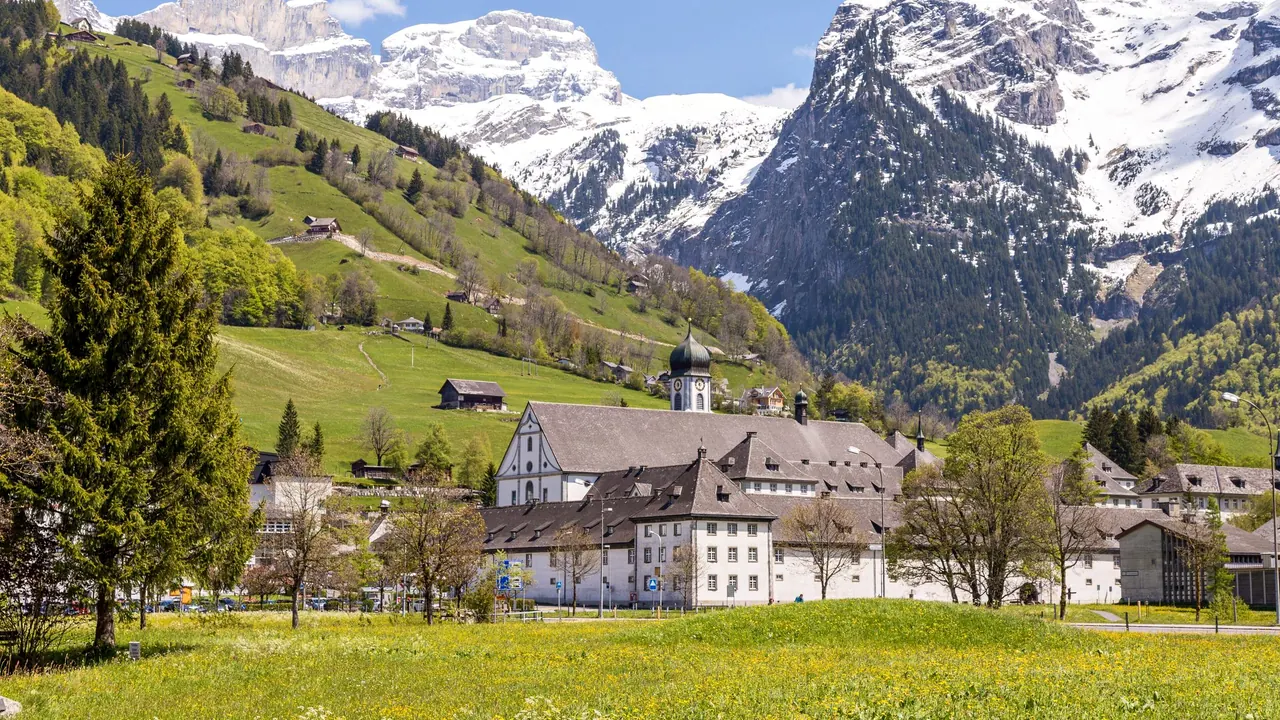
Engelberg suits travellers who want the mountains with a little more around them. Lucerne is less than an hour down the valley, the Benedictine abbey gives the village a real centre, and in winter the freeride crowd keeps a few bars going late. Families also have an easier time, thanks to the flat village and the lakeside play areas at Brunni and the Trübsee.
Choose Wengen for
- nature and the outdoors
- wellness
- getting around
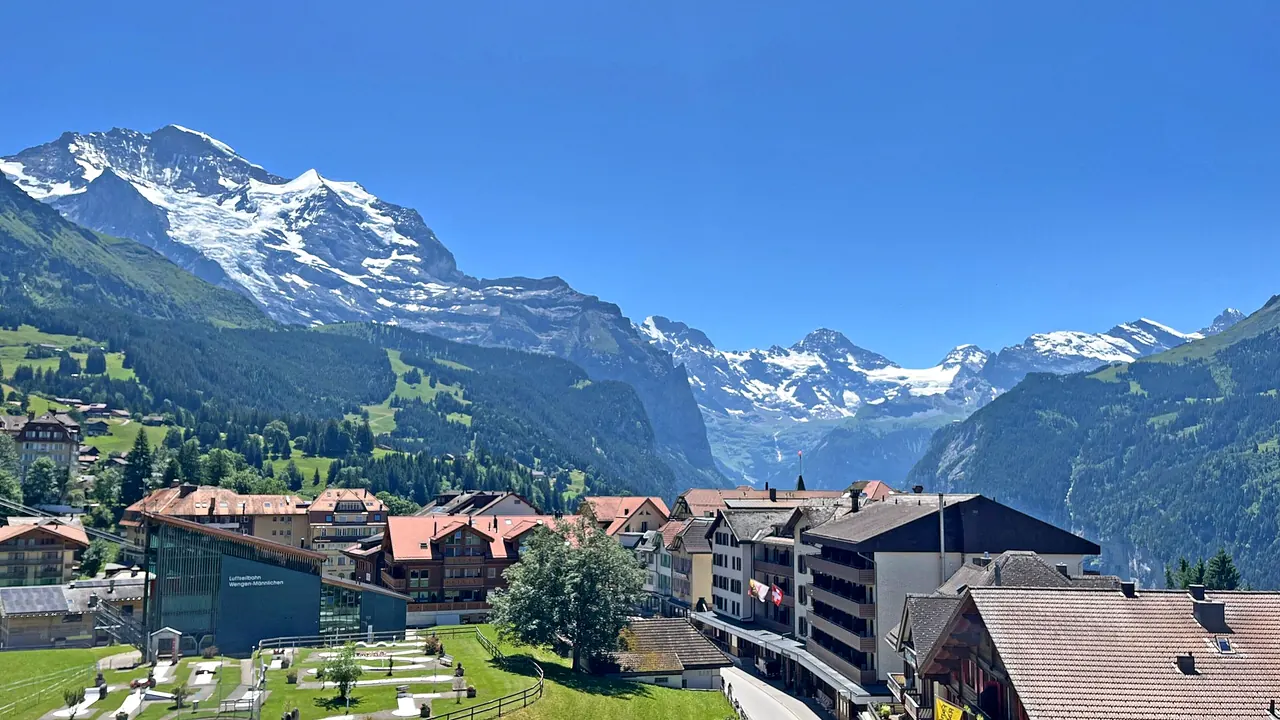
Wengen is for people who come mainly for the view and the walking. There are no cars, the Eiger, Mönch and Jungfrau stand straight across the Lauterbrunnen valley, and trails start at the hotel door. Evenings are quiet and there is little to see in the usual sense, but if your days will be spent on ridges and in meadows, nothing in Engelberg quite matches this setting.
Scoreboard
Twelve categories on one fixed scale from 0 to 100. The shaded stretch is the gap between the two.
Your match
Pick a travel style or drag the sliders, and both match scores follow your weighting.
Wins on culture and sights and day trips with your weighting.
Wins on nature and the outdoors and wellness with your weighting.
What matters to you?
Category by category
What the scores mean for a trip.
Beaches & swimming
Neither village is a place to swim, and the difference lies in where you go instead. From Engelberg the train runs down to the lidos and lakeside meadows of Lake Lucerne, and the village sports centre has an indoor pool for a cold day. From Wengen the nearest water is around Interlaken, where Lake Thun is the warmer choice and glacier-fed Lake Brienz stays cool. Unless your hotel has a pool, there is nowhere to swim in Wengen itself.
Food & drink
Both villages eat in much the same way, with hotel dining rooms, a few village restaurants and mountain huts serving fondue, raclette and rösti. Engelberg has the one stop worth planning around: the show dairy in the monastery, where you watch the cheese being made and then buy it. Älplermagronen is the local dish to try there.
In Wengen the memorable meal is a terrace lunch facing the Jungfrau, where the view counts for more than the cooking. Many guests simply book half-board. If you want a change of menu, you have to go down to Interlaken.
Culture & sights
Engelberg has a real sight and Wengen essentially does not. The Benedictine abbey, founded in 1120, fills the valley floor, and its bright baroque church holds one of Switzerland's largest organs. Add the small valley museum and a walk past the old resort hotels and you have a pleasant morning.
Wengen offers a stroll among wooden chalets and Belle Époque hotels from its days as an English resort, plus a long ski-racing history. Anything more means taking the train to Thun, Brienz or Bern.
Nightlife
Engelberg has the livelier winter evenings. Freeriders and seasonal workers, many of them Scandinavian, keep a couple of late bars and a small club busy at weekends in high season. Wengen's après-ski is gentler, with a few bars and a hotel bar or two, and the village only really parties on the weekend of the Lauberhorn downhill in January. In summer both go quiet after dinner.
Nature & outdoors
Both are superb mountain bases, and Wengen has the slight edge for sheer scenery. It sits on a sunny shelf above the sheer, waterfall-lined Lauterbrunnen valley and looks straight at the Jungfrau, with the Eiger and Mönch behind. Trails run from the village along the Männlichen ridge to Kleine Scheidegg and beneath the Eiger north face, and the railway continues up to the Jungfraujoch.
Engelberg's highlight is the Titlis glacier, with its rotating gondola, ice cave and suspension bridge. In summer you can walk the Four Lakes route over the Jochpass, and in winter its steep north faces draw serious freeriders. Wengen's skiing is the broader, linked area shared with Grindelwald.
Day trips
Engelberg is better placed for days out. Lucerne, with its covered wooden bridges and lake steamers, is under an hour away, and Stans, Schwyz with its Confederation charters, the great abbey at Einsiedeln and even Zurich are all within reach.
From Wengen, every trip starts with the slow descent to Lauterbrunnen. That opens up Interlaken, Thun's castle, the lakeside castles at Spiez and Oberhofen, and the Ballenberg open-air museum near Brienz, with Bern as a long day out. Lucerne is too far for a comfortable return.
Good for families
Engelberg is the more child-friendly of the two. It is flat and compact, Brunni and the Trübsee have play areas, boats and adventure trails, and Lucerne's transport museum rescues a rainy day. The one caution is the glacier station at about 3,000m, which can be hard going for very young children.
Wengen's strengths are that it has no cars and its nursery slopes sit close to the hotels. Beyond that, the lanes are steep, buggies struggle in snow and there is little indoors when the weather closes in.
Getting around
Both are easy without a car, but they work differently. Engelberg is reached by a direct train from Lucerne up a cog section, and the village is flat enough to walk, with a free shuttle to the lifts in the ski season. Wengen is car-free: you leave the car or main line at Lauterbrunnen, ride the rack railway up, and electric carts carry your luggage.
Wengen's railway also carries on to Kleine Scheidegg and the Jungfraujoch, so the high mountains are on your doorstep. The trade-off is steep, sometimes icy lanes and a change in Interlaken for most trips down.
Shopping & style
Engelberg's main street gives you a little more to browse, and the best thing to buy there is edible: cheese from the monastery dairy, with local butter, dried meats and Swiss chocolate alongside. If you arrive short of gear for the glacier, its mountain-sports shops are well stocked, and a few watch and jewellery shops cater to the tour groups.
Wengen's short main street has ski hire, outdoor gear, a few chocolate and souvenir counters and a small grocery. That covers a mountain stay but nothing beyond it, so for real shopping you go down to Interlaken or on to Bern.
Affordability
In Engelberg, the cable car up to the Titlis glacier is the one big expense, and in winter ski passes and equipment hire come on top. In Wengen, the big expense is the train to the Jungfraujoch, the dearest ride of all. Because the village is reached only by rack railway, and almost every outing starts with a train or cable car, the fares mount up day after day.
Hotels, meals and drinks cost much the same in both. In Engelberg, a Swiss travel pass covers the valley train and takes something off some lifts. In Wengen, self-catering chalets and a regional rail pass do the same job, and the trails from the village cost nothing.
Live music & performing arts
There is little live performance in either village. Engelberg has a little more, with organ recitals and concerts in the baroque abbey church, a small summer classical festival, and Lucerne's concert halls under an hour away. In Wengen, live music means the odd yodelling or alphorn evening in a hotel and a brass band at village celebrations, and theatre means a trip down to Interlaken or Bern.
Wellness & relaxation
Both offer rest rather than a proper spa culture: hotel saunas and pools, but no thermal baths. In Engelberg that rest comes from the clean air of an old health resort and the village's public indoor pool, although peak ski weeks and the Titlis crowds make it feel busier.
Wengen's calm is more complete because there are no cars. The loudest sounds are cowbells, the cog railway and the waterfalls across the valley, which makes a balcony afternoon there especially restful.
When should you go?
Pick your month. The climate figures are measured averages, not a forecast.
Engelberg in July
Wengen in July
Daytime high, °C
Rainfall in the month, mm
Where the figures come from
Engelberg has no weather station within reach, so its figures come from a gridded climate model rather than a measured record, and read a broad area rather than one spot.
Wengen has no weather station within reach, so its figures come from a gridded climate model rather than a measured record, and read a broad area rather than one spot.
Temperature and rainfall are climate normals, averaged over the years shown. Engelberg: 2001-2020 normals, NASA POWER reanalysis grid, no weather station within 90 km. Wengen: 1991-2020 normals, TerraClimate 4 km grid at the town, no weather station within 90 km.
Both villages are snowy and cold from December to February, with daytime highs around freezing. Neither is ever warm enough for a beach trip. The walking season runs from June to September, and Engelberg is noticeably milder then, with July and August highs of about 21°C, while Wengen's higher shelf rarely gets past 16°C. Engelberg also starts to warm earlier, so a spring walk in the valley is more pleasant there than up in Wengen, where April still feels wintry.
Engelberg pays for its warmth with rain. From May to August it gets about 150mm a month, so summer afternoons there often bring showers. Wengen's summers are drier, at around 110mm a month, and its rainfall is more even through the year. For hiking in cool, clear air, Wengen in late summer and early autumn is the better choice. For warmer days in the valley, choose Engelberg, but expect to wait out the odd wet spell.
Which traveller are you?
For an outdoors trip, choose Wengen. You wake up facing the Jungfrau, the Männlichen ridge walk to Kleine Scheidegg starts close by, and the waterfalls of the Lauterbrunnen valley lie below. Engelberg's Titlis glacier is a spectacle, but Wengen's everyday walking is richer.
On a family trip with children, Engelberg is the easier base. The village is flat, Brunni has the Härzlisee with its stepping stones and rafts, and the Trübsee has boats. On a wet day, Lucerne's transport museum is a short train ride away. Wengen is car-free but steep and has little built for children.
For a culture and arts trip, Engelberg is the better choice. The abbey church, with its huge organ, hosts recitals, and a summer festival brings classical concerts. Lucerne's old town and concert halls are under an hour away. Wengen has little beyond chalets, Belle Époque hotels and the view.
Before you go
| Measure | Engelberg | Wengen |
|---|---|---|
| Official language | French, German, Italian, Romansh | French, German, Italian, Romansh |
| Currency | Swiss Franc (CHF) | Swiss Franc (CHF) |
| Sockets | CJ230 V, 50 Hz | CJ230 V, 50 Hz |
| Driving side | Right | Right |
| Time zone | UTC+1, UTC+2 in summer | UTC+1, UTC+2 in summer |
| Emergency number | 112 | 112 |
| Elevation | 1,015 m | 1,274 m |
| Main airport | Zürich Airport (ZRH)72 km from centre226 non-stop destinations | Zürich Airport (ZRH)106 km from centre226 non-stop destinations |
| Public holidays this year | 13 days | 10 days |
By the numbers
| Measure | Engelberg | Wengen |
|---|---|---|
| Population | 4,181 | 1,116 |
| People per km² | 56 | 31 |
| Museums within 10 km | 0 | 2 |
| UNESCO World Heritage sites within 50 km | 2 | 1 |
Where else could you go?
Every comparison below shares a destination with this one, so you can follow Engelberg or Wengen somewhere new.
- Mürrenvs Wengen
- Grindelwaldvs Wengen
- Andermattvs Engelberg
- Adelbodenvs Wengen
- Leukerbadvs Wengen
- Grindelwaldvs Engelberg