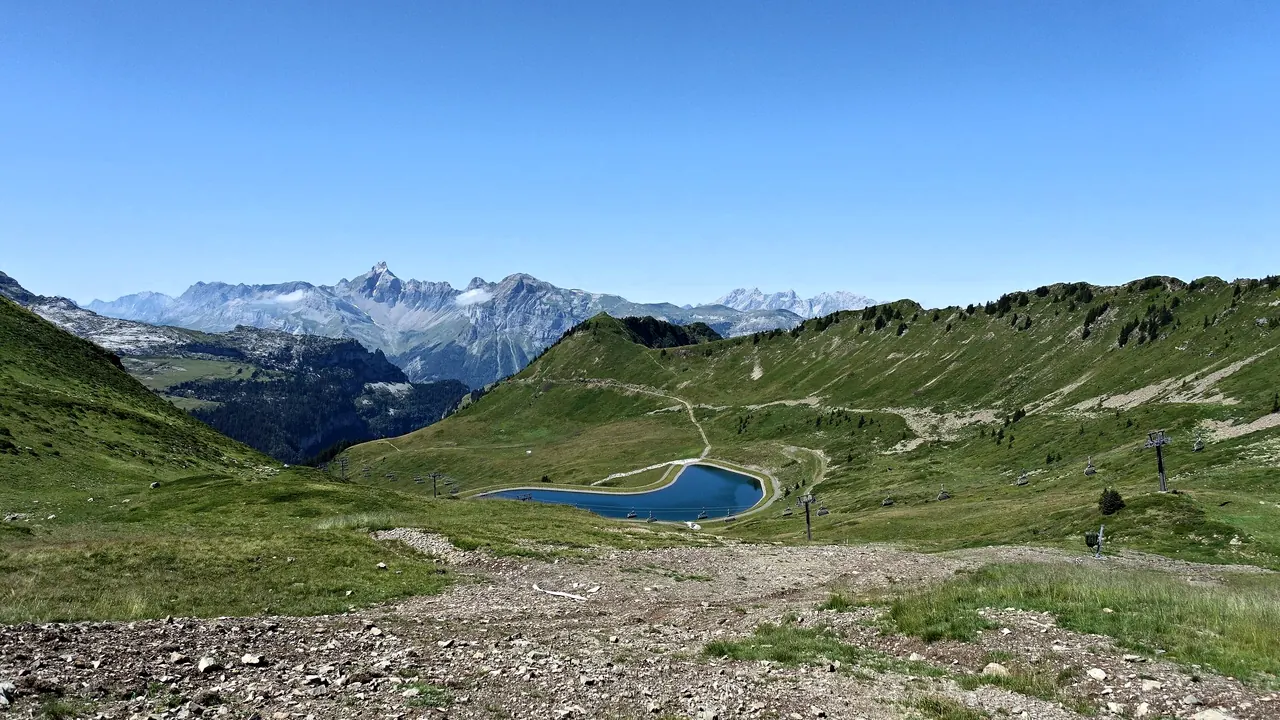
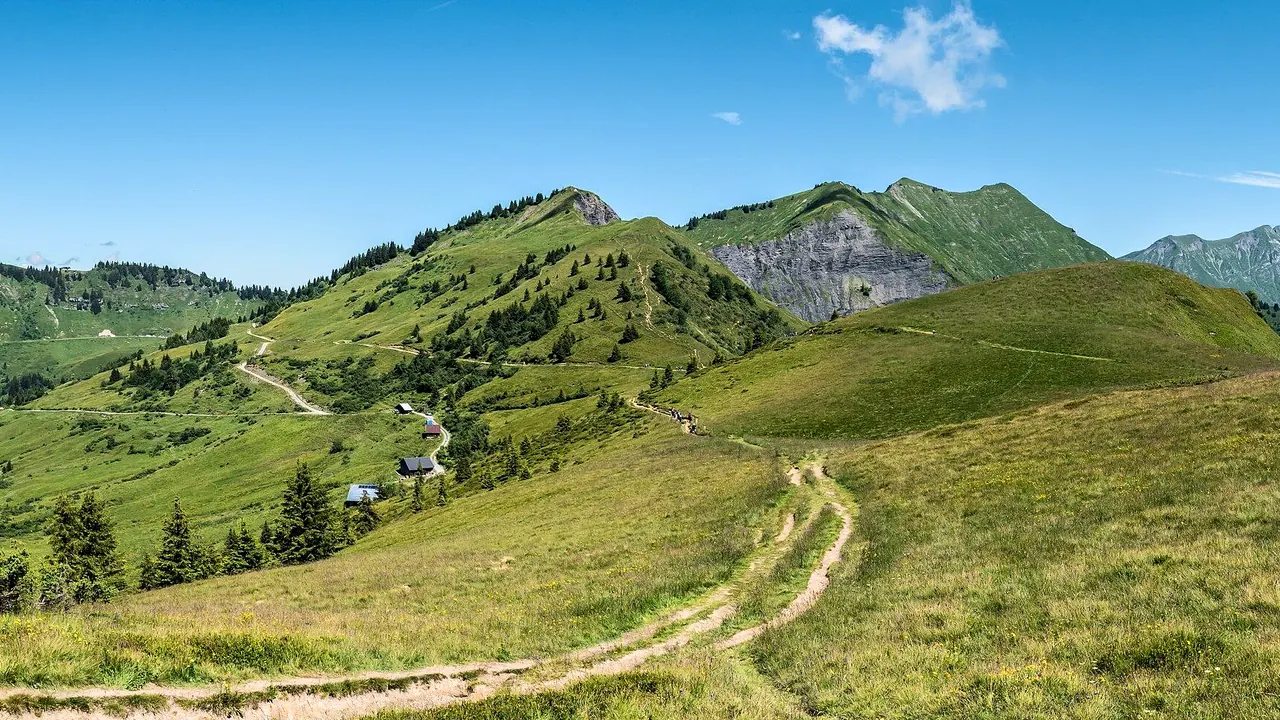
Photos: Flaine by Guilhem Vellut, CC BY 2.0, cropped; Samoëns by Krzysztof Golik, CC BY-SA 4.0, cropped.
Flaine or Samoëns?
Our verdict in twelve categories, each scored against the same fixed benchmark cities, and the climate month by month, so you can choose for your trip.
Choose Flaine for
- getting around
- nightlife
Flaine suits a winter trip built around skiing and nothing else. The resort was laid out so that you step from your apartment onto the snow, the car stays parked all week, and its high, north-facing bowl keeps good snow for off-piste and touring. Breuer's modernist blocks and the open-air sculpture will appeal if you like architecture, but after dark and out of season there is very little going on.
Choose Samoëns for
- beaches
- shopping
- food and drink
Samoëns is the better choice for a stay that isn't only about the pistes. It is a real stone village with a square, a weekly market, a few restaurants worth booking and a gondola up into the same Grand Massif. Summer is its strongest season: there's a lake to swim in, rafting on the Giffre and the Cirque du Fer-à-Cheval just up the valley. It also costs a little less than Flaine.
Scoreboard
Twelve categories on one fixed scale from 0 to 100. The shaded stretch is the gap between the two.
Your match
Pick a travel style or drag the sliders, and both match scores follow your weighting.
Wins on getting around and nightlife with your weighting.
Wins on beaches and shopping with your weighting.
What matters to you?
Category by category
What the scores mean for a trip.
Beaches & swimming
Neither place is somewhere to go for swimming, but Samoëns at least has a lake on the edge of the village. The Lac aux Dames has a lifeguarded bathing area in July and August, a lawn to lie on and an outdoor pool facing the peaks.
Flaine's small lake is for walks and picnics, not swimming. Up there, a swim means a residence pool or a drive down to Lake Annecy or Lake Geneva. From Samoëns, the Lake Geneva beaches at Évian and Thonon are about an hour away.
Food & drink
The two serve the same Savoyard food, fondue, raclette, tartiflette and Reblochon, but Samoëns has more places to eat it. As a working village it has diots sausages with polenta, a few more ambitious restaurants and a weekly market on the square where local producers sell cheese, charcuterie and honey.
In Flaine, eating mostly means cooking in your apartment with food from the resort's supermarkets and cheese counters, plus lunch on a slope-side terrace. The few better dinners largely close once the ski season ends. The market mornings Flaine lacks are exactly what Samoëns offers down in the valley.
Culture & sights
Each has about an afternoon's worth of sights, but they are very different. Flaine is a 1960s design statement: Marcel Breuer's concrete blocks stepped along the rock, a building cantilevered over the cliff, and Picasso's Sylvette and Dubuffet's Boqueteau standing out in the open.
Samoëns offers older history in the work of the frahans, the stonemasons who left the valley to build across Europe. You can see it in the stone centre, the church fountain and the lime tree on the Grande Place said to date from 1438. Above the church, the Jaÿsinia alpine garden climbs the hillside. Go to Flaine for modernism and to Samoëns for village heritage.
Nightlife
Both are early-to-bed family resorts. In winter, Flaine has the slightly livelier finish. Its bars are grouped around the Forum, so the après-ski crowd ends up in the same few places, and one or two stay open late with a DJ at weekends. Out of season, though, almost nothing opens at night.
Samoëns feels more like an evening in a village: a drink on the square or by the gondola, dinner, then perhaps one of a couple of pubs that stay open later in winter. In spring and autumn its evenings are just as quiet as Flaine's.
Nature & outdoors
Both are excellent bases for the Grand Massif. The difference is altitude and season. Flaine sits in the bowl itself, with lifts to the Grandes Platières at about 2,500m and north-facing slopes that hold their snow, so it is the stronger choice for off-piste, ski touring and a dependable winter. The Désert de Platé's rock pavements start right outside the door in summer.
Samoëns reaches the same ski area by gondola. It also has cross-country trails on the valley floor and a broader summer offer: rafting on the Giffre, the Gorges des Tines, and the Cirque du Fer-à-Cheval with its waterfalls, chamois and ibex a short drive up the valley.
Day trips
With a car, both reach the same places: Annecy, Geneva, Chamonix, Yvoire and the old abbey at Sixt. The main difference is the start of each outing. Every day out from Flaine begins with the long winding descent to the Arve valley, which is slow in winter.
Samoëns is already down in the valley, with Sixt next door and Samoëns' own stone centre on the doorstep. From there it is an easy run to the French shore of Lake Geneva, where a ferry from Évian crosses to Lausanne.
Good for families
Both work well for children, but they suit different seasons. Flaine was designed for a ski week. It has no cars, apartments sit next to the snow, nursery slopes are steps from the door and wide gentle runs help children improve. In summer there is much less to do, and the top lifts can be bitterly cold.
Samoëns comes into its own in summer. The leisure area at the Lac aux Dames has lake bathing, a pool with a slide and paddling area, playgrounds and easy walks. In winter, though, children need the gondola or a shuttle to reach the slopes.
Getting around
Flaine is easier once you're there. Forum, Forêt and Front de Neige are joined by lifts and a shuttle bus, much of the lodging is ski-in ski-out, and the car can sit untouched all week. Getting up there is the effort: the long mountain road or a transfer from Geneva airport.
Samoëns has a walkable centre with the gondola at its edge and winter shuttles, so a ski week can still be car-free. Beyond that you need to drive: trailheads, the Fer-à-Cheval and summer outings are hard without a car, and buses up the Giffre valley are slow.
Shopping & style
Neither is a shopping destination, but Samoëns gives you more to browse. It has gift and homeware boutiques around the square and a weekly market selling cheese, honey and woollens.
Flaine has ski hire, supermarkets and a few souvenir counters in the Forum, and a Savoyard cheese is about the best you'll take home. From either place, anything more serious means a trip to Annecy or Geneva.
Affordability
In winter, both cost what a French ski resort costs: the lift pass, ski hire and lessons take most of the budget, and school vacation weeks cost the most. Samoëns comes out somewhat cheaper. Its village supermarket and market make self-catering easy, and its long summer, with free hiking and a lake, is a cheap way to enjoy the place.
Flaine's apartments are modest and you can keep accommodation costs down, but daily life is pricier. Lunch on the slope-side terraces is expensive, and once the ski season ends there is less of a stay to make use of.
Live music & performing arts
You won't plan an evening around live performance in either place. Samoëns has a little more: outdoor concerts and music in the church in summer, and village festivals.
Flaine has almost nothing beyond the odd ski-season show and live music at après-ski. For a proper concert or opera, both rely on Geneva.
Wellness & relaxation
Both offer roughly the same wellness: saunas, steam rooms and hot tubs in residences and hotels, good after skiing but not a reason to choose either. The calm feels different, though. Flaine's is the silence of a car-free resort high up in clean air, while Samoëns' is a slow evening on the square under the old lime tree.
For a proper soak, Samoëns has the historic thermal baths at Saint-Gervais-les-Bains about an hour away. From Flaine, the long descent leads to the spa towns of the Chablais and Lake Geneva.
When should you go?
Pick your month. The climate figures are measured averages, not a forecast.
Flaine in July
Samoëns in July
Daytime high, °C
Rainfall in the month, mm
Where the figures come from
Flaine has no weather station within reach, so its figures come from a gridded climate model rather than a measured record, and read a broad area rather than one spot.
Samoëns's temperatures are measured 49 km from the centre, at Sion.
Samoëns's station stands 189 m below the city centre, so the centre is likely a little cooler than the figures say.
Samoëns has no rain gauge within 25 km of the centre, so its rainfall comes from a gridded climate dataset read at the destination rather than from a gauge further away.
Temperature and rainfall are climate normals, averaged over the years shown. Flaine: 2001-2020 normals, NASA POWER reanalysis grid, no weather station within 90 km. Samoëns: 1991-2020 (sunshine 1961-1990) normals, Sion (49.1 km from centre).
Flaine is a snow resort for most of the year. Daytime highs sit around -2°C from December to February and barely rise above freezing in March, which is what keeps the snow in good order. Summer is short and cool, at about 18°C in July and August. That's good walking weather on the Désert de Platé, but too fresh to make swimming appealing. Rain or snow falls steadily all year, and May is the wettest month, so late spring is the least rewarding time to go.
Samoëns sits much lower, and its seasons arrive weeks earlier. It is already mild in March and April, and July and August reach about 27°C, warm enough for afternoons at the Lac aux Dames. July is also the sunniest month. December is the wettest and the darkest, with short, grey days. Neither place has a reliably dry month, so pack for showers in any season.
Which traveller are you?
On a family trip with young children in the ski season, Flaine is easier. The centre has no cars, nursery slopes and snow gardens sit right by the apartments, and much of the lodging is ski-in ski-out, so there are no shuttles to wait for with tired toddlers.
For a beach and sun trip in the mountains, Samoëns is the one to choose. Its summers are much warmer, and the Lac aux Dames has a lifeguarded bathing area, a grassy shore and an outdoor pool. In Flaine, swimming means a residence pool or a long drive down.
On a trip on a tight budget, Samoëns is a little easier on the wallet. It has plenty of self-catering, a weekly market for cheap picnic food and free summer hiking straight from the village. Flaine's slope-side lunches and its ski-focused season make it the more expensive place to stay.
Before you go
| Measure | Flaine | Samoëns |
|---|---|---|
| Official language | French | French |
| Currency | Euro (EUR) | Euro (EUR) |
| Sockets | CE230 V, 50 Hz | CE230 V, 50 Hz |
| Driving side | Right | Right |
| Time zone | UTC+1, UTC+2 in summer | UTC+1, UTC+2 in summer |
| Emergency number | 112 | 112 |
| Elevation | 1,600 m | 671 m |
| Main airport | Geneva International Airport (GVA)52 km from centre150 non-stop destinations | Geneva International Airport (GVA)51 km from centre150 non-stop destinations |
| Public holidays this year | 11 days | 11 days |
By the numbers
| Measure | Flaine | Samoëns |
|---|---|---|
| Population | - | 2,203 |
| People per km² | - | 23 |
| Museums within 10 km | 0 | 1 |
| UNESCO World Heritage sites within 50 km | 2 | 3 |
Where else could you go?
Every comparison below shares a destination with this one, so you can follow Flaine or Samoëns somewhere new.
- Les Getsvs Samoëns
- Morzinevs Samoëns
- Avoriazvs Samoëns
- Saint-Gervais-les-Bainsvs Flaine
- Chamonixvs Flaine
- Les Getsvs Flaine