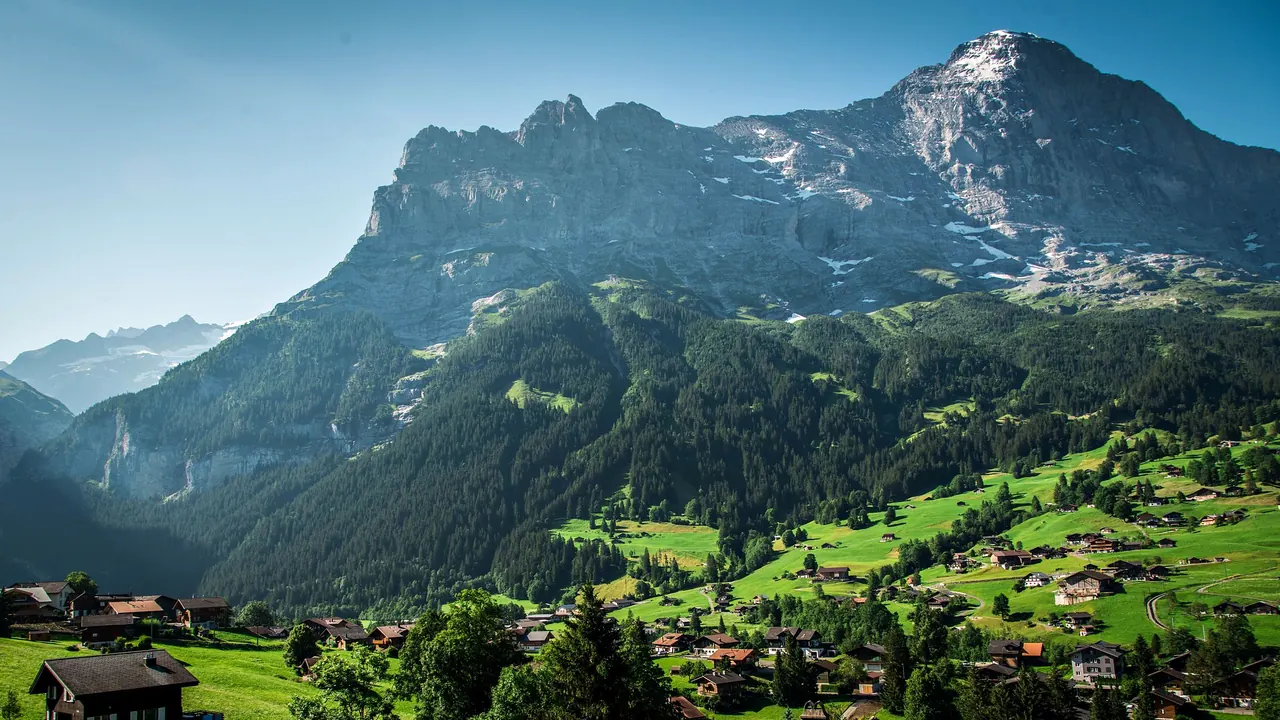
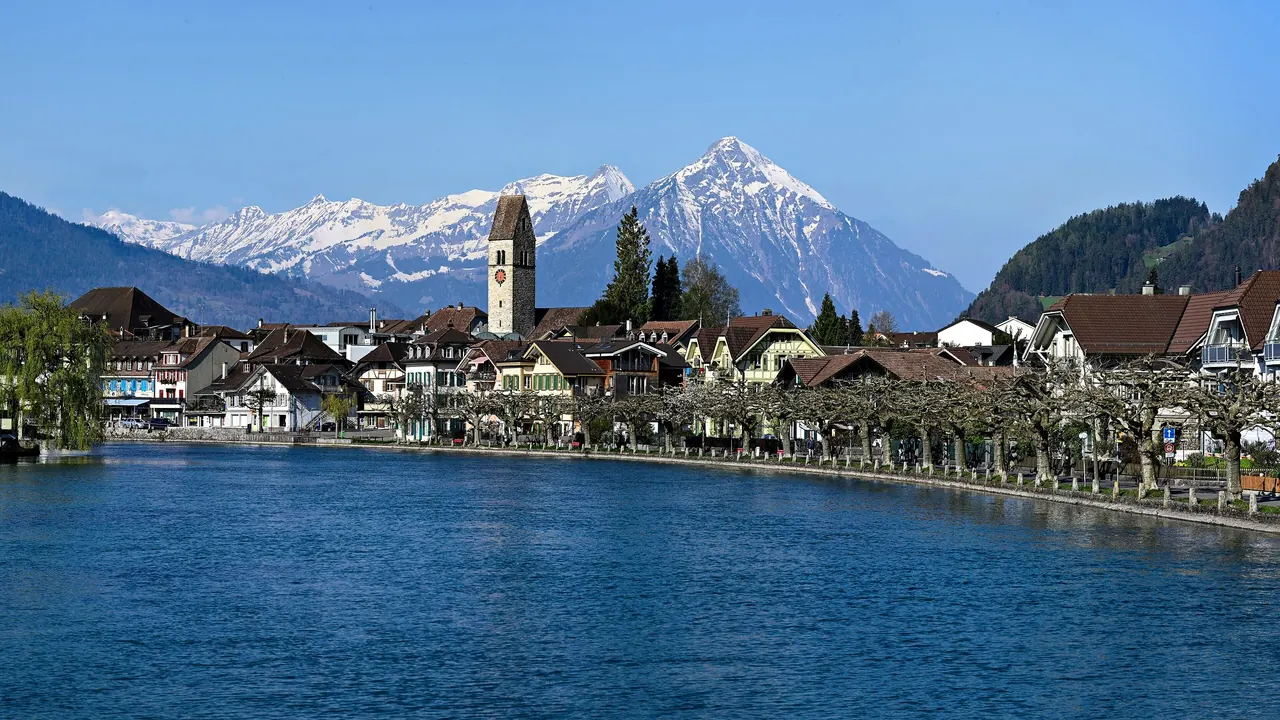
Photos: Grindelwald by Christopher Becke, Pexels License; Interlaken by Roy Egloff, CC BY-SA 4.0, cropped.
Grindelwald or Interlaken?
Our verdict in twelve categories, each scored against the same fixed benchmark cities, and the climate month by month, so you can choose for your trip.
Choose Grindelwald for
- wellness
Grindelwald suits travellers who want to wake up directly beneath the Eiger north face and spend the day on the mountain. Gondolas to First and Männlichen start in the village, the ski runs are on the doorstep in winter, and evenings are quiet and early. Choose it if you came for the peaks and don't mind that almost everything else means a train ride down the valley.
Choose Interlaken for
- beaches
- day trips
- shopping
Interlaken is the better base for a trip that mixes mountains with lakes and towns. Bern and Thun are close by rail, steamers cross both lakes, you can swim in Lake Thun on a summer afternoon, and adventure sports from paragliding to canyoning start in town. The valley floor is flat and warmer, and there is a little more to do after dark.
Scoreboard
Twelve categories on one fixed scale from 0 to 100. The shaded stretch is the gap between the two.
Your match
Pick a travel style or drag the sliders, and both match scores follow your weighting.
Wins on wellness with your weighting.
Wins on beaches and day trips with your weighting.
What matters to you?
Category by category
What the scores mean for a trip.
Beaches & swimming
Interlaken has the edge for swimming simply because it lies between the two lakes. In July and August you can walk or take a short bus ride to the grassy lidos and shingle shore at Neuhaus on Lake Thun, or to the bathing area at Bönigen on the colder, turquoise Lake Brienz.
From Grindelwald the same lakes are half an hour to an hour away by train and bus, so a swim becomes a planned afternoon out. Neither place is a beach destination, and the season is short in both.
Food & drink
Both serve the same hearty alpine menu of fondue, raclette and rösti, and neither is worth travelling to for its food. In Grindelwald the best meals come from the setting: lunch on a mountain terrace at a top station facing the Eiger, or cheese bought at a summer dairy.
Interlaken has more variety, with Indian, Asian and Middle Eastern restaurants that cater to its international crowd, and white wine from the shores of Lake Thun. Many visitors in both places eat supermarket picnics.
Culture & sights
There is very little to see in either place, and neither is a reason to choose one over the other. Grindelwald has a small museum on farming and the climbers drawn to the Eiger, a whitewashed church, and old chalets with painted gables on the slopes.
Interlaken's sights are those of a nineteenth-century resort. There is the row of grand hotels and the Kursaal on the Höheweg, and across the Aare, the timber houses and church tower of Unterseen. Both towns are bases for something else.
Nightlife
Evenings are short in both, but they differ in kind. Grindelwald's nights are après-ski: bars near the slopes fill up as the lifts close, a few hotel bars stay open a little later, and in summer the village is dark early.
Interlaken has a small backpacker scene of pubs, sports bars and a couple of basement clubs near the hostels, plus the casino in the Kursaal. Even so, the streets go quiet well before midnight.
Nature & outdoors
Both give you access to some of the finest high-Alpine scenery anywhere, including the Jungfraujoch railway above the Aletsch Glacier. Grindelwald puts you right at the foot of it. The north face of the Eiger rises over the village, gondolas lead straight to the Bachalpsee trails and the Panoramaweg, and the Glacier Canyon is just below the houses.
Interlaken is a step further back, with the big peaks about an hour away by rail. In exchange it offers lakes and adventure sport. Paragliders land on the Höhematte, canyoning and rafting on the Lütschine start here, the Harder Kulm funicular climbs from town, and the Trümmelbach falls in Lauterbrunnen are close.
Day trips
Interlaken is the better base for getting out, because it is where the trains meet. Bern is under an hour away and Thun about half an hour. Lake steamers stop at Spiez and Oberhofen with their castles, and Lucerne is reachable over the Brünig Pass.
From Grindelwald, every outing begins with the ride down the valley to Interlaken. That stretches Bern to about an hour and a half and makes Lucerne a long day. Wengen, Mürren and Ballenberg remain easy from either place.
Good for families
Both work well for outdoor families and have the same gaps: no zoos or aquariums, and little to do on wet days. Grindelwald's draws are on its own slopes: mountain carts and scooter-bikes down from First, the toboggan run below Pfingstegg, and ski schools and nursery slopes in winter.
Interlaken adds the St Beatus caves above Lake Thun, the farm animals and craft demonstrations at Ballenberg, and steamer rides children enjoy. Its flat valley floor is also easier with a pushchair than Grindelwald's sloping streets.
Getting around
Neither needs a car, and both run on linked trains and lifts. Grindelwald's advantage is that the gondolas to First, Männlichen and the Eiger glacier leave from the village itself. The drawback is the slope: some chalets sit well above or below the main street, and the walk back can be steep.
Interlaken is flat and compact, with a twenty-minute walk along the Höheweg between its two stations. It is also the hub for mainline trains to Bern. The catch is crowding on the busiest mountain trains in summer.
Shopping & style
Interlaken's Höheweg gives you more to browse than anything in Grindelwald, though shopping is a minor part of a trip to either. Grindelwald's main street is mostly practical: ski and outdoor gear, rental counters, and a few watches, army knives, chocolate and cowbells. It is handy if you forgot walking poles or a warm layer.
In Interlaken the Höheweg is lined with large watch and jewellery stores aimed at tour groups, as well as cuckoo clocks, chocolate and souvenirs. The one local craft worth finding is the hand-carved woodwork of Brienz, a short trip along the lake.
Affordability
The two cost much the same. What differs is where you can save. Grindelwald's hotels and chalets charge resort prices, and even a simple lunch at a mountain restaurant is expensive. Your best savings come from a self-catering apartment and a supermarket picnic carried up on the gondola.
Interlaken has far more hostel and budget beds, so it is the easier place to keep the cost of a room down. On the other hand, the paragliding and canyoning that start in town add to the bill. In both places the mountain railways take the biggest share, the Jungfraujoch above all, and regional passes are the main way to reduce it.
Live music & performing arts
Interlaken has more live performance. Its open-air William Tell, played by local amateurs in the woods every summer, is a long-standing tradition. The Kursaal hosts concerts, Thun stages a summer musical on the lake, and Bern's theatre and orchestra are under an hour away.
In Grindelwald, performance means yodelling choirs, alphorns and brass bands in the summer village programme. They are pleasant to come across, but for anything more formal you go down the valley.
Wellness & relaxation
The two are broadly level here. Neither has thermal springs or a bathing tradition, so a spa day means a hotel or the public pool. In Grindelwald that is the sports centre, with a pool and sauna open to anyone. The rest comes from the place itself: cowbells, clean air and a balcony evening watching the light fade off the north face.
Interlaken's grand hotels along the Höheweg have sizeable spas, and the town has a public pool with its own wellness area. Its calm comes from the water: an early walk on the lakeshore, or a slow steamer crossing of Lake Thun or Lake Brienz. Visitors who want real quiet tend to stay in the lakeside villages or up in Wengen and Mürren rather than in town.
When should you go?
Pick your month. The climate figures are measured averages, not a forecast.
Grindelwald in July
Interlaken in July
Daytime high, °C
Rainfall in the month, mm
Where the figures come from
Grindelwald has no weather station within reach, so its figures come from a gridded climate model rather than a measured record, and read a broad area rather than one spot.
Interlaken has no rain gauge within 25 km of the centre, so its rainfall comes from a gridded climate dataset read at the destination rather than from a gauge further away.
Interlaken's sunshine is measured 66 km from the centre, at Sion.
Temperature and rainfall are climate normals, averaged over the years shown. Grindelwald: 1991-2020 normals, TerraClimate 4 km grid at the town, no weather station within 90 km. Interlaken: 2005-2020 (sunshine 1961-1990, rainfall 1991-2020) normals, Meiringen / Unterbach (19.3 km from centre).
Grindelwald is a proper mountain climate. Daytime highs sit around 0°C in January and February, which suits skiing and sledging rather than strolling. Summer stays cool, peaking at about 17°C in July. That is good hiking weather, and the high trails are clear of snow from about June. June to August is also the wettest stretch, with around 119mm a month, so plan for cloud and showers. September is often the calmest month for walking, with less rain and air that is still mild.
Interlaken sits lower in the valley and is noticeably warmer all year. Spring comes weeks earlier, with April highs near 15°C against single figures up in Grindelwald. July reaches about 24°C, warm enough to swim in the lakes, and it is also the sunniest month. Its summer rain pattern is much like Grindelwald's. In winter the town stays a few degrees above freezing, milder for walking around but without snow at the door.
Which traveller are you?
On a relaxing and wellness trip, Grindelwald is the calmer choice. Hotel spas look out at the Eiger, the evenings are still and the village slows right down out of season. Central Interlaken is busier, with coach groups and backpackers.
For a culture and arts trip, Interlaken is the clear pick. Bern's arcaded old town is under an hour away, lake steamers stop at castle towns, and in summer the open-air William Tell plays in the woods. Grindelwald offers little beyond folk evenings.
Skiers should stay in Grindelwald. The Jungfrau runs, nursery slopes and long sledging tracks start in the village and ski buses link the lift stations. From Interlaken, every ski day begins with a train ride up the valley.
Before you go
| Measure | Grindelwald | Interlaken |
|---|---|---|
| Official language | French, German, Italian, Romansh | French, German, Italian, Romansh |
| Currency | Swiss Franc (CHF) | Swiss Franc (CHF) |
| Sockets | CJ230 V, 50 Hz | CJ230 V, 50 Hz |
| Driving side | Right | Right |
| Time zone | UTC+1, UTC+2 in summer | UTC+1, UTC+2 in summer |
| Emergency number | 112 | 112 |
| Elevation | 1,034 m | 571 m |
| Main airport | Zürich Airport (ZRH)100 km from centre226 non-stop destinations | Zürich Airport (ZRH)100 km from centre226 non-stop destinations |
| Public holidays this year | 10 days | 10 days |
By the numbers
| Measure | Grindelwald | Interlaken |
|---|---|---|
| Population | 3,942 | 6,123 |
| People per km² | 23 | 1,424 |
| Museums within 10 km | 0 | 3 |
| UNESCO World Heritage sites within 50 km | 2 | 2 |
Where else could you go?
Every comparison below shares a destination with this one, so you can follow Grindelwald or Interlaken somewhere new.
- Wengenvs Grindelwald
- Mürrenvs Grindelwald
- Engelbergvs Grindelwald
- Adelbodenvs Grindelwald
- Leukerbadvs Grindelwald
- Andermattvs Grindelwald