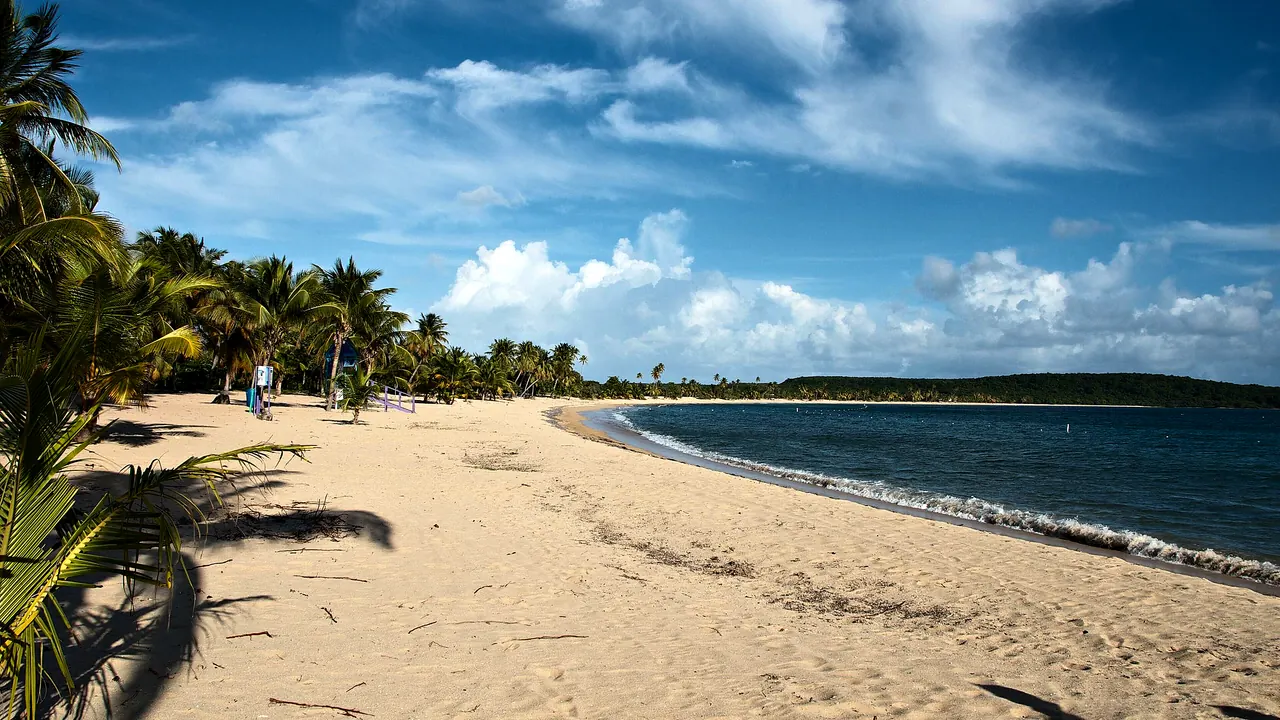
Photos: Vieques by Edgar Torres, CC BY 3.0, cropped.
Guadeloupe or Vieques?
Our verdict in twelve categories, each scored against the same fixed benchmark cities, and the climate month by month, so you can choose for your trip.
Choose Guadeloupe for
- day trips
- live music and the arts
- food and drink
Guadeloupe suits travellers who want an island with range. It has rainforest and a volcano on Basse-Terre, calm lagoons along Grande-Terre's south coast, Creole cooking and rum distilleries, and ferries to Les Saintes and Marie-Galante. It is the better choice for a longer stay, for a family, or for anyone who would get restless after a few days on the sand.
Choose Vieques for
- beaches
Vieques is for people who want to do almost nothing beside empty water. The point of going is the quiet refuge beaches, the night kayak on Mosquito Bay and the near absence of nightlife, shops and sights. Anyone who needs restaurants, outings or culture to fill the evenings will find it thin.
Scoreboard
Twelve categories on one fixed scale from 0 to 100. The shaded stretch is the gap between the two.
Your match
Pick a travel style or drag the sliders, and both match scores follow your weighting.
Wins on day trips and live music and the arts with your weighting.
Wins on beaches with your weighting.
What matters to you?
Category by category
What the scores mean for a trip.
Beaches & swimming
Both islands are excellent for swimming in warm water, and the difference is in the kind of beach. Guadeloupe gives you choice. Grande-Terre's south coast has white sand, knee-deep lagoons and beach life all day. Basse-Terre has wilder beaches backed by forest, such as Grande Anse, and Les Saintes and Marie-Galante are a ferry ride away. That range also helps when sargassum washes up on one shore.
Vieques offers emptiness. Sun Bay and Media Luna near Esperanza are calm and shallow, and the refuge beaches in the east have reefs close to shore and hardly anyone on them. But there are no cafés, sunbeds or lifeguards, so you bring your own water and shade.
Food & drink
Guadeloupe is by far the better place to eat. You can find colombo curries, accras, court-bouillon and bokit everywhere from roadside vans and beach lolos to family tables. The agricultural rum distilleries on Basse-Terre and Marie-Galante are worth a day out for the tastings alone. Fine dining is thin, but the everyday food is the reason to eat here.
On Vieques the choice is short: fish tacos and mofongo on Esperanza's seafront, alcapurrias from kiosks and a few guesthouse kitchens that cook with more care. Many places close for days out of season, and supplies come by ferry, so menus run thin. Self-caterers rely on what they bring from the main island.
Culture & sights
Neither island is a culture destination, but Guadeloupe has far more to see. The Mémorial ACTe in Pointe-à-Pitre is a serious museum of slavery and Caribbean history. Elsewhere on the island there are forts, Amerindian rock carvings at Trois-Rivières, Hindu temples and the sugar windmills of Marie-Galante.
Vieques has the Fortín Conde de Mirasol above Isabel Segunda, whose small museum covers the island's years as a naval bombing range. Add the lighthouses, plantation ruins and an old ceiba tree, and that fills one afternoon.
Nightlife
Guadeloupe at least offers a night out. Le Gosier has bars, a casino and clubs playing zouk and dancehall late at weekends, and the waterfronts of Sainte-Anne and Saint-François stay lively until around midnight. During carnival, from January to Ash Wednesday, the whole island stays up late.
Vieques has a handful of open-air bars in Esperanza, no clubs and early nights. Its most memorable evening is the kayak on the bioluminescent bay, not a bar.
Nature & outdoors
Guadeloupe is the island for the outdoors. Basse-Terre has a rainforest national park, the climb past steaming vents to the top of La Soufrière at 1,467m, and the Carbet falls. Diving in the Cousteau Reserve adds real wilderness under the water as well.
Vieques is gentler. Its wildlife refuge has dry forest, salt ponds and dirt tracks, with wild horses, good birding and easy snorkelling with turtles and rays, but nothing steep to climb. Its one standout is Mosquito Bay, where the water glows around your kayak on dark nights, and nothing on Guadeloupe matches it.
Day trips
Guadeloupe is made for days out. Ferries run to Terre-de-Haut in Les Saintes, with its painted village above the bay, to Marie-Galante with its rum and windmills, and to quiet La Désirade. A longer crossing reaches Dominica.
Vieques is a place you stay put. The main outing is a chartered boat to Culebra and Flamenco Beach. Getting to old San Juan means a ferry or flight and then a drive, so it makes a long day.
Good for families
Guadeloupe is the easier family vacation. The knee-deep lagoons at Sainte-Anne are ideal for small children. There is also an aquarium at Le Gosier, a zoo at Parc des Mamelles and the botanical garden at Deshaies, and French healthcare is close at hand.
Vieques works for families who are happy with calm water at Media Luna, horses by the road and the night kayak, which older children love. But the beaches have no lifeguards or shade, nothing is built for children, and serious medical care means crossing back to the main island.
Getting around
You need a car on both islands, but Guadeloupe makes it simpler. The roads are good and French-style, and the ferries to the outer islands are easy to use. Traffic around Pointe-à-Pitre is a good reason to base yourself on one wing of the island.
Vieques is only about 30km long but harder work. Ferries from Ceiba sell out and change their schedules, jeeps are scarce and must be booked early, and the refuge beaches are reached on rough dirt tracks.
Shopping & style
Neither island is worth choosing for shopping, but Guadeloupe at least sends you home with something to unpack. The best buys are things to eat and drink: agricultural rum bought straight from the distilleries, and vanilla, spices and home-made punches from the covered market in Pointe-à-Pitre, where you will also find the checked madras cotton used in traditional Creole costume. French chain stores, supermarkets and a few malls on the outskirts of Pointe-à-Pitre cover anything practical you forgot.
Vieques has almost nothing in comparison. Shopping there mostly means the grocery stores, which stock less and charge more than those on the main island. Apart from those, a handful of small galleries in its two towns might sell you a painting or a pair of earrings in under an hour. Anything you really need is easier to pick up on the main island before you board the ferry.
Affordability
Both islands are expensive, but they are measured against different places. Guadeloupe is a French overseas region with prices at or above those of mainland France, while Vieques runs at US levels. On both, anything that arrives by sea costs more in the shops.
How you save also differs. On Guadeloupe you eat from bokit vans, markets and lolos and share a villa or apartment with a kitchen, though a hire car adds to every trip. On Vieques you stay in a simple guesthouse in Esperanza, cook for yourself and take the ferry rather than the plane, while jeep hire is a cost you can't avoid.
Live music & performing arts
Guadeloupe's music is part of everyday life. There is gwoka drumming at léwòz evenings, zouk everywhere and weeks of carnival parades. For staged performance there is theatre and dance at L'Artchipel in Basse-Terre town and the Terre de Blues festival on Marie-Galante.
Vieques has the occasional guitarist in an Esperanza bar, and bomba and plena in the town square once a year during the patron saint festivities. For a real programme you go to San Juan.
Wellness & relaxation
Both are slow places, but Guadeloupe has volcanic hot springs, which Vieques lacks. You can soak in the Bains Jaunes in the forest below La Soufrière, in warm rock pools on the shore near Bouillante or at the small spa at Ravine Chaude. Then you can retreat to a guesthouse in Deshaies or the bays of Les Saintes.
Vieques offers quiet instead of treatments: yoga and massage at a few guesthouses, villa pools, little traffic and long empty afternoons. It is excellent for switching off, but it has no real spa.
When should you go?
Pick your month. The climate figures are measured averages, not a forecast.
Guadeloupe in July
Vieques in July
Daytime high, °C
Rainfall in the month, mm
Where the figures come from
Vieques's temperatures are measured 53 km from the centre, at C. Amalie / St. Thomas Airport.
Vieques has no rain gauge within 25 km of the centre, so its rainfall comes from a gridded climate dataset read at the destination rather than from a gauge further away.
Vieques's sunshine is measured 67 km from the centre, at San Juan / Int., Puerto Rico.
Temperature and rainfall are climate normals, averaged over the years shown. Guadeloupe: 1991-2020 normals, Le Raizet, Guadeloupe (7.3 km from centre). Vieques: 1991-2020 normals, C. Amalie / St. Thomas Airport (52.7 km from centre).
You can swim on both islands in every month. The sea stays between 26°C and 29°C, and daytime highs barely change through the year. The real differences are rain and sun. Where most visitors stay on Guadeloupe, February and March are the driest months. Rain builds steadily from midsummer, and October is the wettest month with over 200mm. The dry months up to April or May are also the season for hiking on Basse-Terre. Vieques gets less rain in every month and much more sunshine, especially from March to August. Its wettest stretch runs from September to November.
From July to September, highs reach 32°C on both islands, so walking, hiking and cycling are best done early in the morning or late in the afternoon. On either island, February to April gives the best mix of dry weather and warm sea. Vieques stays the more reliable choice into early summer, when Guadeloupe is already turning wetter.
Which traveller are you?
On an outdoors trip, Guadeloupe is the clear choice. Basse-Terre's rainforest, the climb up La Soufrière, the waterfall trails and the dives in the Cousteau Reserve fill many days. Vieques offers flat refuge tracks, easy snorkelling and its glowing bay.
For a food and nightlife trip, Guadeloupe wins again. It has Creole cooking from lolos and bokit vans, rum tastings on Marie-Galante, zouk in the bars and clubs of Le Gosier and carnival in season. Vieques, with its early nights and short menus, can't match that.
On a beach and sun trip, it depends on the kind of beach you want. Vieques has more sunshine and long, empty refuge beaches with reefs close to shore, ideal if you bring your own shade. Guadeloupe suits those who want calm lagoons with cafés and people around.
Before you go
| Measure | Guadeloupe | Vieques |
|---|---|---|
| Official language | - | Spanish, English |
| Currency | Euro (EUR) | US Dollar (USD) |
| Sockets | CE230 V, 50 Hz | AB120 V, 60 Hz |
| Driving side | Right | Right |
| Time zone | UTC-4 | UTC-4 |
| Emergency number | 112 | 911 |
| Main airport | Maryse Condé International Airport (PTP)21 non-stop destinations | Luis Munoz Marin International Airport (SJU)59 non-stop destinations |
| Public holidays this year | 12 days | 21 days |
By the numbers
| Measure | Guadeloupe | Vieques |
|---|---|---|
| Population | 384,160 | - |
| People per km² | 236 | - |
| Swim season, months above 21 °C | 12 months | 12 months |
Where else could you go?
Every comparison below shares a destination with this one, so you can follow Guadeloupe or Vieques somewhere new.
- Culebravs Vieques
- St Thomasvs Vieques
- US Virgin Islandsvs Vieques
- St Johnvs Vieques
- St Croixvs Vieques
- British Virgin Islandsvs Vieques