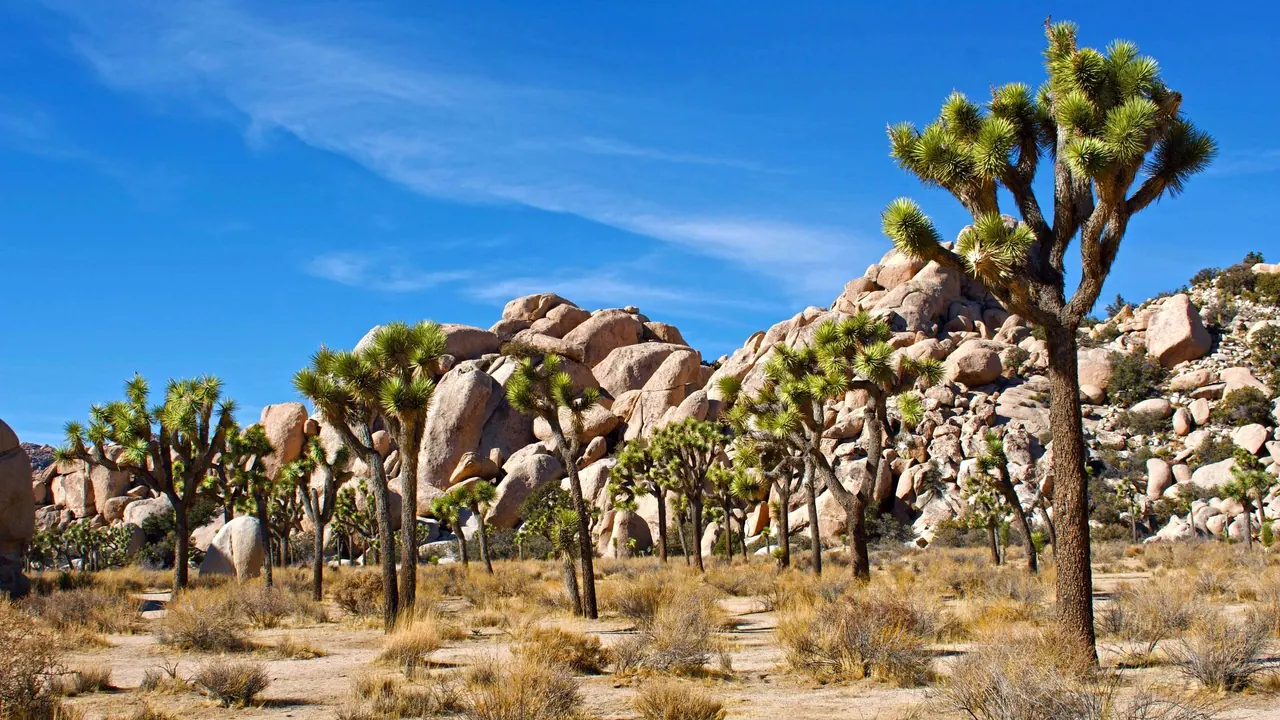
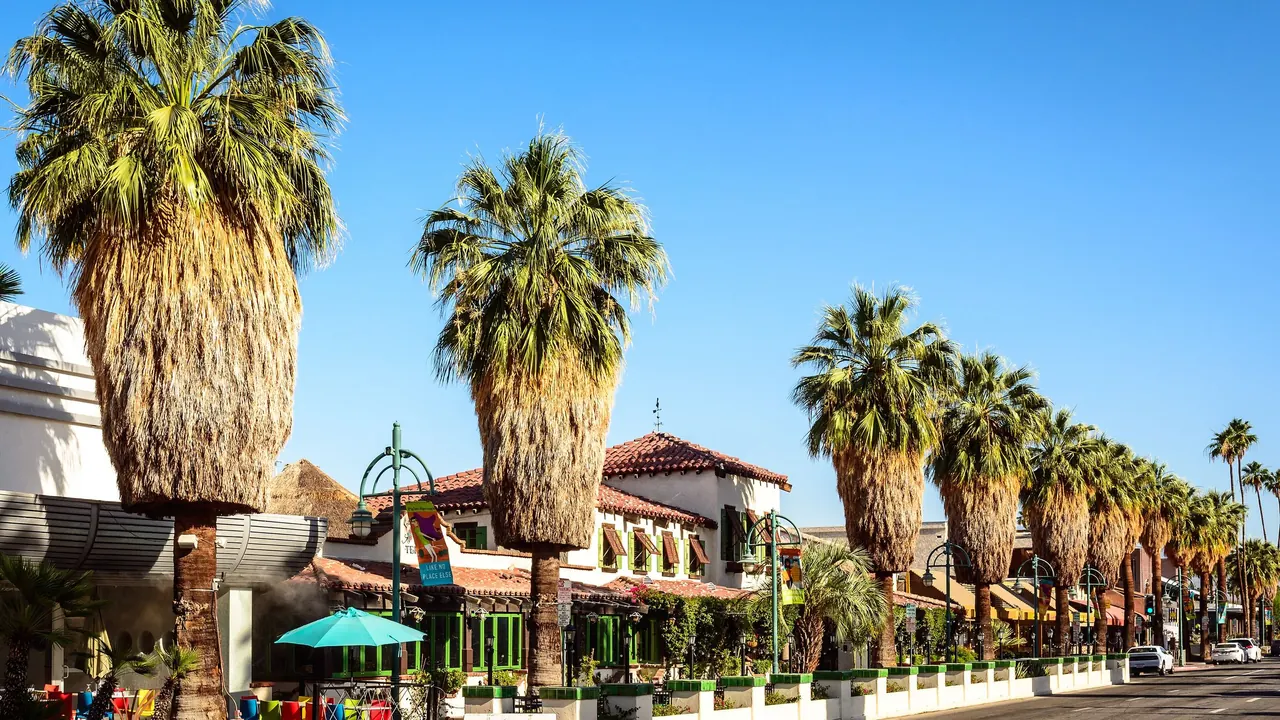
Photos: Joshua Tree by Mr. Location Scout, Pexels License; Palm Springs by Domenico Convertini, CC BY-SA 2.0, cropped.
Joshua Tree or Palm Springs?
Our verdict in twelve categories, each scored against the same fixed benchmark cities, and the climate month by month, so you can choose for your trip.
Choose Joshua Tree for
- getting around
- nature and the outdoors
- prices
Joshua Tree is for travellers who come for the land itself: climbers and boulderers, hikers bound for Ryan Mountain or the palm oases, and anyone who wants a truly dark sky over a rental house with a fire pit. It is a region you explore by car, with the national park at its centre and small towns strung along the highway. To have all that, you give up restaurants, bars and sights.
Choose Palm Springs for
- nightlife
- culture and sights
- shopping
Palm Springs suits a slower, more sociable desert stay: pool days, soaks in mineral water, mid-century houses to tour and a patio or drag night to end the evening. It works as a town base with a walkable centre, and the national park is still close enough for a day of hiking. What you lose is the wilderness right at your door.
Scoreboard
Twelve categories on one fixed scale from 0 to 100. The shaded stretch is the gap between the two.
Your match
Pick a travel style or drag the sliders, and both match scores follow your weighting.
Wins on getting around and nature and the outdoors with your weighting.
Wins on nightlife and culture and sights with your weighting.
What matters to you?
Category by category
What the scores mean for a trip.
Beaches & swimming
Neither place has a beach or natural swimming, so in both the water means a pool. The difference is in how much the pool matters. In Palm Springs it is the centre of the stay, with hotels built around it and long afternoons lounging under the mountains. In Joshua Tree a rental's plunge pool is mostly somewhere to cool off after a morning on the rocks.
Food & drink
Joshua Tree's eating is small-town and practical. There are diners, Mexican places and climbers' coffee shops along Highway 62, and barbecue up in Pioneertown. The choice runs thin in the evening, so most visitors stock up in Yucca Valley and cook at their rental.
Palm Springs is no gourmet destination either, but it has far more choice. You get long brunches on shaded patios and mid-range restaurants along Palm Canyon Drive. The valley adds date shakes from the groves around Indio and honest taquerias in the towns further east.
Culture & sights
What Joshua Tree has is oddities rather than institutions. There is Noah Purifoy's scrap-sculpture museum in the open desert, the Integratron dome near Landers, the film-set street of Pioneertown, and Keys Ranch and the petroglyphs inside the park. They add colour to a trip but would not fill a day on their own.
Palm Springs has a real subject to explore, which is mid-century modern architecture. You can see Albert Frey's houses, Neutra's Kaufmann House and the Alexander homes of Twin Palms and Vista Las Palmas by car or bike. The town also has the Palm Springs Art Museum and the Agua Caliente Cultural Museum, which tells the Cahuilla story.
Nightlife
After dark Joshua Tree offers a couple of saloons and the Pioneertown roadhouse at weekends. Beyond that, the evening means the Milky Way and a fire pit.
Palm Springs has a proper going-out scene, if a modest one. It centres on the LGBTQ bars and drag nights of Arenas Road, with retro cocktail lounges on Palm Canyon Drive and pool parties at spring weekends. There are almost no clubs, though, and most places wind down well before the small hours.
Nature & outdoors
Both are strong outdoor bases, but Joshua Tree puts you inside the main attraction. The national park spans two deserts, with Joshua tree forests and granite boulders in the higher Mojave half and cholla gardens in the lower Colorado Desert half. It is one of the world's great climbing areas, and its dark skies are certified.
Palm Springs gives you contrast instead. The aerial tramway climbs straight from the desert floor into the pine forest and winter snow of Mount San Jacinto. Palm oases and a waterfall wait in the Indian and Tahquitz Canyons. Joshua Tree's boulders are a day out from here rather than the view from your door.
Day trips
The two share many of the same outings, including Idyllwild in the pines and the strange shoreline of the Salton Sea, and each is the other's best day out. Joshua Tree also has Route 66 through the empty Mojave past Amboy. Palm Springs looks south and west instead, to Temecula's wineries and the old mining town of Julian, with the other Coachella Valley towns as easy short hops.
Good for families
Both work with children, but in different ways. Joshua Tree suits older children who like to scramble, with the boulders of Hidden Valley and Skull Rock, the junior ranger programme and nights under the stars. Nothing there is built for children, though, and the days involve long drives.
Palm Springs offers more ready-made outings: the tramway with snow at the top in winter, the Air Museum, and the Living Desert zoo a short drive away. Many of its boutique hotels are adults-only, however. In both places the summer heat is a real hazard for small children.
Getting around
You need a car in both, but in Joshua Tree driving is simple and light traffic is the norm. One highway links the three towns, the park roads are easy to follow, and you can park close to the rocks. The main snags are queues at the west entrance on spring weekends and no mobile signal in much of the park.
Palm Springs has a flat, walkable downtown and an airport on the edge of town. Its sights, though, are spread up into the canyons and down the valley, and the buses are too slow and sparse to reach them. In summer, walking anywhere at midday is out of the question.
Shopping & style
Joshua Tree's shops are few and full of character. Yucca Valley has vintage Western wear and mid-century furniture, and Joshua Tree village has crystal shops, galleries and climbing gear. Palm Springs has much more. Its Uptown Design District specialises in mid-century furniture, lighting and vintage clothing, and El Paseo in Palm Desert and the outlet centres at Cabazon are close by for mainstream shopping.
Affordability
Neither is cheap in the cool months, but Joshua Tree leaves more room to save. You can camp or take an older motel in Twentynine Palms, and the park costs little to enter. Its stylish rental houses are expensive at spring weekends, though, and you will spend steadily on petrol.
In high season Palm Springs charges resort prices, and festival weekends push them higher still. Its bargain is summer, when room prices fall sharply for anyone willing to put up with the heat.
Live music & performing arts
In Joshua Tree, live music mostly means the Pioneertown roadhouse, which books well-known indie, rock and country acts. The Joshua Tree Music Festival adds camping weekends in spring and autumn.
Palm Springs reaches further. Every April the Coachella and Stagecoach festivals fill the polo grounds in Indio. The McCallum Theatre and the valley casinos host touring shows and concerts, and in town there is drag cabaret and piano bar singing.
Wellness & relaxation
Joshua Tree offers stillness. Yoga and meditation retreats gather around the village, the Integratron is known for its sound baths, and many rentals have hot tubs under the stars. For real mineral water, though, you drive half an hour to Desert Hot Springs.
Palm Springs is built on a hot spring. There is a bathhouse over the sacred Agua Caliente spring downtown, Desert Hot Springs is fifteen minutes away, and resort spas are found across the valley. Its unhurried routine of pool days fits the switch-off trip better.
When should you go?
Pick your month. The climate figures are measured averages, not a forecast.
Joshua Tree in July
Palm Springs in July
Daytime high, °C
Rainfall in the month, mm
Where the figures come from
Joshua Tree has no rain gauge within 25 km of the centre, so its rainfall comes from a gridded climate dataset read at the destination rather than from a gauge further away.
Palm Springs has no rain gauge within 25 km of the centre, so its rainfall comes from a gridded climate dataset read at the destination rather than from a gauge further away.
Temperature and rainfall are climate normals, averaged over the years shown. Joshua Tree: 1992-2020 (rainfall 1991-2020) normals, Twentynine Palms / Sunfair Heights (20.4 km from centre). Palm Springs: 2006-2020 (rainfall 1991-2020) normals, Palm Springs (2.3 km from centre).
Joshua Tree sits higher than Palm Springs and is a few degrees cooler all year. Its best months are March to May and October to November, when days are warm enough for hiking and climbing, around 23°C in March. Winter days are cool, with cold nights. From June to September highs near 39°C push any outdoor activity to dawn and dusk.
Palm Springs is warmer in every month. Winter afternoons near 21°C give the mild pool weather the town is known for. By April it is hot, and summer reaches 42°C, far too hot for walking the streets in the middle of the day. Rain is light in both places and falls mostly in winter, a little more of it in Palm Springs.
Which traveller are you?
For an outdoors trip, Joshua Tree is the clear pick. You wake up beside the boulder piles, the climbing routes and the Joshua tree forests, and at night the dark sky is overhead. From Palm Springs the park is an hour's drive each way.
On a food and nightlife trip, Palm Springs has much more to offer. It has brunch patios, retro cocktail lounges and the bars and drag nights of Arenas Road. In Joshua Tree's towns, kitchens close early and most evenings end around a fire pit.
For a relaxing and wellness trip, Palm Springs is the better choice. It has a bathhouse over its own sacred spring, resort spas and the spring-fed pools of Desert Hot Springs close by. Joshua Tree offers quieter retreats and sound baths, with real soaking half an hour away.
Before you go
| Measure | Joshua Tree | Palm Springs |
|---|---|---|
| Currency | US Dollar (USD) | US Dollar (USD) |
| Sockets | AB120 V, 60 Hz | AB120 V, 60 Hz |
| Driving side | Right | Right |
| Time zone | UTC-8, UTC-7 in summer | UTC-8, UTC-7 in summer |
| Emergency number | 911 | 911 |
| Elevation | - | 146 m |
| Main airport | Palm Springs International Airport (PSP)29 non-stop destinations | Palm Springs International Airport (PSP)2 km from centre29 non-stop destinations |
| Public holidays this year | 13 days | 13 days |
By the numbers
| Measure | Joshua Tree | Palm Springs |
|---|---|---|
| Population | - | 44,575 |
| People per km² | - | 181 |
| Museums within 10 km | - | 3 |
| UNESCO World Heritage sites within 50 km | - | 0 |
Where else could you go?
Every comparison below shares a destination with this one, so you can follow Joshua Tree or Palm Springs somewhere new.
- Palm Desertvs Palm Springs
- Big Bear Lakevs Palm Springs
- Laguna Beachvs Palm Springs
- Anaheimvs Palm Springs
- Newport Beachvs Palm Springs
- San Diegovs Palm Springs