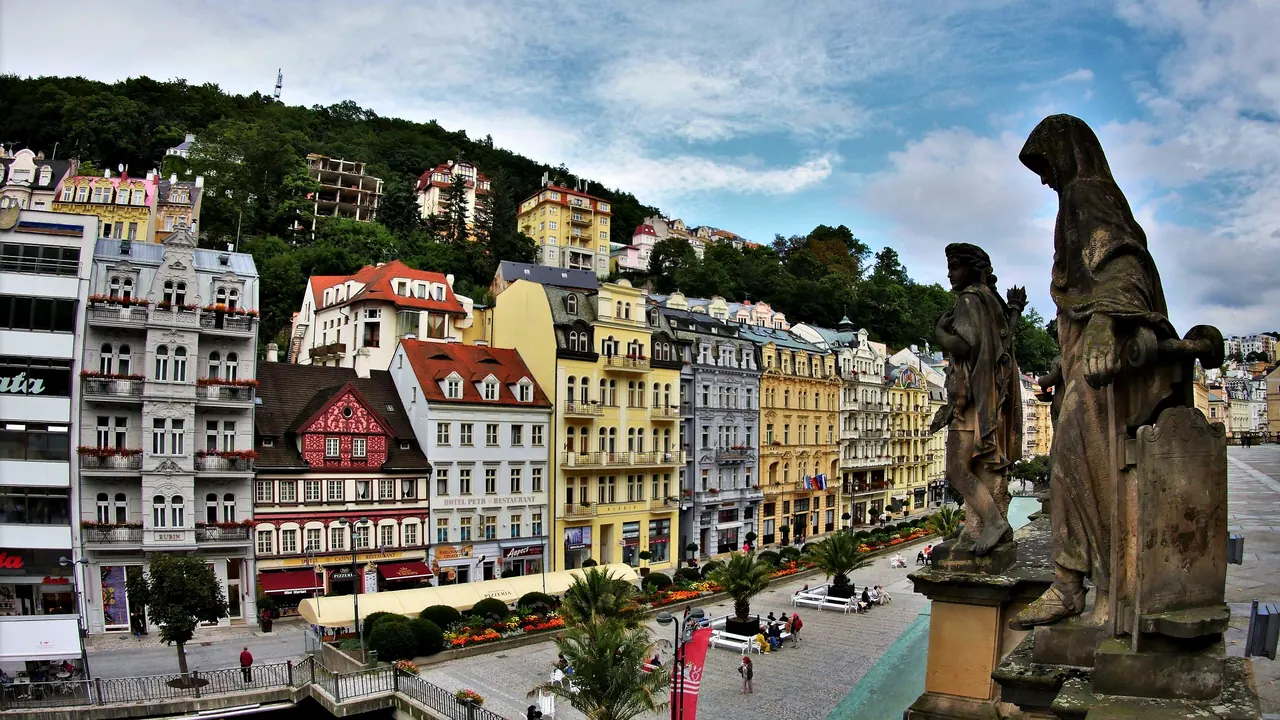
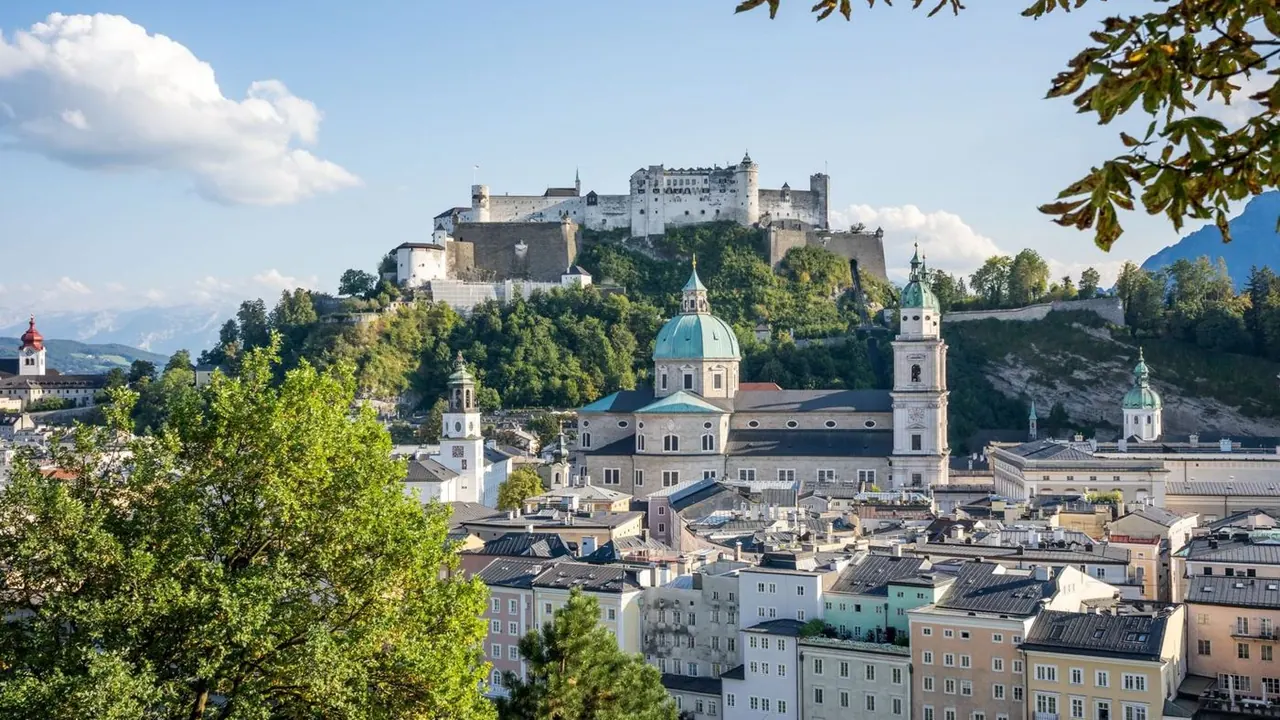
Photos: Karlovy Vary by Rolf Dietrich Brecher from Germany, CC BY-SA 2.0, cropped; Salzburg by Leonhard Niederwimmer, Pexels License.
Karlovy Vary or Salzburg?
Our verdict in twelve categories, each scored against the same fixed benchmark cities, and the climate month by month, so you can choose for your trip.
Choose Karlovy Vary for
- wellness
- prices
Karlovy Vary is for travellers who want to slow down and be looked after. The whole town is built around taking the waters: you sip from the springs under the colonnades, book a few days of baths and massages in a sanatorium, and walk the forest paths between coffee and cake. It also costs noticeably less than Salzburg. It suits a restful break for adults, not a packed sightseeing trip.
Choose Salzburg for
- live music and the arts
- families
- beaches
Choose Salzburg if you want more to do each day. Its Baroque old town and fortress give you richer sightseeing, its concert and opera life is in a different league, and the Alps and the Salzkammergut lakes begin almost at the city edge. Families, walkers and music lovers will all find more here, as long as they accept higher prices and wetter summers.
Scoreboard
Twelve categories on one fixed scale from 0 to 100. The shaded stretch is the gap between the two.
Your match
Pick a travel style or drag the sliders, and both match scores follow your weighting.
Wins on wellness and prices with your weighting.
Wins on live music and the arts and families with your weighting.
What matters to you?
Category by category
What the scores mean for a trip.
Beaches & swimming
Neither is a swimming destination, but Salzburg has the better water. Fuschlsee, Wolfgangsee and Mondsee are clear Alpine lakes under an hour away, where you swim from lawns and wooden jetties on a warm summer day.
From Karlovy Vary the main option is Lake Medard, a flooded former mine near Sokolov, or the warm spring-fed outdoor pool above the town. It is enough for a swim, not a reason to choose the town.
Food & drink
Both serve hearty, meaty cooking, but Salzburg has more range and better coffee houses. Karlovy Vary offers Czech roast pork, dumplings and svíčková with Pilsner-style beer, plus two local treats, warm spa wafers and Becherovka, and little beyond that.
Salzburg adds the Salzburger Nockerl and Kasnocken, a stronger coffee-house tradition and the Augustiner monastery brewery in Mülln, where beer comes from wooden barrels. Its best cooking is in the inns of the outer districts and on the hills, not in the touristy old town.
Culture & sights
Both towns hold UNESCO listings, but for different things. Karlovy Vary's sight is its spa architecture: pastel Belle Époque hotels stacked up the Teplá valley, colonnades of columns and carved timber, and the Vřídlo geyser shooting hot water into the air. Its museums are small and specialist, and a day or two is enough.
Salzburg has more depth. The Baroque cathedral, the Residenz state rooms, the Hohensalzburg fortress, St Peter's catacombs, the Mirabell gardens and the two Mozart houses fill two or three days, and the Museum der Moderne on the Mönchsberg adds a modern note that Karlovy Vary lacks.
Nightlife
Both are quiet in the evening, though Salzburg has slightly more going on. Its beer halls, with long tables and litre mugs, fill with locals, and student pubs around Rudolfskai stay open later at weekends during term.
Karlovy Vary is asleep by about eleven. Evenings mean hotel bars, wine bars and casinos, except during the film festival week in early summer. For a real night out from Salzburg, people take the train to Munich.
Nature & outdoors
Salzburg is much the stronger choice for the outdoors. The Untersberg cable car takes you to limestone ridges at about 1,800m, paragliders launch from the Gaisberg, and both the Salzkammergut lakes and the Königssee fjord in Berchtesgaden National Park are close by.
Karlovy Vary's countryside is gentler: beech and spruce forest, old graded spa paths up to the Diana tower, the moors of the Slavkov Forest and easy canoeing on the Ohře. Skiing at Klínovec in the Ore Mountains is the nearest it gets to mountain sport.
Day trips
Both make good bases, but Salzburg's outings are grander and more varied. Hallstatt, the salt mines at Hallein and Berchtesgaden, the clifftop fortress at Werfen and the imperial spa at Bad Ischl are all within reach, and Munich is about an hour and a half by train.
Karlovy Vary's best trips are closer and smaller in scale. The castle town of Loket is twenty minutes away, Mariánské Lázně and Františkovy Lázně complete the West Bohemian spa trio, and the St Maurus reliquary at Bečov is a real treasure. Prague takes a long day by coach.
Good for families
Salzburg suits children far better. The trick fountains at Hellbrunn, the zoo next door, the hands-on Haus der Natur, the marionette theatre and the miners' slides in the nearby salt mines could fill several days.
Karlovy Vary is calm and safe, but it is built for adults taking cures. The geyser, the spouted cups of spring water, the funicular to the small animal enclosure and the castle at Loket keep children busy for an afternoon or two. In both towns, steep slopes make pushchairs hard work.
Getting around
Both centres are best on foot, with Salzburg slightly easier. Its old town, fortress and Mirabell are all within about fifteen minutes' walk on largely car-free streets, trolleybuses cover the rest, and flat riverside paths suit cycling.
Karlovy Vary stretches along one long, narrow valley, so you rely on buses and the funicular to climb its steep sides. Its rail links are slow regional lines, while Salzburg has direct trains to Munich and Vienna. Either way, a hire car helps with the countryside.
Shopping & style
There is little between them in range, but the specialities differ. Karlovy Vary sells glass and gems: Moser crystal from the town's own showroom, local porcelain and Bohemian garnets, alongside furs and jewellery for wealthy spa guests.
Salzburg's speciality is Tracht, dirndls and loden jackets, often made to measure. It also has the farmers' market by the Andräkirche and the old Advent market on Domplatz, and Karlovy Vary has no market to match either.
Affordability
Karlovy Vary is clearly the cheaper stay. Hotels and restaurants on the colonnades charge for the setting, but pubs and canteens a street away charge local Czech prices, and only the film festival week pushes room rates up sharply.
Salzburg is expensive all year, and much more so during the summer festival and the Advent markets. To keep costs down, stay across the river or in the suburbs, eat in the outer beer halls and buy the city card.
Live music & performing arts
Salzburg is one of Europe's great music cities, and Karlovy Vary cannot compete. Its summer festival fills the Grosses Festspielhaus and the Felsenreitschule, a riding school cut into the cliff, and Jedermann is played outdoors in front of the cathedral. Mozart Week and the Easter Festival add two more seasons, and the Mozarteum and the Landestheater keep a programme going all year.
Karlovy Vary's symphony orchestra comes from the old spa orchestras and plays mostly light classical programmes, some outdoors on the colonnades. The Fellner and Helmer theatre and an autumn Dvořák festival make for a pleasant evening out, not a reason to choose the town.
Wellness & relaxation
Karlovy Vary is the specialist here. It has thirteen springs piped into the colonnades, a drinking cure prescribed for centuries, and dozens of sanatoria offering carbonated baths, peat wraps and medical consultations. The full experience comes with booking a spa stay, since public bathhouses are fewer than you might expect.
Salzburg has no springs of its own. It offers the Paracelsus Bad's saunas and quiet walks in the Mirabell gardens and on the Mönchsberg. For real spa bathing you go out of town, to the brine baths of Bad Reichenhall or the radon springs of the Gastein valley.
When should you go?
Pick your month. The climate figures are measured averages, not a forecast.
Karlovy Vary in July
Salzburg in July
Daytime high, °C
Rainfall in the month, mm
Where the figures come from
Karlovy Vary's station stands 156 m above the city centre, so the centre is likely a little warmer than the figures say.
Karlovy Vary has no rain gauge within 25 km of the centre, so its rainfall comes from a gridded climate dataset read at the city rather than from a gauge further away.
Karlovy Vary's sunshine is measured 37 km from the centre, at Cheb.
Temperature and rainfall are climate normals, averaged over the years shown. Karlovy Vary: 1999-2020 (sunshine 1981-2010, rainfall 1991-2020) normals, Karlovy Vary (4.6 km from centre). Salzburg: 1991-2020 normals, Salzburg (3.4 km from centre).
Karlovy Vary is the cooler and drier of the two. Daytime highs peak at about 22°C in July and August, and even its wettest month, July, brings around 95mm, less than Salzburg gets in any month from May to September. Summer is short for outdoor swimming at Lake Medard, but the warm, spring-fed outdoor pool makes a dip pleasant in cooler months too. From December to February the town sits just above freezing, which matters little if your days are spent in thermal baths and spa hotels.
Salzburg is warmer, reaching about 25°C in midsummer, and its lakes are good for swimming from June to early September. It is also far wetter, and summer brings the most rain, peaking near 168mm in June, so expect showers on walks and lake days. Salzburg is the sunnier town for most of the year, and only in May does Karlovy Vary edge ahead. In both towns, May and September are the best months for walking. In winter, snow often reaches Salzburg, and its ski areas are about an hour away.
Which traveller are you?
On a relaxing and wellness trip, Karlovy Vary is the obvious choice. Its springs, drinking cure, sanatoria and thermal pools make rest the whole point of a stay. Salzburg has one public bath and sends you out of town for serious spa bathing.
For a culture and arts trip, choose Salzburg. The archbishops' Baroque old town, the Hohensalzburg fortress and the Mozart houses offer more to see, and the summer festival, Mozart Week and nightly chamber concerts outclass Karlovy Vary's light classical programme.
On a tight budget, Karlovy Vary goes further. Pubs one street back from the colonnades serve Czech food and beer at local prices, and the springs and promenades cost nothing. Salzburg is expensive for its size, especially near the old town.
Before you go
| Measure | Karlovy Vary | Salzburg |
|---|---|---|
| Official language | Czech | German, Austrian Sign Language |
| Currency | Czech Koruna (CZK) | Euro (EUR) |
| Sockets | CE230 V, 50 Hz | CF230 V, 50 Hz |
| Driving side | Right | Right |
| Time zone | UTC+1, UTC+2 in summer | UTC+1, UTC+2 in summer |
| Emergency number | 112 | 112 |
| Elevation | 447 m | 424 m |
| Main airport | Václav Havel Airport Prague (PRG)100 km from centre178 non-stop destinations | Salzburg Airport (SZG)3 km from centre64 non-stop destinations |
| Public holidays this year | 13 days | 16 days |
By the numbers
| Measure | Karlovy Vary | Salzburg |
|---|---|---|
| City population | 49,073 | 155,021 |
| People per km² | 830 | 2,360 |
| Museums within 10 km | 2 | 38 |
| UNESCO World Heritage sites within 50 km | 3 | 3 |
Where else could you go?
Every comparison below shares a destination with this one, so you can follow Karlovy Vary or Salzburg somewhere new.
- Hallstattvs Salzburg
- Dresdenvs Karlovy Vary
- Praguevs Karlovy Vary
- Munichvs Salzburg
- Leipzigvs Karlovy Vary
- Innsbruckvs Salzburg