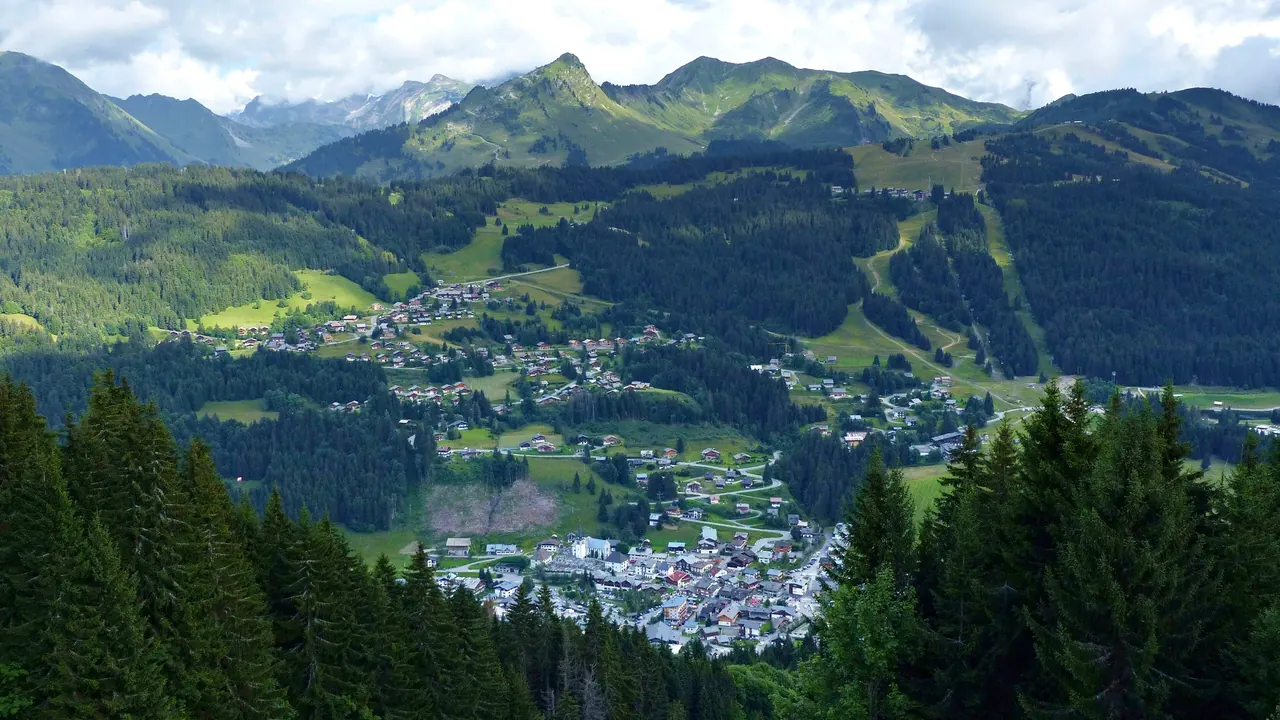
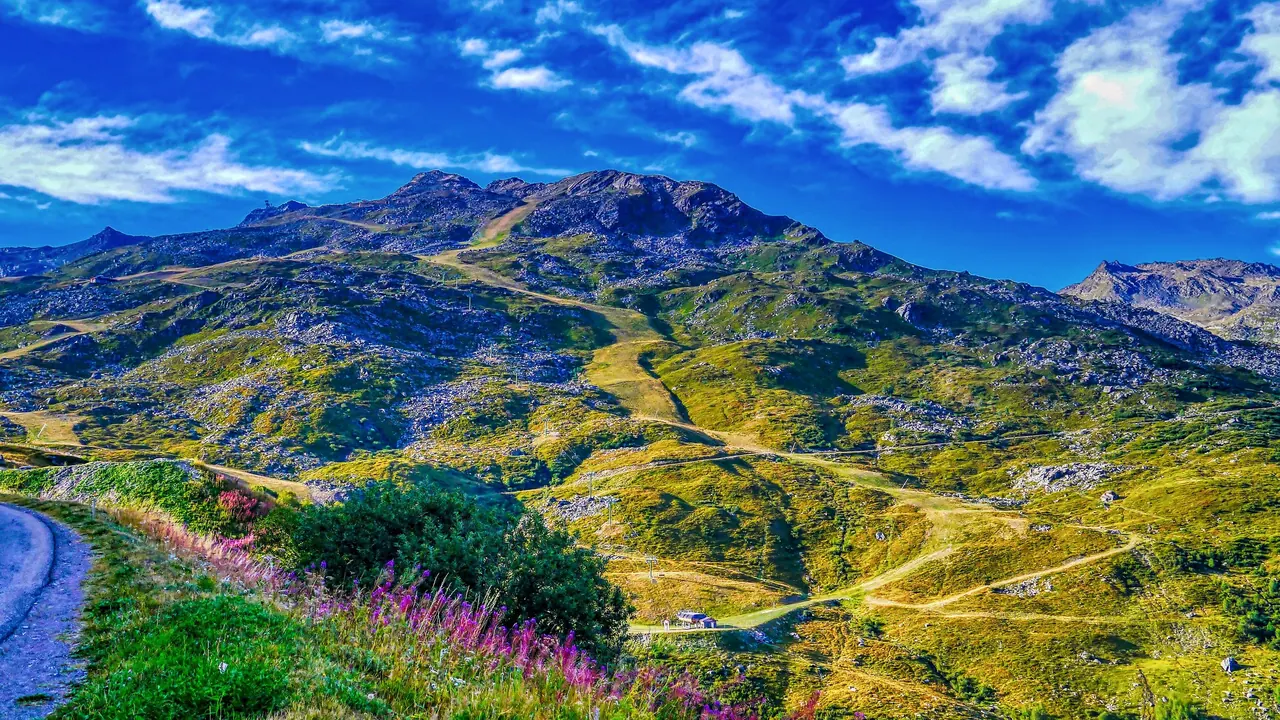
Photos: Les Gets by Jjt.pub, CC BY 3.0, cropped; Val Thorens by Zairon, CC BY-SA 4.0, cropped.
Les Gets or Val Thorens?
Our verdict in twelve categories, each scored against the same fixed benchmark cities, and the climate month by month, so you can choose for your trip.
Choose Les Gets for
- day trips
- families
- beaches
Les Gets suits families and mixed groups who want a proper village around them. Its tree-lined slopes stay skiable in flat light, the children's facilities are among the best of any French resort, and in summer it turns into a bike-park and lake destination with real warmth. With a car, Geneva, Annecy and Lake Geneva are all within reach, so a week can include more than the mountain.
Choose Val Thorens for
- nightlife
- getting around
- food and drink
Val Thorens is the pick for committed skiers and groups of friends who want snow they can rely on and a lively evening afterwards. At the top of the Three Valleys, it offers high glacier terrain, a season that runs deep into spring and the busiest après-ski of the two. It asks more in return: the cold and wind of high altitude, little beyond the resort, and almost nothing to do once the snow has gone.
Scoreboard
Twelve categories on one fixed scale from 0 to 100. The shaded stretch is the gap between the two.
Your match
Pick a travel style or drag the sliders, and both match scores follow your weighting.
Wins on day trips and families with your weighting.
Wins on nightlife and getting around with your weighting.
What matters to you?
Category by category
What the scores mean for a trip.
Beaches & swimming
Neither has a beach, but Les Gets at least offers a swim. In high summer the Lac des Écoles, just above the village, warms to lake temperatures with a shallow area for children and a lawn, and the shores of Lake Geneva are an hour's drive away. At Val Thorens the glacier-fed lakes are far too cold to swim in, so swimming means an indoor pool.
Food & drink
Both kitchens are Savoyard at heart, with fondue, raclette, tartiflette and diots on almost every menu, and in both the best meal is often a long lunch on a slope-side terrace. Les Gets adds local Reblochon and Abondance and terraces that look out to Mont Blanc.
Val Thorens offers more choice at the top end. A handful of ambitious gastronomic kitchens in its upmarket hotels give it a special-occasion dinner that the Les Gets dining rooms do not quite match, even if the everyday menus there are just as repetitive.
Culture & sights
Neither resort is a destination for sights, but Les Gets is an old village with one stop worth planning around. The Musée de la Musique Mécanique brings its music boxes, barrel organs and automata to life on guided tours, and the parish church and balconied farmhouses give a stroll through the centre some character.
Val Thorens has no equivalent. It is a resort of the ski age, apartment blocks on open mountainside with no history before the lifts arrived, so the peaks themselves are the only thing to look at. Anyone wanting Savoyard heritage has to go down the mountain from either base, but the drive is much shorter from Les Gets.
Nightlife
Val Thorens is the place for a big night out. Its après-ski spills from mountain terraces into village pubs and then into clubs, including a well-known underground one, and a crowd of students and groups of friends keeps it going late all winter.
Les Gets is deliberately gentler. A few bars with DJs and terraces fill up as the lifts close, but its family crowd keeps things relaxed, and anyone wanting more drives over to Morzine. Out of season, neither has much going on after dark.
Nature & outdoors
Both are first-rate mountain bases, but the mountains are very different. Les Gets sits among forest and pasture on the Portes du Soleil, with tree-lined runs that ski well in poor visibility. In summer it becomes one of Europe's leading bike parks, with hiking and paragliding facing Mont Blanc.
Val Thorens is stark high-alpine ground of rock, snowfields and glacier, at the head of the vast Three Valleys, with off-piste, glacier terrain and snow that lasts into May. Its short summer brings marmots, ibex and the edge of the Vanoise national park, though the weather is cooler and less settled.
Day trips
Les Gets is much the better base for seeing the region. Geneva, Annecy and Chamonix are each within about an hour or so, and the southern shore of Lake Geneva adds Évian, walled Yvoire and the ferry to Lausanne, though a car makes all of this far easier.
From Val Thorens, the most rewarding towns, Annecy and Chambéry, are around two hours away down a winding road. Closer to hand there is only Moûtiers and the medieval quarter of Conflans, and the trips to Méribel and Courchevel are really ski outings.
Good for families
Les Gets is built around families. Ski schools, children's areas and beginner slopes sit close to the village, and in summer there is a supervised lake, a luge, rope parks and a little tourist train. The main gaps are a large attraction and things to do in the rain.
Val Thorens works well on the practical side, with a car-free centre, slope-side lodging and good children's clubs. But the altitude brings fierce cold, wind and lift closures, small children can sleep badly up there, and the young party crowd sets the tone more than families do.
Getting around
Val Thorens is easier once you arrive. The village is compact and largely car-free, many apartments are ski-in, ski-out, and the lifts link the whole Three Valleys. Getting up from the train at Moûtiers means an hour of hairpin bends, though.
Les Gets has a walkable centre and free shuttles out to the chalets, but more of its accommodation is spread out, and with no railway it relies on a transfer from Geneva. For anything beyond the resort, a car matters more here, and winter roads can need chains.
Shopping & style
Both offer only practical shopping: ski and bike hire, technical clothing, and delicatessens selling cheese and charcuterie to take home. Les Gets has a little more character thanks to its weekly market with local produce and crafts, and Geneva and Annecy are near enough for proper shopping. Val Thorens has little more than resort shops and supermarkets for self-catering.
Affordability
A winter week costs a lot in either resort, and Les Gets comes out a little lighter. It is a mid-altitude village and less extravagant than the grand high-altitude names, so lift passes, ski school and a catered chalet add up to somewhat less. A lunch on a mountain terrace still costs well above what the same plate would in the valley.
Val Thorens charges high-altitude prices for everything, from hotel rooms and lift passes to slope-side lunches and the goods in its shops. In both resorts the French school vacation weeks are the dearest. Here the biggest saving comes from sharing an apartment as a group and cooking for yourselves.
Live music & performing arts
Neither has a theatre or concert hall, so for anything formal you have to travel. The live music differs: Les Gets has outdoor concerts on the slopes at the end-of-season Portes du Soleil festival, summer street bands and its own museum of playing instruments, with Geneva in reach for opera. In Val Thorens, live music means cover bands and DJs in the après-ski bars.
Wellness & relaxation
Both offer hotel pools, saunas and massages rather than a bathing culture, and each has a historic spa town about an hour away: Évian for Les Gets, Brides-les-Bains for Val Thorens. The difference is the pace. Les Gets is a quiet village with clear air and long terrace lunches, while Val Thorens revolves around hard skiing and late après-ski, so rest there means a hotel spa rather than a calm place.
When should you go?
Pick your month. The climate figures are measured averages, not a forecast.
Les Gets in July
Val Thorens in July
Daytime high, °C
Rainfall in the month, mm
Where the figures come from
Les Gets's temperatures are measured 61 km from the centre, at Bourg-St-Maurice.
Les Gets has no rain gauge within 25 km of the centre, so its rainfall comes from a gridded climate dataset read at the destination rather than from a gauge further away.
Val Thorens has no weather station within reach, so its figures come from a gridded climate model rather than a measured record, and read a broad area rather than one spot.
Temperature and rainfall are climate normals, averaged over the years shown. Les Gets: 1999-2020 (rainfall 1991-2020) normals, Bourg-St-Maurice (60.8 km from centre). Val Thorens: 1991-2020 normals, TerraClimate 4 km grid at the town, no weather station within 90 km.
The two resorts sit at very different heights, and the climate shows it. Les Gets has winter highs of around 5°C, and the snow there depends on the season, while Val Thorens stays below freezing through the deep winter and keeps its ski season going from late November into May. That makes it the safer bet at both ends of winter. In Les Gets, late spring and early autumn are mild and good for walking, and June to August reach about 27°C, warm enough for the swimming lake and long days on the bike trails.
Val Thorens never really warms up. Even August peaks at around 16°C, which suits high hiking but means a fleece every day, and the weather can turn cold at short notice. Both places are wet all year, with no real dry season. The heaviest months come at the start of winter, when Val Thorens gets about 180mm in November, mostly as snow at that altitude.
Which traveller are you?
On a family trip with young children, Les Gets is the clear choice. Its ski schools, gentle slopes near the village, free shuttles and summer lake, luge and pony rides are built around children, and the milder altitude spares them Val Thorens' cold and wind.
For a food and nightlife trip, Val Thorens wins. Its après-ski starts with table dancing on the mountain terraces and ends in clubs open until the early hours, and a few gastronomic hotel kitchens give the eating a top end that Les Gets lacks.
On a tight budget, Les Gets is the easier place to manage, though neither resort is cheap. It is less costly than high-altitude Val Thorens, and a summer stay built around a bike-park pass, the lake and a self-catering apartment costs far less than any ski week.
Before you go
| Measure | Les Gets | Val Thorens |
|---|---|---|
| Official language | French | French |
| Currency | Euro (EUR) | Euro (EUR) |
| Sockets | CE230 V, 50 Hz | CE230 V, 50 Hz |
| Driving side | Right | Right |
| Time zone | UTC+1, UTC+2 in summer | UTC+1, UTC+2 in summer |
| Emergency number | 112 | 112 |
| Elevation | 900 m | 1,710 m |
| Main airport | Geneva International Airport (GVA)44 km from centre150 non-stop destinations | Geneva International Airport (GVA)111 km from centre150 non-stop destinations |
| Public holidays this year | 11 days | 11 days |
By the numbers
| Measure | Les Gets | Val Thorens |
|---|---|---|
| Population | 1,227 | - |
| People per km² | 41 | - |
| Museums within 10 km | 1 | 0 |
| UNESCO World Heritage sites within 50 km | 3 | 1 |
Where else could you go?
Every comparison below shares a destination with this one, so you can follow Les Gets or Val Thorens somewhere new.
- Morzinevs Les Gets
- Les Menuiresvs Val Thorens
- Avoriazvs Les Gets
- Samoënsvs Les Gets
- Méribelvs Val Thorens
- Courchevelvs Val Thorens