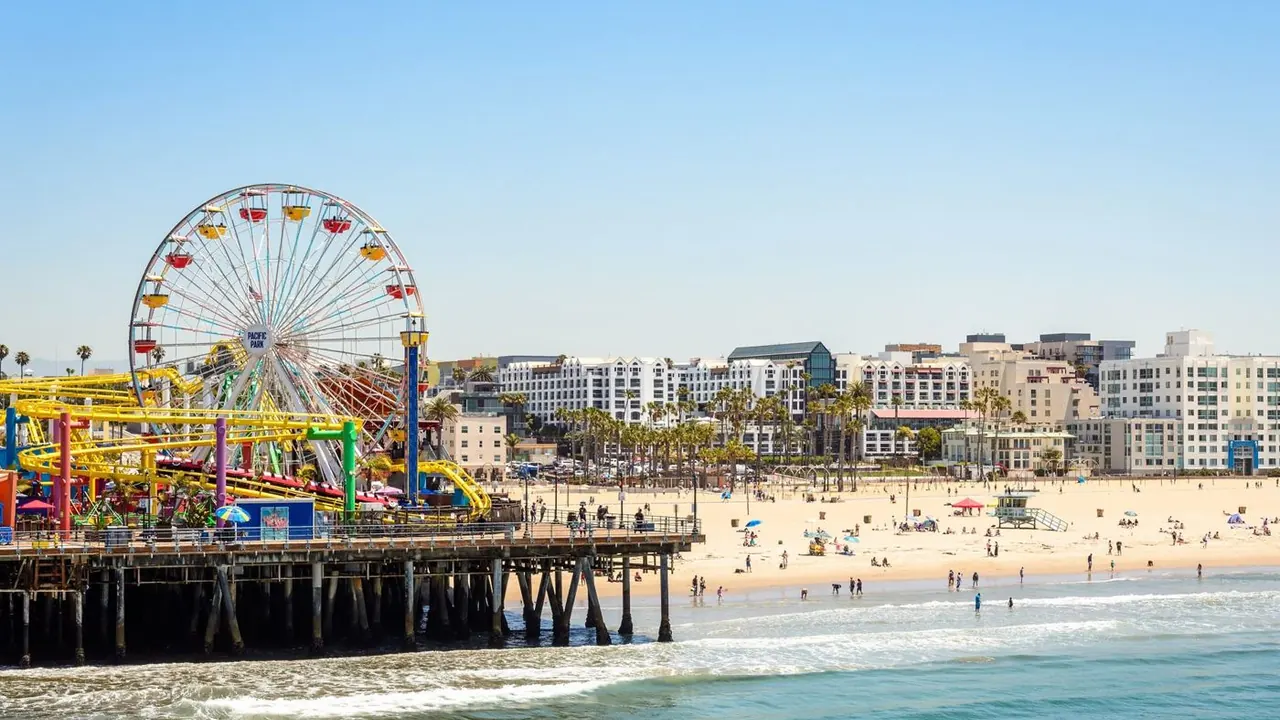
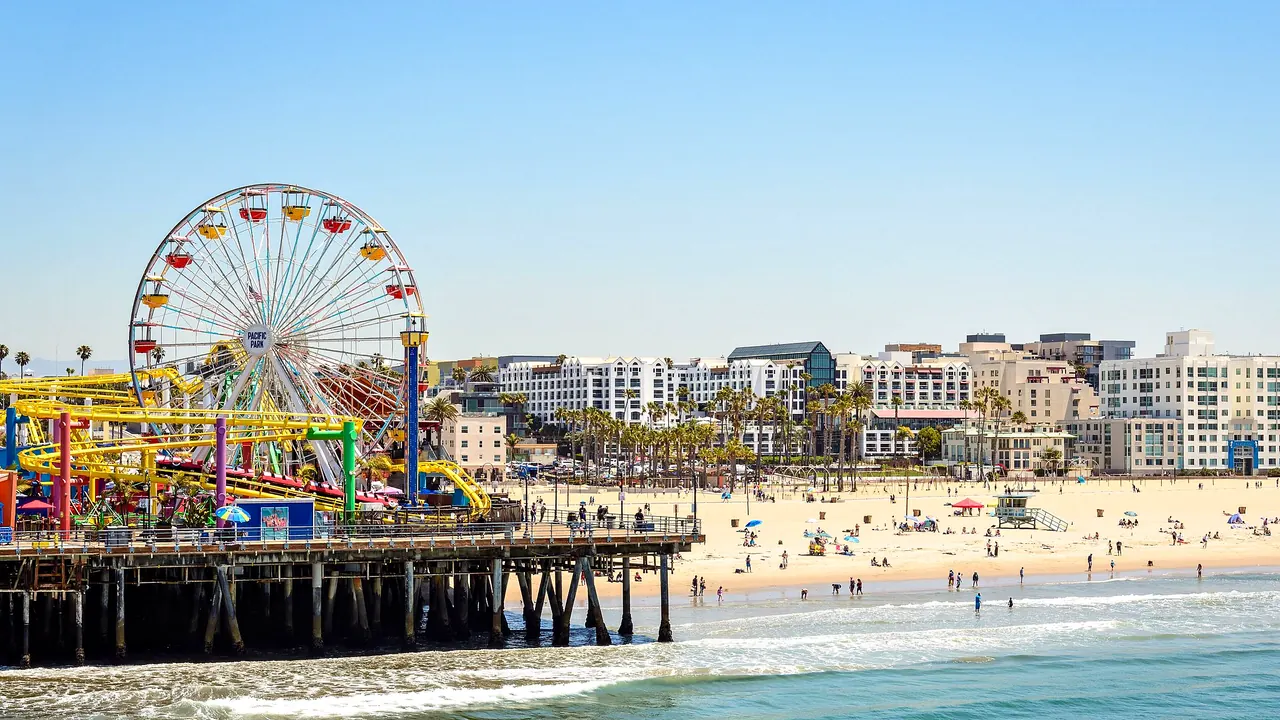
Photos: Los Angeles by BenSherman, Public domain; Santa Monica by Domenico Convertini, CC BY-SA 2.0, cropped.
Los Angeles or Santa Monica?
Our verdict in twelve categories, each scored against the same fixed benchmark cities, and the climate month by month, so you can choose for your trip.
Choose Los Angeles for
- live music and the arts
- culture and sights
- nightlife
Los Angeles suits the traveller who wants the whole metropolis and is ready to drive for it. The food of Koreatown and the San Gabriel Valley, the Philharmonic and the Hollywood Bowl, the Getty and LACMA, the clubs of Hollywood and West Hollywood and the big theme parks all sit in the wider city. Base yourself in the basin, hire a car and plan each day around one district.
Choose Santa Monica for
- getting around
- beaches
- day trips
Santa Monica is the better choice if the trip is really about the ocean. You stay on a wide sandy beach with the mountains behind it, walk to dinner and take the bike path in the morning. It costs even more and has far less to see or do at night, but you can spend most days without a car, and the city is a light-rail ride or a drive away when you want it.
Scoreboard
Twelve categories on one fixed scale from 0 to 100. The shaded stretch is the gap between the two.
Your match
Pick a travel style or drag the sliders, and both match scores follow your weighting.
Wins on live music and the arts and culture and sights with your weighting.
Wins on getting around and beaches with your weighting.
What matters to you?
Category by category
What the scores mean for a trip.
Beaches & swimming
Much of the coast is shared, since Santa Monica is one of the beach towns along the Los Angeles shore. The difference is distance. Santa Monica puts a very wide band of pale sand, the pier and the lifeguard towers right outside the door. From Hollywood or downtown, the shore that runs from Malibu down to the South Bay and Long Beach usually means a drive.
Los Angeles has more variety along its 100km, from the Zuma and El Matador coves to the volleyball and surf of Hermosa and Redondo. The water is the same cool Pacific on both, better for wading and surfing than long swims. In Santa Monica, swim a little way from the pier rather than right beside it.
Food & drink
This is one of the widest gaps between the two. Los Angeles cooks at full strength across its immigrant communities: tacos in the Eastside and South LA, charcoal barbecue in Koreatown, regional Chinese in the San Gabriel Valley, plus Thai Town and Little Ethiopia. Grand Central Market is an easy place to graze.
Santa Monica eats well but in a narrower register. You get seasonal Californian cooking built around the Wednesday farmers market, seafood, brunch and good Italian and Japanese along Main Street and Montana Avenue. The cheap, deep food Los Angeles is famous for is a long drive east.
Culture & sights
Los Angeles has a real art circuit: LACMA, the Broad and MOCA, the Huntington's library and gardens in San Marino, and Griffith Observatory looking across to the Hollywood Sign. Add the studio lots, Walt Disney Concert Hall and the Art Deco downtown, and a culture-led trip has plenty to fill it.
Santa Monica's own sights are the pier with its carousel and Route 66 sign, the galleries of Bergamot Station and some fine Spanish Colonial Revival buildings. Its advantage is that both Gettys are a short drive away, so the best collections on the Westside are close. Anything beyond them means crossing the city.
Nightlife
Los Angeles offers whole districts of nightlife, each with its own crowd: velvet-rope clubs in Hollywood, the gay strip on Santa Monica Boulevard in West Hollywood, rooftop cocktails in downtown's old banks, and dive bars and natural wine in Silver Lake and Echo Park. The catch is that one night usually stays in one neighbourhood.
Santa Monica is for drinks, not dancing. You will find wine bars and ocean-view hotel rooftops around the Promenade and British-style pubs on Main Street, with Venice next door for a looser crowd. The town quietens well before closing time, and a proper night out means a long taxi ride to Hollywood.
Nature & outdoors
Both have mountains and sea close by, but Los Angeles reaches further. Griffith Park and Runyon Canyon are inside the city. Behind it the San Gabriel Mountains rise above 3,000m, with pine forest, waterfalls and winter snow on Mount Baldy, and boats run out to the Channel Islands.
Santa Monica's outdoors starts at the edge of town. Trails in Temescal Canyon and Topanga climb through chaparral to views over the bay, and the beach path runs about 35km for cycling and skating. There are easy surf lessons too, and dolphins are often seen from the shore. It is less wild but takes less effort.
Day trips
The list is largely the same from either base: Santa Barbara's mission and wine country, Ojai, Laguna Beach and Catalina by ferry. Where you start changes which trips are easy. Santa Monica is already on the coast road north, so Malibu and Santa Barbara come naturally. Pasadena, Hollywood and downtown also count as full days out from there.
A central Los Angeles base points the other way. Mission San Juan Capistrano, Temecula's vineyards and, at the outer limit, Palm Springs and San Diego are more practical from there. Neither base has a historic old town within reach, and traffic sets the range of both.
Good for families
Los Angeles has far more for children. Disneyland and Universal Studios are joined by Knott's Berry Farm and Six Flags Magic Mountain. There is also the space shuttle at the California Science Center, the fossils at the La Brea Tar Pits, the zoo and the Aquarium of the Pacific. Each outing means a drive, so families do best with a car and one area a day.
Santa Monica is the gentler option. Its strengths are the wide lifeguarded sand, the pier's Ferris wheel and carousel, the small aquarium under the pier and flat bike rides along the beach. It is compact and easy with small children, but a theme park takes up the whole day.
Getting around
Santa Monica is clearly easier without a car. Downtown, the pier, the Promenade and Main Street are within walking distance, and the blue buses cover the rest of town. The E Line takes about an hour to downtown Los Angeles, stopping near the Exposition Park museums.
Los Angeles is built around the freeway. The Metro links downtown, Hollywood, Pasadena and Long Beach, but it leaves large areas uncovered. Most visitors end up with a hire car or ride-hailing and long waits in traffic between pleasant walkable pockets such as Old Pasadena.
Shopping & style
Los Angeles goes much deeper. Rodeo Drive has the luxury houses, Melrose mixes streetwear and vintage, Silver Lake has records and design objects, and the Rose Bowl flea market is a serious vintage hunt. The Fashion District adds wholesale fabrics and bargains.
Santa Monica covers the chains well along the Third Street Promenade. For something more distinctive, Montana Avenue has upmarket boutiques and children's shops, and Main Street has surfwear. Abbot Kinney in Venice is close to both bases, but for luxury labels Santa Monica shoppers drive to Beverly Hills.
Affordability
Neither is a budget trip, but Santa Monica costs more. You pay to sleep by the ocean, especially in summer, and restaurant bills run high. In its favour, the beach, the trails and the bike path are free, and local buses and light rail mean you can often skip the hire car.
Los Angeles gives you more ways to cut costs. Taco trucks, Koreatown and the San Gabriel Valley feed you well for little, and Griffith Observatory and the Getty are free. Hotels away from the coast are cheaper too, though a car, parking and theme park tickets add up quickly.
Live music & performing arts
For concerts and the stage, Los Angeles has far more than its beach neighbour. The Philharmonic plays at Walt Disney Concert Hall and moves outdoors to the Hollywood Bowl in summer, LA Opera performs at the Music Center, and bands play every night on the Sunset Strip and in Echo Park. Hollywood's improv and comedy clubs and the jazz of Leimert Park round it out.
Santa Monica's stage is small but has character. There is chamber music, dance and theatre at the Broad Stage, folk and acoustic sets in small rooms, and free summer concerts on the pier. For anything bigger, it is a long drive across town.
Wellness & relaxation
Los Angeles has the stronger answer in Koreatown's bathhouses, with hot and cold pools, body scrubs and heated floors, often open late or around the clock. Beyond them you have the luxury spas of Beverly Hills and yoga everywhere. For real quiet, people head out of town to Ojai or the desert springs.
Santa Monica has no bathing culture at all. What it has is yoga on the sand, a morning run along the ocean, polished hotel spas and sunset over the bay. The pace there is more restful than in the city, but rest is something you arrange for yourself.
When should you go?
Pick your month. The climate figures are measured averages, not a forecast.
Los Angeles in July
Santa Monica in July
Daytime high, °C
Rainfall in the month, mm
Temperature and rainfall are climate normals, averaged over the years shown. Los Angeles: 1991-2020 normals, Los Angeles Airport (18.5 km from centre). Santa Monica: 1991-2020 normals, Los Angeles Airport (13.4 km from centre).
Los Angeles and Santa Monica share the same mild coastal climate, so the question is what you do in it rather than when you go. Daytime highs run from 19°C in winter to 25°C in August and September, so it is never too cold to walk the streets and rarely too hot near the coast. The wet season runs from about December to March, with the most rain in January and February at up to around 76mm a month, and March still brings a fair share. From May to October it is close to dry, though early summer mornings are often grey under the marine layer.
The sea sets the beach season for both. It stays around 15°C through spring and climbs only to about 20°C from July to September, so late summer and early autumn are the months for getting in the water. In Los Angeles that matters less, because the winter months suit museums, food and hiking just as well. In Santa Monica, where the beach is the reason to stay, it decides the trip.
Which traveller are you?
On a beach and sun trip, Santa Monica wins because you wake up beside the sand. The wide lifeguarded beach, the pier and the coastal path are a walk from your room, and the Malibu coves are close.
For a food and nightlife trip, Los Angeles is far stronger. Its taco trucks, Korean barbecue and San Gabriel Valley Chinese kitchens lead on to Hollywood clubs, West Hollywood's strip and Silver Lake dive bars, while Santa Monica tends to wind down after a sunset cocktail.
For a short city break, Santa Monica is the easier choice. The pier, Promenade and Main Street are all walkable, and the light rail reaches downtown. In Los Angeles a few days can easily disappear into freeway traffic between scattered districts.
Before you go
| Measure | Los Angeles | Santa Monica |
|---|---|---|
| Currency | US Dollar (USD) | US Dollar (USD) |
| Sockets | AB120 V, 60 Hz | AB120 V, 60 Hz |
| Driving side | Right | Right |
| Time zone | UTC-8, UTC-7 in summer | UTC-8, UTC-7 in summer |
| Emergency number | 911 | 911 |
| Elevation | 106 m | 32 m |
| Main airport | Los Angeles International Airport (LAX)19 km from centre177 non-stop destinations | Los Angeles International Airport (LAX)11 km from centre177 non-stop destinations |
| Public holidays this year | 13 days | 13 days |
By the numbers
| Measure | Los Angeles | Santa Monica |
|---|---|---|
| City population | 3,898,747 | 93,076 |
| People per km² | 2,994 | 4,270 |
| Museums within 10 km | 39 | 19 |
| UNESCO World Heritage sites within 50 km | 1 | 1 |
| Swim season, months above 21 °C | None | None |
Where else could you go?
Every comparison below shares a destination with this one, so you can follow Los Angeles or Santa Monica somewhere new.