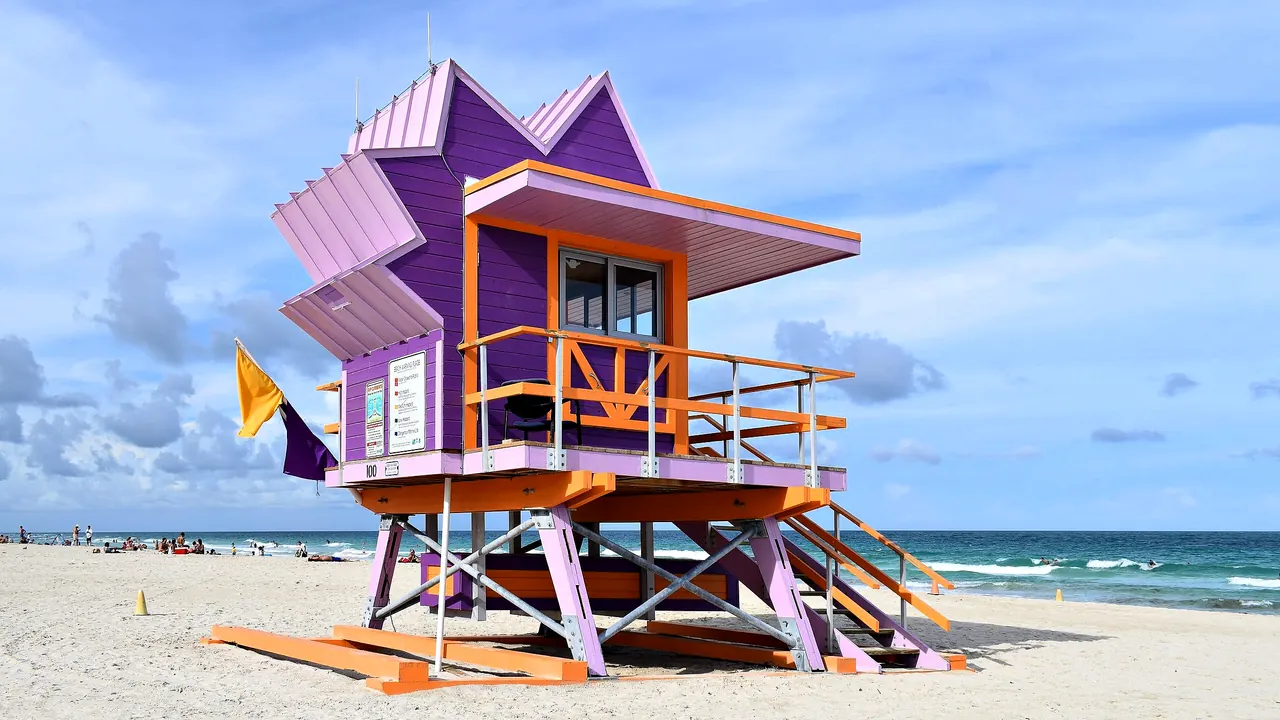
Photos: Miami Beach by Radomianin, CC BY-SA 4.0, cropped.
Marco Island or Miami Beach?
Our verdict in twelve categories, each scored against the same fixed benchmark cities, and the climate month by month, so you can choose for your trip.
Choose Marco Island for
- nature and the outdoors
Marco Island is for a slow, nature-minded beach vacation. You get a calm, shallow Gulf beach where you can wade and collect shells, and the mangrove channels of the Ten Thousand Islands start at the island's edge. Dolphins, manatees, fishing and the Everglades are all close by. Evenings end with the sunset, and the island suits couples, retirees and families who are happy to drive and don't want much going on after dark.
Choose Miami Beach for
- nightlife
- getting around
- culture and sights
Miami Beach is the better pick if you want the beach and a city in the same trip. The Atlantic stays warmer in winter, and you can walk the Art Deco streets of South Beach. The Latin food is far better, and the nightlife carries on until dawn. There is real classical music and ballet too. It is louder and more crowded, but you can manage without a car, and it has much more to fill a week.
Scoreboard
Twelve categories on one fixed scale from 0 to 100. The shaded stretch is the gap between the two.
Your match
Pick a travel style or drag the sliders, and both match scores follow your weighting.
Wins on nature and the outdoors with your weighting.
Wins on nightlife and getting around with your weighting.
What matters to you?
Category by category
What the scores mean for a trip.
Beaches & swimming
Both beaches are wide and pale with calm water, but they feel very different. Marco Island's curve of Gulf sand is quiet and shallow, good for shelling, wading out on the Tigertail sandbar and watching the sunset over the sea. Keewaydin's undeveloped shore is a short boat ride away.
Miami Beach has the edge overall. It runs for about 11km along the Atlantic, with lifeguards and a beachwalk, and its water stays warm enough for proper swimming through the winter. You can choose busy South Beach or the calmer stretches of Mid-Beach and North Beach. In return, the busy parts come with crowds, music and the occasional summer seaweed.
Food & drink
Marco Island's food is mostly Gulf seafood: grouper sandwiches, shrimp and stone crab claws, eaten on waterfront decks or at the dockside shacks of Goodland. Beyond that the choice is narrow, so for a more ambitious dinner you drive to Naples.
Miami Beach eats far better and with much more variety. Its Latin American cooking brings croquetas, cafecito, arepas and ceviche alongside upscale hotel and chef-led restaurants. The trick is to avoid the tourist menus on Ocean Drive and eat on the side streets, in North Beach or across the causeway in Little Havana.
Culture & sights
Marco Island has little to see. It is a resort town built within living memory, so most of it is canals and condominiums. The one real cultural stop is the historical museum, which tells the story of the Calusa people and the carved wooden figures dug up here in the 1890s, along with the island's clam-cannery past. Beyond that there is only the old fishing village of Goodland.
Miami Beach has a sight of its own in the Art Deco Historic District. Its hundreds of pastel hotels and apartment blocks from the 1930s have porthole windows and neon, and you can see them on an easy walk. The Wolfsonian, the Bass and the Holocaust Memorial are enough for another day or two. The bigger museums are across the bay on the mainland, but even without them Marco Island has nothing to match it.
Nightlife
This is the biggest gap between the two. On Marco Island the evening means a sunset drink and dinner, maybe a resort lounge afterwards, and the island is quiet well before midnight.
South Beach is the opposite: clubs with guest DJs until dawn, pool parties in the afternoon and lobby bars where people go to be seen, with dress codes and door policies to match. For something gentler, the cocktail bars of Sunset Harbour are still far livelier than anything on Marco Island.
Nature & outdoors
Marco Island is the better base for wildlife. It sits on the edge of the Ten Thousand Islands, so you can kayak through mangroves, see manatees and dolphins, fish some of Florida's best inshore waters, and reach Rookery Bay, Big Cypress and the Fakahatchee Strand within an hour.
Miami Beach is a built-up island, and its nature is mostly at sea: snorkelling and diving on offshore reefs and wrecks, and Biscayne National Park's keys. Oleta River State Park offers mangrove paddling closer to the city. Neither has hills, and summer heat drives everyone outdoors early in both.
Day trips
From Marco Island the outings are pleasant but limited. Naples has its pier and gallery streets, Everglades City and Chokoloskee have their old trading post, and further north are the Edison and Ford Winter Estates and the shelling islands of Sanibel and Captiva.
Miami Beach has a stronger list, starting just across the bay with Little Havana, the Wynwood murals, Vizcaya and Coral Gables. Further away you can reach Fort Lauderdale, Palm Beach and Key Largo in a day. For both, you will need a car or a tour.
Good for families
For children the two work about equally well, but in different ways. Marco Island is the gentler of the two: shallow, still water, soft sand, lagoon wading and resort kids' clubs, on an island that is quiet the whole time.
Miami Beach adds lifeguards along the whole shore and playgrounds behind the sand. The catch is that South Beach is loud on weekends and during spring break, so families are better off in Mid-Beach or near Surfside. In both places the zoos and children's museums are on the mainland.
Getting around
On Marco Island you can cycle between the beach and the shops in the cooler months, but for anything else you need a car. That includes Naples, the airport and the Everglades.
Miami Beach is much easier. South Beach is compact enough to walk, and free trolleys and buses run up Collins Avenue, so a beach stay works without a car. Getting off the island is the weak point, with no rail link, buses that get stuck on the causeways and parking that is hard to find.
Shopping & style
Shopping on Marco Island is limited to resort wear, shells and coastal décor in a few small plazas. Anyone serious about it drives to Fifth Avenue South in Naples.
Miami Beach has more to offer on the island itself. Lincoln Road, the pedestrian mall laid out by Morris Lapidus, is lined with chain stores and is nicer for an evening walk than for finding anything unusual. At the northern tip, Bal Harbour has a full set of European luxury houses.
Affordability
Neither is cheap, and in both the winter peak is the most expensive time, with summer rates much lower. On Marco Island the costs are resort rooms, waterfront dining and a hire car you can hardly do without, while a weekly condo with a kitchen helps families and groups.
On Miami Beach the extras add up: resort fees, parking and South Beach cocktail and club prices. On the other hand, you don't need a car, the trolleys are free, Cuban takeaway windows are cheap and hotels on the side streets or in North Beach cost less.
Live music & performing arts
On Marco Island the music is a guitarist in a resort bar or a show at the community theatre, and for the philharmonic you go to Naples in winter.
Miami Beach has a real arts scene of its own. The New World Symphony plays in its Frank Gehry hall and sometimes projects concerts onto the outside wall for people on the lawn. Miami City Ballet is based on the island, and the Jackie Gleason and Colony theatres host touring and smaller shows from autumn to spring.
Wellness & relaxation
Both rely on resort spas rather than any bathing tradition. The difference is the setting. On Marco Island the whole island is unhurried, so any hotel makes a calm base for a slow week.
Miami Beach's bigger resorts have more elaborate facilities, with hydrotherapy circuits, steam rooms and sunrise yoga on the sand. Rest depends on where you stay, though: South Beach is loud, so look in Mid-Beach or towards Surfside.
When should you go?
Pick your month. The climate figures are measured averages, not a forecast.
Marco Island in July
Miami Beach in July
Daytime high, °C
Rainfall in the month, mm
Where the figures come from
Marco Island has no rain gauge within 25 km of the centre, so its rainfall comes from a gridded climate dataset read at the destination rather than from a gauge further away.
Temperature and rainfall are climate normals, averaged over the years shown. Marco Island: 2012-2025 (rainfall 1991-2020) normals, Marco Island / Old Marco Junction (7.5 km from centre). Miami Beach: 1991-2020 (sunshine 1981-2010) normals, Miami International Airport (18.8 km from centre).
Both places are warm all year, and their best months are the dry ones from about November to April. Winter is where they differ most. On Marco Island the Gulf drops to about 21°C in January and February, which many people find too cool for long swims. At Miami Beach the Atlantic stays near 25°C, and days are slightly warmer, so it is the more reliable choice for a beach trip in midwinter. Marco Island is very dry in winter and spring, which makes those months ideal for kayaking and walking the boardwalks.
From June to September both are hot and humid, with seas near bath temperature and afternoon storms almost every day. Marco Island gets around 232mm of rain in June. Miami Beach's wet season starts earlier and lasts longer, with about 193mm still falling in October, while Marco Island has mostly dried out by then. Miami Beach's sunniest stretch runs from March to May, a good time for the beach before the summer storms.
Which traveller are you?
On an outdoors trip, choose Marco Island. You can paddle through mangroves, watch manatees in the canals, fish inshore for snook and tarpon, and reach Big Cypress and the Everglades boardwalks within an hour. On Miami Beach, outdoor life mostly means time on the water.
For a food and nightlife trip, choose Miami Beach without much thought. It has Cuban takeaway windows, ceviche and late dinners, and South Beach clubs run until dawn. Marco Island offers seafood with a view, and then most of the island goes to bed.
On a culture and arts trip, Miami Beach has far more. You can walk the Art Deco Historic District, visit the Wolfsonian and the Bass, and hear the New World Symphony in its Gehry hall. On Marco Island, culture means one local history museum.
Before you go
| Measure | Marco Island | Miami Beach |
|---|---|---|
| Currency | US Dollar (USD) | US Dollar (USD) |
| Sockets | AB120 V, 60 Hz | AB120 V, 60 Hz |
| Driving side | Right | Right |
| Time zone | UTC-5, UTC-4 in summer | UTC-5, UTC-4 in summer |
| Emergency number | 911 | 911 |
| Elevation | 0 m | 1 m |
| Main airport | Southwest Florida International Airport (RSW)66 km from centre79 non-stop destinations | Miami International Airport (MIA)16 km from centre198 non-stop destinations |
| Public holidays this year | 11 days | 11 days |
By the numbers
| Measure | Marco Island | Miami Beach |
|---|---|---|
| Population | 15,760 | 82,890 |
| People per km² | 267 | 2,109 |
| Museums within 10 km | 1 | 14 |
| UNESCO World Heritage sites within 50 km | 0 | 0 |
| Swim season, months above 21 °C | 10 months | 12 months |
Where else could you go?
Every comparison below shares a destination with this one, so you can follow Marco Island or Miami Beach somewhere new.
- Miamivs Miami Beach
- Naples, Floridavs Marco Island
- Fort Lauderdalevs Miami Beach
- Boca Ratonvs Miami Beach
- Sanibelvs Marco Island
- Fort Myersvs Marco Island