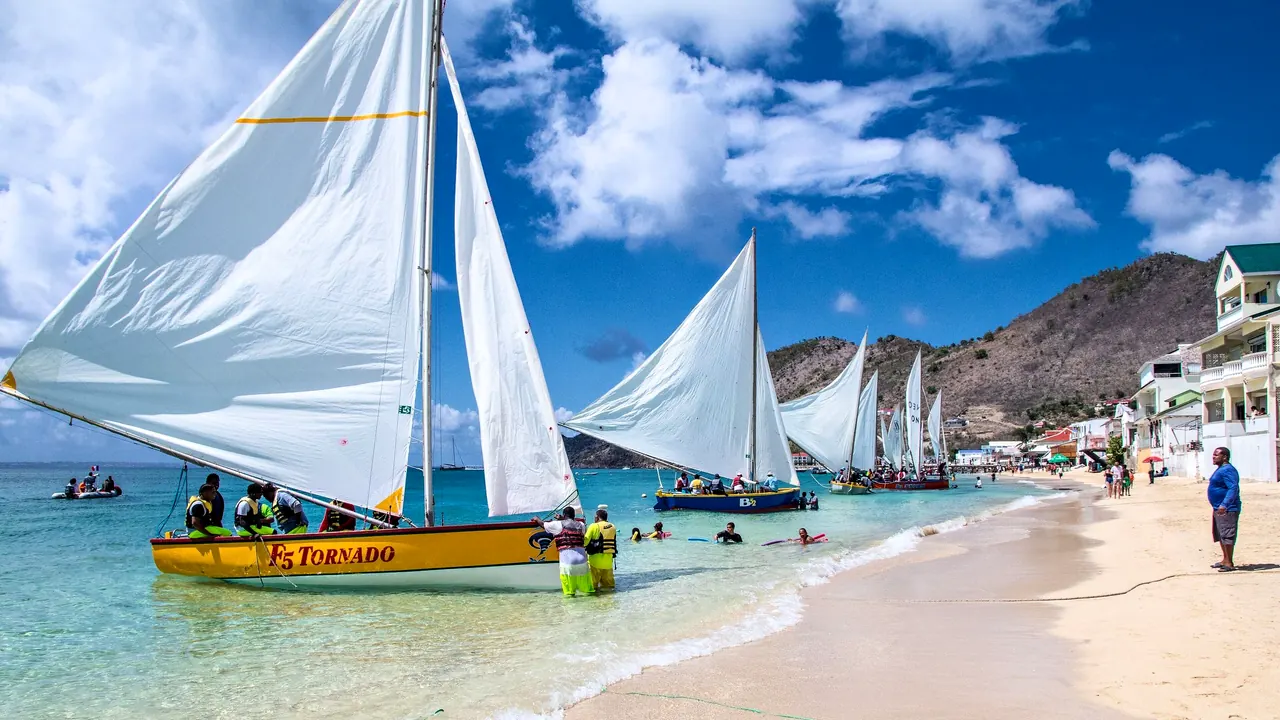
Photos: Saint-Martin by Grégory Rohard, CC BY-SA 4.0, cropped.
Martinique or Saint-Martin?
Our verdict in twelve categories, each scored against the same fixed benchmark cities, and the climate month by month, so you can choose for your trip.
Choose Martinique for
- nature and the outdoors
- culture and sights
- live music and the arts
Martinique suits the traveller who wants the island itself to be the trip. Its volcanic north, with Mount Pelée, the rainforest of the Route de la Trace and canyoning gorges, gives days of walking and exploring that Saint-Martin cannot match. Saint-Pierre's ruins, the rum estates and bèlè drumming evenings add history and culture. It is a bigger, slower place that pays back the time you spend driving around it.
Choose Saint-Martin for
- shopping
- day trips
- nightlife
Saint-Martin is the better pick for a compact beach-and-dinner vacation with plenty of variety close by. Orient Bay, the quiet west-coast coves and the waterside tables of Grand Case are all a short drive apart. Anguilla and St Barths are close enough for easy boat days. The open border to the Dutch side brings duty-free shopping and later nights, so the trip feels more sociable and less like an expedition.
Scoreboard
Twelve categories on one fixed scale from 0 to 100. The shaded stretch is the gap between the two.
Your match
Pick a travel style or drag the sliders, and both match scores follow your weighting.
Wins on nature and the outdoors and culture and sights with your weighting.
Wins on shopping and day trips with your weighting.
What matters to you?
Category by category
What the scores mean for a trip.
Beaches & swimming
Both islands have excellent beaches, but they feel different. Martinique's best are separate coves on the Caribbean side and the southern tip. There is the palm-lined curve of Grande Anse des Salines, turtles grazing close to shore at Les Anses-d'Arlet, and the black-and-gold pair of Anse Noire and Anse Dufour.
Saint-Martin's beaches sit closer together and are more varied in mood. Orient Bay is a long, sociable strip with sunbeds and water sports. Baie Rouge and Baie Longue are quieter, and Pinel is a small islet a short boat ride away. Its eastern bays can collect seaweed in some months, whereas Martinique's Atlantic side is simply too rough for most swimming.
Food & drink
Martinique's eating is spread across its rum country, while Saint-Martin's is concentrated in one seafront village. On Martinique, the cane estates of the north and centre pour rhum agricole for tasting, and a ti-punch comes before most meals. Some of the best colombo, blaff and grilled conch comes from roadside stalls and beach shacks, and the covered market in Fort-de-France sells spices and hot sauces.
On Saint-Martin, Grand Case does most of the work. French and creole dining rooms over the water stand beside the lolos, where ribs and grilled lobster are served at shared tables. That makes it easy to eat well night after night, though a week covers most of it, and the rest of the island adds little beyond beach restaurants and bakeries.
Culture & sights
Martinique has much the deeper heritage. Saint-Pierre, destroyed by Mount Pelée in 1902, is a powerful visit to ruins beneath the volcano. Fort-de-France adds the Schoelcher Library and its cast-iron cathedral, and the island also has Empress Joséphine's birthplace and the Anse Cafard slavery memorial.
Saint-Martin offers the view from Fort Louis over Marigot, a few streets of painted creole houses and a small museum. That fills a morning, not a theme for the trip.
Nightlife
A night out on Martinique means driving to the zouk and kompa clubs around Fort-de-France, which fill late at weekends with a mostly local crowd. Otherwise, evenings end early after a ti-punch at a beach bar in Sainte-Anne or Les Trois-Îlets. Carnival is the exception, with parades and drumming late into the night until King Vaval burns on Ash Wednesday.
On Saint-Martin, the late options are a short drive across the open border, where the casinos and clubs of Simpson Bay and Maho stay open well past midnight. On the French side, Grand Case has street music and late terraces on busy winter nights, and the beach bars at Orient Bay draw a crowd at sunset.
Nature & outdoors
Here Martinique is in another league. Its UNESCO-listed volcanic north includes Mount Pelée at around 1,400m, the rainforest of the Pitons du Carbet and gorges you can descend by canyoning. Offshore, there is diving at Diamond Rock and on the Saint-Pierre wrecks, and you may see whales in season.
Saint-Martin's highest point, Pic Paradis, is only about 424m, with forest trails and a zipline park. Its real outdoor strength is the water: the Tintamarre reserve for snorkelling with turtles and rays, and Orient Bay's steady trade winds for kitesurfing.
Day trips
Saint-Martin has the edge because it sits among other islands. Anguilla's quiet beaches are a short ferry ride from Marigot, and St Barths' chic Gustavia makes a contrasting day out. Saba and Sint Eustatius are within reach for a longer outing, and Philipsburg is just across the border.
Martinique's best outings are on the island itself: a tour of the rum estates around Sainte-Marie and Le Robert, the fishing villages of the far north, and the sandbanks off Le François. Dominica and St Lucia are reachable by fast ferry, but each takes a long day.
Good for families
Both work for families because of calm, shallow bays rather than attractions built for children. Martinique's Anse Mitan and Grande Anse d'Arlet let children snorkel with turtles right off the sand, and French healthcare makes the practical side easy. The drawback is distance: winding roads and traffic make outings tiring.
Saint-Martin is small enough that the reef-sheltered bay at Le Galion or the boat ride to Pinel never involves a long journey. Older children usually enjoy watching the planes come in low at Maho.
Getting around
You need a hire car on both islands, and buses on either will not get a visitor to the beaches reliably. What differs is scale. Martinique is big enough that the drive north on steep roads, and the rush-hour jams around Fort-de-France and Le Lamentin, take real time. The ferries across the bay to Les Trois-Îlets are a pleasant way to skip some of it.
On Saint-Martin, nothing is much more than about forty minutes away, the open border with the Dutch side costs no time, and water taxis handle the hops to Pinel and Tintamarre. The congestion is concentrated around Marigot and the lagoon bridges.
Shopping & style
Saint-Martin is the better place for shopping, largely because of its Dutch half. Philipsburg's Front Street is a long run of duty-free jewellery, watch and electronics shops, and Marigot adds French boutiques, perfume and a waterfront market.
Martinique's shopping is about what the island makes. The best buys are aged agricole rum from the estates, vanilla and hot sauces from the Fort-de-France market, madras cotton and craft-village pottery. Otherwise it has little beyond mainland chain stores.
Affordability
Neither is cheap, but Martinique costs less to stay on. A self-catering gîte, fish and fruit bought at roadside stalls, and free or inexpensive rum tastings keep a stay within reach, even with French prices and an island premium.
Saint-Martin charges high Caribbean rates for rooms in the popular bays, restaurants match or exceed French prices, and boat trips to the islets and neighbouring islands add up. The lolos and supermarket picnics help, and rates ease outside the winter season.
Live music & performing arts
Martinique has a real living tradition to seek out. Bèlè drum-and-dance evenings in the villages of the north and centre welcome visitors into the circle. Fort-de-France has a national arts centre with year-round theatre and dance, plus a long-running July festival, though formal shows are in French.
Saint-Martin has no stage or concert hall at all. Steel pan, soca and reggae come with dinner at Grand Case or a beach bar, and Carnival's calypso contests are the one time music becomes the main event.
Wellness & relaxation
Neither island has a spa or bathing tradition, so relaxing comes down to pace and a good base. Martinique adds a few warm volcanic springs in the northern forest to its resort spas at Les Trois-Îlets and Sainte-Anne, and its south slows naturally to swims and long lunches.
On Saint-Martin, the quietest retreats are a villa above Anse Marcel or a west-coast cove. They are best kept well away from the cruise-day crowds around Marigot.
When should you go?
Pick your month. The climate figures are measured averages, not a forecast.
Martinique in July
Saint-Martin in July
Daytime high, °C
Rainfall in the month, mm
Temperature and rainfall are climate normals, averaged over the years shown. Martinique: 1991-2020 normals, Le Lamentin (7.7 km from centre). Saint-Martin: 1991-2020 normals, Juliana Airport, Saint Maarten (4.1 km from centre).
Both islands are hot all year, with daytime highs of about 29°C to 32°C and a sea warm enough for swimming in every month, so the beach never goes out of season. Late summer and early autumn are the steamiest, when walking through town at midday is tiring. The real difference is rain. Where most visitors stay on Martinique, February and March are the driest stretch. From July the showers build, and August, October and November each bring over 260mm, the time when the northern rainforest trails turn muddy.
Saint-Martin is drier and sunnier in every month. Its driest spell, February to April, still brings about 50mm a month, but that is less than Martinique gets in the same months, and even its wettest months, October and November, stay well below Martinique's autumn totals. It also has more sunshine hours all year round. January to April is the most settled period on both islands, and from summer into autumn Saint-Martin keeps the better odds of clear days.
Which traveller are you?
On an outdoors trip, Martinique is the clear choice. You can climb Mount Pelée through cloud forest, wade the gorges off the Route de la Trace, dive Diamond Rock or the Saint-Pierre wrecks, and walk the Caravelle peninsula. Saint-Martin's outdoor offer is mostly on the water.
For a culture and arts trip, Martinique again has far more to offer. There are the ruins of Saint-Pierre, the Schoelcher Library, the Anse Cafard memorial and the sugar estates, and bèlè evenings in northern villages bring you into living tradition. Saint-Martin's sights take about a morning.
On a shopping trip, Saint-Martin is the better bet. Marigot has a waterfront market and French boutiques, and across the open border Philipsburg's Front Street is lined with duty-free jewellery, watch and liquor shops. Martinique's shopping is mostly estate rum, spices and madras cotton.
Before you go
| Measure | Martinique | Saint-Martin |
|---|---|---|
| Official language | - | French |
| Currency | Euro (EUR) | Euro (EUR) |
| Sockets | CE220 V, 50 Hz | CF60 Hz |
| Driving side | Right | Right |
| Time zone | UTC-4 | UTC-4 |
| Emergency number | 112 | - |
| Main airport | Martinique Aimé Césaire International Airport (FDF)17 non-stop destinations | Princess Juliana International Airport (SXM)44 non-stop destinations |
| Public holidays this year | 13 days | 11 days |
By the numbers
| Measure | Martinique | Saint-Martin |
|---|---|---|
| Population | 360,630 | 32,358 |
| People per km² | 320 | 578 |
| Swim season, months above 21 °C | 12 months | 12 months |
Where else could you go?
Every comparison below shares a destination with this one, so you can follow Martinique or Saint-Martin somewhere new.
- Sint Maartenvs Saint-Martin
- Anguillavs Saint-Martin
- St Bartsvs Saint-Martin
- British Virgin Islandsvs Saint-Martin
- St Croixvs Saint-Martin
- St Johnvs Saint-Martin