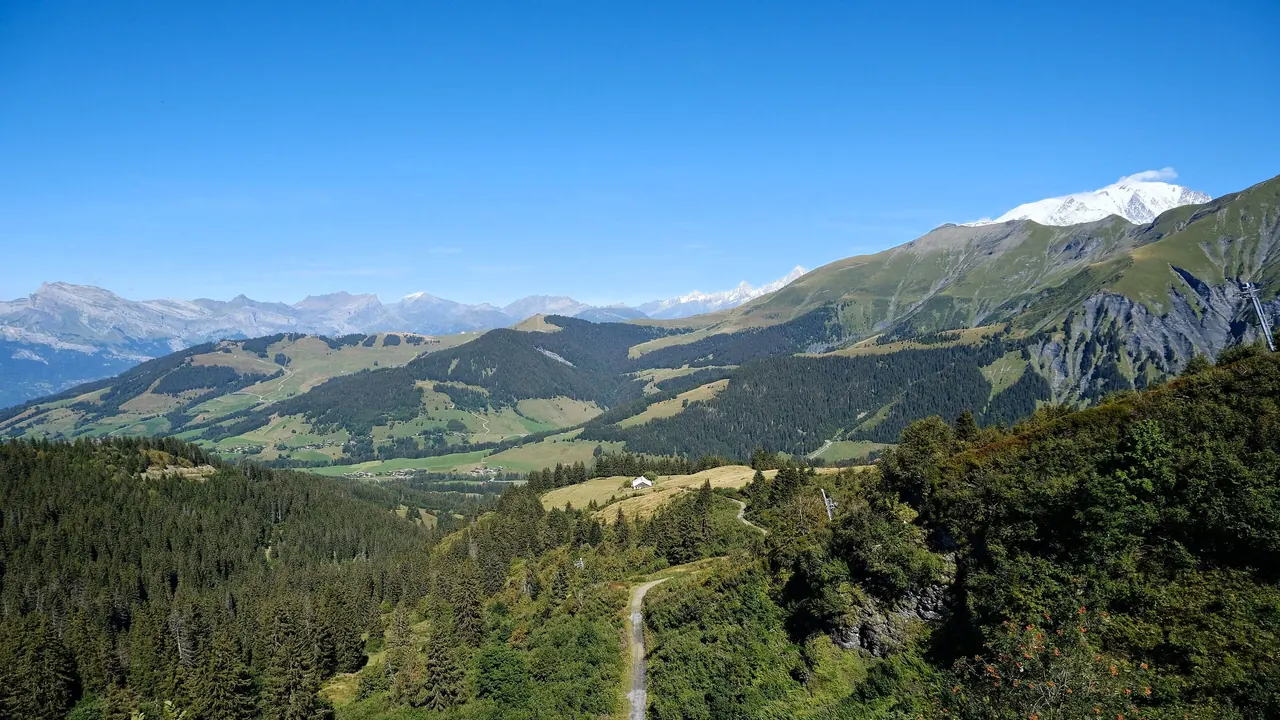
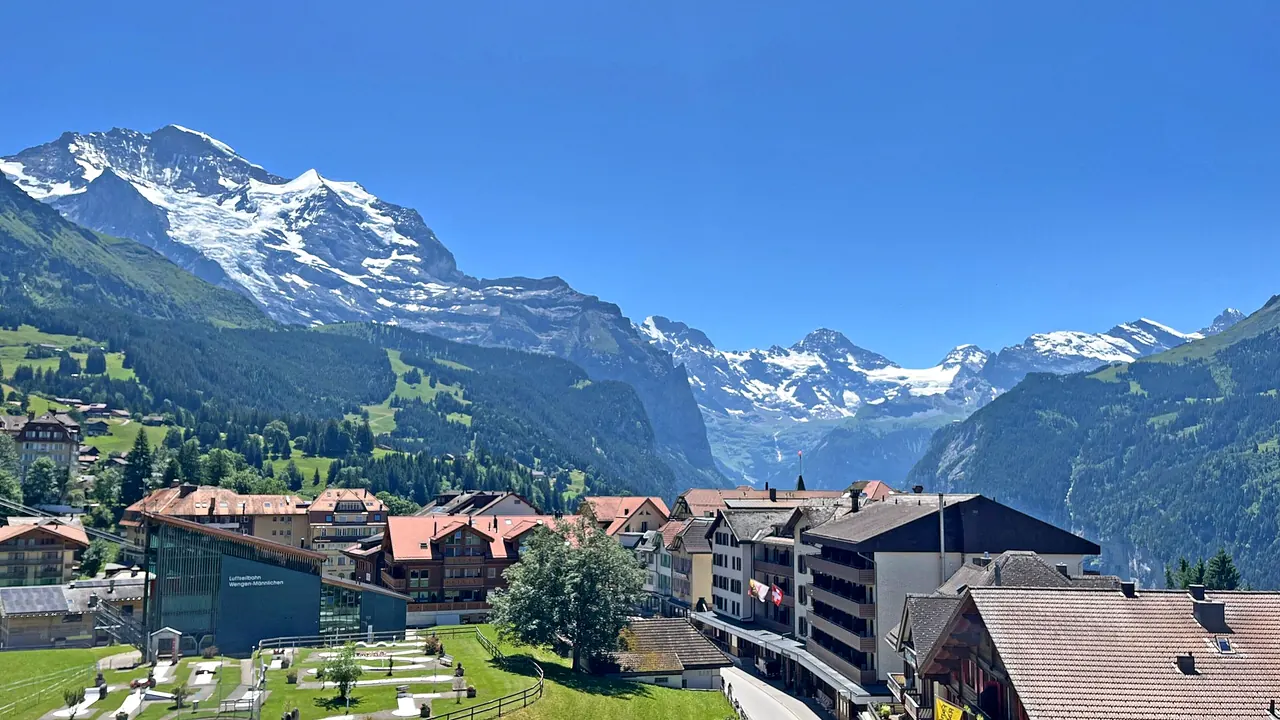
Photos: Megève by Guilhem Vellut, CC BY 2.0, cropped; Wengen by Charles J. Sharp, CC BY-SA 4.0, cropped.
Megève or Wengen?
Our verdict in twelve categories, each scored against the same fixed benchmark cities, and the climate month by month, so you can choose for your trip.
Choose Megève for
- shopping
- food and drink
- nightlife
Megève is the better pick for travellers who want the mountains as a backdrop to a comfortable, sociable stay. Its wide wooded pistes suit intermediate skiers, and it adds what Wengen barely has: Savoyard cooking and starred kitchens, hotel spas and a public wellness centre, boutique lanes and fire-lit bars after dark. With a car it also opens up Chamonix, Annecy, Geneva and Aosta.
Choose Wengen for
- getting around
- nature and the outdoors
Wengen is for people who want to be as close as possible to the high peaks and are happy for little else to happen. The Jungfrau, Eiger and Mönch fill the view, trails start at the hotel door, and trains and cable cars reach the ridges and glacier without a car. Evenings are early and eating is simple, so it rewards walkers, skiers and anyone who finds silence restful.
Scoreboard
Twelve categories on one fixed scale from 0 to 100. The shaded stretch is the gap between the two.
Your match
Pick a travel style or drag the sliders, and both match scores follow your weighting.
Wins on shopping and food and drink with your weighting.
Wins on getting around and nature and the outdoors with your weighting.
What matters to you?
Category by category
What the scores mean for a trip.
Beaches & swimming
Neither village is a place to swim, and the difference is only in what lies within reach. Megève has small bathing ponds in the nearby valleys and the indoor and outdoor pools of the Palais, so a hot afternoon can be spent in the water without leaving the area.
Wengen has nothing of the kind in the village. Its bathing means a train down to the lidos on Lake Thun or glacier-cooled Lake Brienz. Megève's bigger lake day, Lake Annecy, is a drive of about an hour and the water there is noticeably warmer.
Food & drink
Megève eats far better. Beyond fondue, tartiflette and Reblochon from the surrounding farms, it has a cluster of Michelin-starred kitchens in the village and up on Mont d'Arbois, plus farmhouse auberges in the side valleys in summer.
Wengen's food is plain Swiss mountain fare, rösti, veal in cream and raclette, mostly served in hotel dining rooms on half-board. A lunch at a hut facing the Jungfrau is the highlight, but it is the view you remember. Neither place has much that is cheap or casual.
Culture & sights
Megève has a modest edge: a medieval street plan around Saint-Jean-Baptiste, the hillside chapels of the Calvaire, a farmhouse museum and the 1920s and 1930s chalets of Henry Jacques Le Même, enough for a pleasant morning.
Wengen has its Belle Époque hotels from the English resort days, a small church and its ski-racing story, but nothing you would plan a visit around. In both cases serious sightseeing means leaving, to baroque village churches near Megève or to Bern and Thun from Wengen.
Nightlife
Megève has a proper evening scene, if a refined one: après-ski at the foot of the lifts, hotel bars with open fires, piano and wine bars in the cobbled centre, and a couple of clubs open late in the peak weeks. The crowd is older and the night usually revolves around a long dinner.
Wengen is quieter still. A few bars fill up when the lifts close, one or two hotel bars carry on, and only the Lauberhorn race weekend brings a real party. Summer nights in both villages end early.
Nature & outdoors
Wengen puts you closer to the great peaks. It faces the Jungfrau directly, with the Eiger and Mönch behind, and looks down into the sheer Lauterbrunnen valley and its waterfalls. Walks to the Männlichen ridge, Kleine Scheidegg and beneath the Eiger north face leave from the village, and in winter the slopes link with Grindelwald and include the long Lauberhorn run.
Megève's landscape is softer: a sunny saddle looking across to Mont Blanc, wide wooded pistes that suit intermediates, and summer meadows for hiking Mont Joly, mountain biking, paragliding and golf. Its lower slopes make snow less reliable, and the glaciers and big climbs of Chamonix are a drive away rather than outside the window.
Day trips
Megève reaches more, and more varied, places. Chamonix, Annecy's canals and lake, and the museums of Geneva all lie within about an hour, and the Mont Blanc tunnel brings Courmayeur and Roman Aosta into range, with Italian food at the end of the drive. Almost all of this needs a car.
From Wengen everything begins with the rack railway down to Lauterbrunnen. The rewards are lakeside: Thun's castle and old town, steamers to Oberhofen and Spiez, and Brienz with the Ballenberg open-air museum. Bern is a long but worthwhile day, and Lucerne and Zurich are out of comfortable reach.
Good for families
Both work well for families who ski, and neither has big attractions such as zoos or theme parks for rainy days. Megève gives children more variety off the slopes: an ice rink, the pools and climbing wall at the Palais, sleigh rides and ponies, with ski kindergartens for the youngest.
Wengen's strength is simplicity. With no cars anywhere in the village, children can walk about safely, the nursery slopes sit next to the hotels, and in summer a train or cable car ride is an outing in itself. Its steep lanes are harder with a buggy, especially in snow.
Getting around
Wengen is far easier without a car. You arrive by train at Lauterbrunnen, ride the rack railway up and let a hotel cart take the luggage, and the same line continues to Kleine Scheidegg and the Jungfraujoch, with a cable car to the Männlichen. The catch is that anything lower down starts with a slow descent and often a change at Interlaken.
Megève's pedestrian centre is quick to walk, and free shuttles link the lifts in winter, but there is no railway station in the village. You come via Sallanches or by road from Geneva, many chalets sit up steep hillside roads, and most visitors end up renting a car.
Shopping & style
Megève turns shopping into part of the stay. The lanes around the church hold designer ski-wear, cashmere and fur, jewellers and galleries of Alpine interiors, along with the long-established Allard ski-wear house and good cheese and charcuterie counters.
Wengen's single short street covers ski hire, outdoor gear, chocolate and groceries and little more, so anyone wanting to browse heads down to Interlaken or Bern.
Affordability
Both are among the costliest mountain stays in Europe, so the question is where the money goes. In Megève the bill is driven by lodging and dining, heaviest over Christmas and the February school weeks and a little lighter in summer, January and March. Staying in the valley towns and driving up is the usual way to save.
In Wengen Swiss prices apply to everything, and the railways and cable cars that make the trip add a charge to almost every outing, the Jungfraujoch most of all. Self-catering and regional rail passes soften it, and the trails cost nothing.
Live music & performing arts
Neither offers theatre or a concert season, but Megève has a little more to hear. Its long jazz connection means live sets in a jazz cellar or piano bar in season, and summer brings open-air concerts and music in the church.
Wengen's music is folk and occasional: yodelling or alphorn in a hotel lounge and a brass band at village festivities. Anything more means a trip down to Interlaken or Bern.
Wellness & relaxation
Megève is better set up for a spa stay. The grand hotels and chalets compete on pools, hammams and Alpine treatments, the Palais opens its saunas and pools to everyone, and the historic thermal baths at Saint-Gervais are about twenty minutes away.
Wengen offers a different kind of rest. With no traffic, cowbells and distant waterfalls are the loudest sounds, and a balcony facing the Jungfrau does much of the work. Its spas are confined to the larger hotels and there are no public baths, so it suits people who unwind by sitting still outdoors.
When should you go?
Pick your month. The climate figures are measured averages, not a forecast.
Megève in July
Wengen in July
Daytime high, °C
Rainfall in the month, mm
Where the figures come from
Megève's temperatures are measured 29 km from the centre, at Bourg-St-Maurice.
Megève's station stands 162 m below the city centre, so the centre is likely a little cooler than the figures say.
Megève has no rain gauge within 25 km of the centre, so its rainfall comes from a gridded climate dataset read at the destination rather than from a gauge further away.
Wengen has no weather station within reach, so its figures come from a gridded climate model rather than a measured record, and read a broad area rather than one spot.
Temperature and rainfall are climate normals, averaged over the years shown. Megève: 1999-2020 (rainfall 1991-2020) normals, Bourg-St-Maurice (29.1 km from centre). Wengen: 1991-2020 normals, TerraClimate 4 km grid at the town, no weather station within 90 km.
Megève is far warmer in summer, with July highs around 27°C, which makes June to September comfortable for hiking and long enough days for a drive to swim in Lake Annecy. Wengen sits higher and stays cool even in July, at about 16°C, so its summer is for walking in layers rather than for swimming, and the trains to the ridges reach colder air still. Spring and autumn are mild in Megève and chilly in Wengen.
The wet seasons fall at opposite times. Megève's heaviest precipitation comes in early winter, peaking at about 140mm in December, much of it as snow on the slopes. Wengen gets its wettest months from May to August, at around 110mm each, so summer walkers there should expect showers and cloud. In winter Wengen's highs hover near 0°C, colder and snowier underfoot than Megève's.
Which traveller are you?
On a food and nightlife trip, Megève is the clear choice. Savoyard cheese dishes, terrace lunches and starred dining rooms give it real depth, and evenings move on to piano bars and wine bars, whereas Wengen offers half-board meals and a few après-ski bars.
For an outdoors trip, Wengen has the edge. You walk straight out onto trails beneath the Eiger and above the waterfalls of the Lauterbrunnen valley, and trains climb to the Jungfraujoch. In Megève the gentler hills are on the doorstep, but the biggest peaks are a drive away.
On a relaxing and wellness trip, Megève does more for you. Grand-hotel spas, the public pools and saunas at the Palais and the thermal baths at nearby Saint-Gervais make a proper spa stay possible. Wengen's restfulness is mostly fresh air and quiet.
Before you go
| Measure | Megève | Wengen |
|---|---|---|
| Official language | French | French, German, Italian, Romansh |
| Currency | Euro (EUR) | Swiss Franc (CHF) |
| Sockets | CE230 V, 50 Hz | CJ230 V, 50 Hz |
| Driving side | Right | Right |
| Time zone | UTC+1, UTC+2 in summer | UTC+1, UTC+2 in summer |
| Emergency number | 112 | 112 |
| Elevation | 1,027 m | 1,274 m |
| Main airport | Geneva International Airport (GVA)58 km from centre150 non-stop destinations | Zürich Airport (ZRH)106 km from centre226 non-stop destinations |
| Public holidays this year | 11 days | 10 days |
By the numbers
| Measure | Megève | Wengen |
|---|---|---|
| Population | 2,893 | 1,116 |
| People per km² | 66 | 31 |
| Museums within 10 km | 2 | 2 |
| UNESCO World Heritage sites within 50 km | 1 | 1 |
Where else could you go?
Every comparison below shares a destination with this one, so you can follow Megève or Wengen somewhere new.
- Mürrenvs Wengen
- Saint-Gervais-les-Bainsvs Megève
- Grindelwaldvs Wengen
- La Clusazvs Megève
- Le Grand-Bornandvs Megève
- Flainevs Megève