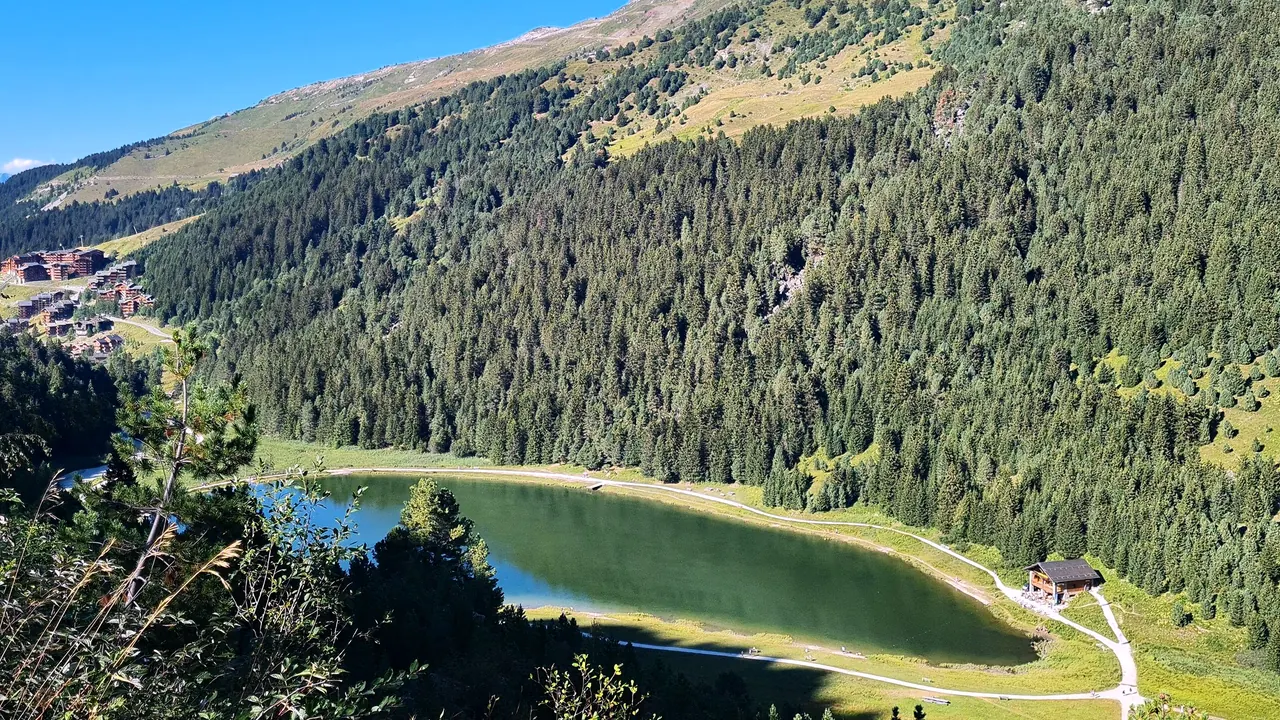
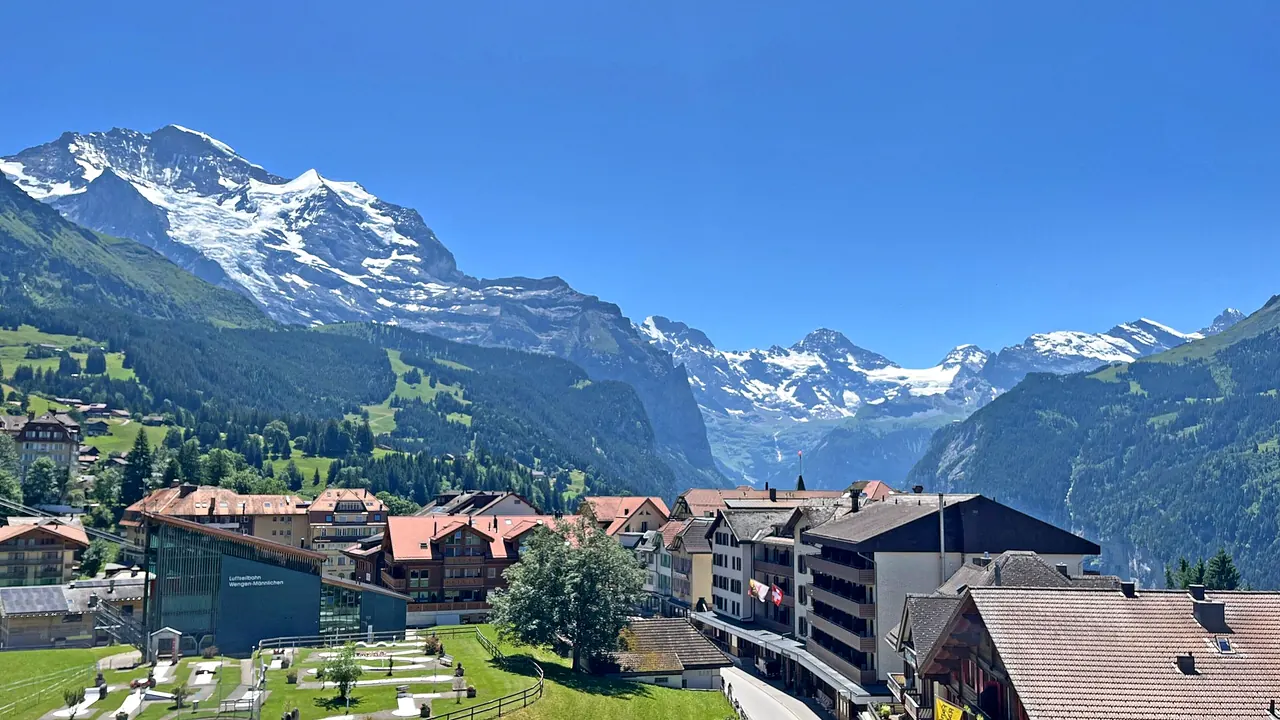
Photos: Méribel by Augustin Cléchet, CC BY-SA 3.0, cropped; Wengen by Charles J. Sharp, CC BY-SA 4.0, cropped.
Méribel or Wengen?
Our verdict in twelve categories, each scored against the same fixed benchmark cities, and the climate month by month, so you can choose for your trip.
Choose Méribel for
- nightlife
- food and drink
- shopping
Méribel suits skiers who want as much terrain as possible and a lively resort around it. From the village you can ski right across the 3 Vallées to Courchevel and Val Thorens, and in the evening there are Savoyard dinners, ambitious hotel restaurants and one of the busier après-ski scenes in the French Alps. Groups of friends and families who ski will find more going on here. The spa town of Brides-les-Bains, a gondola ride below, also helps tired legs.
Choose Wengen for
- getting around
- day trips
- beaches
Wengen is for travellers who come for the view and the quiet. There are no cars, cowbells carry across the village, and you look straight at the Eiger, Mönch and Jungfrau. Trains and cable cars take you up to the high trails and the Jungfraujoch without driving. The rail link down to the valley also makes it easier to reach Interlaken, the lake castles and Bern. Choose it for walking, scenery and calm evenings rather than for nightlife.
Scoreboard
Twelve categories on one fixed scale from 0 to 100. The shaded stretch is the gap between the two.
Your match
Pick a travel style or drag the sliders, and both match scores follow your weighting.
Too close to call, 2 points apart
Wins on nightlife and food and drink with your weighting.
Wins on getting around and day trips with your weighting.
What matters to you?
Category by category
What the scores mean for a trip.
Beaches & swimming
Neither place is for swimmers, but Wengen makes a lake afternoon easier. The train takes about an hour to reach Interlaken, where the lidos on Lake Thun get pleasantly warm in a hot July. Glacier-fed Lake Brienz stays colder.
In Méribel, summer swimming mostly means the pool at the Olympic Park. The mountain lakes are for walking around, and the big Savoie lakes are more than an hour away by car.
Food & drink
Both serve hearty Alpine food, but Méribel has more range. As well as rustic piste huts selling croûtes, there are polished terrace restaurants with long wine lists, and a handful of ambitious gastronomic tables in the hotels and across the 3 Vallées.
Wengen's food is mostly in hotel dining rooms and mountain huts, with rösti, veal in cream sauce and raclette, and many guests book half-board. Lunch facing the Jungfrau is memorable mainly for the view. For more variety you have to go down to Interlaken.
Culture & sights
Neither village has museums or monuments, so the interest lies in how each resort came to be. Méribel was planned from the 1930s in a strict timber-and-stone style that gives it an unusually consistent look, and it has a little legacy from the 1992 Winter Olympics. Wengen grew up as an early English resort, and its Belle Époque hotels and ski-racing history give it a more old-fashioned character. For real history, you have to go down the valley from either.
Nightlife
Méribel is the place for a night out. The après-ski starts with dancing on tables at the mountain bars as the lifts close. It carries on in village pubs with a strong British crowd, and on busy weeks a couple of late bars and a small club stay open into the early hours.
Wengen has a few bars that fill up at the end of the ski day and a hotel bar or two in the evening. The village only really parties on the Lauberhorn race weekend in January, and in summer evenings end after dinner.
Nature & outdoors
Both have outstanding mountain scenery, but they are strongest at different things. Méribel's main asset is sheer skiing range. It sits at the centre of the largest linked ski area in the world, with couloirs, off-piste bowls and high, snow-sure runs, and its summer trails lead through the Tueda reserve into the Vanoise National Park, where you can see ibex and marmots.
Wengen's appeal is the drama of the landscape. It sits on a ledge above the waterfall-lined Lauterbrunnen trough, faces the Jungfrau, and its trails run beneath the Eiger north face, with the glacier at the Jungfraujoch above. Its ski area with Grindelwald is large, though smaller than the 3 Vallées, and includes the long Lauberhorn run.
Day trips
Wengen is better for days away. The train runs down to Interlaken, and from there steamers serve the castles at Oberhofen and Spiez. Thun, Brienz and the Ballenberg open-air museum are all within an hour or so, and the arcaded old town of Bern makes a good full day.
From Méribel you need a car and patience on the winding road to Moûtiers. Annecy, Chambéry and the medieval quarter of Conflans are within about two hours, and the Beaufort valley's cheese cooperative is closer. Snow on the roads makes winter outings harder.
Good for families
Both work well for families who ski, for different reasons. Méribel offers more to do: chalet childcare lets parents ski, and the Olympic Park's ice rink and pool, dog-sledding and snowshoe outings fill days off the slopes.
Wengen's main advantage is that it has no cars. Children can walk around safely, and the nursery slopes are next to the hotels. On the other hand, there is little to do when it rains. In both, steep, icy lanes are hard work with small children.
Getting around
Wengen is easier to get around and makes more sense without a car. You arrive by rack railway, electric carts carry your luggage, and you can walk across the village in minutes. The same line continues to Kleine Scheidegg and the Jungfraujoch.
Méribel has free shuttles and lifts linking the whole 3 Vallées, but the village climbs a steep hillside, and many chalets are a bus ride from the centre. Arriving involves a transfer from Moûtiers station, and going beyond the valley means driving.
Shopping & style
Shopping is not a reason to visit either, but Méribel has slightly more. Besides ski hire, it has a few smart boutiques selling ski wear and chalet homeware, and delicatessens with Beaufort and local wine to take home. Wengen's short main street has outdoor gear, chocolate counters and a grocery, and for anything more you go down to Interlaken.
Affordability
Both are among the most expensive places in the Alps, so budget alone won't decide between them. In Méribel, the big costs are lift passes, lessons and chalets, especially in the weeks when schools are off. Self-catering in Mottaret, staying down at Brides-les-Bains or coming in summer can bring the bill down.
In Wengen, it is the mountain railways that add up, above all the train to the Jungfraujoch, although walking the trails costs nothing and regional rail passes help.
Live music & performing arts
Neither has any theatre or concert life, and what live music there is suits each resort. In Méribel it means cover bands and DJs at après-ski, plus the occasional outdoor festival weekend. Wengen has yodelling or alphorn evenings in hotels and a brass band at village celebrations. For proper stages you would go to Chambéry or Annecy from Méribel, or to Bern from Wengen.
Wellness & relaxation
Méribel is better for a spa trip. Many chalets have their own saunas and hot tubs, the Olympic Park pool has a wellness area, and the gondola runs down to the thermal spa at Brides-les-Bains. The drawback is the brisk pace of the winter season.
Wengen relaxes you through quiet rather than treatments. With no traffic, you can spend an afternoon on a balcony facing the Jungfrau, but there are no public thermal baths and the spas are mostly in the larger hotels.
When should you go?
Pick your month. The climate figures are measured averages, not a forecast.
Méribel in July
Wengen in July
Daytime high, °C
Rainfall in the month, mm
Where the figures come from
Méribel has no weather station within reach, so its figures come from a gridded climate model rather than a measured record, and read a broad area rather than one spot.
Wengen has no weather station within reach, so its figures come from a gridded climate model rather than a measured record, and read a broad area rather than one spot.
Temperature and rainfall are climate normals, averaged over the years shown. Méribel: 1991-2020 normals, TerraClimate 4 km grid at the town, no weather station within 90 km. Wengen: 1991-2020 normals, TerraClimate 4 km grid at the town, no weather station within 90 km.
Neither is ever warm enough for a beach trip, so the choice is between snow and summer trails. From December to March, daytime highs in both stay around freezing, which is weather for skiing rather than for strolling the streets. Méribel is the warmer of the two in summer, reaching about 20°C in August. Wengen peaks around 16°C in July and August, cool enough for long climbs.
The rain falls in opposite seasons. Méribel is driest in July and August and wettest in late autumn, with about 150mm in November. Wengen's winters are relatively dry, but May to July each bring more than 110mm, with June the wettest, and August is barely drier. For walking, Méribel is most reliable from July to September. In Wengen, September is often the better bet, still mild enough for the high trails and drier than early summer. July and August give the warmest days if you allow for some cloudy spells.
Which traveller are you?
For a food and nightlife trip, Méribel is the clear choice. Your evenings have somewhere to go, with a real choice of tables and a winter bar scene that runs late on busy weeks. In Wengen, most guests eat at their hotel and turn in early.
On an outdoors trip, the choice depends on how you like to move. Skiers who want to cover as much ground as possible will get more from Méribel. Walkers without a car are better placed in Wengen, where trains bring the high paths within easy reach.
For a relaxing and wellness trip, Méribel offers more pampering, with plenty of places to recover after an active day, especially in early summer or September. Wengen relaxes you in a different way: slow days, no traffic and little to do but watch the mountains.
Before you go
| Measure | Méribel | Wengen |
|---|---|---|
| Official language | French | French, German, Italian, Romansh |
| Currency | Euro (EUR) | Swiss Franc (CHF) |
| Sockets | CE230 V, 50 Hz | CJ230 V, 50 Hz |
| Driving side | Right | Right |
| Time zone | UTC+1, UTC+2 in summer | UTC+1, UTC+2 in summer |
| Emergency number | 112 | 112 |
| Elevation | 1,447 m | 1,274 m |
| Main airport | Geneva International Airport (GVA)100 km from centre150 non-stop destinations | Zürich Airport (ZRH)106 km from centre226 non-stop destinations |
| Public holidays this year | 11 days | 10 days |
By the numbers
| Measure | Méribel | Wengen |
|---|---|---|
| Population | - | 1,116 |
| People per km² | - | 31 |
| Museums within 10 km | 0 | 2 |
| UNESCO World Heritage sites within 50 km | 0 | 1 |
Where else could you go?
Every comparison below shares a destination with this one, so you can follow Méribel or Wengen somewhere new.
- Courchevelvs Méribel
- Mürrenvs Wengen
- Les Menuiresvs Méribel
- Grindelwaldvs Wengen
- Val Thorensvs Méribel
- La Plagnevs Méribel