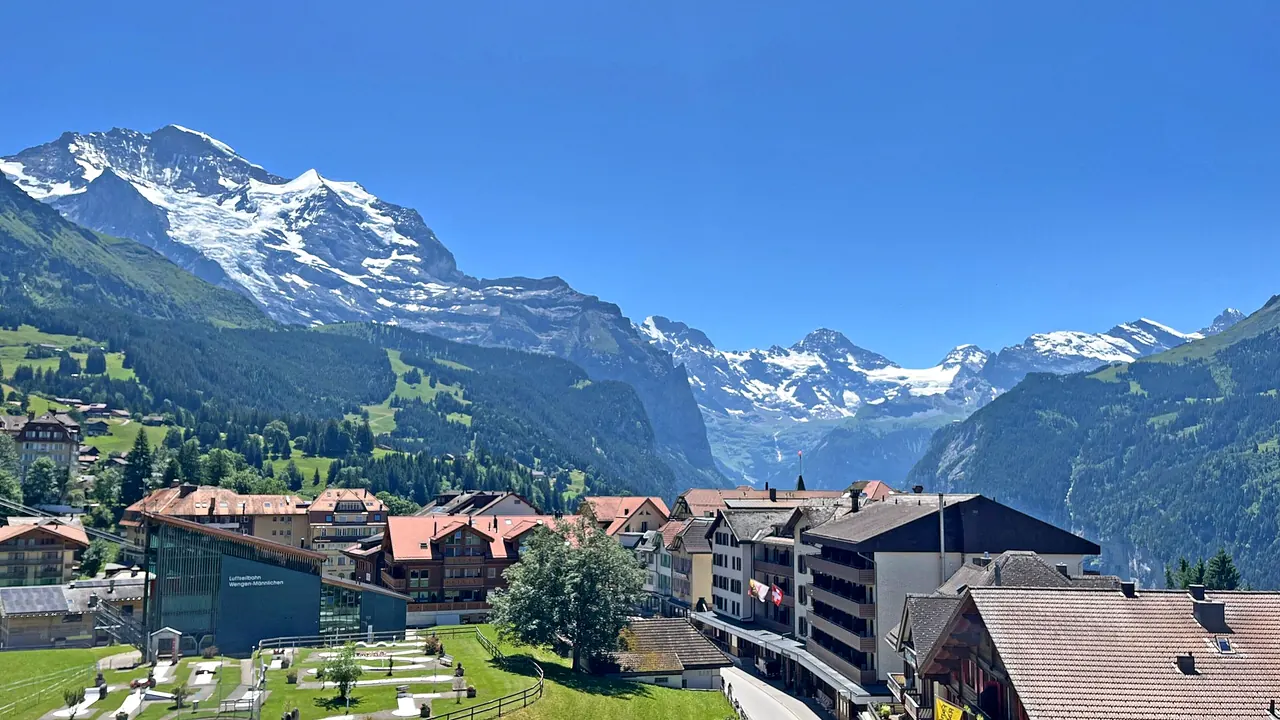
Photos: Wengen by Charles J. Sharp, CC BY-SA 4.0, cropped.
Verbier or Wengen?
Our verdict in twelve categories, each scored against the same fixed benchmark cities, and the climate month by month, so you can choose for your trip.
Choose Verbier for
- nightlife
- live music and the arts
- food and drink
Choose Verbier if you want the mountain to test you and the evenings to matter as much as the days. Its off-piste and freeride terrain draws serious skiers, winter après-ski carries on into late clubs, and the food and Valais wine are a clear step up. In summer there is a major classical music festival, with day trips into three countries.
Choose Wengen for
- getting around
- families
- beaches
Wengen suits travellers who want the scenery itself to be the vacation. It is a car-free village facing the Eiger, Mönch and Jungfrau, with walks from the door and a railway up to the Jungfraujoch. It is the calmer and easier base for families and anyone who likes early nights, as long as they are happy with simple Alpine food and little to do after dark.
Scoreboard
Twelve categories on one fixed scale from 0 to 100. The shaded stretch is the gap between the two.
Your match
Pick a travel style or drag the sliders, and both match scores follow your weighting.
Wins on nightlife and live music and the arts with your weighting.
Wins on getting around and families with your weighting.
What matters to you?
Category by category
What the scores mean for a trip.
Beaches & swimming
Neither village is a place to swim, but Wengen has the slightly better answer. An hour on the train takes you down to the lidos around Interlaken, where Lake Thun reaches about 20°C in a warm July, which makes an easy afternoon on a hot day.
From Verbier, the nearest open water is the shore of Lake Geneva, a little over an hour away by car. The alpine lakes above the resort, such as Lac des Vaux, stay too cold for bathing even in August, so summer swimming usually means the sports centre pool.
Food & drink
Verbier eats noticeably better. Its own Val de Bagnes makes one of Switzerland's most prized raclette cheeses, the village has a group of ambitious chef-led dining rooms, and the vineyards just below fill the wine lists with Petite Arvine and Cornalin.
Wengen serves honest Alpine cooking, mostly in hotel dining rooms and mountain huts, and many guests simply book half-board. A terrace lunch facing the Jungfrau is memorable more for the view than the plate. Neither village has much cheap or casual eating, but only Verbier has food worth planning a day around.
Culture & sights
Neither village has real sights, so in both, culture means going somewhere else for the day. Wengen at least has some period character in its large Belle Époque hotels from its days as an English resort, plus a long ski-racing history. Verbier is mostly modern chalets, and its older past lies down in Le Châble, with a stone church, a small museum of Bagnes life and old granaries along the valley.
Nightlife
This is one of the widest gaps between the two. In winter, Verbier's après-ski moves from terraces at the foot of the slopes to packed bars around the Place Centrale and then on to late clubs, with seasonal workers and a wealthy international crowd in the same rooms.
Wengen has a few bars that fill up at the end of the ski day and a hotel bar or two, and its one real party is the Lauberhorn race weekend in January. Both go quiet outside winter, Wengen especially, where summer walkers are in bed early.
Nature & outdoors
Both are outstanding mountain bases, so the choice comes down to the kind of mountain you want. Verbier is built for skiers who want a challenge. The 4 Vallées area is huge, the lifts reach Mont Fort at about 3,300m, and the freeride and ski touring terrain is known worldwide. Summer brings mountain biking, a bike park and paragliding.
Wengen is about the view and the walk. It looks straight at the Eiger, Mönch and Jungfrau across the waterfall-lined Lauterbrunnen valley, classic trails such as the panorama walk from Männlichen to Kleine Scheidegg start close by, and the railway climbs to the Jungfraujoch glacier. In winter it shares a large ski area with Grindelwald, including the long Lauberhorn run.
Day trips
Verbier has more within reach and more variety. Martigny, with its Roman remains and art foundation, is half an hour away. Sion's hilltop castles, the ancient abbey at Saint-Maurice, Chillon and the Lavaux terraces are all close enough for a day, and so are Aosta in Italy and Chamonix in France, though a car helps.
Every outing from Wengen starts with the rack railway down to Lauterbrunnen, which adds time to everything. Thun, the lake steamers to Oberhofen and Spiez, and the Ballenberg open-air museum make good days out, and Bern is a long but rewarding one. Still, the range falls short of Verbier's choice across three countries.
Good for families
Wengen is the easier family base. There are no cars, so children can walk around the village safely, the nursery slopes are close to the hotels, and sledging fills winter afternoons. In summer, trains and cable cars turn high views into short outings.
Verbier has good ski schools with snow gardens, and gentler slopes at La Tzoumaz and Savoleyres. But the village is steep and spread out, the skiing is famous for its difficult terrain and the evenings lean towards après-ski. Neither village has attractions made for children, so rainy days are hard to fill in both.
Getting around
Once you arrive, Wengen is far simpler. It is car-free and small enough to cross on foot in a few minutes, hotel carts collect luggage from the station, and the railway and the Männlichen cable car take you straight into the high mountains. The trade-off is that any trip lower down starts with the slow descent to Lauterbrunnen.
Verbier is easy to reach by train to Le Châble and then the gondola. Its chalets are scattered across a steep slope, though, so many guests rely on shuttle buses or taxis to get around, and day trips are much easier with a car.
Shopping & style
Verbier has clearly the wider and smarter choice. Its centre is somewhere to buy proper ski and touring equipment, not just hire a pair of skis, and a few designer and homeware boutiques aimed at chalet owners make an hour of browsing between ski days worthwhile. The best things to take home come from the valley, such as Valais cheese, a bottle of local wine or air-dried meat.
Wengen's shops are there to keep a mountain stay running. You can hire skis, replace a forgotten fleece, stock up on groceries and pick up some chocolate, and a short stroll covers the lot. For shopping as an outing in its own right, Verbier visitors head to Lausanne or Geneva, while from Wengen it means the train down to Interlaken or on to Bern.
Affordability
Both are among the most expensive places to stay in Europe, and neither can be done cheaply. The costs fall in different places. In Verbier it is winter chalets, lift passes, ski hire and lessons, which you can ease a little by staying in Le Châble or coming outside winter. In Wengen the mountain railways and cable cars add to the cost of every outing, and self-catering chalets, regional rail passes and the free trails are the ways to soften it.
Live music & performing arts
Verbier gives music lovers a real reason to come. Each summer the Verbier Festival, held since 1994, fills a large festival hall and the village church with leading soloists and chamber musicians, and its academy masterclasses are open to the public. Outside those weeks there is little.
Wengen has nothing like it. There are occasional summer concerts, the odd yodelling or alphorn evening in a hotel and a brass band at village celebrations, and for anything more you go to Interlaken or Bern.
Wellness & relaxation
Both villages rely mainly on hotel spas, but beyond those they offer different kinds of rest. Verbier adds a public pool and wellness area at the sports centre, and the thermal baths at Saillon and Lavey-les-Bains are within about an hour. Peak winter weeks, though, are loud rather than calm.
Wengen's strength is quiet. With no cars, you hear cowbells and the distant waterfalls, and you can spend an afternoon on a balcony facing the Jungfrau. It suits people who unwind by sitting still, while Verbier is the better choice for a proper spa trip.
When should you go?
Pick your month. The climate figures are measured averages, not a forecast.
Verbier in July
Wengen in July
Daytime high, °C
Rainfall in the month, mm
Where the figures come from
Verbier has no weather station within reach, so its figures come from a gridded climate model rather than a measured record, and read a broad area rather than one spot.
Wengen has no weather station within reach, so its figures come from a gridded climate model rather than a measured record, and read a broad area rather than one spot.
Temperature and rainfall are climate normals, averaged over the years shown. Verbier: 1991-2020 normals, TerraClimate 4 km grid at the town, no weather station within 90 km. Wengen: 1991-2020 normals, TerraClimate 4 km grid at the town, no weather station within 90 km.
Neither village ever gets beach weather, so the year splits into a snow season and a walking season. Both sit around 0°C by day from December to February, and both warm from June into a mild summer that is best for hiking. Verbier runs a touch warmer, at about 18°C in August against Wengen's 16°C. April is still chilly in both.
The rain falls differently. Verbier's wettest months are in early winter, peaking at around 145mm in December, much of it falling as snow at that height, and July to September are its driest stretch. Wengen's rain is spread more evenly but is heaviest from May to August, at around 110mm a month, so summer walkers there should expect some cloudy days. In both villages, September is a drier and quieter alternative to high summer.
Which traveller are you?
For a food and nightlife trip, Verbier is the clear pick. You get raclette from its own valley, chef-led dining rooms and Valais wine, then an après-ski scene that runs into late clubs in winter. In Wengen most evenings end with a half-board dinner.
On a family trip with young children, Wengen is the easier choice. Its car-free lanes let children walk safely, nursery slopes sit beside the hotels and trains carry everyone up to the views. Verbier is steep, spread out and better known for difficult skiing.
For a culture and arts trip, Verbier has more to offer, especially in summer. The Verbier Festival brings leading classical musicians to the village, and Martigny's art foundation and Sion's castles are close by. Wengen has little music and no sights of its own.
Before you go
| Measure | Verbier | Wengen |
|---|---|---|
| Official language | French, German, Italian, Romansh | French, German, Italian, Romansh |
| Currency | Swiss Franc (CHF) | Swiss Franc (CHF) |
| Sockets | CJ230 V, 50 Hz | CJ230 V, 50 Hz |
| Driving side | Right | Right |
| Time zone | UTC+1, UTC+2 in summer | UTC+1, UTC+2 in summer |
| Emergency number | 112 | 112 |
| Elevation | 1,490 m | 1,274 m |
| Main airport | Geneva International Airport (GVA)88 km from centre150 non-stop destinations | Zürich Airport (ZRH)106 km from centre226 non-stop destinations |
| Public holidays this year | 9 days | 10 days |
By the numbers
| Measure | Verbier | Wengen |
|---|---|---|
| Population | - | 1,116 |
| People per km² | - | 31 |
| Museums within 10 km | 4 | 2 |
| UNESCO World Heritage sites within 50 km | 0 | 1 |
Where else could you go?
Every comparison below shares a destination with this one, so you can follow Verbier or Wengen somewhere new.
- Mürrenvs Wengen
- Grindelwaldvs Wengen
- Adelbodenvs Wengen
- Crans-Montanavs Verbier
- Chamonixvs Verbier
- Leukerbadvs Wengen