Adirondacks or Outer Banks?
Our verdict in twelve categories, each scored against the same fixed benchmark cities, and the climate month by month, so you can choose for your trip.
Choose Adirondacks for
- nature and the outdoors
- wellness
- day trips
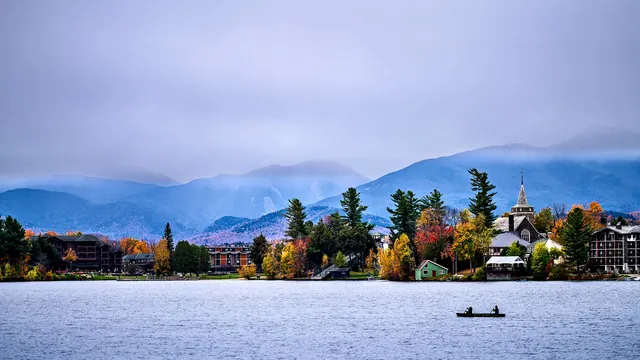
The Adirondacks suit travellers who want mountains, forest and fresh water rather than the sea. You come for High Peaks hikes from Lake Placid or Keene Valley, canoe days through the Saranac Lakes, autumn foliage, and skiing at Whiteface in winter. It is also the more restful of the two, a place of porches above still lakes, and from its edges you can reach Saratoga Springs, Vermont and even Montreal for a day.
Choose Outer Banks for
- beaches
- food and drink
- culture and sights
For a vacation built around the ocean, the Outer Banks are the clear pick. Long Atlantic beaches, a sea warm enough to swim in all summer and a rented house shared by the whole family make up the classic week here, with better seafood and two famous chapters of American history thrown in. Away from the sand and the sounds there is less to fill the days, so it rewards people who are happy to spend most of them on the beach.
Scoreboard
Twelve categories on one fixed scale from 0 to 100. The shaded stretch is the gap between the two.
Your match
Pick a travel style or drag the sliders, and both match scores follow your weighting.
Too close to call, 1 point apart
Wins on nature and the outdoors and wellness with your weighting.
Wins on beaches and food and drink with your weighting.
What matters to you?
Category by category
What the scores mean for a trip.
Beaches & swimming
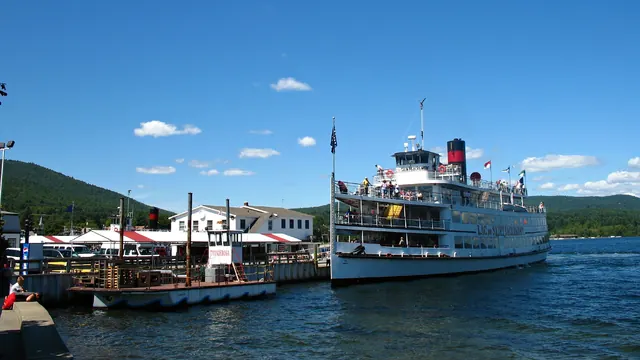
In the Adirondacks, swimming means lakes. You get the sandy public beaches of Lake George, the town beach on Mirror Lake and the docks along the Fulton Chain, all lovely in July and August but cold for much of the rest of the year. It is calm, freshwater lake life, with rafts and picnic tables instead of waves.
The Outer Banks are a true beach destination, with well over 100 miles of open Atlantic sand. You can choose between the lifeguarded town beaches of Kitty Hawk and Nags Head and the empty dunes of Cape Hatteras National Seashore. The surf and rip currents need respect, and families with toddlers use the shallow sound side instead.
Food & drink
Neither place is a food trip, but the Outer Banks give you more to look forward to. In the Adirondacks you eat diner pancakes with maple syrup, trout and steak in lodge dining rooms and Champlain Valley cider in autumn, with the widest choice in Lake Placid and Saranac Lake.
On the coast, the meals revolve around fresh catch: steamed shrimp, soft-shell crab and local tuna in dockside shacks, or fish bought from the harbours at Wanchese and Hatteras to cook in your rental house.
Culture & sights
Both places offer scattered single sights, not great museums, but the Outer Banks' history is slightly better known. The Adirondacks have colonial forts at Ticonderoga and Lake George, Gilded Age Great Camps such as Sagamore, and the Olympic venues of Lake Placid, with long drives between them.
On the Outer Banks, the Wright Brothers memorial at Kill Devil Hills and the Lost Colony site on Roanoke Island are landmarks of national history. Add the striped lighthouses from Currituck to Cape Hatteras and you can see a fair amount in a few mornings.
Nightlife
The real difference is how spread out the evenings are. In the Adirondacks, going out is concentrated in Lake George village, where a bar strip, waterfront decks and party boats draw a young crowd on summer weekends, with a few brewpubs on Lake Placid's Main Street. Anywhere else, the night ends at a campfire.
The Outer Banks give you a little more to choose from along the coast. There are sunset drinks on sound-side decks, beach bars and taprooms along the bypass in Kill Devil Hills and Nags Head, and seafood bars where people stay on after dinner. Clubs are almost absent here too.
Nature & outdoors
This is where the Adirondacks pull far ahead. They have a huge protected wilderness of forty-six High Peaks, with Mount Marcy rising to about 1,630m, and thousands of lakes linked by portages and lean-tos. Moose live in the north, foliage turns the hills red and gold in autumn, and in winter there is skiing and ice climbing.
The Outer Banks' nature is lower and flatter, though it has its own appeal. You can walk the great sand dunes of Jockey's Ridge, watch wild mustangs north of Corolla and migrating birds at Pea Island, and the shallow sounds near Rodanthe are world-class for kiteboarding. Walking there, though, means beach strolls, not summits.
Day trips
The Adirondacks have more within reach. From Lake George you can visit the Victorian streets and racecourse of Saratoga Springs or the capitol in Albany. From the Champlain shore, ferries cross to Burlington in Vermont, and Montreal makes a long but possible day from the northern lakes.
On the Outer Banks, the best outing is the ferry from Hatteras to the sandy lanes of Ocracoke. After that come colonial Edenton and the naval museums of Norfolk, both worth a day but neither strong enough to plan a trip around.
Good for families
Both are long-standing family favourites, but they give children different summers. In the Adirondacks, families have the theme park and water parks around Lake George and Old Forge, the treetop walkway at the Wild Center and Olympic bobsled rides at Lake Placid, with drives in between and High Peaks trails too steep for small legs.
On the Outer Banks, a week revolves around the rented house and its pool, crab-catching, the aquarium on Roanoke Island and the wild-horse tours. There is no big attraction for a rainy day, and parents need to watch the strong surf.
Getting around
Either way, you need a car, but the driving is different. In the Adirondacks, you drive winding two-lane forest roads, so moving between lake towns takes well over an hour. A train along Lake Champlain and a few buses link the bigger towns.
The Outer Banks are one long strip. You follow parallel roads through the central towns and then a single highway down Hatteras Island, with bike paths between Kitty Hawk and Nags Head, a ferry to Ocracoke and long bridge queues on changeover Saturdays.
Shopping & style
Shopping is a sideline in both places, and what you take home is what sets them apart. From the Adirondacks it is rustic twig furniture, pack baskets, balsam pillows and maple syrup, alongside the outdoor-gear shops of Lake Placid. From the Outer Banks it is surf and kite gear, plus pottery, decoys and coastal paintings from galleries in Duck, Manteo and Ocracoke.
Affordability
A summer in the Adirondacks is a little easier to do cheaply, because the cheaper places sit inland, away from the resorts. Lake Placid and the Lake George lakefront charge resort rates, but the central and western lakes have family motels and state campgrounds that cost much less.
On the Outer Banks, the beachfront is the whole point, and summer rentals often go only by the full week. You save by sharing a big house and cooking fish from the docks, or by coming in spring or autumn, when the sea is too cool for most swimmers.
Live music & performing arts
Live performance in both places is a summer affair, and the Adirondacks offer a broader programme. They have chamber festivals in lakeside churches near Lake George, a young singers' opera programme near Schroon Lake and Lake Placid's arts centre, with the orchestra and ballet seasons at the Saratoga amphitheatre an evening's drive away.
The Outer Banks have one real show, but it is a distinctive one: The Lost Colony, an outdoor drama staged since 1937 on Roanoke Island, where the settlers lived.
Wellness & relaxation
For rest, the Adirondacks are the better choice. Saranac Lake grew up as a place where people came to recover in mountain air, and the whole region still keeps that slow pace: a canoe on a still lake at dawn, loons in the evening and nothing planned. If you want proper treatments too, the old mineral baths of Saratoga Springs lie just beyond the park's southern edge.
The Outer Banks give you a slower week rather than real restoration. The beach house sets the rhythm, with evenings on the porch listening to the surf, but beyond a few day spas and yoga studios in Duck there is little else to look after the body. The quietest places are Hatteras Island and Ocracoke in late spring and autumn.
When should you go?
Pick your month. The climate figures are measured averages, not a forecast.
Adirondacks in July
Outer Banks in July
Daytime high, °C
Rainfall in the month, mm
Where the figures come from
Adirondacks has no rain gauge within 25 km of the centre, so its rainfall comes from a gridded climate dataset read at the destination rather than from a gauge further away.
Outer Banks has no rain gauge within 25 km of the centre, so its rainfall comes from a gridded climate dataset read at the destination rather than from a gauge further away.
Outer Banks's sunshine is measured 77 km from the centre, at Cape Hatteras.
Temperature and rainfall are climate normals, averaged over the years shown. Adirondacks: 2006-2020 (rainfall 1991-2020) normals, Harrietstown (20.1 km from centre). Outer Banks: 2009-2025 (sunshine 1981-2010, rainfall 1991-2020) normals, Manteo / Sunny Side (7.7 km from centre).
The Adirondacks have a short summer and a long, hard winter. July is the warmest month at about 25°C, and late June to August is the only stretch when the lakes are pleasant for swimming. Summer is also the wettest time of year, mostly in showers. September is the best month for hiking, mild and a little drier, with the foliage turning from late in the month. October is colder and wetter, but the colour often holds into its first weeks. From December to February daytime highs stay below freezing, so this is a snow-sports season, not a time for wandering the towns.
The Outer Banks are milder all year and warmer in summer. On the central beaches July highs reach about 30°C. From June to September the sea is warm enough to swim, peaking at 26°C in July and August, and the days are long and sunny. The catch is that late summer is the wettest period, with September the wettest month at 165mm. May and October are good for walking the beaches and visiting the lighthouses in comfortable warmth. Winter stays above freezing but is grey and quiet.
Which traveller are you?
On a beach and sun trip, the Outer Banks win easily. They have long stretches of Atlantic sand, lifeguarded beaches at Nags Head and Kill Devil Hills, empty national seashore further south and a summer sea warm enough for long swims. The Adirondacks offer only lake beaches during a few short weeks.
For an outdoors trip, choose the Adirondacks. Forty-six High Peaks, multi-day canoe routes through the St Regis Canoe Area, moose, loons, autumn colour and winter skiing add up to far more than the Outer Banks' flat dunes and marsh, though kiteboarders will still prefer Hatteras Island's sounds.
On a relaxing and wellness trip, the Adirondacks are the gentler choice. Saranac Lake grew up as a mountain resting place, the grand Lake George resorts have spas, and the Saratoga mineral baths are close by. The Outer Banks offer porch-time by the surf but little real spa culture.
Before you go
| Measure | Adirondacks | Outer Banks |
|---|---|---|
| Currency | US Dollar (USD) | US Dollar (USD) |
| Sockets | AB120 V, 60 Hz | AB120 V, 60 Hz |
| Driving side | Right | Right |
| Time zone | UTC-5, UTC-4 in summer | UTC-5, UTC-4 in summer |
| Emergency number | 911 | 911 |
| Main airport | Albany International Airport (ALB)26 non-stop destinations | Norfolk International Airport (ORF)44 non-stop destinations |
| Public holidays this year | 13 days | 14 days |
By the numbers
| Measure | Adirondacks | Outer Banks |
|---|---|---|
| Swim season, months above 21 °C | - | 4 months |
Where else could you go?
Every comparison below shares a destination with this one, so you can follow Adirondacks or Outer Banks somewhere new.
- Virginia Beachvs Outer Banks
- Catskillsvs Adirondacks
- Poconosvs Adirondacks
- Myrtle Beachvs Outer Banks
- Cape Codvs Adirondacks
- Martha's Vineyardvs Adirondacks