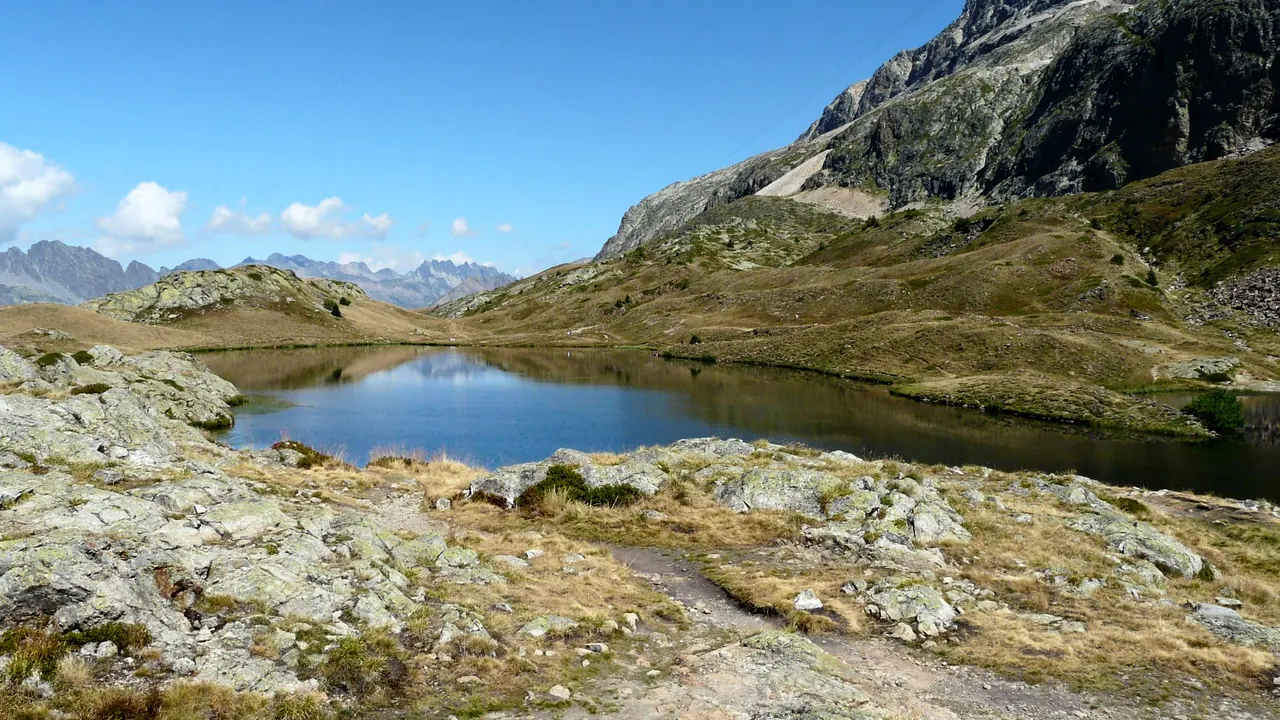
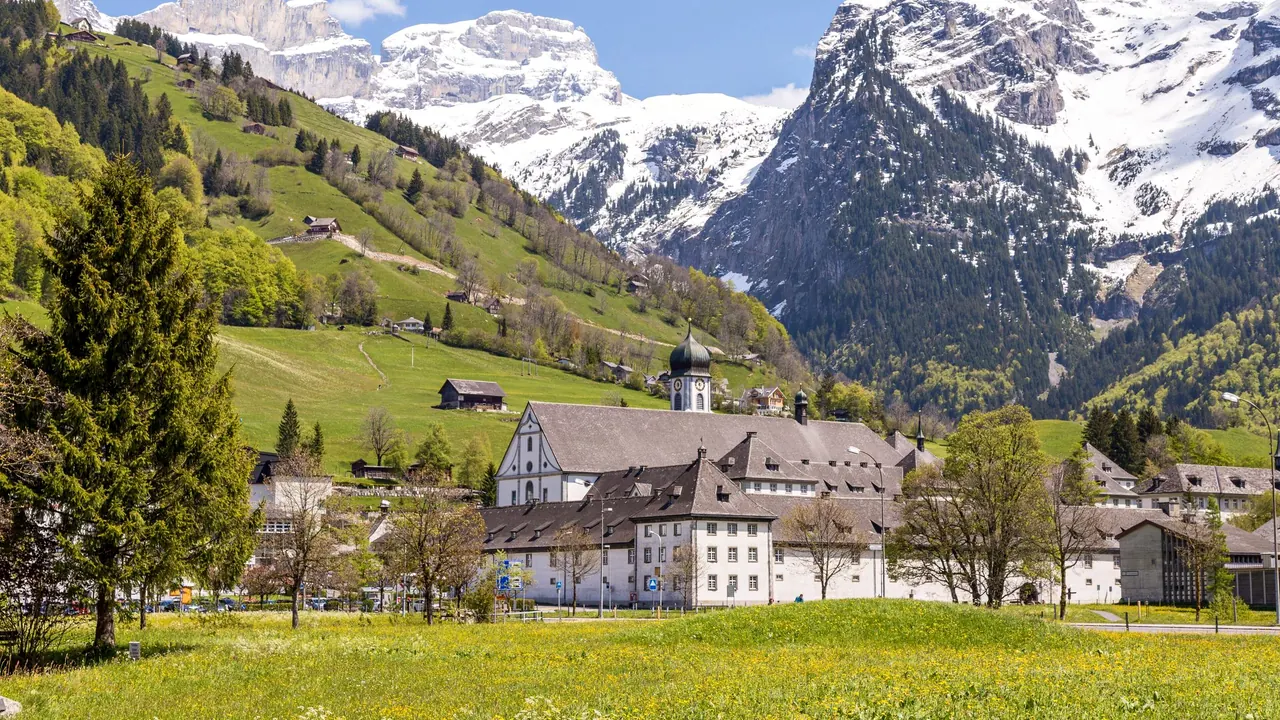
Photos: Alpe d'Huez by Beany, CC BY-SA 3.0, cropped; Engelberg by JoachimKohler-HB, CC BY-SA 4.0, cropped.
Alpe d'Huez or Engelberg?
Our verdict in twelve categories, each scored against the same fixed benchmark cities, and the climate month by month, so you can choose for your trip.
Choose Alpe d'Huez for
- nightlife
- prices
- food and drink
Alpe d'Huez suits groups and families who want a sunny ski week with some life in the evenings. Its south-facing slopes, huge linked ski area and the long Sarenne run sit alongside a busier après-ski scene and a wider choice of places to eat. Bills are high, but less punishing than in Switzerland. In summer, the road cyclists who come for the famous hairpins and the mountain bikers have it largely to themselves.
Choose Engelberg for
- getting around
- day trips
- beaches
Engelberg is the better pick if you would rather arrive by train and leave the car at home. The village is compact and easy to walk, and there is permanent glacier snow on Titlis whatever the month. Lucerne and its lake are close enough for a day out, and the abbey gives the place a history Alpe d'Huez lacks. It also draws serious freeriders. Expect quieter nights and Swiss prices.
Scoreboard
Twelve categories on one fixed scale from 0 to 100. The shaded stretch is the gap between the two.
Your match
Pick a travel style or drag the sliders, and both match scores follow your weighting.
Wins on nightlife and prices with your weighting.
Wins on getting around and day trips with your weighting.
What matters to you?
Category by category
What the scores mean for a trip.
Beaches & swimming
Neither resort has a beach, but Engelberg gives you a real option in midsummer. Lake Lucerne is about an hour away by train, and its lidos and lakeside meadows have clear water that is mild enough for a proper swim. The Trübsee above the village is for looking at, not bathing.
At Alpe d'Huez, the small lakes on the Lac Besson plateau stay cold even in July, and the Romanche valley lakes are only slightly milder. Swimming there mostly means the sports-centre pool.
Food & drink
Both serve hearty Alpine cheese cooking, but Alpe d'Huez gives you more to choose from over a week. Alongside tartiflette, diots with polenta and Beaufort, the village has pizzerias, brasseries and a few French kitchens that aim higher. Sunny slope-side terraces make lunch part of the ski day.
Engelberg's menus are narrower and pricier, with rösti and Älplermagronen in wood-panelled rooms and mountain huts. Its stand-out is the monastery's show cheese dairy, where you watch the cheese being made and buy it at the counter.
Culture & sights
Sightseeing is thin in both, but Engelberg has more depth. Its Benedictine abbey, founded in 1120, dominates the valley floor. The late-baroque church holds one of Switzerland's largest organs, and Belle Époque hotels recall the age of the grand Alpine resorts.
Alpe d'Huez is a twentieth-century ski resort. Its sights are the tent-shaped Notre-Dame des Neiges, a small local museum and, in summer, the remains of the medieval silver-mining village of Brandes up on the plateau.
Nightlife
Alpe d'Huez has the bigger night out. Bars by the lower runs fill as soon as the lifts close, and the crowd then moves on to village pubs, with a few late bars and small clubs open past midnight. The crowd is mostly young British, Dutch and French skiers.
Engelberg's après-ski is lively but brief. A couple of late bars and a small club run mainly at high-season weekends, kept going by freeriders and seasonal workers, many of them Scandinavian. Outside winter, both resorts wind down to a drink after dinner.
Nature & outdoors
These are two of the Alps' great mountain settings, but they feel different. Alpe d'Huez is open and sunny, on a south-facing shelf below the Grandes Rousses. A vast linked ski area runs up to the Pic Blanc at 3,330m, the Sarenne run is famous, and summer brings the Écrins trails and the 21 hairpins up from Bourg d'Oisans.
Engelberg lies in a deep green valley under the glaciated Titlis. The rotating gondola, the ice cave and the suspension bridge put permanent snow within anyone's reach. Its steep north faces draw freeriders, and the Four Lakes walk over the Jochpass is the classic summer outing.
Day trips
Engelberg is much better placed for days out. The valley train reaches Lucerne in under an hour, with its covered bridges and paddle steamers to Weggis and Vitznau. Stans, Schwyz with the Confederation charters and the baroque abbey at Einsiedeln are all within reach, and Zurich is under two hours away.
From Alpe d'Huez, every trip starts with the winding road down. Grenoble, with the Bastille cable car, is about an hour and a quarter away. Beyond that there is the revolution museum at Vizille, then La Grave and Vauban's Briançon over the Col du Lautaret.
Good for families
Both work well for families. Alpe d'Huez has wide, gentle beginner slopes close to the village, kids' clubs, an ice rink and sunshine that makes cold days easier. Its steep, spread-out layout, though, is hard work with a pushchair.
Engelberg is easier to get around on foot, with short, flat walks between station, hotels and lifts. Children can play on the Härzlisee rafts and the Trübsee boats, and Lucerne's transport museum is there for a rainy day. Keep the glacier station short for small children.
Getting around
Engelberg is far simpler. A valley railway from Lucerne, partly on a steep cog section, brings you to a small, flat village you can walk around. From there, cable cars reach both mountain areas, so you never need a car.
Alpe d'Huez has no railway, so you arrive by coach, transfer or a drive up the hairpins, sometimes with chains on. Free shuttles and a small gondola link the quarters, which climb the slope at different heights. Walking between them with ski gear is tiring.
Shopping & style
Neither is a shopping destination, and both are mostly ski rental and outdoor gear. The edible souvenirs are what set them apart. Alpe d'Huez has delicatessens with regional cheese and charcuterie, and serious shoppers head to Grenoble. Engelberg offers monastery-made cheese and Swiss chocolate, plus a few watch and jewellery shops aimed at tour groups.
Affordability
Both are expensive, but Alpe d'Huez costs noticeably less. It has more modest places to stay than the grander French resorts, self-catering helps, and summer or the quieter ski weeks bring costs down a good deal.
Engelberg has Swiss price levels for hotels, meals and drinks, and the Titlis cable car is a big expense in itself. A Swiss travel pass and supermarket picnics take some of the sting out, but only so far.
Live music & performing arts
Both resorts offer little beyond organ music in church. Alpe d'Huez holds seasonal concerts in its modern tent-shaped church and the occasional outdoor gig. Engelberg has recitals in its baroque abbey and a small summer classical festival. For a proper programme, you would head to Grenoble from Alpe d'Huez, or take the short train to Lucerne's concert halls from Engelberg.
Wellness & relaxation
The two are much alike: hotel spas with saunas and pools, a sports-centre pool, and no thermal springs of their own. Engelberg began as a health resort, and its enclosed, quiet valley lends itself to slowing down. From Alpe d'Huez, the historic baths at Uriage-les-Bains are about an hour's drive away. In both, early summer is the restful time.
When should you go?
Pick your month. The climate figures are measured averages, not a forecast.
Alpe d'Huez in July
Engelberg in July
Daytime high, °C
Rainfall in the month, mm
Where the figures come from
Alpe d'Huez has no weather station within reach, so its figures come from a gridded climate model rather than a measured record, and read a broad area rather than one spot.
Engelberg has no weather station within reach, so its figures come from a gridded climate model rather than a measured record, and read a broad area rather than one spot.
Temperature and rainfall are climate normals, averaged over the years shown. Alpe d'Huez: 2001-2020 normals, NASA POWER reanalysis grid, no weather station within 90 km. Engelberg: 2001-2020 normals, NASA POWER reanalysis grid, no weather station within 90 km.
Alpe d'Huez is the colder and higher of the two. From December to February daytime highs stay below freezing, down to about -3°C in January, which keeps the snow in good shape for the ski season. Even in July and August days only reach around 18°C, which is pleasant for hiking and cycling but never hot. Rain is spread fairly evenly through the year. May and November are the wettest months, and midsummer is relatively dry.
Engelberg is a few degrees milder in every month, with highs around freezing in midwinter and about 21°C in July and August. The catch is summer rain. From May to August it gets around 150mm a month, so expect showers and changeable days on the trails. Neither place has warm enough water for a swim nearby, except Engelberg in midsummer, when the lakeside lidos on Lake Lucerne are a train ride away. For dry summer walking, Alpe d'Huez has the edge.
Which traveller are you?
For a food and nightlife trip, choose Alpe d'Huez. Après-ski bars by the lower runs lead on to village pubs and a few clubs open past midnight, and pizzerias and brasseries give you a break from the fondue and tartiflette. Engelberg's nights end sooner and its menus are narrower.
On a tight budget, Alpe d'Huez is the one to choose. Go in summer or a quiet ski week, cook most evenings in a self-catering apartment and skip the slope-side lunches. Engelberg stays expensive however carefully you plan.
On a family trip with young children, Engelberg is easier. Alpe d'Huez's steep, spread-out quarters are hard going with a pushchair. In Engelberg you arrive by train with no car to manage, walk on the flat from hotel to lift, and can head to Lucerne when it rains.
Before you go
| Measure | Alpe d'Huez | Engelberg |
|---|---|---|
| Official language | French | French, German, Italian, Romansh |
| Currency | Euro (EUR) | Swiss Franc (CHF) |
| Sockets | CE230 V, 50 Hz | CJ230 V, 50 Hz |
| Driving side | Right | Right |
| Time zone | UTC+1, UTC+2 in summer | UTC+1, UTC+2 in summer |
| Emergency number | 112 | 112 |
| Elevation | 1,860 m | 1,015 m |
| Main airport | Grenoble Alpes Isère Airport (GNB)65 km from centre16 non-stop destinations | Zürich Airport (ZRH)72 km from centre226 non-stop destinations |
| Public holidays this year | 11 days | 13 days |
By the numbers
| Measure | Alpe d'Huez | Engelberg |
|---|---|---|
| Population | - | 4,181 |
| People per km² | - | 56 |
| Museums within 10 km | 1 | 0 |
| UNESCO World Heritage sites within 50 km | 0 | 2 |
Where else could you go?
Every comparison below shares a destination with this one, so you can follow Alpe d'Huez or Engelberg somewhere new.
- Les Deux Alpesvs Alpe d'Huez
- Andermattvs Engelberg
- Grindelwaldvs Engelberg
- Serre Chevaliervs Alpe d'Huez
- Wengenvs Engelberg
- Les Menuiresvs Alpe d'Huez