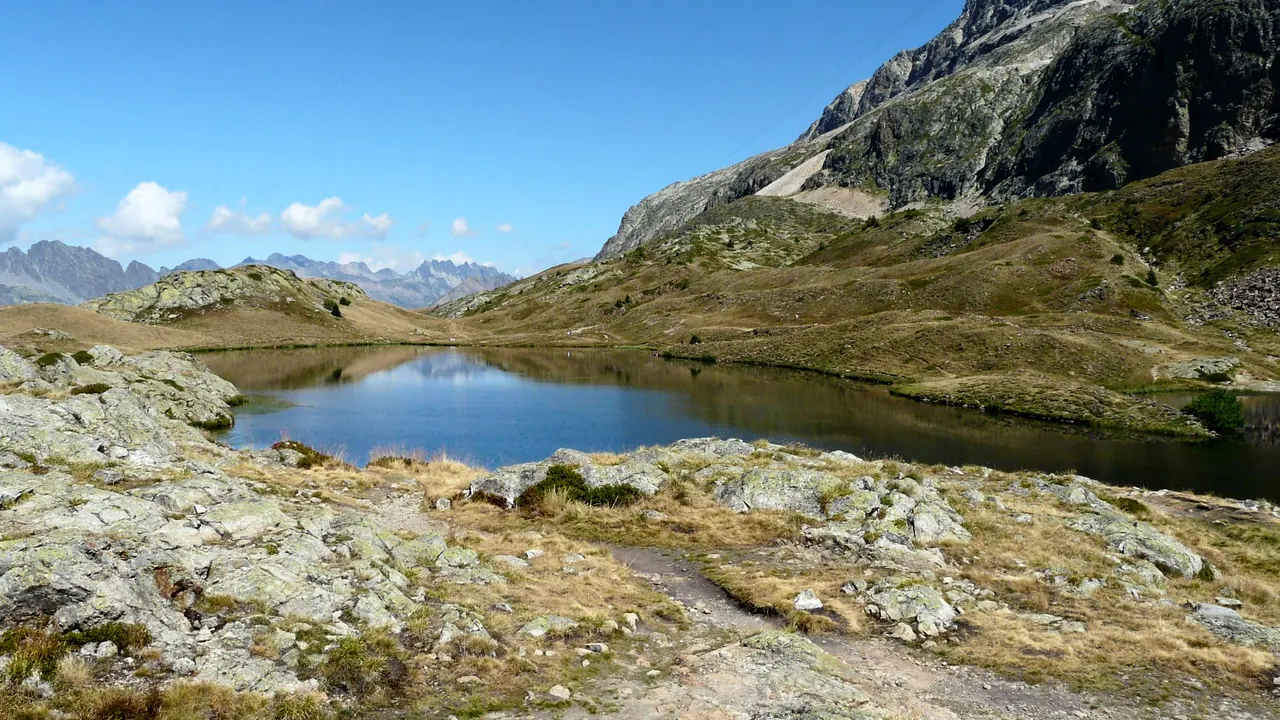
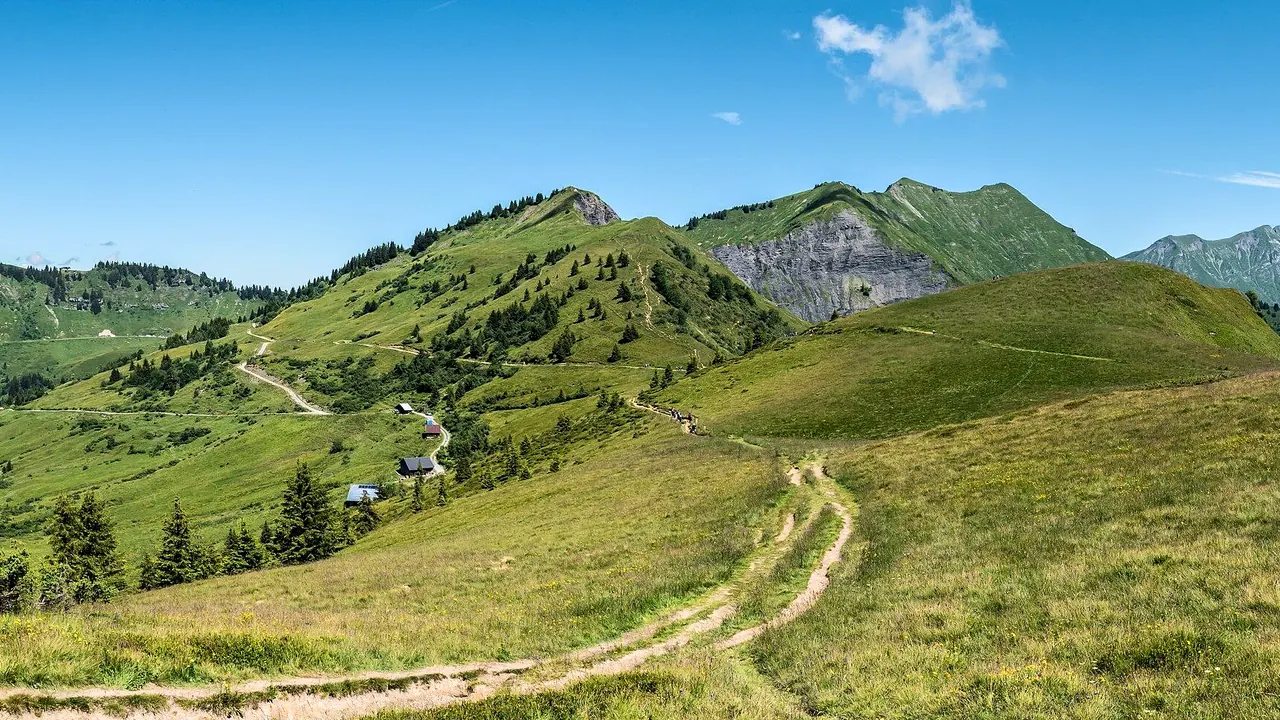
Photos: Alpe d'Huez by Beany, CC BY-SA 3.0, cropped; Samoëns by Krzysztof Golik, CC BY-SA 4.0, cropped.
Alpe d'Huez or Samoëns?
Our verdict in twelve categories, each scored against the same fixed benchmark cities, and the climate month by month, so you can choose for your trip.
Choose Alpe d'Huez for
- nightlife
- wellness
- getting around
Alpe d'Huez suits skiers who want height, sun and long descents. Its lifts climb far above the village to the Pic Blanc, its south-facing slopes catch unusual amounts of sunshine, and after the lifts close there is a proper après-ski scene with late bars. In summer it draws road cyclists to the famous hairpins and riders to its lift-served bike trails. You pay for all this, and it suits groups of friends better than anyone looking for a quiet or cheap week.
Choose Samoëns for
- day trips
- beaches
- prices
Samoëns is the choice for families and anyone who wants a real village around their ski week. Its stone centre, weekly market and calm evenings have a character the purpose-built resort lacks, and it costs less. It is also much better placed for days out, with Geneva, Annecy and Chamonix all within easy driving distance, and a green valley full of waterfalls and walks for the summer.
Scoreboard
Twelve categories on one fixed scale from 0 to 100. The shaded stretch is the gap between the two.
Your match
Pick a travel style or drag the sliders, and both match scores follow your weighting.
Wins on nightlife and wellness with your weighting.
Wins on day trips and beaches with your weighting.
What matters to you?
Category by category
What the scores mean for a trip.
Beaches & swimming
Neither is a swimming destination, but Samoëns does summer water much better. The Lac aux Dames has a lifeguarded bathing area in July and August, a grassy shore and an outdoor pool next to it, and the lakeside beaches of Lake Geneva at Évian and Thonon are about an hour's drive away.
At Alpe d'Huez, the small lakes on the Lac Besson plateau are cold even in high summer, so most real swimming happens in the sports centre pool or a hotel pool.
Food & drink
The plates are almost the same in both: tartiflette, fondue, raclette and diots with polenta, and the menus get repetitive over a week. What differs is where you eat.
At Alpe d'Huez the best meal of the day is a long lunch on a sunny slope-side terrace. Samoëns serves some of its mountain food in old alpine farm buildings, and its weekly market on the square is good for local Abondance and Reblochon, charcuterie and honey to take back to an apartment.
Culture & sights
Samoëns is the more rewarding place to wander, because it kept its old village. The stonework of the frahan masons, the Grande Place with its ancient lime tree and carved fountain, and the Jaÿsinia alpine garden climbing the hillside make a pleasant afternoon.
Alpe d'Huez is a twentieth-century ski station. Its sights are the tent-shaped church of Notre-Dame des Neiges, a small local museum and, in summer, the ruins of the medieval silver-mining village of Brandes. Neither will keep you busy for more than a few hours.
Nightlife
Alpe d'Huez is clearly the livelier of the two after dark. The après-ski bars by the lower runs fill up as the lifts close, the crowd moves on to the village pubs, and a few late bars and small clubs stay open past midnight. Much of the crowd is young skiers from Britain, the Netherlands and France.
Samoëns stops early: a drink on the square or at the foot of the gondola, dinner, and a couple of pubs open later in winter. That suits families, but a group of friends after a big night will find it flat.
Nature & outdoors
Both are excellent mountain bases, but the landscapes are different. Alpe d'Huez is high, open and sunny. Its lifts reach the Pic Blanc at 3,330m and the long Sarenne black run, and in summer there are the Lac Blanc, hikes into the Écrins, lift-served bike trails and the 21 hairpins up from Bourg d'Oisans.
Samoëns sits lower, in a green valley. Its gondola leads into the Grand Massif, with runs through forest and views to Mont Blanc, and there is cross-country skiing on the valley floor. In summer the Cirque du Fer-à-Cheval offers waterfalls, chamois and ibex, and there is rafting on the Giffre and walking on the Désert de Platé.
Day trips
Samoëns is far better placed for days out. Geneva and Chamonix are each about an hour away by car and Annecy only a little further. The French shore of Lake Geneva adds walled Yvoire and Évian, where a ferry crosses to Lausanne.
From Alpe d'Huez, every outing starts with the winding road down to the valley. Grenoble and its Bastille cable car, the Revolution museum at Vizille, and Briançon's Vauban upper town beyond the Col du Lautaret are good days out, but the list is short.
Good for families
Both work well for a family ski week, with ski schools, kids' clubs and gentle beginner slopes, so the choice comes down to the setting. Alpe d'Huez offers sunshine, wide nursery areas near the village, an ice rink and sledging, but its altitude and steep, spread-out layout make it harder with toddlers and pushchairs.
Samoëns is small, traffic-calmed and easy to manage. In summer the Lac aux Dames base adds a pool with a slide, a paddling area and playgrounds, though teenagers may find the evenings slow.
Getting around
Both can manage a car-free ski week, in different ways. Alpe d'Huez has no railway and is reached by coach, transfer or the long climb by road. Once you are there, free shuttles and a small gondola link the quarters spread up the slope, and many lodgings are ski-in, ski-out, but walking between them with gear is tiring.
Samoëns has a compact centre that is easy on foot, with the gondola at its edge and buses up from the railway in the Arve valley. Once you want to explore the valley or reach Geneva and Annecy, though, a car is close to essential.
Shopping & style
Neither is a place to shop, and both stock mainly ski gear, outdoor clothing, regional delicatessens and souvenirs. Samoëns is a little more pleasant to browse, with boutiques around the square and a weekly market selling woollens and mountain cheeses. For anything more, Alpe d'Huez sends you to Grenoble, and Samoëns to Geneva or Annecy.
Affordability
Alpe d'Huez is the dearer of the two. A winter week adds up quickly: the lift pass, equipment hire, ski lessons and lodging at its peak in the school vacation weeks. Lunch on the slope-side terraces also costs far more than the same meal down in the valley. Most visitors keep the bill down by renting an apartment and cooking for themselves, and the resort does have more modest places to stay than the most exclusive French resorts.
Samoëns is easier on the wallet, though a family still pays for passes, hire and lessons, and the mountain restaurants charge resort prices. The saving comes from how easily you can look after yourself there. The village has plenty of self-catering apartments, a supermarket and a weekly market, so most meals can be made at home. In both resorts summer and the quieter weeks cost much less, and in Samoëns the hiking is free.
Live music & performing arts
Both are thin, and the small amount on offer is similar. Alpe d'Huez has organ concerts in Notre-Dame des Neiges and the occasional outdoor gig. Samoëns has summer concerts outdoors and in its church, plus village festivals. For a real programme, one points you to Grenoble and the other to Geneva, which also has opera.
Wellness & relaxation
Alpe d'Huez has a slightly fuller offer after a day outdoors. Hotels and residences have saunas, hot tubs and massages, there is the sports centre pool, and the thermal spa at Uriage-les-Bains is about an hour away. Early summer there is quiet and very restful.
Samoëns relies on hotel saunas and the aquatic centres in neighbouring resorts, with the baths at Saint-Gervais about an hour's drive away. Its strength is the slow village pace, especially outside the busiest winter weeks.
When should you go?
Pick your month. The climate figures are measured averages, not a forecast.
Alpe d'Huez in July
Samoëns in July
Daytime high, °C
Rainfall in the month, mm
Where the figures come from
Alpe d'Huez has no weather station within reach, so its figures come from a gridded climate model rather than a measured record, and read a broad area rather than one spot.
Samoëns's temperatures are measured 49 km from the centre, at Sion.
Samoëns's station stands 189 m below the city centre, so the centre is likely a little cooler than the figures say.
Samoëns has no rain gauge within 25 km of the centre, so its rainfall comes from a gridded climate dataset read at the destination rather than from a gauge further away.
Temperature and rainfall are climate normals, averaged over the years shown. Alpe d'Huez: 2001-2020 normals, NASA POWER reanalysis grid, no weather station within 90 km. Samoëns: 1991-2020 (sunshine 1961-1990) normals, Sion (49.1 km from centre).
Alpe d'Huez is a cold place in winter. Daytime highs stay below freezing from December to February, around -3°C in January, and March is barely above zero, so the long ski season is built on real cold. Summer is short and fresh, peaking at about 18°C in July and August. That is ideal weather for hiking and cycling but too cool for comfortable lake swimming. Rain is spread through the year, with May and November the wettest months.
The figures for Samoëns are much milder and wetter. Days reach 27°C in July and August, warm enough for the Lac aux Dames bathing area, and July is the sunniest month with about 270 hours. April to June and September to October are pleasant for walking. Rain falls steadily all year and peaks in December at around 129mm, and the short, dull midwinter days are a real contrast with the bright, frozen days higher up at Alpe d'Huez.
Which traveller are you?
For a food and nightlife trip, Alpe d'Huez is the better pick. The mountain food is much the same in both, but its après-ski bars, village pubs and small late clubs keep going well past the hour when Samoëns goes quiet.
On a culture and arts trip, Samoëns has more to offer. Its old stone village, built by the frahan masons, and the Jaÿsinia alpine garden are worth a walk, and Geneva's museums and Annecy's old quarter are close enough for day trips.
On a tight budget, Samoëns is easier. It has plenty of self-catering apartments, a supermarket and a market for picnic food, and free hiking in summer. A winter week at Alpe d'Huez, with its pricier slope-side lunches, adds up faster.
Before you go
| Measure | Alpe d'Huez | Samoëns |
|---|---|---|
| Official language | French | French |
| Currency | Euro (EUR) | Euro (EUR) |
| Sockets | CE230 V, 50 Hz | CE230 V, 50 Hz |
| Driving side | Right | Right |
| Time zone | UTC+1, UTC+2 in summer | UTC+1, UTC+2 in summer |
| Emergency number | 112 | 112 |
| Elevation | 1,860 m | 671 m |
| Main airport | Grenoble Alpes Isère Airport (GNB)65 km from centre16 non-stop destinations | Geneva International Airport (GVA)51 km from centre150 non-stop destinations |
| Public holidays this year | 11 days | 11 days |
By the numbers
| Measure | Alpe d'Huez | Samoëns |
|---|---|---|
| Population | - | 2,203 |
| People per km² | - | 23 |
| Museums within 10 km | 1 | 1 |
| UNESCO World Heritage sites within 50 km | 0 | 3 |
Where else could you go?
Every comparison below shares a destination with this one, so you can follow Alpe d'Huez or Samoëns somewhere new.
- Flainevs Samoëns
- Les Getsvs Samoëns
- Les Deux Alpesvs Alpe d'Huez
- Morzinevs Samoëns
- Avoriazvs Samoëns
- Chamonixvs Samoëns