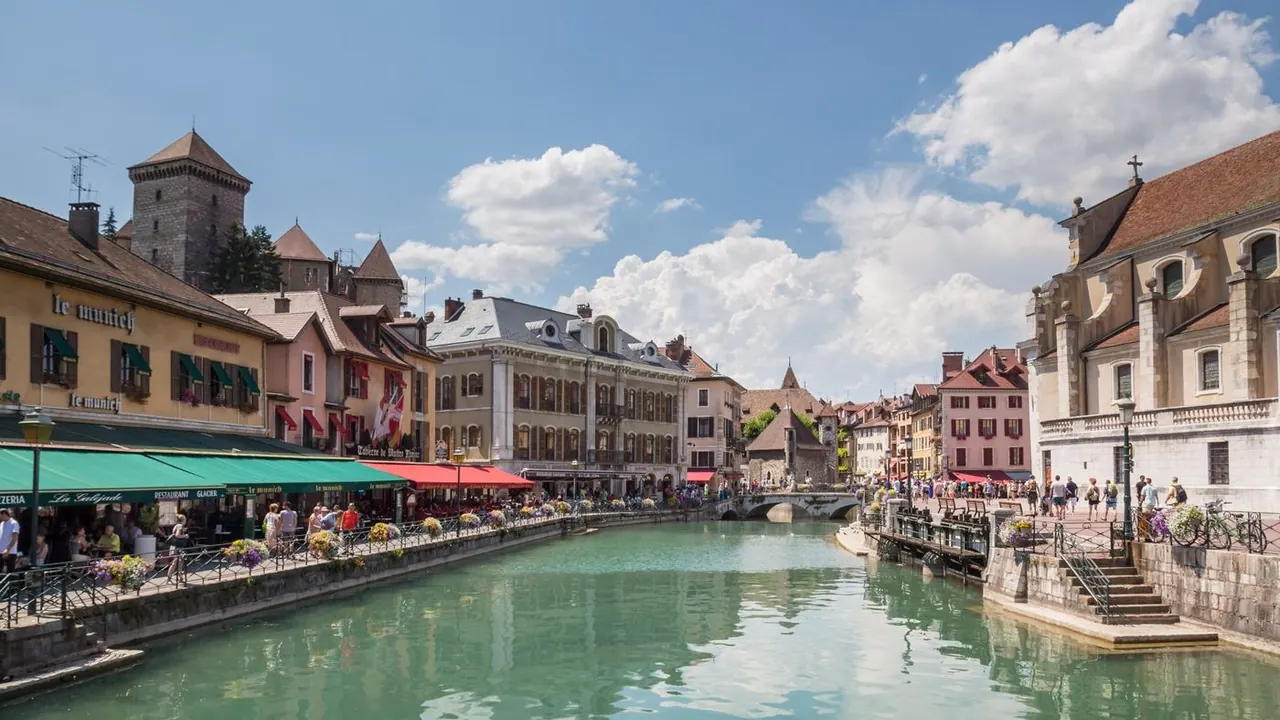
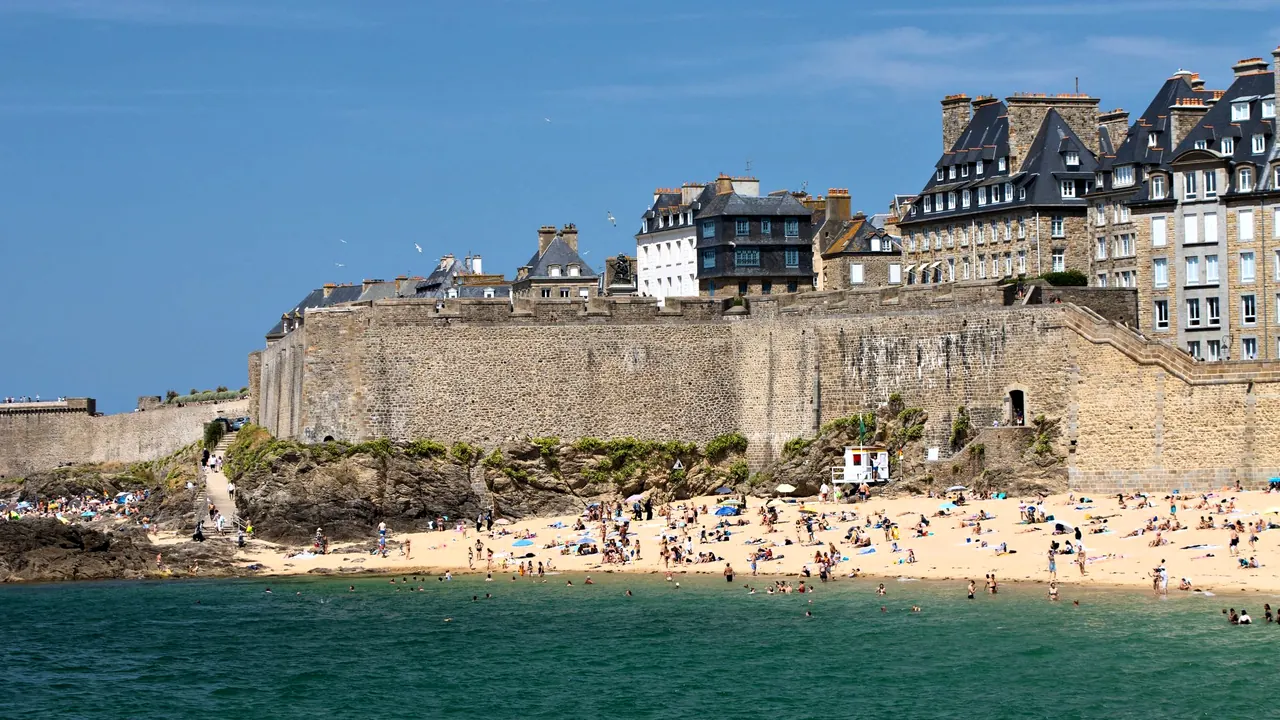
Photos: Annecy by Dmitry A. Mottl, CC BY-SA 4.0, cropped; Saint-Malo by Efrem Efre, Pexels License.
Annecy or Saint-Malo?
Our verdict in twelve categories, each scored against the same fixed benchmark cities, and the climate month by month, so you can choose for your trip.
Choose Annecy for
- nature and the outdoors
- live music and the arts
- beaches
Annecy suits travellers who want mountains and warm, clear water in the same place. Hiking trails start at the edge of town, paragliders launch above Talloires, and in high summer the lake is warm enough for long swims. It is also the better pick if you want a theatre or dance programme on a weeknight. In exchange you get a small old town, rich Savoyard food and prices pushed up by nearby Geneva.
Choose Saint-Malo for
- wellness
- day trips
- prices
Saint-Malo is for people who would rather have the sea, the tides and a long list of outings. The town's best moments are walking the ramparts, crossing to the island forts at low tide and eating oysters at Cancale. Mont-Saint-Michel, Dinan and Dinard are close by, and its seawater spas make an off-season break of real rest possible. The trade-off is a cold Channel, gentler countryside and a cultural life that mostly comes alive during its festivals.
Scoreboard
Twelve categories on one fixed scale from 0 to 100. The shaded stretch is the gap between the two.
Your match
Pick a travel style or drag the sliders, and both match scores follow your weighting.
Too close to call, 1 point apart
Wins on nature and the outdoors and live music and the arts with your weighting.
Wins on wellness and day trips with your weighting.
What matters to you?
Category by category
What the scores mean for a trip.
Beaches & swimming
These two are about level for swimming, but the water is very different. Annecy's lake is clear, warm enough by July for long swims, and the swimming spots are grassy lawns with jetties and a little shingle, in town and in villages such as Talloires.
Saint-Malo has proper sand, including a long beach that starts right below the walls. Its tides double the size of the beaches and fill the sea pool at Bon-Secours. The Channel is cold, though, so most people take a quick dip and spend the rest of the day on the sand.
Food & drink
The two are evenly matched, and both have narrow menus built on regional cooking. In Annecy that means Alpine cheese: fondue, tartiflette and lake fish with Savoie whites. The arcaded market mornings are the highlight.
Saint-Malo cooks from the sea: buckwheat galettes with cider, mussels, and oysters eaten by the harbour wall at Cancale. In both towns the touristy centre is the weakest place to eat. The better tables are in the lake villages around Annecy and in Saint-Servan and towards Cancale.
Culture & sights
Neither town has much in the way of serious museums, and in each the old town is the sight. Annecy is about canals and pastel houses around the Palais de l'Isle, with the château museum above, and an unhurried day covers it.
Saint-Malo has a little more to fill a day. You can walk the full circuit of the granite ramparts, cross to Chateaubriand's grave on the Grand Bé at low tide, see the Solidor Tower and visit the shipowners' malouinières in the countryside. Its corsair history is told more in the streets than in exhibitions.
Nightlife
Both towns are equally quiet after dark, so going out mostly means a drink after dinner. Annecy has canal-side terraces and lakeside wine, while Saint-Malo has pubs and Irish-style bars inside the walls, kept busy by sailors in summer. For clubs you would head to Geneva or Lyon from Annecy and to Rennes from Saint-Malo.
Nature & outdoors
This is where Annecy pulls well ahead. Mountains rise straight from the lake, and trails up Mont Veyrier, the Semnoz or the Tournette start almost from town. The Col de la Forclaz is one of Europe's great paragliding launch sites, and the lake suits paddleboards and sailing boats. In winter the Aravis ski slopes are under an hour away.
Saint-Malo's outdoors are on a smaller scale but still distinctive. The GR34 coastal path runs to Pointe du Grouin and the cliffs of Cap Fréhel, the tides are among the largest in Europe, and the Rance suits kayaks and bikes. Inland, though, there are no hills to climb.
Day trips
Saint-Malo has the stronger list, led by Mont-Saint-Michel about an hour east. Medieval Dinan is half an hour up the Rance, Dinard is a boat ride across the estuary, and Rennes is close by train. In summer you can also take a ferry to Jersey.
Annecy's best outings go in other directions. Geneva is under an hour away, Chamonix sits under Mont Blanc, and Chambéry and Aix-les-Bains are short train rides south. For both towns, a car makes many of these trips much easier.
Good for families
Both towns are safe and easy with children, and their summers suit different ages. Annecy is built around the lake, with pedal boats, flat lakeside lawns and a shoreline cycle path, plus summer toboggan runs and treetop courses in the hills. It has no attractions built specifically for children.
Saint-Malo appeals to children who like pirate stories. They can build sandcastles, jump into the Bon-Secours sea pool and walk out to the island forts, and the Grand Aquarium is there for wet days. Parents need to keep a close eye on the fast-rising tides and the cold water.
Getting around
The two are level here, and both are small enough that you rarely need transport within town. In Annecy you get around by bike and boat. The shoreline path makes cycling to the southern villages an easy outing, and summer boats link the villages around the lake. The mountains are another matter, because trailheads and passes are hard to reach without a car. Anyone coming mainly to hike or climb will probably want to hire one.
Saint-Malo connects better with the wider world. Direct high-speed trains reach Paris and Rennes, so a car-free trip is realistic, and the passenger boat to Dinard means that crossing the estuary is part of the fun. The beach, the walls and Saint-Servan are all within walking distance, so a car only matters for outings to places like Mont-Saint-Michel, and in summer it is more trouble than help near the ramparts.
Shopping & style
Shopping is limited in both towns and is mostly about food to take home. In Annecy that means Savoyard cheese, sausages, génépi and honey from the markets, plus cutlery shops and outdoor gear around Rue Sainte-Claire. Saint-Malo offers striped sailor tops, salted-butter caramels, cider and faience. For serious shopping you would go to Geneva from Annecy and to Rennes from Saint-Malo.
Affordability
Both are priced as resorts, but Saint-Malo is a little easier on the budget. A galette and cider or a set lunch keeps meals affordable, and prices fall noticeably in spring and autumn.
Annecy stays expensive all year because wealthy Geneva is so close, and eating out costs what it does in prosperous French resorts. What softens the bill there is that the lake beaches, cycle path and mountain trails are all free.
Live music & performing arts
Annecy has the more dependable programme. Bonlieu, its national stage by the lake, runs contemporary theatre, dance, circus and concerts through the season, and summer adds a classical festival and the Fête du Lac fireworks.
Saint-Malo's town theatre has a modest season, with occasional concerts in the cathedral. Most of its cultural life comes in festival bursts: La Route du Rock for indie music, Étonnants Voyageurs for books and Quai des Bulles for comics. Outside those dates there is little on most nights.
Wellness & relaxation
Saint-Malo is the better place for a restorative break, thanks to its thalassotherapy tradition. The seafront centre on the Sillon beach has heated seawater pools and hydrotherapy, and a quiet off-season weekend there combines low-tide walks with afternoons in the water.
Annecy relies on its slow pace and a few hotel spas in calm lakeside spots around Talloires and Veyrier. For proper thermal bathing you have to make the short trip to Aix-les-Bains or Saint-Gervais.
When should you go?
Pick your month. The climate figures are measured averages, not a forecast.
Annecy in July
Saint-Malo in July
Daytime high, °C
Rainfall in the month, mm
Where the figures come from
Annecy has no rain gauge within 25 km of the centre, so its rainfall comes from a gridded climate dataset read at the city rather than from a gauge further away.
Annecy's sunshine is measured 39 km from the centre, at Geneve-Cointrin.
Saint-Malo has no rain gauge within 25 km of the centre, so its rainfall comes from a gridded climate dataset read at the city rather than from a gauge further away.
Saint-Malo's sunshine is measured 68 km from the centre, at Rennes.
Temperature and rainfall are climate normals, averaged over the years shown. Annecy: 2007-2020 (sunshine 1991-2020, rainfall 1991-2020) normals, Annecy / Metz-Tessy (4.4 km from centre). Saint-Malo: 2002-2020 (sunshine 1991-2020, rainfall 1991-2020) normals, Dinard (7.9 km from centre).
Annecy has the bigger swings. July reaches about 27°C, with the most sunshine of either town, and that brings the lake to bathing temperature from late June to early September. Winter is properly cold at around 5°C, though the Aravis ski resorts nearby make up for it. Rain falls fairly evenly through the year and is heaviest from September to December. Late spring and September are the best months for walking and hiking without the midsummer heat.
Saint-Malo stays mild all year. Summer days peak at about 22°C, a good temperature for walking the walls but rarely hot, and the sea never gets much past 18°C, even in August and September. Its summers are also drier than Annecy's, at around 45mm a month. The rain comes from October to December. In winter Saint-Malo is the milder of the two and gets a little more sun, so it holds up better as an off-season break.
Which traveller are you?
On a beach and sun trip, Annecy has the edge. Its summers are warmer and sunnier, and by July the lake is warm enough to swim in for as long as you like. In Saint-Malo the beaches are wide and sandy, but the Channel stays cold.
For an outdoors trip, Annecy is the clear choice. It has mountain hikes from town, paragliding from the Col de la Forclaz, paddling and sailing on the lake and Alpine passes for cyclists. Saint-Malo's coastal path and kitesurfing are good, but the land behind them is flat farmland.
On a relaxing and wellness trip, Saint-Malo does better. Its seafront thalassotherapy centre offers heated seawater pools and treatments, and outside summer you can walk the empty sand at low tide. Annecy's calm comes mostly from its slow pace and a few lakeside hotel spas.
Before you go
| Measure | Annecy | Saint-Malo |
|---|---|---|
| Official language | French | French |
| Currency | Euro (EUR) | Euro (EUR) |
| Sockets | CE230 V, 50 Hz | CE230 V, 50 Hz |
| Driving side | Right | Right |
| Time zone | UTC+1, UTC+2 in summer | UTC+1, UTC+2 in summer |
| Emergency number | 112 | 112 |
| Elevation | 418 m | 0 m |
| Main airport | Geneva International Airport (GVA)38 km from centre150 non-stop destinations | Rennes-Saint-Jacques Airport (RNS)68 km from centre15 non-stop destinations |
| Public holidays this year | 11 days | 11 days |
By the numbers
| Measure | Annecy | Saint-Malo |
|---|---|---|
| City population | 132,117 | 47,439 |
| People per km² | 1,975 | 1,296 |
| Museums within 10 km | 1 | 3 |
| UNESCO World Heritage sites within 50 km | 2 | 2 |
| Swim season, months above 21 °C | - | None |
Where else could you go?
Every comparison below shares a destination with this one, so you can follow Annecy or Saint-Malo somewhere new.