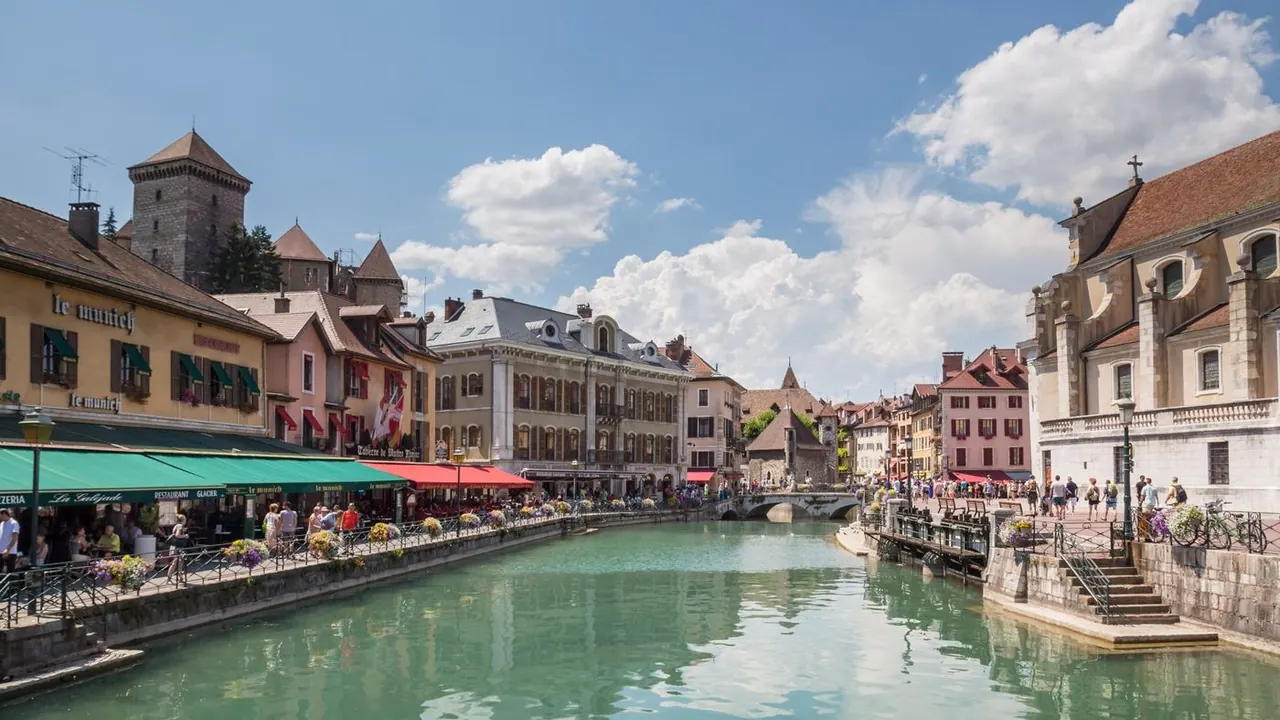
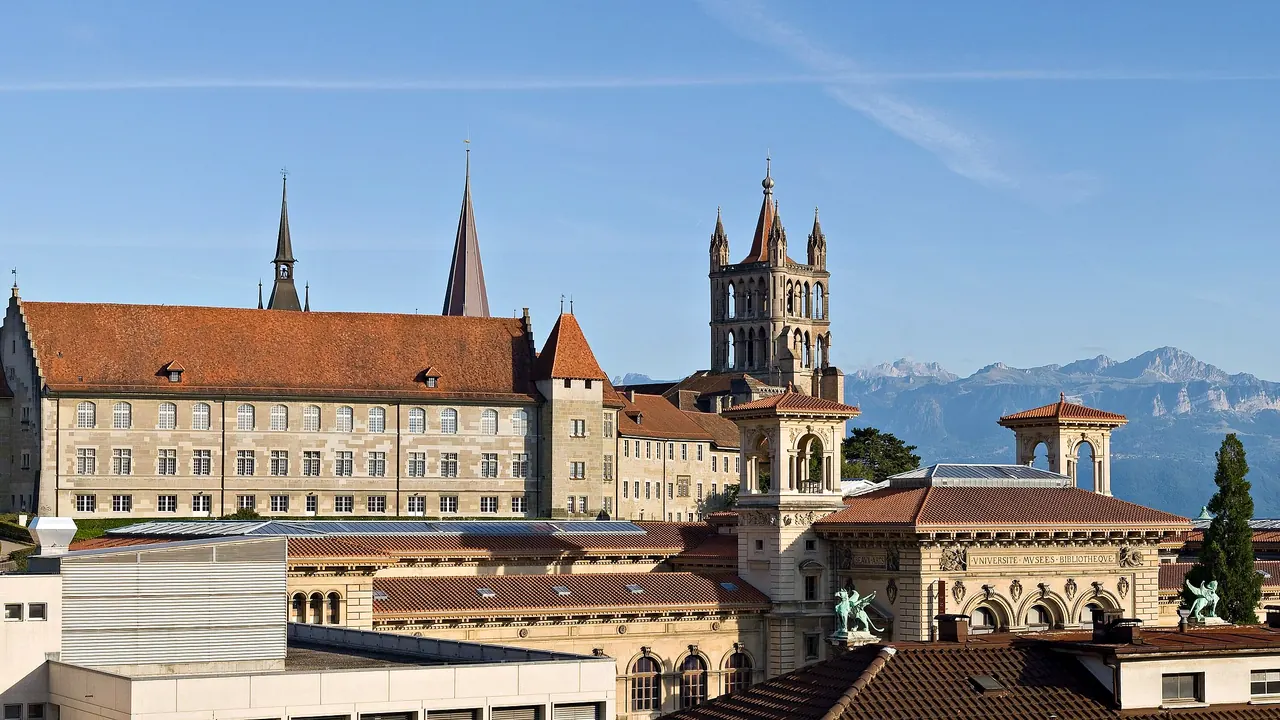
Photos: Annecy by Dmitry A. Mottl, CC BY-SA 4.0, cropped; Lausanne by Christian Mehlführer, CC BY-SA 3.0, cropped.
Annecy or Lausanne?
Our verdict in twelve categories, each scored against the same fixed benchmark cities, and the climate month by month, so you can choose for your trip.
Choose Annecy for
- prices
- beaches
- nature and the outdoors
Annecy suits travellers who want the mountains and the lake to be the whole point of the trip. Trails start at the edge of town, paragliders launch above Talloires, and in high summer the lake is warmer and better set up for swimming than its Swiss neighbour. It is also the cheaper of the two by a clear margin, though still not cheap. The trade-off is a small old town that takes a day to see, quiet evenings, and a stage programme that sends anyone keen on opera or ballet off to Geneva or Lyon.
Choose Lausanne for
- live music and the arts
- culture and sights
- nightlife
Choose Lausanne for a fuller city stay with excellent trains. The Olympic Museum, Plateforme 10 and the Gothic cathedral give it more to see indoors, the Flon gives it real weekend nights, and the Béjart Ballet and the Théâtre de Vidy make its stage life serious. Vevey, Montreux, Bern and Gruyères are all a short train ride away without a car. Expect to pay Swiss prices for all of it, and expect steep streets between the lake and the upper town.
Scoreboard
Twelve categories on one fixed scale from 0 to 100. The shaded stretch is the gap between the two.
Your match
Pick a travel style or drag the sliders, and both match scores follow your weighting.
Wins on prices and beaches with your weighting.
Wins on live music and the arts and culture and sights with your weighting.
What matters to you?
Category by category
What the scores mean for a trip.
Beaches & swimming
Neither city has sand or surf, but Annecy makes the better summer bathing spot. Its lake is clearer and a touch warmer, and as well as the grassy town beaches at Albigny and the Marquisats there are village beaches all round the shore at Sevrier, Talloires and Doussard.
Lausanne swims from a narrower waterfront of lawns, piers, concrete steps and shingle at Vidy and towards Lutry. The Bellerive lido with its pools is the highlight, but bathing there is something you fit around a city stay, not a reason to go.
Food & drink
The two are close at the table, and the difference is mainly the wine. Annecy cooks hearty Savoyard cheese dishes and lake féra, with Apremont and Chignin to drink, and its old-town market mornings are the highlight. Its canal-side terraces can be repetitive, so the better cooking is out in the lake villages.
Lausanne serves Vaudois perch fillets and papet, but its real asset is Lavaux Chasselas, which you can taste with the growers in the caveaux just east of town. Both have a strong high-end tier and a rather ordinary middle.
Culture & sights
Lausanne has more to see. The carved Gothic cathedral with its night watchman crowns a steep old town, and below it the Olympic Museum at Ouchy and the cluster of museums at Plateforme 10 can fill two or three days.
Annecy's heritage is prettier but much smaller: the canals, the island Palais de l'Isle and the château museum above it. You can see it all in one unhurried day, and the town relies on its looks more than its collections.
Nightlife
Lausanne goes out more. Its large student population fills the clubs and late bars in the old warehouses of the Flon on Friday and Saturday nights, and it is quiet on weeknights.
Annecy's evenings are about a drink by the canal or the lake, with a couple of small clubs and a town that winds down by midnight outside summer. To party properly from Annecy, you go to Geneva or Lyon.
Nature & outdoors
Annecy comes out ahead, and much of its outdoors needs no transport at all. You can set off on foot from your hotel and be climbing above the lake within the hour, or save a whole day for the Semnoz ridge or the wilder Bauges park to the south. The lake adds rowing and sailing, the old railway line along the western shore gives a flat, easy ride, and on fine days paragliders circle over Talloires. In winter the Aravis slopes and the Mont Blanc massif take over.
Lausanne's outdoors mostly begins at the station, and it suits walkers and skiers more than anyone after thrills in the air or on the water. The classic outing is the vineyard path through terraced Lavaux from Lutry to Saint-Saphorin. Further out, the Vaud Alps have skiing and the ice of Glacier 3000, and the Jura ridges have long hikes and cross-country trails, often in sunshine above the winter fog. The lake view across to the French Alps is a constant backdrop, even if you rarely get your feet on a summit from town.
Day trips
Lausanne is the better base for day trips, mainly because the Swiss trains do the work. Montreux and the Château de Chillon, Bern's arcaded old town, Fribourg, Gruyères and Neuchâtel are all easy without a car, and boats cross the lake to Évian.
Annecy's outings are good but more spread out. Geneva, Chambéry and Aix-les-Bains are close, and Yvoire and Chamonix make strong days out, but many of them are much easier with a car.
Good for families
Lausanne has a slight edge with children because it has more attractions built for them. There is the hands-on Olympic Museum, the aquarium-vivarium, and the animal park and lookout tower at Sauvabelin, though the steep streets are hard with a pushchair.
Annecy is flatter and gentler, with pedal boats, lake beaches and summer toboggan runs. It has no zoo, aquarium or theme park, though, and outside summer there is less to keep children busy.
Getting around
Lausanne is easier to get around, even with its hills. The m2 metro climbs from the lakeshore at Ouchy to the upper town, and the main station connects you to the whole Swiss network, so a car is rarely needed.
Annecy's centre is flat and walkable, and a bike path follows the western shore. Once you head for trailheads, passes or Chamonix, though, most visitors find a hire car simpler, and summer traffic around the lake can be slow.
Shopping & style
Neither city is a shopping destination, but Lausanne offers a little more. Rue de Bourg has Swiss watches, jewellery and chocolatiers, and the Flon adds a few design shops among the chains.
Annecy's best buys are edible: Reblochon, sausages, génépi and honey from the market stalls, plus cutlery shops and outdoor gear around Rue Sainte-Claire. Serious shoppers in either city end up in Geneva.
Affordability
Annecy is expensive for a French town of its size, with resort rates in summer, but Lausanne is in another league. Swiss prices make hotels, meals, wine and taxis costly, and even a simple lunch adds up.
In both places the lakeside, parks and trails are free. A budget in Annecy simply goes much further, especially in the shoulder seasons or with a self-catering flat.
Live music & performing arts
Lausanne is the clear choice for evenings at the theatre. It is home to the Béjart Ballet and the Prix de Lausanne, it has the Théâtre de Vidy for contemporary work, a full opera season and a respected chamber orchestra, and the Montreux Jazz Festival is close by in July.
Annecy relies on Bonlieu, its lakeside national stage for theatre, dance and circus, plus a summer classical festival and the Fête du Lac fireworks in August. For opera or a major orchestra, you have to travel.
Wellness & relaxation
For a restful trip the two are much alike, and the difference lies in the setting and the spas. Annecy's calm comes from slow lake-village days and hotel spas around Talloires, with thermal baths at Aix-les-Bains or Saint-Gervais within reach.
Lausanne has grand lakeside hotel spas and a name for private clinics and retreats. Yverdon-les-Bains and the hot springs of Lavey are easy by train, but the steep centre itself is less soothing than its quiet edges.
When should you go?
Pick your month. The climate figures are measured averages, not a forecast.
Annecy in July
Lausanne in July
Daytime high, °C
Rainfall in the month, mm
Where the figures come from
Annecy has no rain gauge within 25 km of the centre, so its rainfall comes from a gridded climate dataset read at the city rather than from a gauge further away.
Annecy's sunshine is measured 39 km from the centre, at Geneve-Cointrin.
Lausanne's temperatures are measured 40 km from the centre, at Payerne.
Lausanne has no rain gauge within 25 km of the centre, so its rainfall comes from a gridded climate dataset read at the city rather than from a gauge further away.
Temperature and rainfall are climate normals, averaged over the years shown. Annecy: 2007-2020 (sunshine 1991-2020, rainfall 1991-2020) normals, Annecy / Metz-Tessy (4.4 km from centre). Lausanne: 1991-2020 (sunshine 1961-1990) normals, Payerne (39.7 km from centre).
The two cities share the same sunshine pattern through the year, brightest from June to August and dim from November to January, so the difference lies in warmth and rain. Annecy runs a degree or so warmer in most months and peaks around 27°C in July, against Lausanne's 26°C. Summer is where they part most. Annecy's July and August are among its drier months, while Lausanne gets its heaviest rain in June and July, around 115mm, so lake days there come with more showers. For swimming, late June to early September works in both.
For walking the streets and the trails, May, June and September are the comfortable months in each city, warm without the summer peak. Winters are cold in both, with Lausanne's highs only around 4°C in December and January and the town often under grey fog, while Annecy's autumn turns wet from September onwards. In winter, both cities are best used as bases for the ski resorts rather than for sightseeing.
Which traveller are you?
On a trip on a tight budget, Annecy is the easier choice. It is expensive for France, but rooms and meals cost far less than in Swiss Lausanne, and its lake beaches, cycle path and mountain trails are free. Self-catering in the shoulder seasons stretches money further.
For a culture and arts trip, Lausanne is clearly stronger. It has the Olympic Museum, the fine arts, photography and design museums at Plateforme 10, the Collection de l'Art Brut, and a stage life led by the Béjart Ballet, the Opéra and the Théâtre de Vidy.
On an outdoors trip, Annecy has the edge. Mont Veyrier and the Tournette rise straight from the shore, the Col de la Forclaz is a famous paragliding launch, and the lake suits kayaks and paddleboards. Lausanne's Lavaux and Vaud Alps are superb but further out.
Before you go
| Measure | Annecy | Lausanne |
|---|---|---|
| Official language | French | French, German, Italian, Romansh |
| Currency | Euro (EUR) | Swiss Franc (CHF) |
| Sockets | CE230 V, 50 Hz | CJ230 V, 50 Hz |
| Driving side | Right | Right |
| Time zone | UTC+1, UTC+2 in summer | UTC+1, UTC+2 in summer |
| Emergency number | 112 | 112 |
| Elevation | 418 m | 495 m |
| Main airport | Geneva International Airport (GVA)38 km from centre150 non-stop destinations | Geneva International Airport (GVA)52 km from centre150 non-stop destinations |
| Public holidays this year | 11 days | 9 days |
By the numbers
| Measure | Annecy | Lausanne |
|---|---|---|
| City population | 132,117 | 144,873 |
| People per km² | 1,975 | 3,499 |
| Museums within 10 km | 1 | 31 |
| UNESCO World Heritage sites within 50 km | 2 | 3 |
Where else could you go?
Every comparison below shares a destination with this one, so you can follow Annecy or Lausanne somewhere new.
- Genevavs Annecy
- Genevavs Lausanne
- Chamonixvs Annecy
- Chamonixvs Lausanne
- Bernvs Lausanne
- Interlakenvs Lausanne