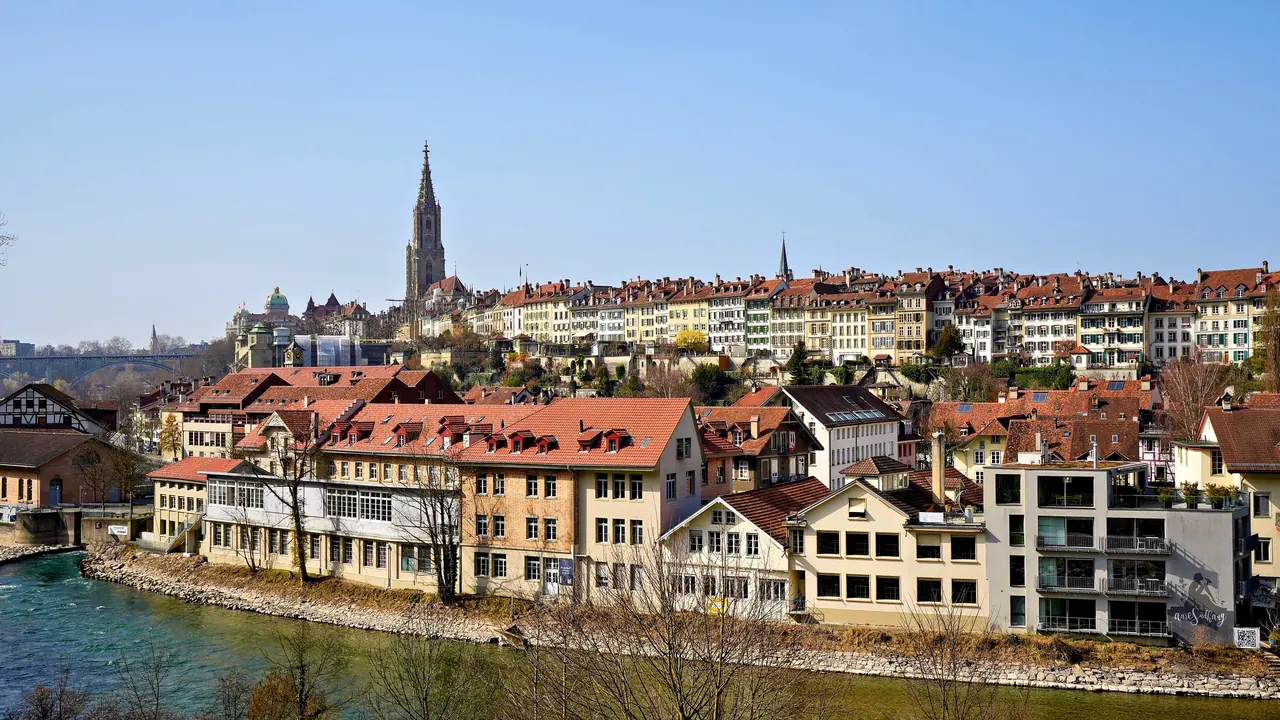
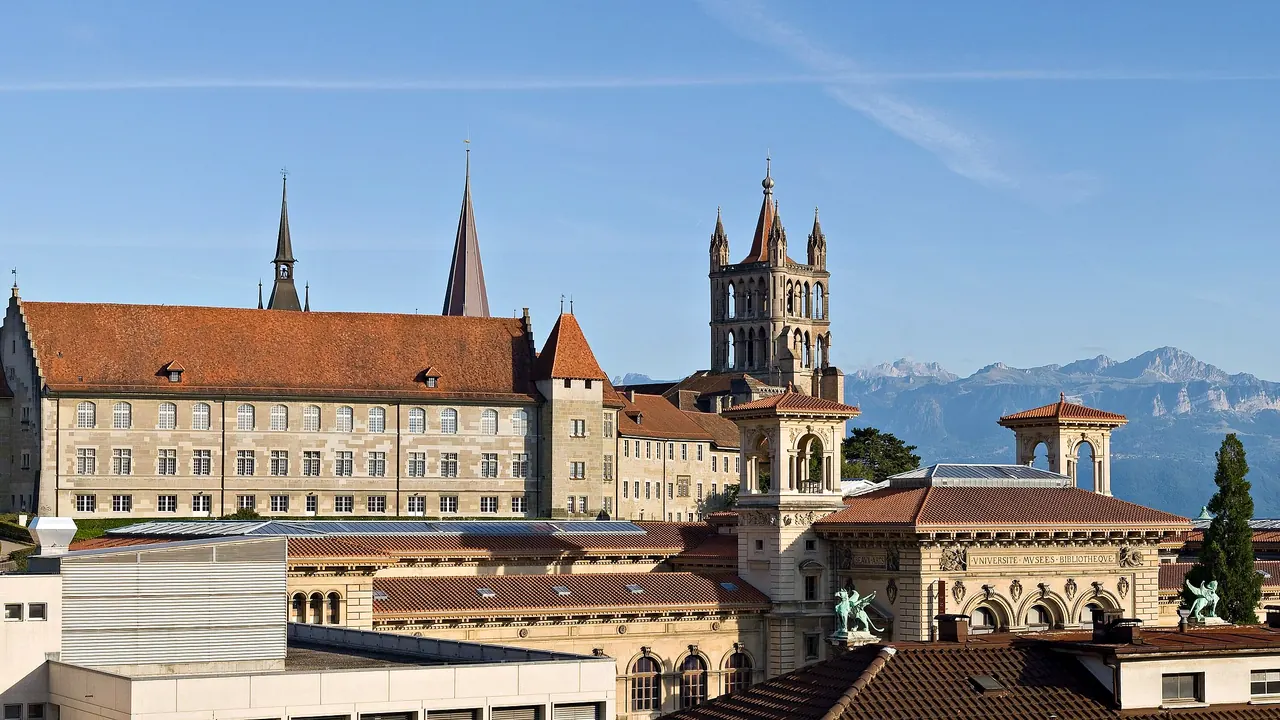
Photos: Bern by Beat Bieri, Pexels License; Lausanne by Christian Mehlführer, CC BY-SA 3.0, cropped.
Bern or Lausanne?
Our verdict in twelve categories, each scored against the same fixed benchmark cities, and the climate month by month, so you can choose for your trip.
Choose Bern for
- getting around
- culture and sights
- shopping
Bern suits the traveller who wants a city that is a pleasure simply to walk through. Its arcaded old town on the loop of the Aare is the finer historic townscape of the two, and the museums, from Paul Klee to Einstein's flat, are strong for a small capital. The centre is flat enough and compact enough to cover on foot, and the station sits right at its top. That makes Bern the easier choice for a short, unhurried stay, or for a week of rail trips into German-speaking Switzerland and the Jungfrau region.
Choose Lausanne for
- food and drink
- live music and the arts
- nightlife
Choose Lausanne if your evenings matter as much as your days. The food is better, built around lake perch and the Chasselas from the Lavaux terraces, and the Flon gives it a livelier night out than Bern. The stage is more serious too, led by ballet and the Théâtre de Vidy. You give up some ease, because the city climbs a steep hillside. In return you get Lake Geneva at your feet, the vineyard walks just east of town and the Riviera towns along the shore.
Scoreboard
Twelve categories on one fixed scale from 0 to 100. The shaded stretch is the gap between the two.
Your match
Pick a travel style or drag the sliders, and both match scores follow your weighting.
Too close to call, 1 point apart
Wins on getting around and culture and sights with your weighting.
Wins on food and drink and live music and the arts with your weighting.
What matters to you?
Category by category
What the scores mean for a trip.
Beaches & swimming
Neither city has a beach, and summer swimming is equally modest in both. What differs is the water. In Bern you walk up the Aare from the Marzili, jump in and let a cold, fast current carry you back past the Federal Palace. That is a thrill for confident swimmers, and calmer bathing means the train to Lake Thun.
Lausanne swims in Lake Geneva itself, from lawns, piers and pebble shores at Vidy and Bellerive, in still water that runs a degree or two warmer. It is gentler and more of a lazy afternoon than Bern's river float.
Food & drink
Lausanne eats noticeably better. Its Vaudois cooking, with lake perch fillets and papet vaudois, comes with Chasselas from the Lavaux terraces, which you can taste straight from the growers in village caveaux. The area also has some of Switzerland's most celebrated top-end tables.
Bern's table is heavier and more traditional: the Berner Platte, rösti and veal in cream, served in guildhall rooms and arcade cellars. It has excellent chocolate, Emmental cheese at the markets and the Zibelemärit in November, but the range stays that of a small city.
Culture & sights
Bern has the stronger sightseeing, and most of it lies in the streets. The entire old town on its river loop is a UNESCO site, with some 6km of arcades, painted fountains, the Zytglogge and the Minster. Add the Zentrum Paul Klee, the Kunstmuseum and Einstein's flat, and two days are well filled.
Lausanne works the other way round. Its Gothic cathedral and steep old lanes are attractive, but the museums carry the visit: the Olympic Museum at Ouchy, the Plateforme 10 cluster by the station and the strange, memorable Collection de l'Art Brut.
Nightlife
Lausanne is the better night out. Its students fill the Flon, a former warehouse valley where clubs, late bars and terraces stack up in old industrial buildings, and on summer evenings people crowd the lakeside at Ouchy.
Bern is more subdued. Weekend drinking happens in vaulted cellar bars and along Aarbergergasse, and the Reitschule is the one place for rough-edged late parties. Both cities go quiet on weeknights, but Bern goes quiet earlier.
Nature & outdoors
Both are superb outdoor bases with different scenery. From Bern the Eiger, Mönch and Jungfrau fill the horizon and are about an hour away by train for high hiking, cable cars and skiing. Closer in are the Gurten, the wooded Aare paths and the farmland of the Emmental.
Lausanne's landscape is lake and vines: the walk through the Lavaux terraces from Lutry to Saint-Saphorin, plus sailing and paddleboarding on the water. The Vaud Alps at Villars and Les Diablerets, and the glacier at Glacier 3000, give it mountains within the hour as well.
Day trips
Bern looks north and east into German-speaking Switzerland, while Lausanne looks west along the lake into the French-speaking part. From Bern, Lucerne, Basel and Zurich are each about an hour by train, with Thun and baroque Solothurn closer still.
From Lausanne, Vevey, Montreux and the Château de Chillon line the shore, Geneva is under an hour away and boats cross to Évian in France. Between the two lie Fribourg, Gruyères, Murten and Neuchâtel, easy from either city, and each city is a good day out from the other.
Good for families
Both are safe, clean and relaxed with children. The outings differ. Bern has its bear park, the riverside Dählhölzli zoo and the playground at the top of the Gurten funicular, but no aquarium. Its river is for strong swimmers only, so children paddle in the lido pools.
Lausanne offers the hands-on Olympic Museum, an aquarium-vivarium, pedal boats at Sauvabelin and paddle steamer trips, and the calm lake water suits young swimmers better. Its steep streets are much harder going with a pushchair than Bern's centre.
Getting around
Bern is the easier city to move around. You can walk the whole old town from the station to the bear park in about twenty minutes, under arcades if it rains. Only the streets dropping to the Aare are steep, and short funiculars and a lift handle those.
Lausanne is compact too, but it rises in steep layers from the lake to the cathedral. The m2 metro carries you up more than 300m and saves the effort, but walking between levels means stairs and real climbs.
Shopping & style
Bern's shopping runs under cover in one straight line, from Spitalgasse to Kramgasse, with watches, chocolate, chains and a long-established department store near the station. The best of it is further down. The cellar shops on Gerechtigkeitsgasse, reached by steep steps from the pavement, sell antiques, books, design and crafts.
Lausanne's main street, by contrast, climbs. Rue de Bourg leans towards watches, jewellery and fashion brands, and the Flon below adds chains and a few design shops. There are fewer independent finds than in Bern's cellars, but Lausanne has the better souvenir to take home: a bottle of Lavaux wine.
Affordability
Both are among the most expensive cities in Europe, and neither offers real savings over the other. The ways to soften the bill differ a little. In Bern hotels usually include a local transport pass, and the bear park, the river paths and the Federal Palace tours are free.
In Lausanne the free pleasures are the lakeside promenades and parks. A glass of Chasselas in a Lavaux caveau is good value for what you get.
Live music & performing arts
Lausanne has much the richer stage. Dance leads, with the Béjart Ballet and the Prix de Lausanne. The lakeside Théâtre de Vidy produces contemporary work that tours Europe, and the opera and the chamber orchestra are well regarded. In July the Montreux Jazz Festival is a short train ride away.
Bern offers solid evenings rather than a reason to travel: German-language opera and drama at the Stadttheater, its symphony orchestra at the Casino, new dance at the Dampfzentrale, a spring jazz festival and the Gurtenfestival in July.
Wellness & relaxation
Both cities are equally good for slowing down, though the calm sits in different places. In Bern it is the centre itself, with unhurried arcades, quiet Sundays and long riverside lunches. A thermal complex on the western edge covers spa time, and serious retreats mean mountain hotels in the Oberland.
In Lausanne the calm is on the edges, along the lakefront and in the vineyards. Its advantage is thermal water within easy reach, at Yverdon-les-Bains and at Lavey-les-Bains, which has Switzerland's hottest springs, plus the spas of the grand lakeside hotels.
When should you go?
Pick your month. The climate figures are measured averages, not a forecast.
Bern in July
Lausanne in July
Daytime high, °C
Rainfall in the month, mm
Where the figures come from
Bern has no rain gauge within 25 km of the centre, so its rainfall comes from a gridded climate dataset read at the city rather than from a gauge further away.
Bern's sunshine is measured 41 km from the centre, at Payerne.
Lausanne's temperatures are measured 40 km from the centre, at Payerne.
Lausanne has no rain gauge within 25 km of the centre, so its rainfall comes from a gridded climate dataset read at the city rather than from a gauge further away.
Temperature and rainfall are climate normals, averaged over the years shown. Bern: 2010-2020 (sunshine 1961-1990, rainfall 1991-2020) normals, Bern / Bern - Belp Airport (5.5 km from centre). Lausanne: 1991-2020 (sunshine 1961-1990) normals, Payerne (39.7 km from centre).
Through the year the two cities have almost the same temperatures. Summer days peak around 26°C in July and August, which is warm enough for river or lake swimming from about June to early September. Spring and autumn are mild and good for walking the old towns. In midwinter highs sit near 5°C, and both cities lie under grey skies while the mountains above are often in sun. Lausanne gets a little more sunshine from spring through summer, so its lakefront evenings are slightly brighter.
Rain falls differently. Bern's wettest months are May to August, at up to 118mm, and its winters are noticeably drier. Lausanne's rain is spread more evenly, with late autumn and winter months at around 100mm, so it is the damper of the two between October and December. For a summer trip Lausanne has the edge in sun. For a winter visit Bern stays drier, and its arcades keep you under cover anyway.
Which traveller are you?
For a short city break, Bern is the easier choice. The station sits at the top of the old town, so you step off the train straight into the arcades. You can walk the centre end to end in twenty minutes and climb the Minster tower for the Alps.
On a food and nightlife trip, Lausanne gives you more to choose from. The Saturday market around the Riponne, the old confiseries and some of the country's top tables make for better eating. Evenings run from old-town wine bars to the summer lakefront at Ouchy.
On a culture and arts trip, Bern has the deeper daytime programme. The whole old town is the sight, the Kunstmuseum is Switzerland's oldest, and the Klee collection is a short ride east of the centre. Lausanne's main advantage comes after dark, at the ballet and the opera.
Before you go
| Measure | Bern | Lausanne |
|---|---|---|
| Official language | French, German, Italian, Romansh | French, German, Italian, Romansh |
| Currency | Swiss Franc (CHF) | Swiss Franc (CHF) |
| Sockets | CJ230 V, 50 Hz | CJ230 V, 50 Hz |
| Driving side | Right | Right |
| Time zone | UTC+1, UTC+2 in summer | UTC+1, UTC+2 in summer |
| Emergency number | 112 | 112 |
| Elevation | 542 m | 495 m |
| Main airport | Zürich Airport (ZRH)101 km from centre226 non-stop destinations | Geneva International Airport (GVA)52 km from centre150 non-stop destinations |
| Public holidays this year | 10 days | 9 days |
By the numbers
| Measure | Bern | Lausanne |
|---|---|---|
| City population | 136,988 | 144,873 |
| People per km² | 2,655 | 3,499 |
| Museums within 10 km | 30 | 31 |
| UNESCO World Heritage sites within 50 km | 2 | 3 |
Where else could you go?
Every comparison below shares a destination with this one, so you can follow Bern or Lausanne somewhere new.