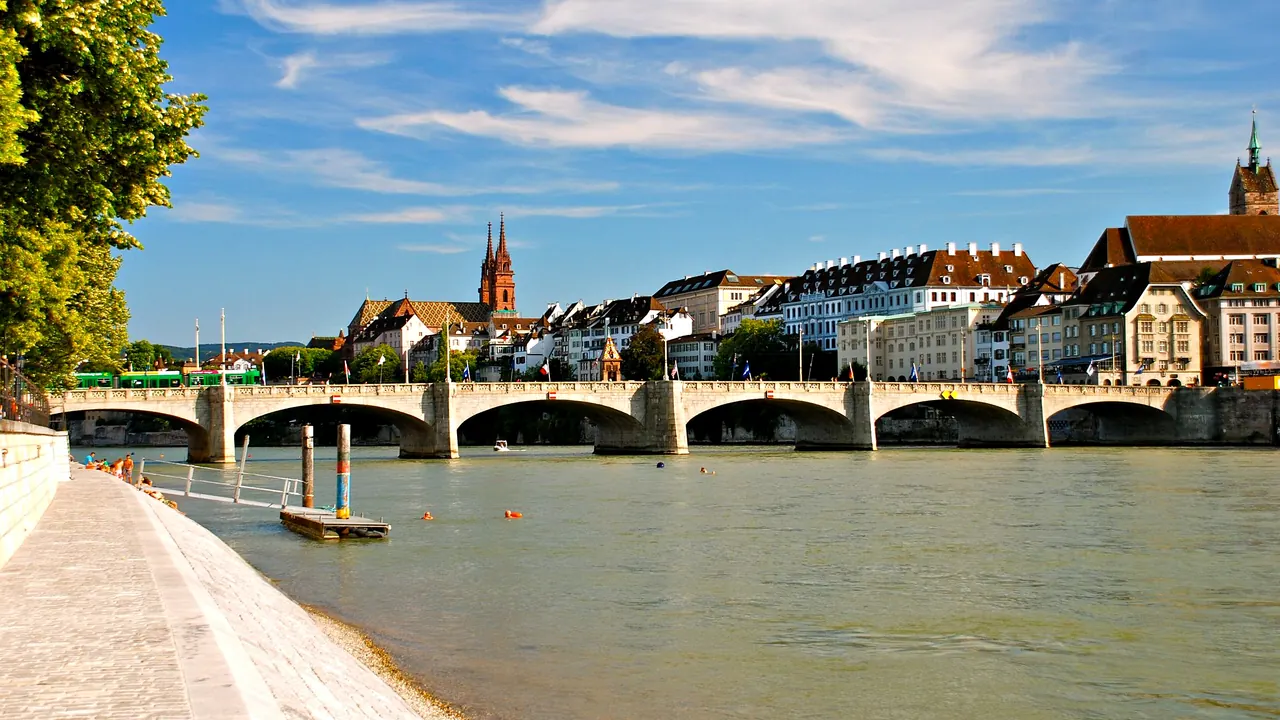
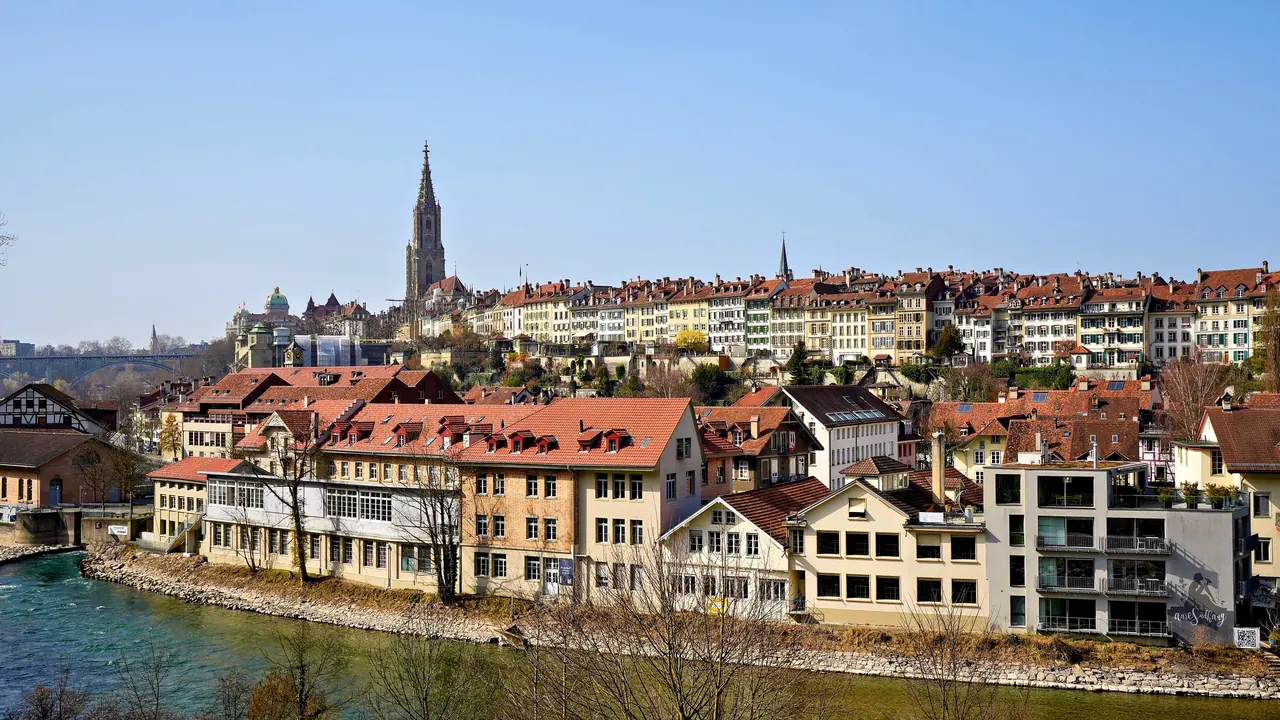
Photos: Basel by Lucazzitto, CC BY-SA 3.0, cropped; Bern by Beat Bieri, Pexels License.
Basel or Bern?
Our verdict in twelve categories, each scored against the same fixed benchmark cities, and the climate month by month, so you can choose for your trip.
Choose Basel for
- live music and the arts
- food and drink
- culture and sights
Basel is the pick for travellers who plan their days around art and their evenings around a stage. Its museums go far deeper than a city this size would suggest, from Holbein at the Kunstmuseum to the Fondation Beyeler and the Vitra campus. Theater Basel and the Stadtcasino give it a proper classical season. Its position on the French and German borders also puts Alsatian villages and Baden wine taverns within easy reach of your table.
Choose Bern for
- nature and the outdoors
- beaches
- families
Choose Bern if the view of the Alps from the old town is what draws you. The Jungfrau region and Lake Thun are close enough for a mountain day or a lake swim without changing hotels. The UNESCO old town of arcades and fountains rewards slow walking, and two days covers the sights. It suits walkers, hikers and anyone who wants a calm Swiss base with the outdoors on its doorstep.
Scoreboard
Twelve categories on one fixed scale from 0 to 100. The shaded stretch is the gap between the two.
Your match
Pick a travel style or drag the sliders, and both match scores follow your weighting.
Too close to call, level with your weighting
Wins on live music and the arts and food and drink with your weighting.
Wins on nature and the outdoors and beaches with your weighting.
What matters to you?
Category by category
What the scores mean for a trip.
Beaches & swimming
Neither city has a beach, and both have the same summer habit: walk upstream, jump in and let the current carry you back past the old town. Bern does it a little better. The Marzili, Lorraine and Eichholz lidos add lawns, pools and showers to the Aare. Lake Thun is about twenty minutes away for calm water under the mountains.
Basel's Rhine float is just as much fun, drifting past the Münster from the gravelly Kleinbasel banks and the old wooden bathing huts. There is nothing calmer nearby, though, so anyone who wants still water has to travel further for it.
Food & drink
Basel eats better, mostly because of its neighbours. Tarte flambée and choucroute from Alsace and wines from Baden sit beside Swiss comfort food. A small but very good fine-dining tier tops the scene, and the Markthalle covers casual meals. The wine villages over the border add cheaper options.
Bern stays closer to tradition: the Berner Platte, rösti and fondue in vaulted cellars under the arcades, with Emmental cheese at the markets and very good chocolate. It is hearty and reliable but has a narrower range. Eating out is costly in both cities.
Culture & sights
Basel goes deeper. Its strength is the museums: the Kunstmuseum's historic collection, the Fondation Beyeler in its park and the Tinguely by the river, plus the Vitra Design Museum and contemporary buildings by Herzog & de Meuron. Give it three or four days.
In Bern, the old town itself is the main sight. Its 6km of arcades, its Renaissance fountains, the Zytglogge and the Minster tower make an unusually complete medieval centre. The Zentrum Paul Klee and the Einstein Museum are real draws, but two days covers the essentials.
Nightlife
Both are quiet places to go out, and the difference lies in where it happens. Basel's best evenings are outdoors in summer, on the steps by the Kleinbasel riverside kiosks. A few clubs in old harbour and industrial buildings keep electronic music going at weekends. Fasnacht, three days of drums and lanterns starting at four in the morning, has no equal in Bern.
Bern's evenings move underground, into the cellar bars below the arcades and along Aarbergergasse. The Reitschule is the place for late, rough-edged nights. On weekdays the city goes quiet early.
Nature & outdoors
Bern is far ahead. The Bernese Alps are on the skyline and within an hour by train, so a day of cable cars, high trails or skiing in the Jungfrau region is easy. Lake Thun, the Gurten funicular and the wooded Aare paths provide gentler outings, and the Emmental adds rolling farmland for cycling.
Basel's countryside is softer and spread over three countries: the Jura ridges, the Black Forest summits around the Feldberg and the Vosges. It is good for hiking and flat Rhine cycling. The real Alps are a couple of hours away, though, so mountain lovers will feel the distance.
Day trips
Both are excellent bases. Lucerne and Zurich are about an hour from either, and the two cities are an easy day trip from each other. What sets them apart is the direction. Basel faces outwards, across the borders to Colmar and the Alsace wine route, Strasbourg's cathedral and Freiburg's minster, with Roman Augusta Raurica just outside town.
Bern's trips stay inside Switzerland and cross its language border. Fribourg and Gruyères are close, as are walled Murten, Thun, Solothurn, Neuchâtel and the Lavaux vineyards above Lake Geneva.
Good for families
The zoo is where the two part ways. Basel has the Zolli, one of the best zoos in Europe and a short walk from the station, and younger children love the little Rhine ferries pulled across by the current. For a bigger outing, Europa-Park in Germany is about an hour away by car.
Bern spreads its treats around more: the bear park below the old town, the Dählhölzli zoo with free paths through its wooded enclosures, and a big playground at the top of the Gurten funicular. The Marzili lido has shallow pools, which Basel's fast Rhine cannot offer small children. Both cities are calm and safe, though Bern's steep streets up from the river make pushing a pram harder work.
Getting around
Basel's tram network reaches across two borders, while Bern's centre is small enough to cross on foot. The green trams cover all of Basel, and some lines carry on into Germany and France. The four river ferries give you a gentle way across the Rhine, and the station has direct trains into both neighbouring countries.
In Bern, the walk from the station to the bear park takes about twenty minutes, mostly under the arcades and dry even in the rain. Funiculars and a public lift handle the drop to the river, and the station sits at the top of the old town. In both cities hotel guests get a local transport pass, so you will not need a car in either.
Shopping & style
Neither is a shopping destination, and both stick to watches, chocolate and chains on their main streets. Basel's Freie Strasse is the main shopping street, with small design shops on Spalenberg and a pretty Christmas market by the Münster. Germany is a tram ride away for cheaper high-street buys.
Bern's shops line the arcades in one long run. Its oddity is the cellar shops down steep steps on Gerechtigkeitsgasse, selling antiques, books and crafts. The Zibelemärit in late November adds onion braids to take home.
Affordability
Basel takes the edge off its prices by sending you over the border. Meals, shopping and even a hotel bed cost less a short tram ride away in France or Germany. Plan around big fairs such as Art Basel, when rooms become scarce.
In Bern, the relief comes from the things that cost nothing: the bear park, the river paths, guided tours of the Federal Palace and walks under the arcades. Visitors on a budget buy lunch from supermarket counters and market stalls. Neither city works out meaningfully cheaper than the other, and both are among the most expensive places to stay in Europe.
Live music & performing arts
Basel is the stronger stage city. Theater Basel is known well beyond Switzerland for bold opera, ballet and drama. The Stadtcasino's fine acoustics serve two resident orchestras, and the early-music tradition adds historical concerts. The season runs from autumn to early summer.
Bern has a small capital's mix: the Stadttheater, the Bern Symphony Orchestra and new dance at the Dampfzentrale. It does better in the warmer months, with the spring jazz festival and the Gurtenfestival's rock and pop on the local hill in July.
Wellness & relaxation
Both cities have a calm pace, quiet Sundays and no bathing tradition of their own. The difference is where the spa is. In Bern, a large thermal complex with pools, saunas and steam rooms sits on the city's edge, and the old town has a hammam-style spa. Mountain spa hotels in the Bernese Oberland are close by for longer stays.
From Basel, proper bathing means a short trip out: Rheinfelden's saline baths are about twenty minutes away. German spa towns such as Badenweiler, and Baden-Baden for a longer day, are within reach.
When should you go?
Pick your month. The climate figures are measured averages, not a forecast.
Basel in July
Bern in July
Daytime high, °C
Rainfall in the month, mm
Where the figures come from
Bern has no rain gauge within 25 km of the centre, so its rainfall comes from a gridded climate dataset read at the city rather than from a gauge further away.
Bern's sunshine is measured 41 km from the centre, at Payerne.
Temperature and rainfall are climate normals, averaged over the years shown. Basel: 1991-2020 (sunshine 1961-1990) normals, Basel / Binningen (1.9 km from centre). Bern: 2010-2020 (sunshine 1961-1990, rainfall 1991-2020) normals, Bern / Bern - Belp Airport (5.5 km from centre).
The two cities share almost the same temperatures. Both reach about 26°C in July and drop to around 5°C in January, so June to early September is the season for river swimming in either. Spring and early autumn are the most comfortable months for long walks through the old towns. From November to February the days are short, cold and grey, which suits museums more than strolling.
The real difference is rain. Bern is noticeably wetter all year and peaks at about 118mm in May. Basel stays drier, with its wettest month near 96mm. Sunshine is very similar in both, at its best from June to August. In Bern, a wet day is easier to bear under the arcades. In Basel, a dry summer afternoon on the Rhine is a little more likely.
Which traveller are you?
On a culture and arts trip, Basel is the better choice. It needs three or four days for its museums, which run from Old Masters to Tinguely's machines. Theater Basel and the Stadtcasino then fill the evenings with opera, ballet and orchestral concerts.
For an outdoors trip, Bern wins clearly. The Eiger, Mönch and Jungfrau are about an hour away by train, with cable cars, high trails and winter skiing. Lake Thun, the Gurten and the Aare paths give easier days closer in.
On a food and nightlife trip, Basel has the edge. Alsace and southern Baden are a tram or train ride away for cheaper, better-rooted meals. The riverside buvettes and harbour clubs keep summer weekends going, and Fasnacht turns the city upside down in late winter.
Before you go
| Measure | Basel | Bern |
|---|---|---|
| Official language | French, German, Italian, Romansh | French, German, Italian, Romansh |
| Currency | Swiss Franc (CHF) | Swiss Franc (CHF) |
| Sockets | CJ230 V, 50 Hz | CJ230 V, 50 Hz |
| Driving side | Right | Right |
| Time zone | UTC+1, UTC+2 in summer | UTC+1, UTC+2 in summer |
| Emergency number | 112 | 112 |
| Elevation | 247 m | 542 m |
| Main airport | EuroAirport Basel–Mulhouse–Freiburg (BSL)7 km from centre112 non-stop destinations | Zürich Airport (ZRH)101 km from centre226 non-stop destinations |
| Public holidays this year | 10 days | 10 days |
By the numbers
| Measure | Basel | Bern |
|---|---|---|
| City population | 176,329 | 136,988 |
| People per km² | 7,378 | 2,655 |
| Museums within 10 km | 61 | 30 |
| UNESCO World Heritage sites within 50 km | 2 | 2 |
Where else could you go?
Every comparison below shares a destination with this one, so you can follow Basel or Bern somewhere new.