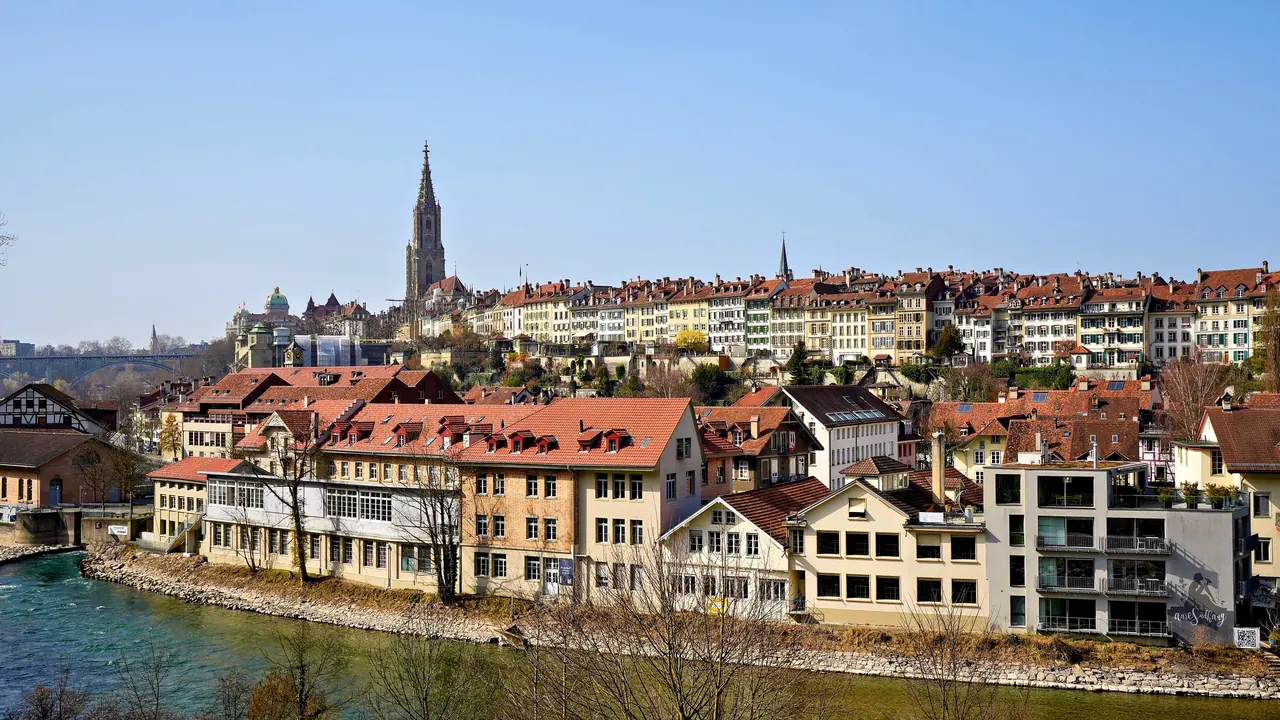
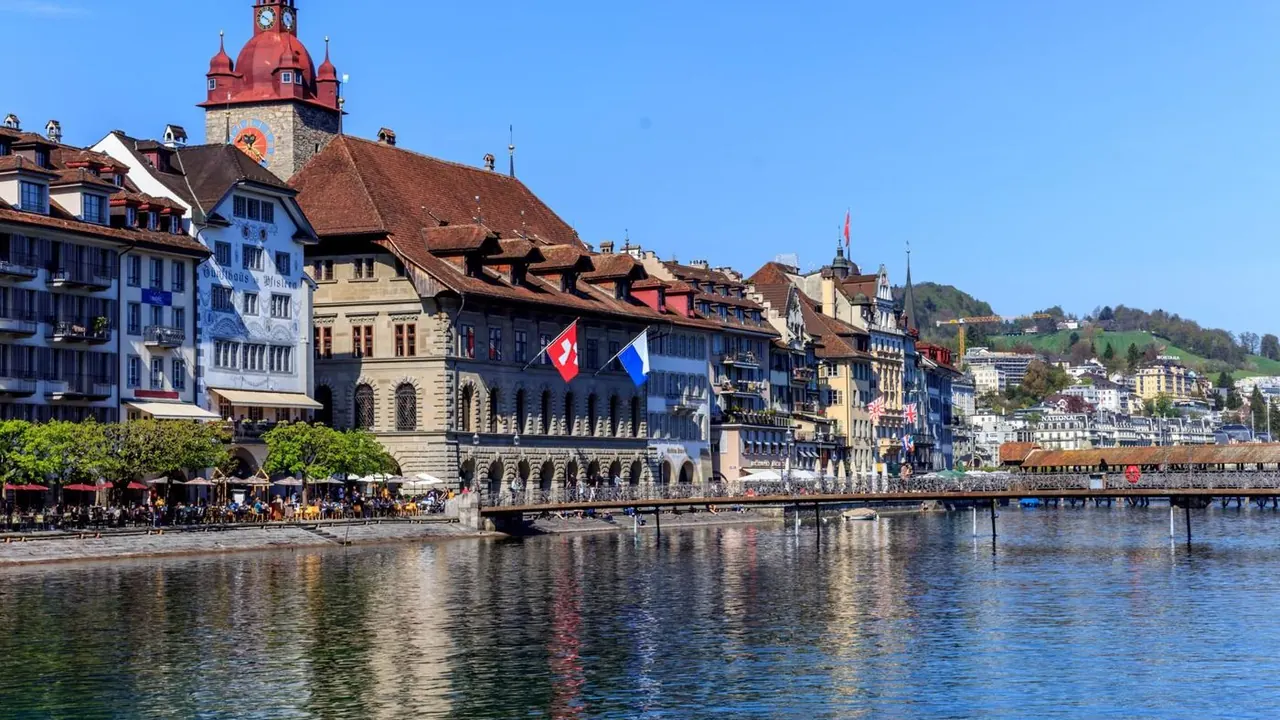
Photos: Bern by Beat Bieri, Pexels License; Lucerne by ILOVESwitzerland, Pexels License.
Bern or Lucerne?
Our verdict in twelve categories, each scored against the same fixed benchmark cities, and the climate month by month, so you can choose for your trip.
Choose Bern for
- day trips
- beaches
- nightlife
Bern suits travellers who want a handsome, walkable old town and a base for exploring Switzerland by train. The UNESCO arcades, the Klee and Einstein museums and the cellar bars give it more to do in town. Fribourg, Murten, Thun, Lucerne and Lake Geneva are all within easy reach, so a week can bring a different town each day without a car.
Choose Lucerne for
- live music and the arts
- nature and the outdoors
Choose Lucerne if the mountains and the lake are the point of the trip. Pilatus, Rigi and the Stanserhorn start almost at the edge of town, and steamers leave from in front of the station. In late summer the Lucerne Festival brings leading orchestras to the lakefront concert hall. In return you get fewer sights and quieter evenings.
Scoreboard
Twelve categories on one fixed scale from 0 to 100. The shaded stretch is the gap between the two.
Your match
Pick a travel style or drag the sliders, and both match scores follow your weighting.
Too close to call, 1 point apart
Wins on day trips and beaches with your weighting.
Wins on live music and the arts and nature and the outdoors with your weighting.
What matters to you?
Category by category
What the scores mean for a trip.
Beaches & swimming
Neither city has a coast, but Bern's river swim is the more memorable experience. You walk upstream from the Marzili baths, jump into the glacier-green Aare and let the current carry you back below the Federal Palace. Lidos at Marzili, Lorraine and Eichholz have lawns and pools, but the river is for confident swimmers only.
Lucerne's lake is about as warm in high summer and much calmer. People swim from the Lido, the old wooden lake baths and the lawns at Ufschötti. With jetties and grass rather than sand, it works as a break between excursions more than a reason to come.
Food & drink
Bern's own dish is the Berner Platte, a heavy board of smoked meats and sausages with sauerkraut and beans. Rösti, fondue and veal in cream sauce fill the menus of the guildhall dining rooms and vaulted cellars under the arcades. Bern also has a little more to graze on: Emmental cheese at the Bundesplatz markets, onion tarts at the late-November Zibelemärit, and chocolate that is a real local strength.
Lucerne's speciality is Chügelipastete, a puff-pastry case of veal and mushrooms in cream, and perch and whitefish come from the lake. Its terraces along the Reuss are best kept for coffee or a glass of Swiss white wine, as many tables near the Chapel Bridge serve the coach groups. In either city, expect a narrow range and high prices.
Culture & sights
In Bern the whole old town is the attraction: sandstone arcades, painted fountains, the Zytglogge and the Minster tower, all on a loop of the Aare. Behind that sit stronger museums than Lucerne has, including the Zentrum Paul Klee, Switzerland's oldest art museum and the Einstein Museum, with his flat on Kramgasse nearby.
Lucerne has fewer sights, though several are famous: the Chapel Bridge and Water Tower, the Lion Monument and the climbable towers of the Musegg Wall. The Rosengart Collection is a fine Picasso and Klee stop, but the list runs out sooner.
Nightlife
Neither is a night-out city, but Bern stays up a little later. Its cellar bars under the arcades and along Aarbergergasse fill at weekends, the Reitschule hosts rough-edged late parties and in summer people gather at riverside bars on the Aare.
In Lucerne, most evenings end with a drink by the water, and the lakefront is mostly empty by midnight. Apart from student weekends in the Neustadt, the real exception is Fasnacht, when the whole town is out in costume until dawn.
Nature & outdoors
Lucerne's mountains rise straight from its lake. Pilatus has the steepest cogwheel railway in the world, Rigi has wide ridge walks, and Titlis keeps glacier snow all year about an hour away. Steamers make it easy to combine a boat, a train and a hike in one day, though low cloud can hide the views.
From Bern the Eiger, Mönch and Jungfrau line the horizon, but they are an hour away by train. Closer to town the outdoors is gentler: the Gurten funicular, wooded paths along the Aare, and walking and cycling in the Emmental and the Jura.
Day trips
Both sit on the Swiss rail network, but Bern reaches more varied places. Fribourg is twenty minutes away, Gruyères is just beyond it, and Murten, Thun, Solothurn and Neuchâtel are all close. Lausanne and the Lavaux terraces add the French-speaking side, and Interlaken is an hour off.
From Lucerne, Zurich, Basel and Bern are all under an hour, and Zug and Einsiedeln are nearby. Its best outing is the lake itself, by boat to Brunnen, the Rütli meadow and the William Tell country around Altdorf. Interlaken takes twice as long as it does from Bern.
Good for families
Both cities are safe, calm and easy with children, but they keep them busy in different ways. In Bern the days are spread across small outings: the bear park, the Dählhölzli zoo along the river, the animal dioramas at the Natural History Museum and the playground at the top of the Gurten. Keep children out of the fast river.
Lucerne relies on one big draw, the hands-on Swiss Museum of Transport, plus the Glacier Garden and rides on steamers and mountain trains. These rides depend on the weather and get expensive, and with no zoo, rainy days can be harder to fill.
Getting around
Bern's arcades keep you dry on the twenty-minute walk from the station to the bear park, and its trams and buses cover the rest of the city. Funiculars and a public lift go down to the riverside quarter, but some streets climbing up from the Aare are steep.
In Lucerne the station, the boat piers and the edge of the Old Town sit together on a flat lakefront, so the steamers leave almost from the platform. The same tickets take you up the lake and into the mountains, though trips that combine boats, trains and cable cars take some reading of the timetables. You won't need a car in either city.
Shopping & style
Bern is better for browsing. Steep steps lead down from Gerechtigkeitsgasse to cellar shops selling antiques, design, books and crafts, and the arcades of Spitalgasse, Marktgasse and Kramgasse have Swiss chains, chocolate and a long-established department store near the station.
Lucerne is about watches. Large watch and jewellery houses on Schwanenplatz serve the tour groups, with army knives and cuckoo clocks alongside. Beyond those there are few fashion labels, no department store worth a visit and little for homeware.
Affordability
In Bern many of the best things cost nothing: the bear park, the river paths, guided tours of the Federal Palace and the old town's arcades. Hotels usually include a pass for trams and buses, and lunch from supermarket counters and market stalls keeps costs down during the day.
Lucerne's highlights come with a fare. The mountain railways and cable cars that make the stay worthwhile take a large share of the budget, and a Swiss travel pass and lakeside picnics only soften the cost. Hotels, meals and drinks are very expensive in both cities, so neither works as a budget trip.
Live music & performing arts
Lucerne is the stronger stage for classical music. The Lucerne Festival brings the world's leading orchestras and soloists, mainly in late summer, and Jean Nouvel's concert hall, known for its acoustics, has a year-round programme. At Fasnacht, Guggenmusik brass bands fill the Old Town.
Bern offers more variety than prestige. There is German-language opera at the Stadttheater, the symphony orchestra at the Casino, new dance at the Dampfzentrale and alternative concerts at the Reitschule. Its jazz festival in spring and the Gurtenfestival in July are pleasant extras, not a reason to come.
Wellness & relaxation
In Bern you can have a spa day in town. On the western edge there is a large thermal bath complex with warm pools, saunas and steam rooms, and there are a hammam-style spa in the old town and several hotel spas. The slower pleasures are long lunches on riverside terraces and Sundays when the arcades go quiet.
Lucerne's best soak is outside the city, at Mario Botta's mineral bath high on the Rigi, about an hour away by boat and cogwheel train. In town, rest means hotel spas, the old wooden lake baths in summer, walks along the promenade and an unhurried steamer ride. The Old Town does fill with tour groups in the middle of the day.
When should you go?
Pick your month. The climate figures are measured averages, not a forecast.
Bern in July
Lucerne in July
Daytime high, °C
Rainfall in the month, mm
Where the figures come from
Bern has no rain gauge within 25 km of the centre, so its rainfall comes from a gridded climate dataset read at the city rather than from a gauge further away.
Bern's sunshine is measured 71 km from the centre, at Herten.
Lucerne has no rain gauge within 25 km of the centre, so its rainfall comes from a gridded climate dataset read at the city rather than from a gauge further away.
Lucerne's sunshine is measured 42 km from the centre, at Zurich Town / Ville..
Temperature and rainfall are climate normals, averaged over the years shown. Bern: 2010-2020 (sunshine 1991-2020, rainfall 1991-2020) normals, Bern / Bern - Belp Airport (5.5 km from centre). Lucerne: 2005-2025 (sunshine 1991-2020, rainfall 1991-2020) normals, Emmen (4.2 km from centre).
Bern is the warmer and sunnier of the two in summer, reaching 26°C in July and August, and its river lidos are open from June to early September. Its wettest month is May, at 118mm. After that the summer stays showery but brighter, with the most sunshine in July. Winters are grey, with highs around 5°C in December and January, though the arcades keep you dry in town.
Lucerne runs a little cooler, at around 24°C in high summer, and is wetter in every month. Its rain builds through the summer to about 141mm in both July and August. That matters, because low cloud can spoil a mountain railway trip. September suits both cities, since it is still warm enough for walking and has less rain than high summer. Lake swimming is mostly for July and August, and from November to February swimming is over in both.
Which traveller are you?
On an outdoors trip, Lucerne is the clear choice. Pilatus, Rigi and the Stanserhorn are reached straight from town by cogwheel railway, cable car or paddle steamer, so one day can mix boat, rail and hiking. From Bern the high mountains are an hour away.
For a short city break, Bern gives you more in two or three days. The UNESCO old town and its arcades are the main sight, the Klee and Einstein museums fill a rainy afternoon, and the cellar bars keep weekend evenings going a little later.
Travellers who come for classical music should pick Lucerne. The Lucerne Festival brings the world's leading orchestras to Jean Nouvel's lakefront hall, famous for its acoustics. Bern's opera, orchestra and jazz festival are good, but they are rarely worth a special journey.
Before you go
| Measure | Bern | Lucerne |
|---|---|---|
| Official language | French, German, Italian, Romansh | French, German, Italian, Romansh |
| Currency | Swiss Franc (CHF) | Swiss Franc (CHF) |
| Sockets | CJ230 V, 50 Hz | CJ230 V, 50 Hz |
| Driving side | Right | Right |
| Time zone | UTC+1, UTC+2 in summer | UTC+1, UTC+2 in summer |
| Emergency number | 112 | 112 |
| Elevation | 542 m | 436 m |
| Main airport | Zürich Airport (ZRH)101 km from centre226 non-stop destinations | Zürich Airport (ZRH)49 km from centre226 non-stop destinations |
| Public holidays this year | 10 days | 12 days |
By the numbers
| Measure | Bern | Lucerne |
|---|---|---|
| City population | 136,988 | 86,234 |
| People per km² | 2,655 | 2,963 |
| Museums within 10 km | 30 | 14 |
| UNESCO World Heritage sites within 50 km | 2 | 1 |
Where else could you go?
Every comparison below shares a destination with this one, so you can follow Bern or Lucerne somewhere new.