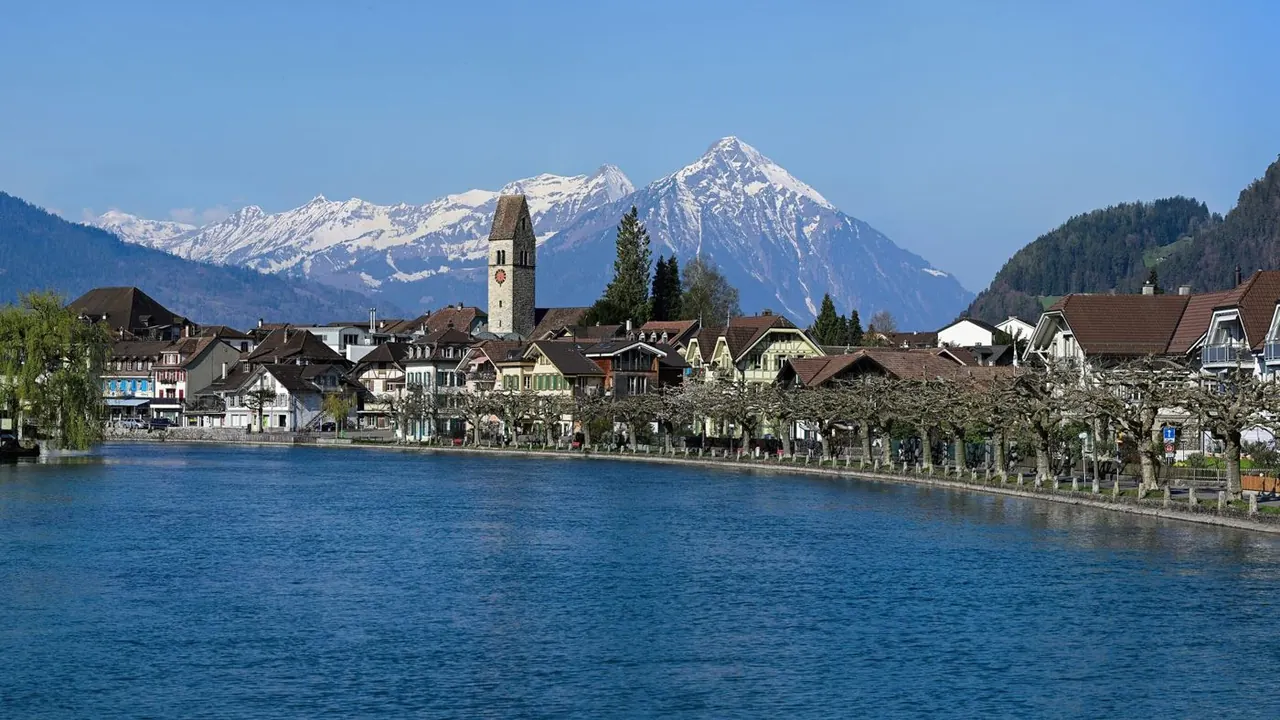
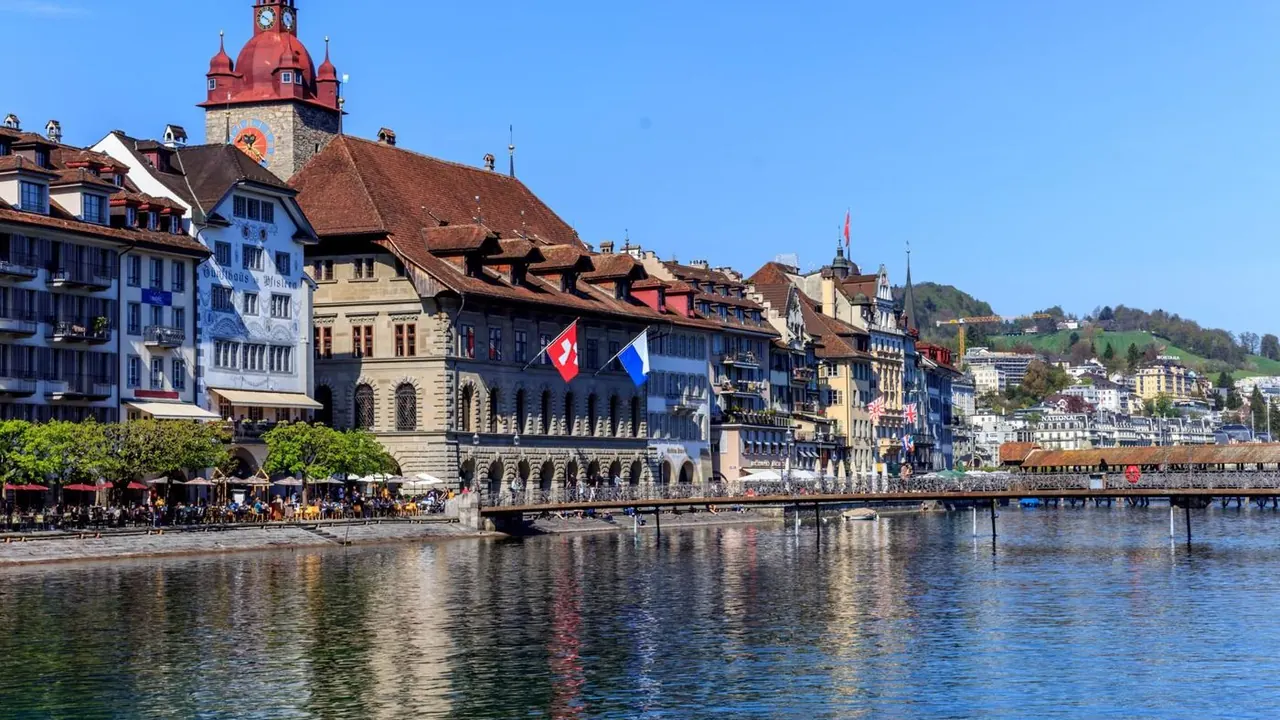
Photos: Interlaken by Roy Egloff, CC BY-SA 4.0, cropped; Lucerne by ILOVESwitzerland, Pexels License.
Interlaken or Lucerne?
Our verdict in twelve categories, each scored against the same fixed benchmark cities, and the climate month by month, so you can choose for your trip.
Choose Interlaken for
- families
- nature and the outdoors
Choose Interlaken if the mountains are the whole point of the trip. The Eiger, Mönch and Jungfrau, the Lauterbrunnen valley and the railway to the Jungfraujoch are all within an hour, and paragliding, canyoning and rafting start from the town itself. In return you get a resort with almost nothing to see and little to do after dark. It suits active travellers who will be out on the trails all day and in bed early.
Choose Lucerne for
- live music and the arts
- culture and sights
- shopping
Lucerne is the better pick for travellers who want a real town around their scenery. The Chapel Bridge, the medieval Old Town, the Lion Monument and a celebrated concert hall fill the hours between excursions, and Pilatus, Rigi and the lake steamers are still on the doorstep. It suits a mixed trip of sightseeing, music and mountain days, and couples who like a quiet evening by the water.
Scoreboard
Twelve categories on one fixed scale from 0 to 100. The shaded stretch is the gap between the two.
Your match
Pick a travel style or drag the sliders, and both match scores follow your weighting.
Wins on families and nature and the outdoors with your weighting.
Wins on live music and the arts and culture and sights with your weighting.
What matters to you?
Category by category
What the scores mean for a trip.
Beaches & swimming
Neither is a beach destination. In both, the swimming season is July and August, with the water at around 20-21°C. What differs is where you swim. Interlaken has two lakes with different characters: the warmer Lake Thun, with grassy lidos and shingle at Neuhaus, and the glacial turquoise Lake Brienz, which is colder but striking, with a bathing area at Bönigen.
In Lucerne, swimming is part of city life. People swim from the old wooden lake baths and the Lido near the centre, or from the lawns at Ufschötti, so a swim fits easily between sights. The shore there is lawns and jetties rather than shingle.
Food & drink
Neither is a place to travel to for food, but Lucerne gives you a little more. It has a dish of its own in Chügelipastete, lake perch and whitefish on the menus, guild-house taverns in the Old Town, terraces along the Reuss and a Saturday market.
Interlaken's restaurants stick to fondue, rösti and international standbys for the visitor crowd. Its better meals happen higher up, on hut terraces above Grindelwald or Mürren, or at picnics with cheese from a mountain dairy.
Culture & sights
This is where the two differ most. Interlaken grew up as a base for the mountains. Its sights are a row of grand hotels and the Kursaal along the Höheweg, a few timber houses in Unterseen and a small local museum, and that is the whole list.
Lucerne has a well-kept medieval Old Town of frescoed squares, the Chapel Bridge and Water Tower, the climbable towers of the Musegg Wall and the Lion Monument. The Rosengart Collection, the Bourbaki Panorama and Wagner's villa at Tribschen add to that. It is no great museum city, but it fills a day or two in a way Interlaken cannot.
Nightlife
Both go quiet early, but Lucerne has a little more going on after dark. It has riverside wine bars, a few cocktail bars and small clubs in the Neustadt, and students keep weekends lively. At Fasnacht the whole Old Town is out in costume until dawn.
Interlaken's evenings follow its early starts. There are pubs and basement clubs around the hostels and the casino in the Kursaal, and the streets are quiet well before midnight.
Nature & outdoors
Both are among the finest mountain bases in the Alps, and the difference is one of character. Interlaken faces the high, glaciated wall of the Eiger, Mönch and Jungfrau, with the Jungfraujoch at 3,454m and the waterfalls of Lauterbrunnen close by. It also offers a huge range of adventure sport, from paragliding down to the Höhematte to canyoning and rafting.
Lucerne's mountains are lower, with Pilatus and Rigi rising straight from the lake and Titlis and its glacier about an hour away. Its strength is combining a steamer, a cogwheel train and a ridge walk in a single day. In both towns, low cloud can hide the peaks for days.
Day trips
These two are evenly matched for day trips, and each is a scenic two-hour ride from the other over the Brünig Pass. From Interlaken the best outings are Bern in under an hour, Thun's castle above the Aare, the lakeside castles at Spiez and Oberhofen, and the open-air museum at Ballenberg near Brienz.
Lucerne reaches bigger cities. Zurich, Bern and Basel with its art museums are each about an hour or less away, and there is the monastery at Einsiedeln. A boat down the lake goes to the Rütli meadow, where the story of the Swiss Confederation begins.
Good for families
Both are safe, easy places with children, and much of the fun is the trains and boats themselves. Interlaken has more variety. The summit stations above Grindelwald and on the Harder Kulm have playgrounds, cliff walks and toboggan runs, and the St Beatus caves and Ballenberg are reliable favourites. The highest trips are best avoided with very young children because of the altitude.
Lucerne has the biggest single attraction of the two, the Swiss Museum of Transport, which fills a day in any weather. It also has the mirror maze in the Glacier Garden. After that its list runs short, and the lakeside lawns have to do much of the work.
Getting around
You can do either without a car, but Lucerne is the more convenient. Its station, boat piers and Old Town sit together on the lakefront, so most sights and most excursions start a short, flat walk away.
Interlaken is small and flat too, but it is strung out between two stations twenty minutes' walk apart. Its narrow-gauge and cog railways reach deep into the Jungfrau region, but the most popular mountain trains get crowded in summer.
Shopping & style
Much of the shopping is the same in both towns: Swiss watches and jewellery sold to tour groups, with army knives, cuckoo clocks and chocolate alongside. In Interlaken that trade along the Höheweg is nearly all there is, apart from outdoor shops where you can replace forgotten kit before a hike. Carved wood from Brienz, the home of Swiss woodcarving, is the souvenir with a real local story behind it.
Lucerne has the same watch trade on Schwanenplatz and the lakefront, but it also has a few independent boutiques in the Old Town lanes and a Saturday market along the river selling produce and crafts. That makes it the better town for an afternoon's browsing, though neither is the place to shop for clothes or homeware.
Affordability
There is nothing to choose between them on cost. Both charge full Swiss prices for rooms, meals and drinks, and in both the mountain railways and cable cars take a large share of the budget.
What differs is where the money goes. In Interlaken the Jungfraujoch and adventure sports cost the most, while in Lucerne central hotel rooms are dearest in summer and during the music festival. In both, a travel pass and supermarket picnics are the main ways to save.
Live music & performing arts
For music, Lucerne is far ahead. Jean Nouvel's lakefront hall, famous for its acoustics, hosts the Lucerne Festival's leading orchestras in late summer and the Lucerne Symphony Orchestra all year, and the city theatre stages opera, drama and dance.
Interlaken has the open-air William Tell play, staged by local amateurs each summer, folklore evenings with yodelling and alphorns, and occasional concerts in the Kursaal. For anything more, you need to go to Bern's theatre or the lake stage at Thun.
Wellness & relaxation
Interlaken's centre is built for activity and busy with coach groups and backpackers. The rest it offers lies mostly outside the town: early mornings on the lakeshore, slow steamer crossings, the quiet of Wengen or Mürren, and the spas of the grand Höheweg hotels.
Lucerne is the calmer place to stay in itself. Evenings are quiet, the lakeside promenades suit slow walks and the old wooden lake baths are a simple summer pleasure, though the Old Town fills with tour groups in the middle of the day. Neither town has thermal springs, but the Botta mineral bath high on the Rigi gives Lucerne a place to soak with a mountain view.
When should you go?
Pick your month. The climate figures are measured averages, not a forecast.
Interlaken in July
Lucerne in July
Daytime high, °C
Rainfall in the month, mm
Where the figures come from
Interlaken has no rain gauge within 25 km of the centre, so its rainfall comes from a gridded climate dataset read at the city rather than from a gauge further away.
Lucerne has no rain gauge within 25 km of the centre, so its rainfall comes from a gridded climate dataset read at the city rather than from a gauge further away.
Lucerne's sunshine is measured 42 km from the centre, at Zurich Town / Ville..
Temperature and rainfall are climate normals, averaged over the years shown. Interlaken: 2005-2020 (rainfall 1991-2020) normals, Meiringen / Unterbach (19.3 km from centre). Lucerne: 2005-2025 (sunshine 1991-2020, rainfall 1991-2020) normals, Emmen (4.2 km from centre).
Interlaken and Lucerne have almost the same temperatures through the year. Both reach about 24°C in July and August, the only months when the lakes are warm enough for a swim, and both stay in single figures from November to February, when the interest turns to snow and skiing. Spring and autumn are mild enough for walking the streets, and neither town ever gets too hot.
Rain is where they differ. Interlaken's rainfall stays moderate all year, and July, at around 126mm, is no wetter than December. Lucerne gets only slightly more rain than Interlaken from May to August, around 135mm a month, though June to August are also its sunniest months, with more than 200 hours of sunshine each. September is a good compromise there: still warm and noticeably drier than high summer.
Which traveller are you?
For an outdoors trip, Interlaken is the stronger base. The Jungfraujoch railway, the Lauterbrunnen valley and the high trails from Grindelwald First and Mürren are all close, and paragliding, canyoning and rafting start right in town.
On a culture and arts trip, Lucerne wins easily. The medieval Old Town, the Chapel Bridge, the Lion Monument and the Picasso and Klee of the Rosengart Collection are all close together, and the summer festival brings leading orchestras to the lakefront hall.
On a family trip with children, Interlaken has the edge. Playgrounds and toboggan runs at the summit stations, the St Beatus caves and Ballenberg's farm animals make a steady run of outings. Lucerne's Transport Museum is excellent, but it has fewer attractions after that.
Before you go
| Measure | Interlaken | Lucerne |
|---|---|---|
| Official language | French, German, Italian, Romansh | French, German, Italian, Romansh |
| Currency | Swiss Franc (CHF) | Swiss Franc (CHF) |
| Sockets | CJ230 V, 50 Hz | CJ230 V, 50 Hz |
| Driving side | Right | Right |
| Time zone | UTC+1, UTC+2 in summer | UTC+1, UTC+2 in summer |
| Emergency number | 112 | 112 |
| Elevation | 571 m | 436 m |
| Main airport | Zürich Airport (ZRH)100 km from centre226 non-stop destinations | Zürich Airport (ZRH)49 km from centre226 non-stop destinations |
| Public holidays this year | 10 days | 12 days |
By the numbers
| Measure | Interlaken | Lucerne |
|---|---|---|
| City population | 6,123 | 86,234 |
| People per km² | 1,424 | 2,963 |
| Museums within 10 km | 3 | 14 |
| UNESCO World Heritage sites within 50 km | 2 | 1 |
Where else could you go?
Every comparison below shares a destination with this one, so you can follow Interlaken or Lucerne somewhere new.