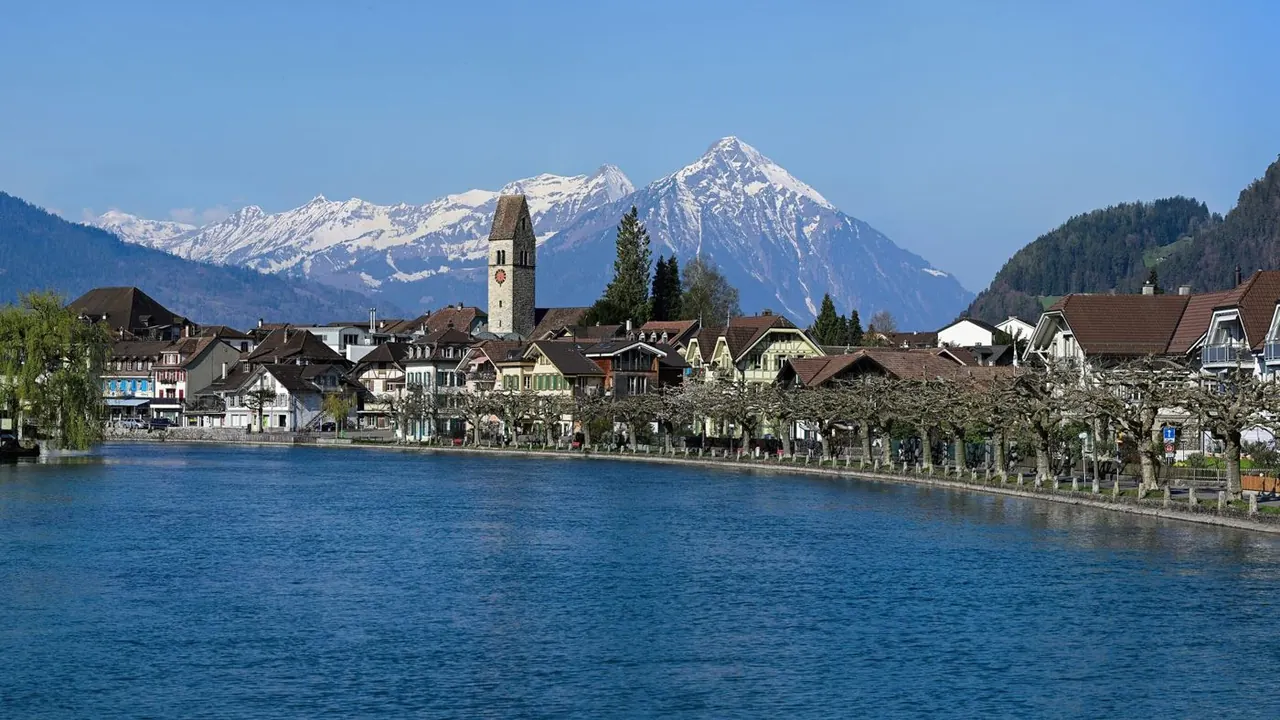
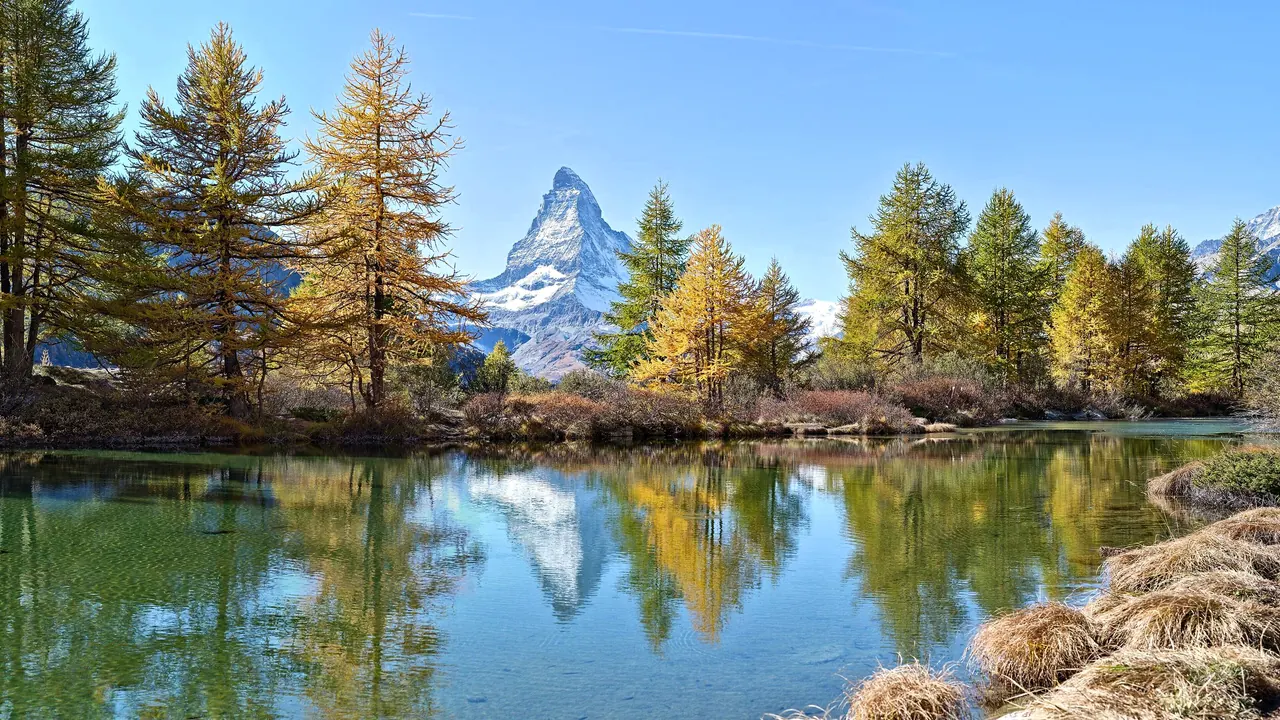
Photos: Interlaken by Roy Egloff, CC BY-SA 4.0, cropped; Zermatt by Roy Egloff, CC BY-SA 4.0, cropped.
Interlaken or Zermatt?
Our verdict in twelve categories, each scored against the same fixed benchmark cities, and the climate month by month, so you can choose for your trip.
Choose Interlaken for
- day trips
- beaches
- families
Interlaken suits travellers who want the Alps as a base for a varied trip. It sits low between two lakes, with summer swimming, paddle steamers and fast trains to Bern, Thun and Lucerne, so you can mix mountain days with towns and castles. Families do well here too. Gentle summit playgrounds, caves and Ballenberg are all close by.
Choose Zermatt for
- food and drink
- nightlife
- culture and sights
If the trip is all about the high mountains, Zermatt is the stronger pick. The Matterhorn stands over a car-free village, the lifts climb higher, glacier skiing carries on into summer, and there is more to the evenings: terrace lunches in the hamlets, winter après-ski and better hotel spas. It is a place to stay put rather than tour from, and like Interlaken it is very expensive.
Scoreboard
Twelve categories on one fixed scale from 0 to 100. The shaded stretch is the gap between the two.
Your match
Pick a travel style or drag the sliders, and both match scores follow your weighting.
Wins on day trips and beaches with your weighting.
Wins on food and drink and nightlife with your weighting.
What matters to you?
Category by category
What the scores mean for a trip.
Beaches & swimming
Interlaken at least has water to swim in. In July and August Lake Thun is warm enough for a dip from the lidos and shingle shores at Neuhaus or towards Spiez. Lake Brienz is colder but a striking turquoise at Bönigen. This is a swim after a hike, not a beach vacation.
Zermatt has nothing like it. Its mountain tarns are for photographing the Matterhorn, not for bathing, and the only swimming is in a hotel pool.
Food & drink
Interlaken's restaurants are reliable but generic: fondue, rösti and veal in cream sauce, plus Indian and Asian places for an international crowd. The memorable meals are out of town on hut terraces above Grindelwald or Mürren, and many visitors get by on supermarket picnics.
Zermatt eats noticeably better. Its wealthy ski crowd keeps a few ambitious kitchens going in the village, and at the chalet terraces in Findeln, Furi and Zum See lunch becomes the event of the day, with air-dried beef, apricot desserts and Valais wines such as Petite Arvine and Cornalin. Many places close between seasons, though.
Culture & sights
Interlaken has almost nothing of its own beyond the grand hotel fronts and the Kursaal on the Höheweg and a few old timber houses in Unterseen. For history you take the train to Bern or Thun.
Zermatt is no cultural destination either, but it can fill a proper morning. The Matterhorn Museum and the mountaineers' cemetery tell the story of the 1865 first ascent and the deaths on the way down. In the Hinterdorf, the larch-wood barns on their stone slabs show the farming village that was there before the resort.
Nightlife
Interlaken's evenings belong to the backpackers. There are pubs, sports bars and a couple of basement clubs near the hostels, the Kursaal casino and a quiet drink on the Höheweg, and the streets are still well before midnight.
Zermatt goes out harder, at least in winter. Après-ski fills the bars beside the runs as skiers come down into the village, and on busy weekends a few bars and small clubs on the main street stay open past midnight. In summer its hikers go to bed early.
Nature & outdoors
Both are among the great Alpine bases. The difference is variety against height. Interlaken spreads wide: the Eiger, Mönch and Jungfrau, the waterfalls of Lauterbrunnen and Trümmelbach, ridge walks at Schynige Platte and First, and two lakes for kayaking and paddleboarding, with rafting on the river and paragliders landing in the middle of town.
Zermatt goes higher and wilder. The Matterhorn fills the view from the village, the lifts reach over 3,800m at the Matterhorn Glacier Paradise, some glacier pistes stay open in summer and the ski area crosses into Italy. Serious mountaineers come for guided climbs of four-thousanders and the end of the Haute Route.
Day trips
Interlaken is by far the better base for seeing more of Switzerland. Bern's arcaded old town is under an hour away, the lake steamers stop at the castles of Thun, Spiez and Oberhofen, Brienz and Ballenberg have woodcarving and old farm buildings, and Lucerne is a scenic two-hour ride.
From Zermatt, every outing starts with the long train ride down the valley. Sion, with its two castle hills and vineyards, repays the effort best, and Brig and Saas-Fee are closer, but most visitors spend their spare days in the mountains.
Good for families
Interlaken is the easier choice with children. The summit stations at the Harder Kulm and above Grindelwald have playgrounds, cliff walks and summer toboggan runs. The St Beatus caves and the farm animals at Ballenberg fill days without going high, and lake steamers make an outing in their own right.
Zermatt's car-free streets make it calm and safe, and it works well for families who ski or hike together, with nursery slopes at Sunnegga and marmots to spot on summer walks. Beyond that, little is made for children, and the viewpoints above 3,000m can be too much for small ones.
Getting around
Both are easy without a car, in different ways. Interlaken is a small, flat town that works as a hub. Mainline trains run to Bern, narrow-gauge lines climb to Lauterbrunnen and Grindelwald, and cog railways, gondolas and steamers connect neatly, so the whole region opens up from one base. The popular trains get crowded in summer.
Zermatt is a car-free village you walk from end to end, with electric taxis to the outlying stations and the Gornergrat railway, the Sunnegga funicular and the cable cars a short walk from the centre. The catch is arriving through Täsch, the train ride of over an hour out of the valley and steep walks up to hotels on the edges.
Shopping & style
Neither is a place to go for shopping, and both main streets mix watch and jewellery stores with chocolate and souvenirs. Interlaken's Höheweg caters to tour groups with army knives and cuckoo clocks, and Brienz woodcarving is the one local craft worth buying.
Zermatt has slightly more to it. Its boutiques are aimed at wealthy skiers, and its ski and mountaineering outfitters are genuinely well stocked, which helps if you need proper kit.
Affordability
Interlaken is the somewhat less expensive of the two, though only by Swiss standards. Its hostels and backpacker crowd give it a cheaper end that Zermatt hardly has, and the regional transport cards many hotels hand out, along with walks from the valley floor, take the edge off. The mountain railways still cost far more than most visitors expect, the Jungfraujoch above all.
Zermatt sits at the very top of Alpine prices, from plain hotel rooms in season to a drink on a mountain terrace. Self-catering apartments, supermarket picnics and sleeping down the valley in Täsch are the real savings, but the lifts and cog railways cost the same whatever you do.
Live music & performing arts
Neither has much live performance, and they differ mainly in what fills the gap. Interlaken's signature is the amateur open-air William Tell performed in the woods each summer, plus folklore evenings of yodelling and alphorns, with Bern's theatre and orchestra under an hour away.
Zermatt has no stage of its own but two festivals with real pull: Zermatt Unplugged's acoustic sets in spring and a chamber music festival in the church in late summer. Outside those weeks, live music means a band in an après-ski bar.
Wellness & relaxation
Interlaken's spas are mostly in the grand nineteenth-century hotels on the Höheweg. If you are not staying in one, the town's public pool and wellness area is the obvious option. Much of the rest comes from the setting: an early hour on the lakeshore costs nothing, and a slow steamer crossing on Lake Thun or Lake Brienz is restful in its own right.
Zermatt offers more choice. Its hotel spas are a real strength, with pools, saunas and steam rooms, many of them facing the peaks, and a few sell day access to visitors staying elsewhere. Peak weeks are busy, though, and the mood stays active. For proper thermal bathing you need to go down to the spa towns of the lower Valais.
When should you go?
Pick your month. The climate figures are measured averages, not a forecast.
Interlaken in July
Zermatt in July
Daytime high, °C
Rainfall in the month, mm
Where the figures come from
Interlaken has no rain gauge within 25 km of the centre, so its rainfall comes from a gridded climate dataset read at the city rather than from a gauge further away.
Interlaken's sunshine is measured 66 km from the centre, at Sion.
Zermatt has no weather station within reach, so its figures come from a gridded climate model rather than a measured record, and read a broad area rather than the city itself.
Temperature and rainfall are climate normals, averaged over the years shown. Interlaken: 2005-2020 (sunshine 1961-1990, rainfall 1991-2020) normals, Meiringen / Unterbach (19.3 km from centre). Zermatt: 1991-2020 normals, TerraClimate 4 km grid at the town, no weather station within 90 km.
Interlaken sits much lower and has properly warm summers. Highs reach 24°C in July, and July and August are the months when the lakes are pleasant for a swim. Early summer is also the wettest time, with around 125mm a month from May to August, though July is the sunniest month too, so expect showery days with plenty of bright spells. Spring and autumn are mild and good for walking in the valley. In winter the highs are only a few degrees above freezing.
Zermatt is cooler all year and its seasons run later. Even in July and August the village only reaches about 14°C, which suits high hiking more than sitting by the water. From December to February daytime highs stay below freezing, which is the snow season. Rain is spread fairly evenly through the year, and November is the wettest month at 130mm, a grey month to skip.
Which traveller are you?
On a family trip with young children, Interlaken is the easier base. The caves, Ballenberg's farm animals, summit playgrounds and toboggan runs keep the days varied, the lakes offer a summer swim, and fewer outings take you into very thin air.
For a food and nightlife trip, Zermatt gives more back. Long lunches on the chalet terraces at Findeln and Furi, Valais wines and a few ambitious village kitchens lead into winter après-ski that runs past midnight. Interlaken's evenings end early.
On a relaxing and wellness trip, Zermatt is the calmer stay, with its many excellent hotel spas and quiet, car-free streets. Interlaken's centre is busy with coach groups and geared to activity, so resting there means getting out to the lakeside villages.
Before you go
| Measure | Interlaken | Zermatt |
|---|---|---|
| Official language | French, German, Italian, Romansh | French, German, Italian, Romansh |
| Currency | Swiss Franc (CHF) | Swiss Franc (CHF) |
| Sockets | CJ230 V, 50 Hz | CJ230 V, 50 Hz |
| Driving side | Right | Right |
| Time zone | UTC+1, UTC+2 in summer | UTC+1, UTC+2 in summer |
| Emergency number | 112 | 112 |
| Elevation | 571 m | 1,624 m |
| Main airport | Zürich Airport (ZRH)100 km from centre226 non-stop destinations | Geneva International Airport (GVA)128 km from centre150 non-stop destinations |
| Public holidays this year | 10 days | 9 days |
By the numbers
| Measure | Interlaken | Zermatt |
|---|---|---|
| City population | 6,123 | 6,023 |
| People per km² | 1,424 | 25 |
| Museums within 10 km | 3 | 2 |
| UNESCO World Heritage sites within 50 km | 2 | 2 |
Where else could you go?
Every comparison below shares a destination with this one, so you can follow Interlaken or Zermatt somewhere new.
- Bernvs Interlaken
- Lucernevs Interlaken
- Chamonixvs Zermatt
- Zurichvs Interlaken
- Luganovs Zermatt
- Lausannevs Interlaken