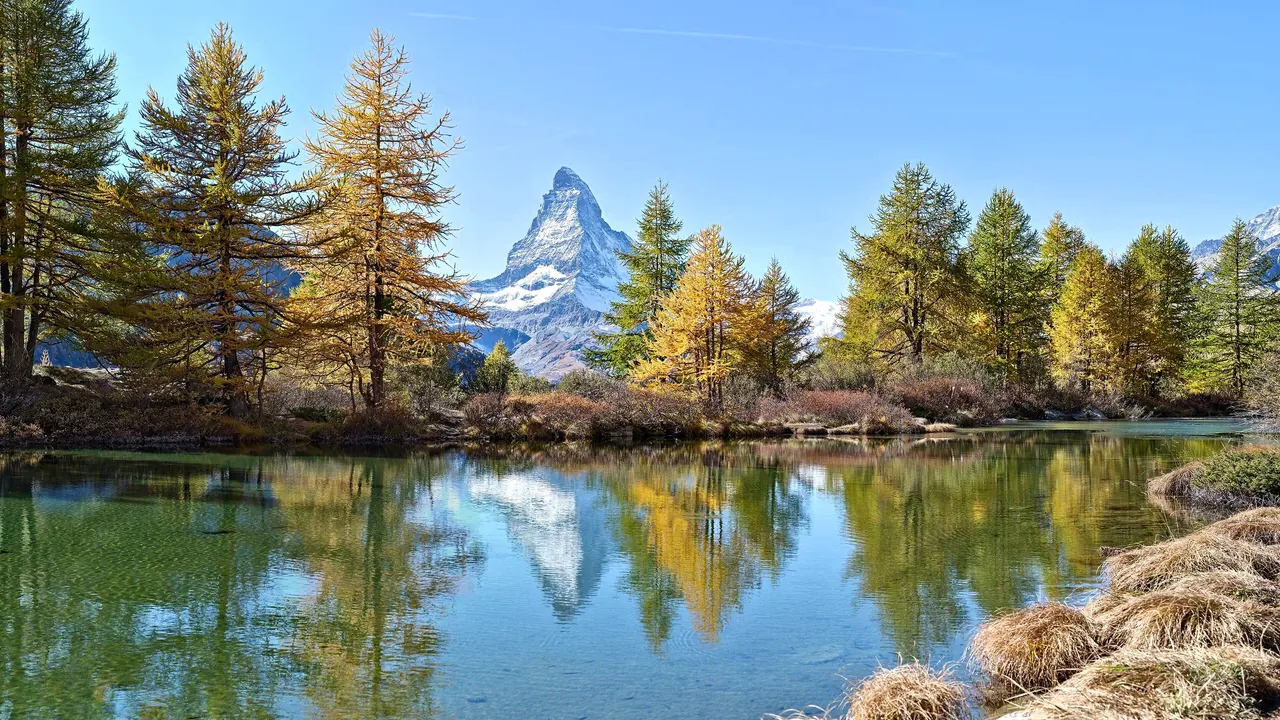
Photos: Zermatt by Roy Egloff, CC BY-SA 4.0, cropped.
Verbier or Zermatt?
Our verdict in twelve categories, each scored against the same fixed benchmark cities, and the climate month by month, so you can choose for your trip.
Choose Verbier for
- day trips
- nightlife
- live music and the arts
Verbier suits skiers and walkers who also want a lively evening and a wider region to explore. Its après-ski runs from the terraces at the foot of the slopes to late clubs around the Place Centrale, its summer festival makes it a serious stop for classical music, and with a car the Rhône valley castles, Lake Geneva and Roman Aosta are all within a day.
Choose Zermatt for
- getting around
- culture and sights
- families
Zermatt is the better pick for a quieter, self-contained mountain stay built around one famous peak. The car-free village is easy to walk with children, the hotel spas and calm streets make evenings restful, and the Matterhorn Museum and the old Hinterdorf barns give it a morning of history that Verbier lacks. Few visitors leave the valley once they arrive, and few feel the need to.
Scoreboard
Twelve categories on one fixed scale from 0 to 100. The shaded stretch is the gap between the two.
Your match
Pick a travel style or drag the sliders, and both match scores follow your weighting.
Too close to call, 2 points apart
Wins on day trips and nightlife with your weighting.
Wins on getting around and culture and sights with your weighting.
What matters to you?
Category by category
What the scores mean for a trip.
Beaches & swimming
Neither place is for swimming, and the mountain lakes above both stay too cold for bathing even in August. There is a small practical difference. Verbier has a public pool at its sports centre, and Lake Geneva is a little over an hour away by car. In Zermatt a swim almost always means a hotel pool.
Food & drink
Both serve the same Valais mountain food and pour the same Fendant, Petite Arvine and Cornalin. Both also have a handful of ambitious restaurants for a wealthy ski crowd and very little cheap or casual eating. Verbier's pride is raclette made from its own Val de Bagnes cheese and scraped at the table from a half wheel.
Zermatt's strength is the setting. The chalet restaurants in Findeln, Furi and Zum See are reached on skis or on foot and put the Matterhorn in view of the lunch table. In both villages, many kitchens close outside the main seasons.
Culture & sights
Zermatt has more to show, though neither is a place for sightseeing. The Matterhorn Museum tells the story of the 1865 first ascent. Add the mountaineers' cemetery by the church and the old larch barns of the Hinterdorf and you have a full morning, and the Gornergrat railway of 1898 is a sight in its own right.
Verbier is a twentieth-century ski resort with almost no history in the village itself. Its main offering is the stone church and small Bagnes museum down in Le Châble, and anyone after culture spends a day in the Rhône valley towns.
Nightlife
Verbier is the place for a big night out. In winter, après-ski spills from the terraces at the foot of the slopes into crowded bars around the Place Centrale and then into several late clubs, where seasonal workers and a wealthy international crowd end up side by side.
Zermatt has après-ski too, in the bars on the runs back into the village, and a few bars and small clubs on the main street. But its nights are shorter, and its summer crowd of climbers goes to bed early. Out of season both go quiet, Zermatt more completely, with much of the village shut.
Nature & outdoors
Both are among the great Alpine bases, and the difference is in character. Verbier is the freeriders' resort. It has the huge linked 4 Vallées ski area, off-piste slopes known among serious skiers, ski touring from Mont Fort and paragliders off the ridges, plus a bike park in summer.
Zermatt is about height and one mountain. The Matterhorn rises above the village, dozens of four-thousand-metre peaks ring the valley and the lifts climb above 3,800m. The glacier keeps some pistes open in summer, and guides take climbers up the big summits. The Haute Route links the two villages.
Day trips
Verbier is far better placed for days away. Martigny's Roman remains and art foundation are about half an hour off, and Sion's castles and the abbey at Saint-Maurice are close. Chillon, Montreux and the Lavaux terraces on Lake Geneva, the Great St Bernard, Aosta and Chamonix all make realistic days out, most easily by car.
From Zermatt, every outing starts with the long train ride down the valley. Brig, Sion and the vineyards above Visp are the main choices, and most visitors stay in the mountains instead.
Good for families
Zermatt is the easier family base. With no cars in the village, children can walk safely between hotel, ski school and lifts, and the Sunnegga nursery slopes, the marmots and the cog railways keep them interested.
Verbier has good ski schools and snow gardens, and La Tzoumaz and Savoleyres have gentler runs. But the village is steep and scattered, and the resort is known for difficult terrain and après-ski. Neither has attractions built for children, so rainy days are hard to fill in both.
Getting around
Zermatt is simpler once you arrive. It is a compact, car-free strip where you walk almost everywhere. Electric taxis and ski buses cover the outlying lifts, and the railways and gondolas leave from the centre. Getting out of the valley, though, takes over an hour by train.
You reach Verbier by train to Le Châble and then a gondola up. Its chalets are spread across a steep hillside, so many guests depend on the free shuttle buses or taxis. Its advantage is the road, since a car opens up the valley and the neighbouring countries.
Shopping & style
Neither is worth a shopping trip, and both main streets are mostly ski and mountaineering shops with genuinely good gear. The difference is at the luxury end. Zermatt leans towards Swiss watches, jewellery and Matterhorn souvenirs. Verbier has fashion and interior boutiques for chalet owners, and its best things to take home are Bagnes cheese and Valais wine.
Affordability
These are two of the most expensive resorts in the Alps, and there is no cheap way to do either. In both, rooms, lifts and meals are priced for wealthy visitors. The ways to save are the same too: self-catering, supermarket picnics and sleeping down the valley, in Le Châble below Verbier or in Täsch below Zermatt, where the shuttle into the car-free village starts.
Live music & performing arts
Verbier is the stronger draw for music lovers, though only for a couple of weeks each summer. Its festival, held since 1994, brings leading soloists and conductors to a large festival hall and the village church, with a youth orchestra, public masterclasses and late chamber music in small rooms. The rest of the year it has no theatre, no resident orchestra and no regular concert programme.
Zermatt has no theatre or concert hall at all. Its music comes from two shorter festivals: the acoustic sets of Zermatt Unplugged in spring, played in tents and on mountain stages, and a chamber music festival in late summer in the village church and other small venues. Outside those weeks, live music means a band in an après-ski bar, and evenings revolve around dinner.
Wellness & relaxation
Zermatt has the slight edge for a restful stay. It has many good hotel spas, a few of which sell day access to non-guests, and its car-free streets give the village a quiet that Verbier's après-ski centre lacks.
Verbier relies on hotel and chalet spas plus the public wellness area at its sports centre. It is closer to real thermal water, though, with the baths at Saillon and Lavey-les-Bains each within about an hour. Both are calmest away from the peak winter weeks.
When should you go?
Pick your month. The climate figures are measured averages, not a forecast.
Verbier in July
Zermatt in July
Daytime high, °C
Rainfall in the month, mm
Where the figures come from
Verbier has no weather station within reach, so its figures come from a gridded climate model rather than a measured record, and read a broad area rather than one spot.
Zermatt has no weather station within reach, so its figures come from a gridded climate model rather than a measured record, and read a broad area rather than one spot.
Temperature and rainfall are climate normals, averaged over the years shown. Verbier: 1991-2020 normals, TerraClimate 4 km grid at the town, no weather station within 90 km. Zermatt: 1991-2020 normals, TerraClimate 4 km grid at the town, no weather station within 90 km.
Neither village is warm in any month, and summer here means hiking weather. Verbier sits lower and stays a few degrees milder, with August highs of about 18°C, comfortable for long walks. Zermatt peaks at around 14°C, so a fleece stays in the daypack even in July. June to September is the walking season in both, and September is the drier end of it.
Zermatt is colder in winter, with daytime highs below freezing from December to February. Verbier gets more rain and snow all year, and is wettest in late autumn and early winter, at about 145mm in December. Zermatt is drier through most months and has one wet month, November, at around 130mm. Spring and late autumn are grey in-between seasons in both places, with snow lingering up high.
Which traveller are you?
For a food and nightlife trip, Verbier is the livelier choice. Raclette from its own valley and Valais wines come before après-ski that moves from terraces to Place Centrale bars and late clubs. In Zermatt, evenings outside busy weekends usually end soon after dinner.
On a family trip with young children, Zermatt is easier. Car-free streets, short walks between hotel, ski school and lifts, nursery slopes at Sunnegga and marmots in summer all suit small legs. Verbier's steep, spread-out village and après-ski evenings suit children less well.
On a relaxing and wellness trip, Zermatt has the calmer feel. It has many hotel spas with mountain views, and with no traffic the evenings are quiet. Verbier has good spas too, and thermal baths within an hour, but its peak weeks are loud.
Before you go
| Measure | Verbier | Zermatt |
|---|---|---|
| Official language | French, German, Italian, Romansh | French, German, Italian, Romansh |
| Currency | Swiss Franc (CHF) | Swiss Franc (CHF) |
| Sockets | CJ230 V, 50 Hz | CJ230 V, 50 Hz |
| Driving side | Right | Right |
| Time zone | UTC+1, UTC+2 in summer | UTC+1, UTC+2 in summer |
| Emergency number | 112 | 112 |
| Elevation | 1,490 m | 1,624 m |
| Main airport | Geneva International Airport (GVA)88 km from centre150 non-stop destinations | Geneva International Airport (GVA)128 km from centre150 non-stop destinations |
| Public holidays this year | 9 days | 9 days |
By the numbers
| Measure | Verbier | Zermatt |
|---|---|---|
| Population | - | 6,023 |
| People per km² | - | 25 |
| Museums within 10 km | 4 | 2 |
| UNESCO World Heritage sites within 50 km | 0 | 2 |
Where else could you go?
Every comparison below shares a destination with this one, so you can follow Verbier or Zermatt somewhere new.
- Saas-Feevs Zermatt
- Crans-Montanavs Verbier
- Chamonixvs Verbier
- Châtelvs Verbier
- Avoriazvs Verbier
- Crans-Montanavs Zermatt