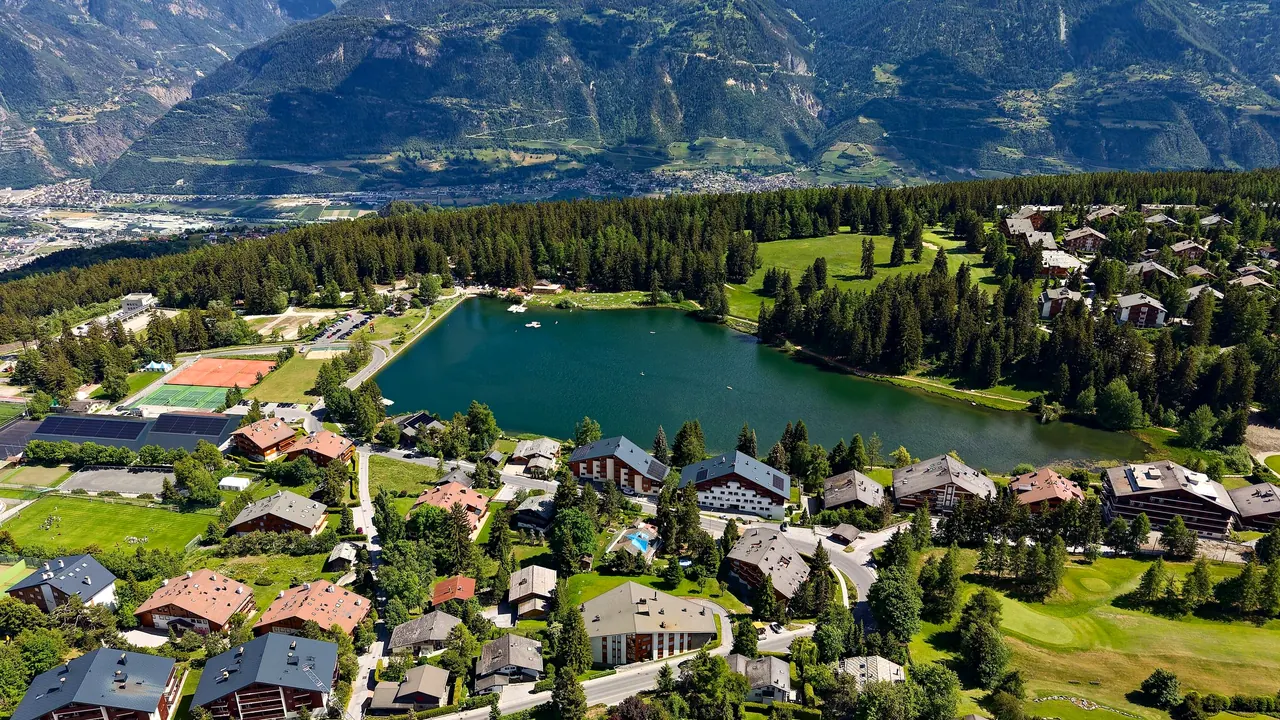
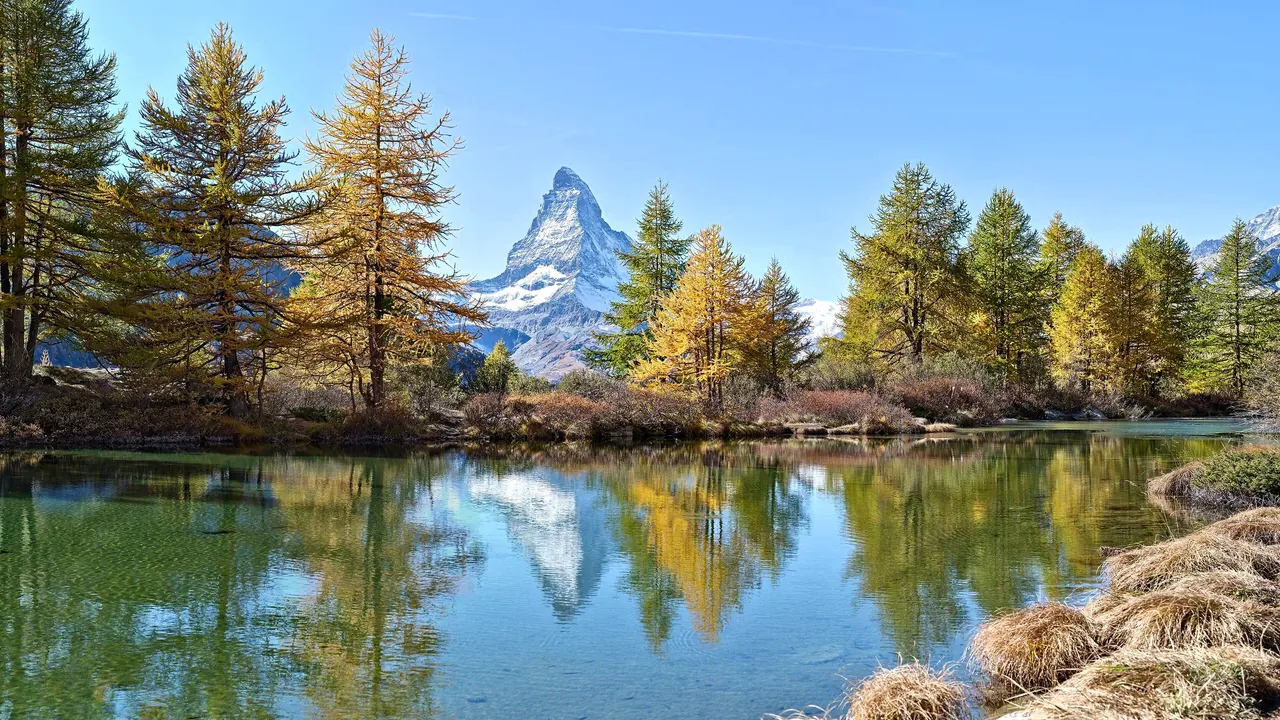
Photos: Crans-Montana by Daniel Reust, CC BY-SA 4.0, cropped; Zermatt by Roy Egloff, CC BY-SA 4.0, cropped.
Crans-Montana or Zermatt?
Our verdict in twelve categories, each scored against the same fixed benchmark cities, and the climate month by month, so you can choose for your trip.
Choose Crans-Montana for
- day trips
- beaches
- shopping
Crans-Montana is the better pick for a mountain stay that also looks outward. The funicular drops you onto the Rhône valley railway, so castles at Sion, wine villages and Lake Geneva all make easy outings. Summers are a little warmer, with lake bathing and golf on the plateau, and Crans has the stronger boutique streets. It suits travellers who want sun, comfort and variety more than drama.
Choose Zermatt for
- getting around
- culture and sights
- nature and the outdoors
Zermatt is for people who want to be as close to the high Alps as possible. The Matterhorn stands over a car-free village where the cog railway and gondolas start a short walk from your door, and they lift you to glaciers, Italian pistes and trails that Crans-Montana cannot match. The mountaineering museum and cemetery give it a little more history too. The trade-off is a dead-end valley, so spare days are spent on the mountains rather than in other towns.
Scoreboard
Twelve categories on one fixed scale from 0 to 100. The shaded stretch is the gap between the two.
Your match
Pick a travel style or drag the sliders, and both match scores follow your weighting.
Too close to call, 2 points apart
Wins on day trips and beaches with your weighting.
Wins on getting around and culture and sights with your weighting.
What matters to you?
Category by category
What the scores mean for a trip.
Beaches & swimming
Neither is a swimming destination, but Crans-Montana at least gives you somewhere to get wet. In July and August, Lac Moubra and Lac Grenon on the plateau warm enough to bathe in, with lawns, pontoons and picnicking families, and they make a pleasant afternoon. Zermatt's tarns are glacial meltwater, there for the Matterhorn reflections, so a swim there means a hotel pool.
Food & drink
The two eat much the same Valais menu of raclette, fondue, air-dried meat and Fendant or Petite Arvine, and in both you will find a few ambitious restaurants but little cheap food. The difference is in where you eat. In Zermatt the best meals are long lunches at chalets in Findeln, Furi and Zum See, reached on skis or on foot with the Matterhorn in front of you.
In Crans-Montana the stronger link is to the terraced vineyards just below the resort, so the wine on the table comes from slopes you can see. In both, many kitchens close between seasons.
Culture & sights
Zermatt has a small heritage worth a morning. The Matterhorn Museum, built underground as a reconstruction of the old village, tells the story of the 1865 first ascent. The climbers' graves lie beside the parish church, and the larch barns of the Hinterdorf stand on their stone slabs.
Crans-Montana grew out of sanatoriums and grand hotels and has almost nothing to visit on the plateau itself. Its history is down in the valley, at places like Sion, rather than in the resort.
Nightlife
Both are small, expensive and seasonal after dark, but the mood differs. Zermatt is louder and more cheerful, with ski boots on the floor in slope-side bars as the runs end, then a few bars and small clubs along the main street. Crans-Montana is dressier: hotel bars and piano lounges, and a couple of late clubs at weekends for a well-heeled crowd. In summer both are quiet soon after dinner.
Nature & outdoors
Both are first-rate mountain bases, but Zermatt is on another level. The Matterhorn rises straight above the village, dozens of four-thousand-metre peaks and the Gorner Glacier surround it, and the lifts reach above 3,800m, with skiing across into Italy and pistes open into summer. Marmots, ibex and the end of the Haute Route add to the pull.
Crans-Montana is gentler and sunnier. It has broad intermediate pistes up to the Plaine Morte glacier, level bisse paths through larch forest, paragliding and golf, all under a wide view from the Matterhorn to Mont Blanc rather than at its foot.
Day trips
Crans-Montana is much the better base for outings. The funicular to Sierre joins the main Rhône valley line, so Sion's castles of Valère and Tourbillon and the wine villages around Salgesch are a short ride away. Martigny's Roman remains and the abbey at Saint-Maurice are a little further on. Montreux, Chillon and the Lavaux terraces fit comfortably into a day, and Zermatt itself is possible as a long one.
From Zermatt, every trip begins with the whole length of the valley on the narrow-gauge train. Visp, the way up to the high vineyards of Visperterminen, and Brig, with the Stockalper Palace, are about an hour down the line. Sion, the most rewarding of them, takes about an hour and a half. Saas-Fee is a bus ride into the next valley, but it is another mountain resort rather than a change of scene.
Good for families
They are equally good for families who ski or hike, and equally short on zoos, aquariums or rainy-day attractions. Zermatt's advantage is its car-free streets, where hotel, ski school and lifts are a short, traffic-free walk apart. Its catch is that the highest viewpoints, above 3,000m, can be too cold and thin-aired for small children.
Crans-Montana has more summer play, with pedalos and playgrounds by the plateau lakes and flat bisse paths for small legs. With toddlers, though, you will depend on the shuttle buses between spread-out villages.
Getting around
Zermatt is easier day to day. Once you are off the train, the village is a compact strip you cover on foot. The cog railway, the Sunnegga funicular and the gondolas all start within walking distance, and electric taxis handle the outlying lifts and your bags.
Crans-Montana is easy to reach, with the funicular climbing from Sierre in about twelve minutes. Up top, though, Crans, Montana and the lift bases are scattered along a hillside, so crossing the resort means the free shuttle bus.
Shopping & style
Crans has the bigger selection of luxury shops, an unusual cluster for a mountain village: international fashion houses, watchmakers, jewellers, cashmere and designer ski wear, with Valais delicatessens alongside. Zermatt's one main street has the watch boutiques and the souvenir cowbells, and its real strength is serious mountaineering gear rather than browsing.
Affordability
There is no cheap option here. Both are among the most expensive places to spend a vacation in Europe, and their lifts, rooms and terrace lunches all cost well above the European norm. The ways to save differ a little. In Zermatt you can sleep down the valley in Täsch and live on supermarket picnics. In Crans-Montana you can self-cater, shop in the valley and come in late spring or early autumn, though none of these cuts costs much.
Live music & performing arts
Both work in festival bursts with little in between, and both have a late-summer classical series in churches and halls. Their spring festivals point in opposite directions. Crans-Montana's Caprices brings electronic music to the slopes at the end of the ski season, while Zermatt Unplugged puts acoustic sets by well-known singers in tents and on mountain stages. Pick your week by taste.
Wellness & relaxation
For a restful stay the two are evenly matched, and what separates them is how easily you get into a spa. In Crans-Montana most of the big hotels let non-residents use their pools, saunas and treatment rooms for a fee, so you can book a spa afternoon wherever you are sleeping. If you want real hot springs, Leukerbad's alpine pools are less than an hour's journey away and fit comfortably into an afternoon. Outside the peak weeks, the sunny plateau is also quiet enough to slow right down.
Zermatt has the denser cluster of fine hotel spas, many of them looking out on the peaks, but only a few sell day passes. That makes the choice of hotel matter more if a spa is part of the plan. With no cars, the village is quiet in the evenings in a way Crans-Montana's roads are not. In the high season, though, most people are there to ski or climb rather than to rest, and thermal bathing means a trip down the valley.
When should you go?
Pick your month. The climate figures are measured averages, not a forecast.
Crans-Montana in July
Zermatt in July
Daytime high, °C
Rainfall in the month, mm
Where the figures come from
Crans-Montana has no weather station within reach, so its figures come from a gridded climate model rather than a measured record, and read a broad area rather than one spot.
Zermatt has no weather station within reach, so its figures come from a gridded climate model rather than a measured record, and read a broad area rather than one spot.
Temperature and rainfall are climate normals, averaged over the years shown. Crans-Montana: 2001-2020 normals, NASA POWER reanalysis grid, no weather station within 90 km. Zermatt: 1991-2020 normals, TerraClimate 4 km grid at the town, no weather station within 90 km.
In winter the two are much alike: daytime highs sit just below freezing from December to February, which is exactly what the ski season needs. They part company in summer. Crans-Montana, lower and on a sunny terrace, reaches about 18°C in July and August. That is warm enough for walking the bisses in shirtsleeves and for a dip in the plateau lakes. Zermatt peaks around 14°C, so evenings are cool and higher up it is properly cold even in August.
Rain falls in a different pattern too. Crans-Montana's wettest stretch runs from May to August, at around 130mm a month, so summer days there often end in showers. Zermatt stays fairly even through the summer, and its wettest month is November, at 130mm. For hiking, July to September is the best window in both. Spring and late autumn are quiet shoulder months, with many lifts shut in each.
Which traveller are you?
On an outdoors trip, Zermatt is the stronger choice. Its lifts reach over 3,800m, the glacier keeps some pistes open in summer, and walks like the Five Lakes and the Europaweg run beneath the Matterhorn. Guided ascents of four-thousanders start from the village.
For a shopping trip, Crans-Montana has more to offer. Its compact centre holds international fashion labels, watchmakers, cashmere and designer ski wear, plus delicatessens selling Valais wine and cheese. Zermatt's single main street mostly sells watches, outdoor gear and souvenirs.
For a short city break, Zermatt works better. The village is a compact car-free strip, so you walk from the station to your hotel, the lifts and dinner. Crans-Montana spreads along several kilometres of hillside, and getting from one end to the other means waiting for shuttle buses.
Before you go
| Measure | Crans-Montana | Zermatt |
|---|---|---|
| Official language | French, German, Italian, Romansh | French, German, Italian, Romansh |
| Currency | Swiss Franc (CHF) | Swiss Franc (CHF) |
| Sockets | CJ230 V, 50 Hz | CJ230 V, 50 Hz |
| Driving side | Right | Right |
| Time zone | UTC+1, UTC+2 in summer | UTC+1, UTC+2 in summer |
| Emergency number | 112 | 112 |
| Elevation | 1,495 m | 1,624 m |
| Main airport | Geneva International Airport (GVA)106 km from centre150 non-stop destinations | Geneva International Airport (GVA)128 km from centre150 non-stop destinations |
| Public holidays this year | 9 days | 9 days |
By the numbers
| Measure | Crans-Montana | Zermatt |
|---|---|---|
| Population | 10,447 | 6,023 |
| People per km² | 175 | 25 |
| Museums within 10 km | 3 | 2 |
| UNESCO World Heritage sites within 50 km | 1 | 2 |
Where else could you go?
Every comparison below shares a destination with this one, so you can follow Crans-Montana or Zermatt somewhere new.
- Leukerbadvs Crans-Montana
- Saas-Feevs Zermatt
- Adelbodenvs Crans-Montana
- Gstaadvs Crans-Montana
- Verbiervs Crans-Montana
- Verbiervs Zermatt