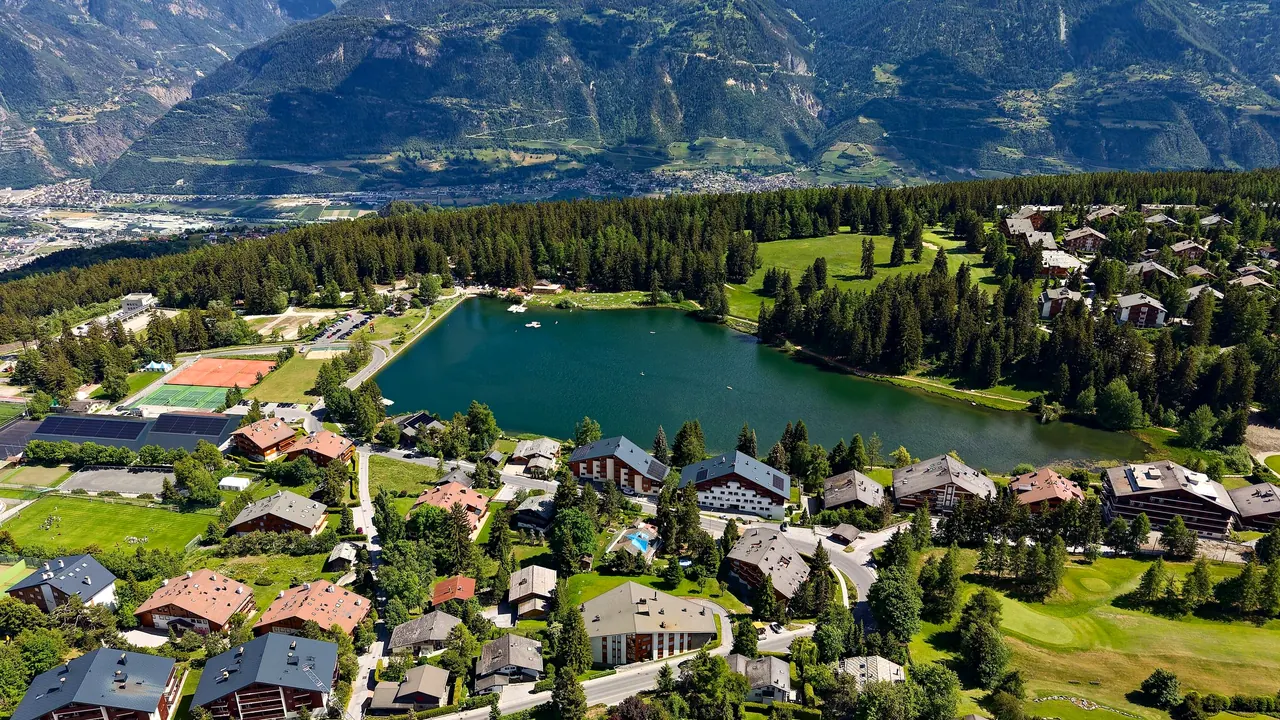
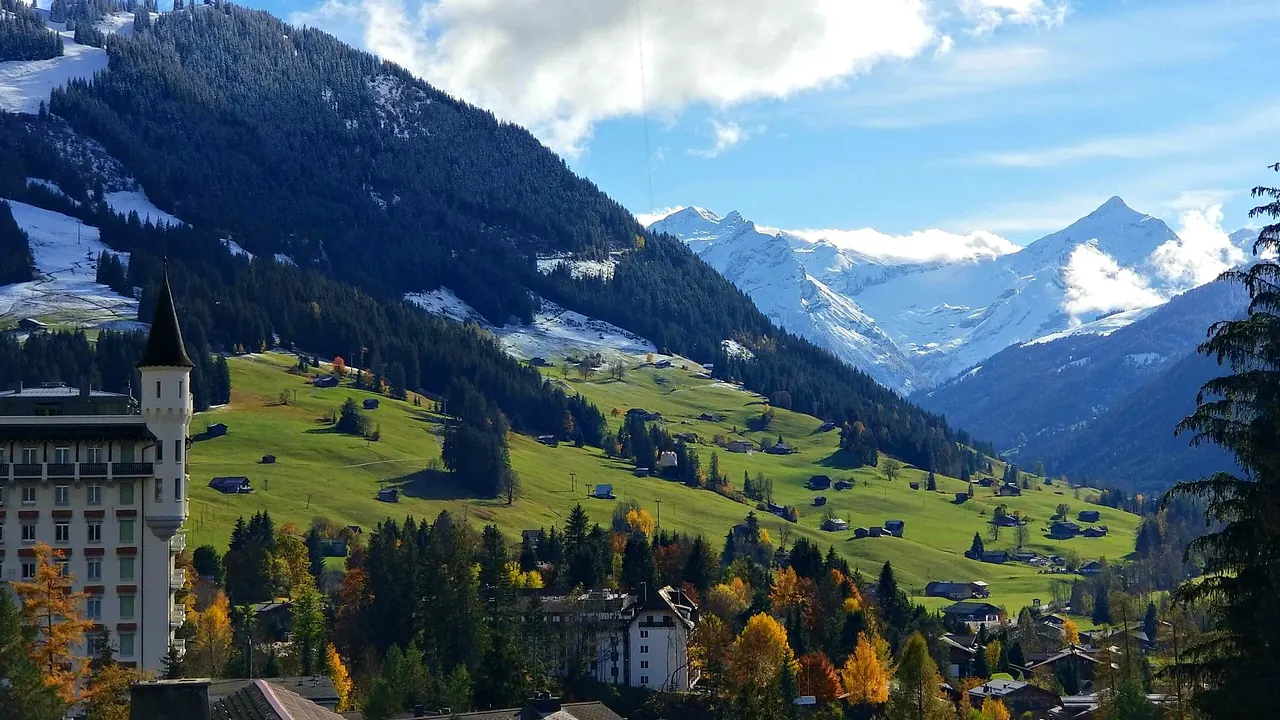
Photos: Crans-Montana by Daniel Reust, CC BY-SA 4.0, cropped; Gstaad by Samuel Barlow, CC BY-SA 4.0, cropped.
Crans-Montana or Gstaad?
Our verdict in twelve categories, each scored against the same fixed benchmark cities, and the climate month by month, so you can choose for your trip.
Choose Crans-Montana for
- families
- nature and the outdoors
- nightlife
Crans-Montana suits active travellers who want the mountains to do most of the work. It sits higher, its lifts reach a glacier, and its sunny, intermediate-friendly pistes and level bisse paths make it the easier choice for families who ski or hike. The funicular to Sierre also puts Sion, the Valais vineyards and the rest of the Rhône valley within easy reach.
Choose Gstaad for
- live music and the arts
- getting around
- shopping
Gstaad is the better pick for a slower, more polished stay built around the village itself. Its car-free Promenade is compact enough to walk end to end, its chalets keep the old Saanenland style, and in summer the Menuhin Festival fills tents and village churches with classical music. Choose it for concerts, luxury shopping and green pastoral walks rather than high-altitude skiing.
Scoreboard
Twelve categories on one fixed scale from 0 to 100. The shaded stretch is the gap between the two.
Your match
Pick a travel style or drag the sliders, and both match scores follow your weighting.
Too close to call, 2 points apart
Wins on families and nature and the outdoors with your weighting.
Wins on live music and the arts and getting around with your weighting.
What matters to you?
Category by category
What the scores mean for a trip.
Beaches & swimming
Neither place is for swimmers, and the difference is in the water itself. On Crans-Montana's plateau, Lac Moubra and Lac Grenon are shallow enough to warm up on good summer days, and they have lawns and pontoons where you can spend a relaxed afternoon.
Gstaad's lakes at Lauenen and Arnensee stay cold even in high summer, so a quick dip is about all most people manage. The heated valley pool or your hotel pool is the realistic plan there.
Food & drink
Both kitchens rest on mountain cheese and a few serious hotel dining rooms, and neither offers much casual eating or anything open in the shoulder seasons. The difference lies in what goes with the cheese. Crans-Montana looks down on the Valais vineyards, so ordering Fendant, Petite Arvine or Cornalin with your raclette is part of the meal.
Gstaad is a cheese place first. Long-aged Hobelkäse shaved into curls and the wood-fired L'Etivaz can be bought straight from small dairies and cellars in the valley.
Culture & sights
Neither resort fills a sightseeing day, but Gstaad's surroundings carry more of their past on the surface. The dark-timbered Saanenland chalets with carved façades, the late-Gothic church in Saanen with its medieval paintings and the old church at Rougemont give a walk some texture.
Crans-Montana grew out of sanatoriums and grand hotels, and its streets are mostly chalets and apartment blocks. Its castles and old towns are down in the Rhône valley rather than on the plateau.
Nightlife
Both scenes are small, expensive and tied to the winter peak, and both go quiet in summer. Crans-Montana's is a little more public: après-ski on terraces by the lifts, then hotel bars, piano lounges and a couple of weekend nightclubs.
In Gstaad more of the evening disappears behind closed doors. Its clubs sit in grand-hotel cellars, and much of the social life happens at private chalet parties that a visitor without the right invitation never sees.
Nature & outdoors
Crans-Montana and Gstaad are equally strong mountain bases, but they offer different kinds of mountain. Crans-Montana is higher and sunnier, with lifts climbing to the Plaine Morte glacier at around 3,000m, a large linked ski area of mostly intermediate runs, and a view across the valley from the Matterhorn to Mont Blanc. In summer the bisse paths along old irrigation channels and its scenic golf make it distinctive.
Gstaad's home slopes are gentler and lower, so early-season snow can be thin, and high snow means a trip to Glacier 3000. In summer, though, its green valleys come into their own, with walks to Lauenensee and the Geltental waterfalls and rafting on the Saane.
Day trips
The two offer equally good outings that run in different directions. From Crans-Montana the funicular and valley railway make for short hops: the castles of Sion, wine villages near Salgesch, Roman Martigny and the abbey at Saint-Maurice, with Zermatt as a long day out.
From Gstaad the GoldenPass line winds down to Montreux, Chillon and Lavaux, Gruyères is close by car, and Thun and Bern lie to the east. The scenery on the way is a pleasure in itself, but almost every outing takes a good part of the day.
Good for families
Crans-Montana does more for children, though neither has a zoo or anything built for a wet day. Its plateau lakes have playgrounds, pedalos and easy loops, the bisse paths are flat, and the ski schools run dedicated children's areas. With toddlers, choose a base near a shuttle stop, because the villages are spread over a hillside.
Gstaad is calm and safe, with sledge runs, sleigh rides and farm animals on summer walks. Beyond that it offers little for children, so it suits families who want a quiet stay rather than plenty to do.
Getting around
Gstaad is easier on foot. Its centre is a short, mostly car-free promenade, and trains on the GoldenPass line stop at Saanen, Schönried and Saanenmöser, close to several lift stations. PostBuses run up the side valleys, although services thin out in the quiet months.
Crans-Montana is easy to reach car-free by funicular from Sierre. Once you are up there, though, the resort stretches along a hillside several kilometres long with climbs between the villages, so you will be relying on the free shuttle buses.
Shopping & style
Both villages have a surprising cluster of luxury boutiques, but Gstaad's Promenade goes further. Alongside the watchmakers, jewellers and fashion labels it has furs and interior design, plus local crafts such as carved wood and the papercut art of the Pays-d'Enhaut.
Crans offers similar watches, cashmere and designer ski wear on a few central streets. Beyond those you are left with sports shops, delicatessens with Valais wine and Montana's everyday shops.
Affordability
In Crans-Montana, self-catering is the main way to soften the cost: rent an apartment, buy supplies down in the valley and come in late spring or early autumn. Even then the savings are modest, and Christmas and February are very expensive.
Gstaad is just as costly, and mid-range rooms are scarce. The usual way to save there is to sleep down the valley in Saanen or Zweisimmen and come in for the day, ideally in summer rather than at the winter peak.
Live music & performing arts
This is where Gstaad pulls clearly ahead. The Menuhin Festival brings leading soloists and orchestras for several summer weeks, playing in a large tent and in the village churches of Saanen, Rougemont and Lauenen, and there is a chamber festival and New Year concerts in winter.
Crans-Montana's live music comes in shorter bursts. The Caprices festival brings electronic music to the slopes in spring, and a summer chamber series plays in local churches, but for anything more you have to go down to the valley towns.
Wellness & relaxation
Crans-Montana's best card for a restful stay lies off the plateau. Leukerbad's alpine hot pools are under an hour away and make an easy half day. On the plateau itself, the resort that began as a place to recover offers hotel spas, many of them open to outside guests, plus clean air and a slow pace.
Gstaad has no hot springs within easy reach, but it has an unusual number of lavish hotel spas for so small a village, with indoor and outdoor pools and mountain views. They are built mainly for their own guests, so staying in one of those hotels matters more here.
When should you go?
Pick your month. The climate figures are measured averages, not a forecast.
Crans-Montana in July
Gstaad in July
Daytime high, °C
Rainfall in the month, mm
Where the figures come from
Crans-Montana has no weather station within reach, so its figures come from a gridded climate model rather than a measured record, and read a broad area rather than one spot.
Gstaad's temperatures are measured 78 km from the centre, at Les Eplatures.
Gstaad has no rain gauge within 25 km of the centre, so its rainfall comes from a gridded climate dataset read at the destination rather than from a gauge further away.
Temperature and rainfall are climate normals, averaged over the years shown. Crans-Montana: 2001-2020 normals, NASA POWER reanalysis grid, no weather station within 90 km. Gstaad: 2010-2020 (rainfall 1991-2020) normals, Les Eplatures (77.5 km from centre).
Crans-Montana is the colder of the two all year, as you would expect from its higher terrace. Daytime highs stay below freezing from December to February, with around -2°C in January, so winter there is firmly a snow season, and the plateau only warms to about 18°C in July and August. Summer is also its wettest stretch, with roughly 130mm a month from May to August, which usually means afternoon showers between hiking days. The small lakes are warm enough for a swim only in July and August.
Gstaad runs a few degrees milder through every month, reaching about 21°C in midsummer, which makes July and August comfortable for valley walks and outdoor concerts. Its wettest month is December, at about 125mm, so early winter brings plenty of precipitation even when the low slopes are short of snow. March and April are the driest months in Gstaad, while in Crans-Montana spring and autumn are quiet and the resort is partly closed.
Which traveller are you?
On a family trip with young children, Crans-Montana keeps the days fuller. Children can learn to ski in their own groups while parents explore the wider area, and summer gives easy outings that small walkers can manage. Gstaad suits families happy with a quieter stay.
For a culture and arts trip, Gstaad is the clear pick, as long as you time it for the summer festival weeks, when evenings revolve around concerts in village churches. Crans-Montana's music comes in shorter bursts, and its history lies down in the valley.
On a shopping trip, Gstaad lets you spend a slow afternoon browsing without a bus or a car, with luxury houses and local crafts on one short pedestrian street. In Crans the luxury choice is narrower, and the rest of the shopping is everyday.
Before you go
| Measure | Crans-Montana | Gstaad |
|---|---|---|
| Official language | French, German, Italian, Romansh | French, German, Italian, Romansh |
| Currency | Swiss Franc (CHF) | Swiss Franc (CHF) |
| Sockets | CJ230 V, 50 Hz | CJ230 V, 50 Hz |
| Driving side | Right | Right |
| Time zone | UTC+1, UTC+2 in summer | UTC+1, UTC+2 in summer |
| Emergency number | 112 | 112 |
| Elevation | 1,495 m | 1,050 m |
| Main airport | Geneva International Airport (GVA)106 km from centre150 non-stop destinations | Geneva International Airport (GVA)94 km from centre150 non-stop destinations |
| Public holidays this year | 9 days | 10 days |
By the numbers
| Measure | Crans-Montana | Gstaad |
|---|---|---|
| Population | 10,447 | 2,960 |
| People per km² | 175 | - |
| Museums within 10 km | 3 | 0 |
| UNESCO World Heritage sites within 50 km | 1 | 4 |
Where else could you go?
Every comparison below shares a destination with this one, so you can follow Crans-Montana or Gstaad somewhere new.
- Leukerbadvs Crans-Montana
- Adelbodenvs Crans-Montana
- Adelbodenvs Gstaad
- Leukerbadvs Gstaad
- Verbiervs Crans-Montana
- Zermattvs Crans-Montana