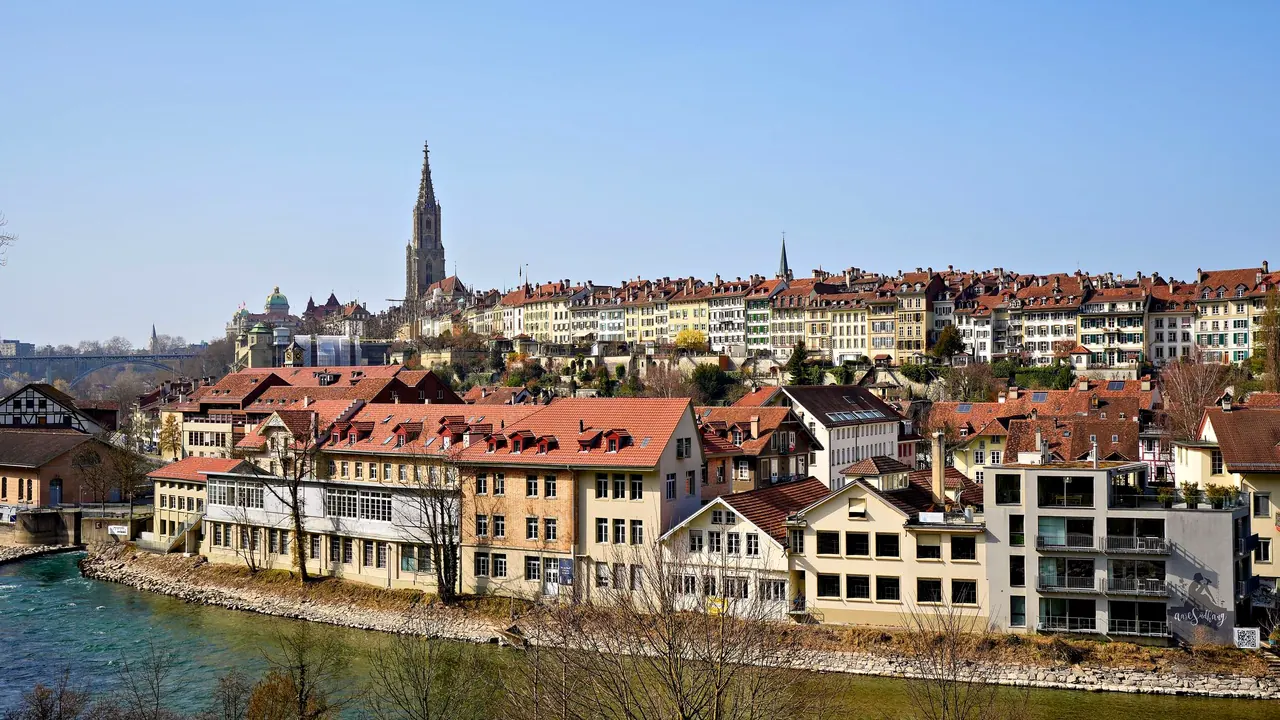
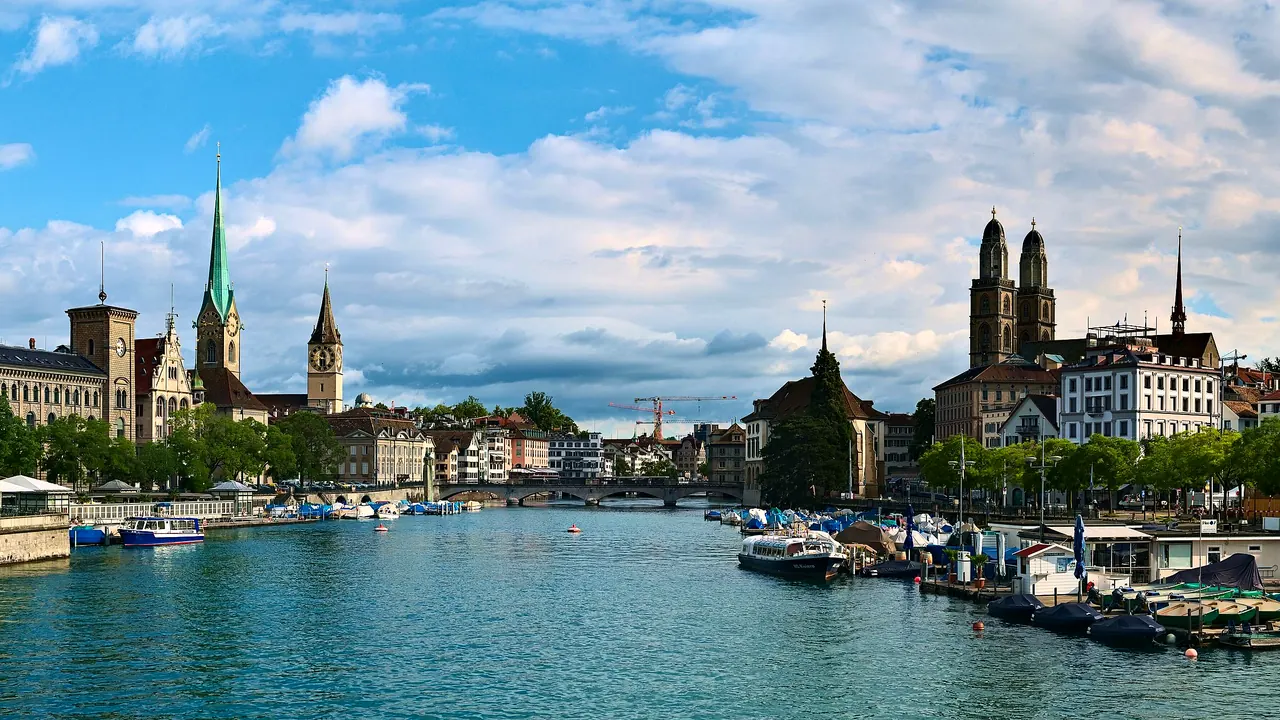
Photos: Bern by Beat Bieri, Pexels License; Zurich by Daniel Kraft, CC BY-SA 3.0, cropped.
Bern or Zurich?
Our verdict in twelve categories, each scored against the same fixed benchmark cities, and the climate month by month, so you can choose for your trip.
Choose Bern for
- culture and sights
- prices
- nature and the outdoors
Bern suits travellers who want a handsome, slow-paced old town to wander and a base for the high mountains. Its UNESCO-listed loop of arcades, painted fountains and the Minster is the finer set piece of the two. The Zentrum Paul Klee and the Einstein flat give it real depth, and the Jungfrau peaks are close enough to fill the days in between. Evenings are quiet, and that is part of the appeal.
Choose Zurich for
- nightlife
- live music and the arts
- shopping
Zurich is the better pick when the trip carries on after dinner. It eats better and goes out much harder in Kreis 4 and 5. The Opernhaus and Tonhalle make a night at the stage easy, and Bahnhofstrasse is there for serious shopping. Families also do better here, with the zoo's rainforest hall and gentle lake lidos. Expect to pay even more for all of it than in Bern.
Scoreboard
Twelve categories on one fixed scale from 0 to 100. The shaded stretch is the gap between the two.
Your match
Pick a travel style or drag the sliders, and both match scores follow your weighting.
Wins on culture and sights and prices with your weighting.
Wins on nightlife and live music and the arts with your weighting.
What matters to you?
Category by category
What the scores mean for a trip.
Beaches & swimming
Neither city has sand. Both swim in summer from lawns and decks, and the real difference is the water. In Bern you walk upstream from the Marzili and let the cold, fast Aare carry you back past the Federal Palace. It is thrilling, but only for strong swimmers.
Zurich's lake is calmer and a few degrees warmer, with wooden bathing houses at Utoquai and Mythenquai, and the Letten river baths are there for anyone who wants a current. Bern's calm-water option, Lake Thun, is a short train ride away.
Food & drink
Zurich eats a little better. Alongside the guild-house veal and rösti, Kreis 4 and 5 have casual and international kitchens and a respectable fine-dining tier, and the Paradeplatz tea rooms turn chocolate into an occasion.
Bern's food is heartier and the choice is narrower: the Berner Platte, fondue in vaulted cellars under the arcades, and the range of other cuisines you would expect in a small city. What Bern has that Zurich largely lacks is its weekly markets on Bundesplatz, a proper place to buy Emmental cheese and bread.
Culture & sights
Bern's old town is the bigger draw. The whole loop of the Aare is UNESCO-listed, with arcades, painted fountains and the Zytglogge, while Zurich's Altstadt is attractive but makes less of an impression. Bern's museums are also better than its size suggests, with the largest Paul Klee collection and the Einstein Museum.
Zurich's answer is the Kunsthaus, the stronger general art collection, plus the Swiss National Museum and Chagall's windows in the Fraumünster. Museum visitors are well served there, but for a city that is a pleasure simply to look at, Bern wins.
Nightlife
Zurich is in another league after dark. Electronic music runs deep there. Clubs in Kreis 4 and 5 and Zurich West stay open until morning at weekends, and the August Street Parade turns the lake shore into one huge techno gathering.
A night out in Bern means cellar bars under the arcades, terraces on the Aare in summer and the Reitschule for anything late. That is fine for a drink, but if you want to dance, choose Zurich.
Nature & outdoors
Both cities have the Alps within about an hour, so the difference lies in which mountains and what is on the doorstep. From Bern the Eiger, Mönch and Jungfrau fill the horizon and Interlaken is the obvious outing, with Lake Thun and the rolling Emmental closer in.
Zurich's landscape is its lake: shore paths, boats out to the villages and the Uetliberg ridge walk, with Rigi, Pilatus and the Flumserberg ski slopes for higher ground. Choose Bern for the big peaks and Zurich for the water.
Day trips
Both cities sit at the hub of the Swiss rail network, and Lucerne and Basel are within easy reach of each, so either works well as a base. The difference is direction. From Bern the trips lead west and south, to Fribourg, Gruyères, Murten and the Lavaux terraces above Lake Geneva.
From Zurich they lead north and east, to the Rhine Falls, Stein am Rhein, St Gallen's abbey library and Lake Constance. Each city also makes an easy day out from the other.
Good for families
Zurich is easier with children, mainly thanks to the lake and the zoo. The lake lidos have shallow areas and lawns, boat trips suit all ages, and the zoo's Madagascar rainforest hall fills a day. The Technorama science centre is a short train ride away.
Bern has the bear park, the Dählhölzli zoo and the playground on the Gurten, all gentle and pleasant. But the river is too fast for young swimmers, and the steep streets up from the Aare are hard work with a pushchair.
Getting around
Both are model cities for getting about without a car, so the difference is scale. Bern's centre is one walk of about twenty minutes from the station to the bear park, under the arcades, with a lift and funiculars down to the river.
Zurich is more spread out, but one integrated ticket covers trams, S-Bahn, funiculars and even the lake boats. The airport is a short train ride from the main station, which makes arriving and leaving the smoother of the two.
Shopping & style
Zurich is the place to shop. Bahnhofstrasse is a world-class luxury street of watchmakers, jewellers and fashion houses, and the viaduct arches in Zurich West add design shops and a covered food market.
In Bern shopping is a pleasant browse rather than a reason to visit. Chains and chocolate shops line the arcaded main street, and the cellar shops of Gerechtigkeitsgasse sell antiques, books and crafts. There is little in the way of fashion or luxury.
Affordability
Neither city is cheap by any European standard, but Bern is the slightly easier of the two. Hotels, dinners and drinks are expensive in both. Zurich is among the most expensive cities in the world to visit, where even a casual lunch costs what a dinner does elsewhere.
The ways to save are much the same: supermarket lunches, free swimming in the river or lake, and walking. In Bern, hotels usually include a local transport pass and the Federal Palace tours are free. In Zurich, a visitor card bundles transport with museum entry.
Live music & performing arts
The gap shows most in the opera house and the concert hall. Bern's Stadttheater fits opera, ballet and drama into one house, a capital's programme that makes a good evening out. Zurich's Opernhaus on the lake shore has a reputation well beyond Switzerland and is worth a journey in itself. The orchestras follow the same pattern: Bern's plays in the Casino above the Aare, while the Tonhalle gives Zurich a grander nineteenth-century setting, and the Schauspielhaus adds one of the German-speaking world's most important theatres.
Away from the main stages the two are closer. In Bern, the Dampfzentrale, an old power station by the river, puts on new dance and music, and the Reitschule hosts alternative gigs. Zurich's Rote Fabrik does the same job on a larger scale, and more touring bands come through. Bern is at its best during the spring jazz festival and the Gurtenfestival in July, while Zurich's summer Theater Spektakel brings performance out to the lake. Only Zurich's stages are worth building a trip around.
Wellness & relaxation
Zurich offers more if you want real spa time. The thermal bath in the stone vaults of the old Hürlimann brewery, with its rooftop pool, is an outing in itself. In the colder months the lake bathing houses open as saunas, and the hot springs of Baden are a short train ride away.
Bern's strength is its pace: quiet Sundays and long lunches by the Aare. It has a thermal complex on the western edge and a hammam-style spa, but for a serious soak most visitors head up to the Bernese Oberland.
When should you go?
Pick your month. The climate figures are measured averages, not a forecast.
Bern in July
Zurich in July
Daytime high, °C
Rainfall in the month, mm
Where the figures come from
Bern has no rain gauge within 25 km of the centre, so its rainfall comes from a gridded climate dataset read at the destination rather than from a gauge further away.
Bern's sunshine is measured 41 km from the centre, at Payerne.
Temperature and rainfall are climate normals, averaged over the years shown. Bern: 2010-2020 (sunshine 1961-1990, rainfall 1991-2020) normals, Bern / Bern - Belp Airport (5.5 km from centre). Zurich: 1991-2020 normals, Zurich Town / Ville. (2.2 km from centre).
The two cities follow the same pattern through the year. Winters are cold and grey, with highs around 4-5°C. Spring warms up through April, and May to August is the wettest stretch in both. The swimming months run from June to early September, when the river and lake are warm enough for a dip. Neither city gets too hot for walking in summer, so the warmest months suit sightseeing as well as swimming.
Bern is slightly warmer and sunnier, reaching 26°C in July and August against Zurich's 24°C. Its summers are also a little drier, while in Zurich May, June and July each bring more than 120mm. September is a good month in both: still mild, with noticeably less rain. From November to February the short, dull days favour museums and cellar restaurants in town, and skiing in the mountains.
Which traveller are you?
For a food and nightlife trip, Bern offers a hearty Berner Platte and cellar bars under the arcades, but evenings end early. Zurich is the better choice, with late crowds on Langstrasse, an electronic club scene and casual international kitchens beyond the guild-house veal.
For a short city break, Bern has the edge. Its UNESCO old town is about twenty minutes end to end, and two days covers the Minster, the Klee collection and Einstein's flat on Kramgasse. Zurich's sights need two or three days.
On a shopping trip, Bern suits a slow browse through antiques, books and crafts in cellar shops below the pavement. Zurich wins clearly for anyone buying a watch, with specialists from the big Swiss names to small side-street dealers, plus Niederdorf boutiques and summer flea markets.
Before you go
| Measure | Bern | Zurich |
|---|---|---|
| Official language | French, German, Italian, Romansh | French, German, Italian, Romansh |
| Currency | Swiss Franc (CHF) | Swiss Franc (CHF) |
| Sockets | CJ230 V, 50 Hz | CJ230 V, 50 Hz |
| Driving side | Right | Right |
| Time zone | UTC+1, UTC+2 in summer | UTC+1, UTC+2 in summer |
| Emergency number | 112 | 112 |
| Elevation | 542 m | 408 m |
| Main airport | Zürich Airport (ZRH)101 km from centre226 non-stop destinations | Zürich Airport (ZRH)9 km from centre226 non-stop destinations |
| Public holidays this year | 10 days | 10 days |
By the numbers
| Measure | Bern | Zurich |
|---|---|---|
| Population | 136,988 | 440,935 |
| People per km² | 2,655 | 5,016 |
| Museums within 10 km | 30 | 63 |
| UNESCO World Heritage sites within 50 km | 2 | 1 |
Where else could you go?
Every comparison below shares a destination with this one, so you can follow Bern or Zurich somewhere new.